Smells Like Some Correction Stew May Be Cooking

Disclosure:  I do not claim to be clairvoyant. I’m fully aware of the fact that I could just as easily be wrong about any prognostications forthwith. I also know you are tired of me disclaiming this over and over but I don’t want anybody to get the wrong idea that I think I’m some kind of market shaman. These are just my interpretations. They can be profitable or at the very least entertaining.

In particular, the charts of the stock indexes are painting a picture of that correction I mentioned in the previous note I sent about “market timing.” In that note, I had stated what I thought were two probable outcomes for the stock markets. Specifically, I said, “…for the stock markets we could see a bounce back to new highs from here and then a stronger, scarier takedown somewhere in the late-July through mid-September range. It’s more probable that we chop along moving sideways through the Summer with some up and down bouncing and then finish out the year strong as animal spirits recover and taper talk dies down with renewed vigor behind the rhetoric of quantitative easing.” It appears as if scenario 1 may be the play, but still with a strong finish to the markets for the year.

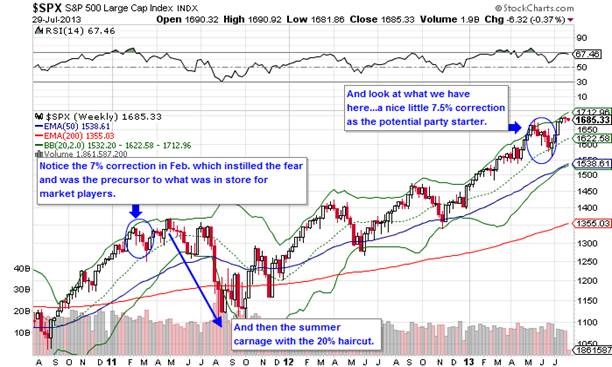
I see this potential move playing out similar to the Summer of 2011. In February of 2011, the S&P 500 had a nice little 7% correction just to whet all the speculators’ whistles and then…BAM! May came along with the fear already established from the 7% correction and the worries of the 1 year anniversary of the infamous “Flash Crash,” and so began a 3 month-long 20% correction. You can observe the action on the Weekly chart below. The Daily chart below it seems to be showing the beginning of the current potential down-move. Monday’s action is not a good sign either and is supportive of the call for a corrective move. As I mentioned in the “market timing” note, this correction(if it occurs) will not be the big one. Articles will be published on the worldwide-interconnected-net about long-term resistance at the highs of 2000, 2007, and now 2013 but this down-move shouldn’t be of the same magnitude as the previous 2 biggies. The true big one, which feels like 2 or 3 years away, will probably be a combination of a bank’s default due to excessive leverage in their derivatives position and a country’s outright default on its debts. Beware of Italy. These actions will initiate a waterfall of negative effects amongst the large financial entities as nobody knows who owes who and who has what collateral for all the intermixing of credit transactions. I spent enough time on that in the previous note on derivatives. This correction will present an opportunity to profit on the way down for the alert trader or at the very least provide some quality entry points at the bottom for the more conservative, before a potential year-end rally.
clip_image001clip_image002

I would look for a move between 10% and 15% off of the high of 1,700ish. A 10% move down would take the S&P to the bottom of the Bollinger and the 50-day EMA on the Weekly chart. It would take a 20% correction to get the index down to the 200-day EMA. A move of that magnitude just doesn’t feel right, especially if the bulk of this move occurs in August and finishes out in the beginning of September. There are multiple ways to play a correction. For the non-tape-reading speculators or un-fool-hardy timers, I won’t bore you with details. Some easy suggestions though would be:  Calls on the VIX equivalent ETF, Puts on the S&P 500 equivalent ETF, Puts on TM as the Nikkei should move down in conjunction, or short the sector leaders(with Puts) but specifically Consumer Discretionary as I think it’s time has come for a real breather. Bear in mind that trying to front run a leader sector is not the brightest move. These are just un-vetted potential plays being thrown out.

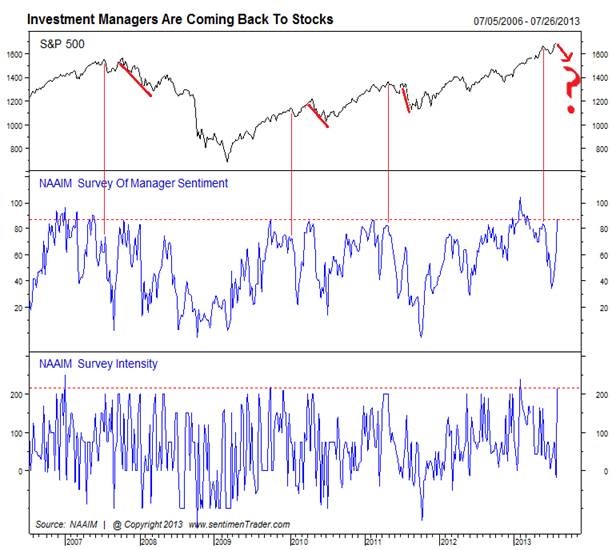
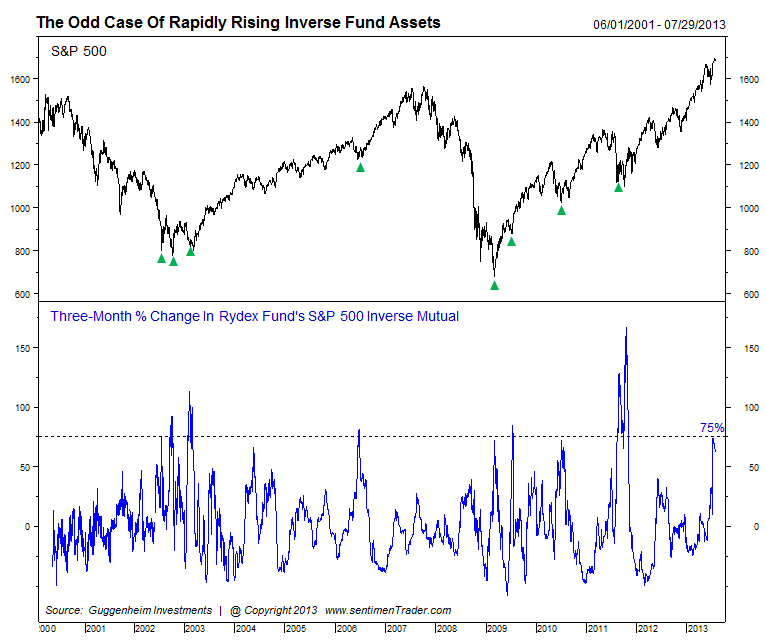
Interestingly, I have some additional charts from SentimenTrader to support a corrective move but the strength of the correlation of these charts to the S&P 500 is admittedly dubious. This first sentiment chart only goes back 7 years, which to a statistician makes the sample size virtually unusable. Fortunately, I am not a statistician. I’m a speculator and the chart is a sentiment reading of the members of the NAAIM, which is the National Association of Active Investment Managers. These members include billion dollar mutual fund companies and large-scale financial advisors. The chart is intriguing because over the last 7 years, each time there has been a correction in the S&P 500 with at least a 45 point move down in sentiment followed by a V-shaped correction in the sentiment then there has always been an even larger correction in the S&P 500 shortly thereafter. This is denoted by the red lines. The second quirky chart is of the Rydex Inverse funds and asset inflows. It’s a contrarian chart, so over the last 11 years every time the 3-month change in asset inflows to the inverse funds moved by 75%; a rally took place. This is because usually the retail speculator or unskilled advisor will use these funds thinking they’re smart and standing apart from the herd. They are almost always wrong, as denoted by the green arrows. What is peculiar though is that this almost always happens after a substantial decline, per SentimentTrader, and the most recent read that hit the 75% change mark was after that little 7.5% move back in May and June. I think that may be due to higher-skilled traders positioning this time ahead of the potential corrective move in the S&P 500. The indicator is usually a contrarian sure thing but it doesn’t smell right this time. And if you like to trade in any capacity, I would strongly recommend a subscription to SentimenTrader. It provides access to a wealth of indicators that have proven valuable to me time and again. I’m not plugging because they kick me back anything. I’m positive they don’t even know this blog exists. I’m just a satisfied subscriber.
clip_image003image

And of course this hasn’t exactly been the most awe-inspiring earnings season either. It hasn’t been bad, but there are all sorts of interpretation on releases and the facts are the facts. Top lines are lagging badly and the new trend appears to be “beat and revise downward.” That doesn’t feel like strength to me. Additionally, thanks to those damn reserve releases by the our friendly Wall St. banks, the Financials have been destroying all sectors when it comes to earnings surprises and thus carrying the S&P 500 on its fraudulent back through Q2. Observe the following charts, courtesy of ZeroHedge:

clip_image005clip_image007

Obviously, you know there is no love lost between me and the “elite” banks. The problem is that when Financials are carrying the day for earnings, trouble has a habit of following. For true strength, we need the sectors underlying actual economic growth to be leading; not the damn derivative rolling, reserve releasing banks. I find this information to be supportive of the evidence relayed above.

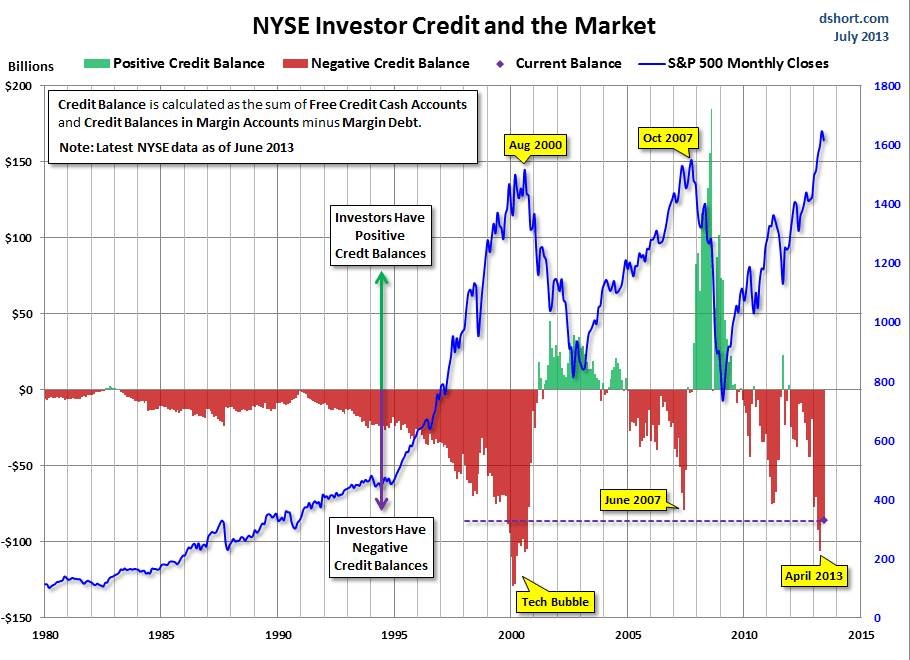
As usual, I’d like to leave you with one last chart to provide some final support behind the thesis. This chart illustrates margin debt(aka investor credit) levels on the NYSE and the correlation to S&P 500 performance. This chart is courtesy of Doug Short. What you’re looking for here is that once margin debt levels peak very close to or past the purple dotted line, then the margin levels begin to taper leading to a correction. This chart creates the perception that a big correction, similar to 2000 or 2007, is on the way and maybe even imminent. Again, I firmly do not believe that is the case. I will reiterate that I think we’re looking at a 10% to 15% correction with the potential to go as high as the low 20%’s for the total corrective move.
clip_image009

This correction has the potential to fall right in line with a rise in gasoline prices if the last note I sent regarding oil prices accurately described a petrol spike. It appears that oil is leveling before a reversion to normalized price levels, but we’ll have to wait and see. If this note proves to be correct I hope that you’re able to take advantage of the data in your own specific way, whether that’s speculating, bottom buying an equity, or raising cash on a name you were ready to liquidate but were unsure of the timing.

Read, Read, and Read some more. Good luck out there.
Market Timing – Trades You Can Apply Yourself

Below I will outline what I feel are some high-probability set-ups for a handful of swing trades. At the very least, maybe you’ll find it fun or interesting if you’re not up for the risk. In the beginning of the year and for the next several months subsequent, my timing skills became out of whack. This is normal as nobody is right all the time. I rely on my ability to “read the tape.” That’s one of my edges…allegedly. Unfortunately, my “tape reading” ability cycles up and down. But every now and again I can get in a zone where I feel like I’m seeing market moves ahead of time, and consequently, make a series of successful trades in a row. Since the return of volatility to the markets back at the end of May, I have been able to capitalize in one of those zones. That volatility has put my technical analysis skills back in play. Keep in mind that I’m not really using traditional chart reading methods where I look for a “flag” in a “rising bear wedge” to determine an intermediate trend change but the overall bull trend remains intact as long as the “Hindenburg Omen” doesn’t offset the “Golden Cross” which is contingent upon the patterns occurring on 5-minute and 60-minute charts but not a daily or a weekly chart. As I’ve relayed before, that kind of stuff can provide value but pretty much gets nullified by skilled systematic traders and the sheer volume of high-frequency-traders in the markets. However, this volatility does allow for my simple use of technical analysis combined with pure “tape reading” to allow for some wins.

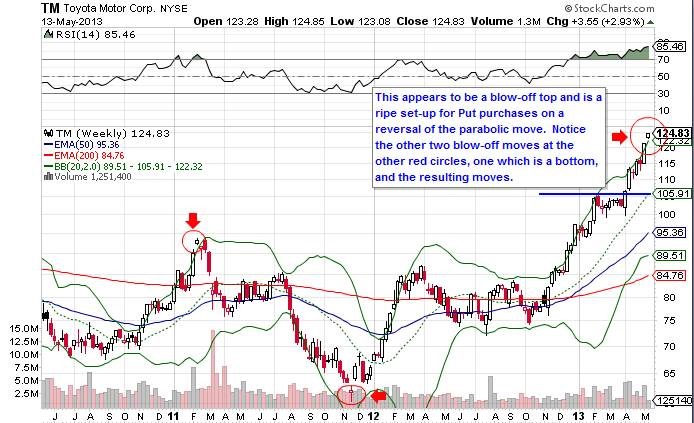
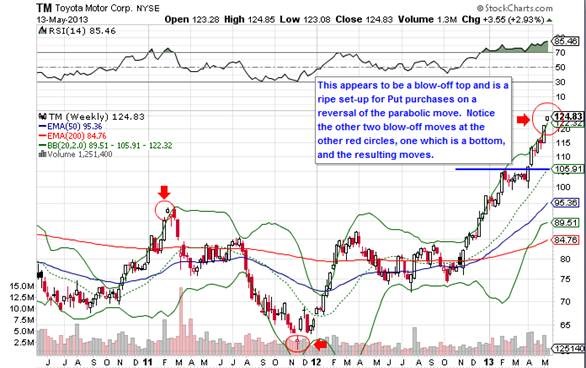
Recall the e-mail sent in May, “Step Right Up and Grab Your Short Opportunity,” and the Toyota recommendation. Observe the results in the original chart(5/13) and the follow-up chart(6/26):

clip_image001clip_image002

And by the way that trade is still open for profit potential on a farther-out timescale. The set-up looked like a mini-Eiffel Tower and I think $105 is still in play. I may re-open the trade as Toyota’s action has been weak in light of the little bounce back in the markets. Now you may be thinking so what. Nice luck, clown. Or even the sun shines on a dog’s rear end, but keep in mind I closed similar trades for profit nailing the turn in the XHB(housing), XLU(utilities), and INTC after it’s jump to $25. Plus, I have other Put option trades open. I also stated in the KSU presentation that a takedown would offer a better entry point for that particular equity when it was priced at $118 at the time I posted the presentation. It’s low since was $102, but I think there’s even more room to correct. But the fun doesn’t end there as there is a tremendous amount of fear still residing in the market. It’s almost palpable and it calls to traders. There has been commentary that the big one is here. This is the beginning of the huge takedown, like in 2000 or 2007, with enormous sell-offs in bonds and stock markets. I disagree. I see the current situation as a natural correction off the irrational 6-month exuberance that existed from the beginning of the year to June. I can’t really speak for the debt markets, but for the stock markets we could see a bounce back to new highs from here and then a stronger, scarier takedown somewhere in the late-July through mid-September range. It’s more probable that we chop along moving sideways through the Summer with some up and down bouncing and then finish out the year strong as animal spirits recover and taper talk dies down with renewed vigor behind the rhetoric of quantitative easing. Now just because I’m an equities guy doesn’t mean I don’t understand the debt markets. It’s just not my primary field of play for profit. What I do think though is that the BIG, GIANT crash in bonds is not on us yet. That period for bonds will shock the markets as the derivatives and debts of the world come together for the big one. No, what I think the correction in bond prices and spike in yields are doing is conveying the first message that judgment day is coming, so it’s time to start worrying but keep partying for now. As always, who friggin knows?

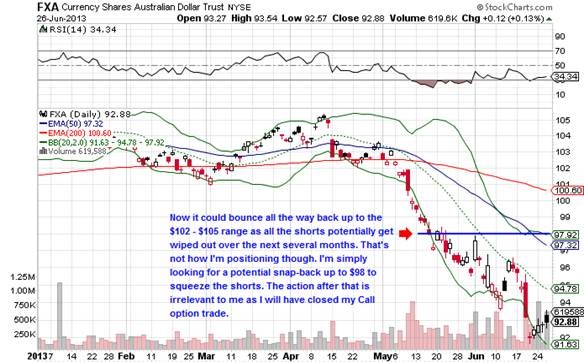
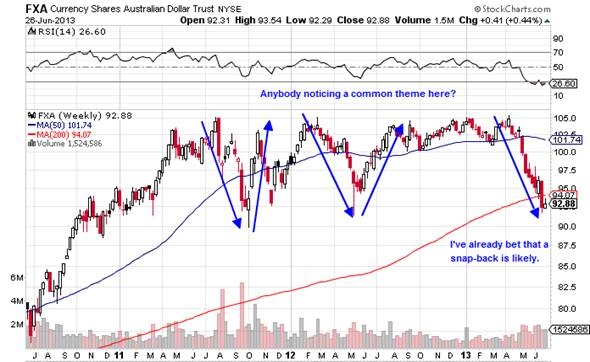
So getting back to the potential money makers I referred to earlier…the first one is on the Aussie dollar. The whole world is short the Aussie dollar. The basic macroeconomic rationale is that the Australian economy is centered solely on commodities and the sale of those commodities to China. With the whole commodity complex coming down, then the Australian currency is due for a dive. And dived it has due to speculators, bond vigilante’s, or the boogeyman. The fact of the matter is that the Australian economy, although possibly overheating, has not blown up yet nor has their housing market yet, either. The central bank of Australia has been raising rates as opposed to lowering, although I suspect that should change in the near future. And the bottom line is that when the whole world agrees on a trade, you simply have to go contrarian. Even if the macroeconomic rationale is correct, there’s still that little matter of timing. Recall gold and gold shares for proof of that. Anyways, observe the following weekly and daily charts of FXA, which as you should know from previous market notes, is an ETF proxy for the Aussie currency.

clip_image003clip_image004

The hedge funds, family offices, and wealth managers can borrow in a stronger or weaker currencies and short or go long another. That’s a carry trade done on margin. It can blow up spectacularly when done in things like borrowing Yen on margin to buy US safe, dividend paying stocks. It works till it doesn’t and then it can blow up fantastically, which is what we have seen this month. Obviously, I’m not operating on that level. Our trade is the September Calls at a $98 strike on the FXA. These options tend to trade with a little bit wider spreads of around $0.10 despite adequate liquidity, so as of 6/26 each Call was trading between $0.40 and $0.50. Do not put more than 2% of your trading capital at stake in the trade. I use a very wider stop-loss generally on option trades. Sometimes you gotta give a thesis time to marinate and that’s what going far enough out with a wide stop-loss allows. Not to get too remedial or insult your intelligence, but let’s do a quick example of what that looks like. Hypothetically you have $10K to trade and a 50% stop loss. That means you’re willing to risk $200, which means that you’d place $400 into the trade if you’re using the 50% stop loss. The resistance point of $98 is a pre-planned sell price, however feel free to liquidate earlier if you’re satisfied with the profits earned…after accounting for transaction fees of course. Full disclosure, I’ve already put the trade in play.

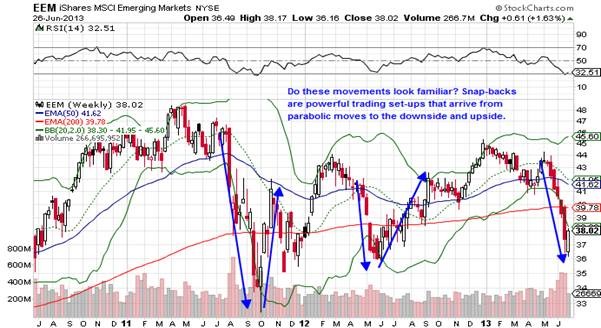
The second trade is in emerging markets. I spend hours every day scouring the web researching various markets and gathering usable intelligence that will allow for a potentially profitable trade set-up. One of the things of I’ve noticed over the last week or so is all the overwhelming negative sentiment on emerging markets. Once again, the whole world is short emerging markets. Literally, all I read are negatives on Brazil, China, India, and the rest of the developing countries and how the US is so strong, while the emerging market investment will destroy your portfolio. As I stated up above, when the whole world is in on a trade then you really do have to go contrarian. Look at the emerging market ETF, EEM. It has been destroyed in the last 4 weeks and with a serious gap-down just last week. In the daily chart we have two 2 beautiful set-ups that I love to see:  1. confirmation of the beginning of a snap-back, and  2. a gap-down that appears as if it will be covered as part of the snap-back. The weekly shows the snap-back consistency subsequent to a parabolic sell-off. Observe the following charts.

clip_image005clip_image006

I often comment on snap-backs when it comes to trading and that’s because I’m always looking for extremes. It’s one of the easiest things to look for in trading set-ups. Others call it mean reversion, although that’s not always the case as the reversion move may not necessarily move back all the way to the mathematical mean, but you get the point. Regardless, I generalize these set-ups as snap-backs and they’re far and away my favorite set-ups to consistently trade. They can be executed up or down. It doesn’t matter. The only real difference is that downside moves are much more explosive than upside moves, so Put option purchases are a touch more delicate than Call purchases. The trade here is the August Calls at a $39 strike for EEM. Each Call is trading at a fair $0.75 despite the resistance point only being a dollar away. Waiting for the mini-gap will present an even better price point. Liquidate at $39 to be safe or earlier if you’re already satisfied with the profit level. The sentiment against EEM is definitely extreme as the top holdings in the ETF are companies like:  1. OAO Gazprom – Russia’s largest natural gas producer and thus Europe’s largest supplier  2. China Mobil – China’s largest mobile carrier  3. Samsung – Largest company in S. Korea and one of the largest consumer electronics companies in the world  4. America Movil – Mexico’s largest telecommunications company, etc. These aren’t exactly the kinds of companies that are about to become insolvent. Full disclosure, I have not put the play in motion yet as I am waiting to allocate once that mini gap is filled.

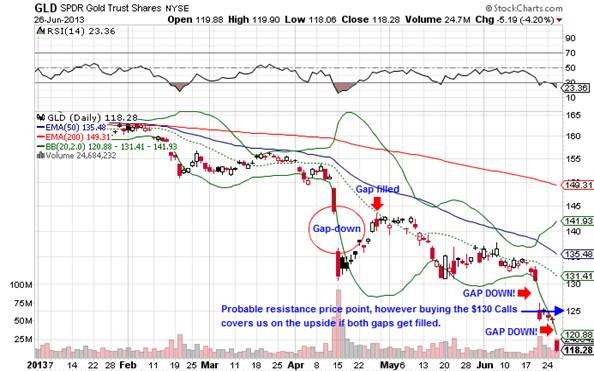
The third and final trade is a golden oldie. The sell-offs in the GLD on 6/20 and 6/26 also present my two favorite set-ups again. We have gap-downs and we have an extreme shift in the trend. By observing similar action in April, we can see the potential of the snap-back here in June. Understand I’m not calling for a secular trend change here in gold. I’m not saying go all-in gold because the correction is over. I’m just seeing a great set-up that deserves a short-term capital allocation. Observe the first chart, which is a daily chart of GLD. The second chart is of the COMEX paper gold. Using any technical analysis on gold is dangerous due to the gross manipulation, however trading is trading and greed is greed and extremes are extremes. These set-ups look compelling.

clip_image007clip_image008

I had shared with a colleague that I had purchased Calls for September, but was mistaken. The trade is for the August Calls at a $130 strike on GLD. These Calls got killed on 6/26 and could have been purchased for $0.85 as of the close, which is when I purchased my allotment. I suspect the trade will be ready for liquidation at $125, but if paper gold is running kind of hot off of the snap-back then there is the potential for $130, in which case the option should be liquidated. It is probable by that point that the takedown will resume in paper gold as $1,200 has not been hit yet and potentially slightly below $1,200, just to run all the stops set at $1,200 for easy profit.

There are some things to keep in mind when considering dipping your toes in. One is that it’s not as hard as it looks. Just be disciplined. Don’t over allocate and get out if the play moves against you. The second thing is that these moves aren’t for waiting on. The FXA and GLD options are for immediate purchase, so if you dilly dally and then decide you want to try, you’ll lose. The EEM is only a wait until the mini gap is covered which should happen the next day or two and then I’m going in. The third thing to consider is hedging. It’s not important to try to think outside of your realm of expertise and hedge each of these bets directly. For instance, you don’t need to short the dollar while buying Calls on GLD or buying E-mini Calls on the S&P 500 while you short the Aussie dollar. Hedge funds have expert analysts, with PhD’s, in combination with sophisticated software to determine correlations and anti-correlations between every asset class in the world and then calculate optimal statistical probabilities of a trade. We don’t have those resources. Like I stated in the previous note, think of your 401K’s and safely allocated retirement funds as your hedges to the risk you take on with options trades. It’s that simple.

I’m assuming that none of you will try these and I knew that before penned this note. I don’t care what the universities & the mutual fund marketers communicate about asset allocation and thinking of the long term. Markets ain’t efficient and short-term profit opportunities consistently present themselves. I enjoy deep-dive analysis on companies for long-term potential as much as the next value investor. That is also fun for me…and profitable. It’s just that swing trading is more fun and presents profits a lot more quickly, but of course the danger factor is amplified exponentially. At the very least, bookmark the charts from Stockcharts.com and the ticker profiles from Yahoo Finance for the next couple weeks to couple of months to see how these play out…just for laughs.

Lastly, remember these are simple option trade set-up’s of the purchase of a Put or Call. You can facilitate more complex option trades around the analysis, but that’s not what I share here. If you have the requisite skill set then you’re covered.

Read, Read, and Read some more. Good luck out there.

Step right up and grab your short opportunity

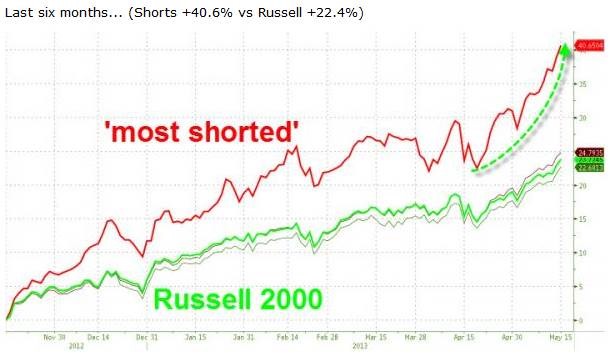
An interesting article was posted at ZeroHedge today regarding the rally in the stock indexes and how short covering is continuing to drive a fair chunk of results.  Any number of reasons can be attributed to this piece of information including the usual suspects of HFT’s algo’ing shorts from their money to the Fed is supporting equity prices to other central banks are buying US stocks.  Causations and correlations are always a funny business, but the graph does paint a unique picture.  The chart is the performance of the most shorted stocks over the last 6 months compared to the Russell 2000.

clip_image002

You can catch the entire article(it’s very short) here.

That being said, if you’ve gotta a steel pair or are as dumb as I am, the following chart of Toyota presents what appears to be a good opportunity for a very short-term swing trade to go short.  I feel that Toyota is going to inevitably take out it’s all-time highs set back when everything else was at all-time highs, 2007, as the Japan trade still has room for a longer term melt-up.  For now though, momentum appears to be arresting in a final move before the let off of some steam.  Observe…

clip_image004

Toyota appears to be forming a weekly blow-off top.  As the caption notes, look what occurred the other two times a blow-off move occurred on a weekly chart.  These moves occurred what now feels like 3 decades ago as far as trading action goes.  If the trading gods allow a normal move to occur as it would have in the old days, then Toyota should correct off of this move; potentially down to between $105 and $100 over the coming weeks or next couple months.  I placed that blue line under the caption to denote what should be a fairly strong support point under normal technical analysis.  I already made one attempt at this trade but was stopped out today.  I will be trying it again on the July $105 Puts.  Of course there is always the risk of a false signal as nobody is allowed to short the markets right now.  Take a gander at this chart below from the Price Action Lab, a great site for the aspiring quant.  Notice at the red circle what appears to be a blow-off top in the tech ETF, QQQ.  Making that same trade of purchasing Puts would’ve have easily stopped out an options trader going short in quick fashion.

clip_image006

I point this out not to show that I’m scared to play the potential move in TM but to simply reiterate that it is a dangerous, dangerous time for one to fashion themselves a trader without the technological and potentially statistical tools that the biggest and most successful players are currently using.  The best way to play the TM “blow-off top” is to wait for a breakout to the downside for confirmation of the trend-break and then quickly position in the option.  Front running the move can yield upwards of 100% gains, which seems sexy until you’re stopped out.  Waiting for confirmation takes your ROI of the trade down significantly but it’s tough to piss and moan about only making 30% – 50% in less than 4 weeks.  I made the exact same play in XLU(utilities ETF) for a quick 45% in 3 days.  Of course, that now makes me 2 for 6 going short in 2013 which ain’t exactly my best work.

Keep in mind I’m just laying out a basic Put purchase position.  I’m not going to delve into complicated options strategies and start laying out straddles, strangles, condors, crosses, hippos, and moosesses.  That’s for the reader to engage in.  I’ll generally just throw out my interpretation of a chart’s potential and possibly a simple Call or Put purchase.  What’d you expect?  The site’s free.

Read, Read, and Read some more.  Good luck out there.
Some legendary thoughts on Japan

By now it is readily apparent hopefully, that Japan has been running all out with the Nikkei up 67% in less than year.  Very impressive.  Abe(Prime Minister) and Kuroda(BoJ Head) have followed through on their commitment to flood the country with liquidity and even though they rang the loudest cowbell(“I gotta feeva.  And the only prescription…is more cowbell!” – Walken voice) about their intentions, many have missed out on the trade so far.   I read a very thorough analysis in January before 20% and 31% upward runs in the DFJ and DXJ, respectively.  Those are two of Wisdom Tree’s ETF’s that offer probably the most simple and best exposure to the move in Japan.  Even though the trade is due for a breather, according to some of the most informed and experienced money managers around, there is still a lot of room left to run.

Here’s a synopsis of Stanley Druckenmiller’s thoughts on Japan from the recent Ira Sohn conference, “Japan’s long term outlook is much more favorable as the country has experienced 15 years of deflation and central bank policy is supporting Japan’s stock market.  He sees the Nikkei gaining for 18 months and exports bolstered by a depreciating yen.  To play this trend, Druckenmiller favors Japanese domestic companies that benefit from reflation.  He feels this could be the beginning of a secular bull market in Japan.  Kuroda in Japan is doing QE x3 of the US relative to equity market capitalization.  He actually thinks the Japanese QE makes sense, because they’ve been in deflation, particularly their currency strengthening against everyone else in the world. He believes when the US economy improves and the Fed tightens, it will overwhelm the growth and cause the market to crash. He does not expect that in Japan, because it has been in a long-term deflation.”  If you don’t know who Druckenmiller is, step your game up.

Here’s some more thoughts on Japan from probably the first big time hedgie to nail the trade, Dan Loeb, before everyone else got in:  “It’s a huge game change, and there’s a lot more room to go,” Loeb said of the yen’s decline, “The structural reform, which should be announced before the election, is going to really be the big game changer over there…We have the potential to get this right, to have a similar kind of massive improvement in the performance of Japanese corporations with the backdrop of the support of government.  It’s a really critical time.”  Loeb did not make any specific recommendations on where to invest in Japan but compared the growth to the 1980s before the country began its “Lost Decade.”  Loeb is arguably the hottest macro guy out there right now next to Gundlach.  And what’s funny is they’re both fixed income guys who have been nailing macro trades in equities.

And some last thoughts on Japan from the living legend of Technical Analysis, Louise Yamada:  “…both the Yen and the Nikkei moves are the real deal.  Today’s leap over 100 is huge for the Yen.  “Yamada and others expected it to take longer for the currency to break through such time-tested resistance.  Now that it’s happened the Yen is in a spot that should be familiar to U.S. investors: the rally is “due for a rest” but the momentum just won’t stop. It’s looks like a legitimate breakout in the Nikkei and clearly a legitimate decline in the currency,”  What’s that mean?  As Yamada often says “the greater the damage the longer the time it will take to recover.”  The Nikkei and yen have spent 3 decades marking time and making doubters of the world.  Extended or not, rallies that tear through resistance so vigorously seldom reverse immediately.  Like Druckenmiller, if you don’t know Louise then step your game up.

If allocating a portion of your portfolio to the Japanese opportunity, then here’s a chart to consider as a matter of timing from the great site Kimble Charting Solutions:clip_image002Coming back to the ETF’s, both obviously specialize in Japanese equities.  The DXJ invests in Japanese equities but it hedges risk by trading the Yen versus the Dollar to “neutralize currency exposure.”  The DFJ(which I like better) invests specifically in Japanese small-cap dividend players.  Depending on where you stand on the reflation of Japan, both ETF’s offer compelling 12 – 24 month opportunities.

And touching on the thesis for gold, here’s an update with an interesting recent graph of small speculators from the Commitment of Traders reporting by the COMEX.  Small specs are your non-giant institutions i.e. banks, large hedge funds, and commercial producers.  Each of those types of entities have their own CoT classification.  The small specs tend to be wrong very often at the extremes and this graph, courtesy of the outstanding services of SentimenTrader, clearly paints a picture of extreme sentiment towards the precious metals as the small specs have a net short position for the first time in 23 years.clip_image004Even if one has enough exposure to PM’s, I think the graph is compelling and it’s worth noting some old words of wisdom here I read this morning, courtesy of LB at WSD:

o From Sir John Templeton we get this nugget of wisdom: “It is impossible to produce superior performance unless you do something that is different from the majority.”

o Warren Buffett advises, “Be fearful when others are greedy and greedy when others are fearful.”

o And Silicon Valley venture-capitalist extraordinaire, Bill Gurley, says, “You can only make money by being right about something that most people think is wrong.”

To conclude with a little monetary opinion, here’s a link to an article about monetary policy that is somewhat in opposition to some of the stances I have shared.  It’s always good to read a qualified opposing opinion.  Keep in mind, I do not completely disagree with the thoughts of the article but I’m not sure the author is framing up his argument correctly as he completely fails to mention or expound on potential sovereign insolvency or derivative exposure at the country and institutional level.  None the less, worth a look:  http://markdow.tumblr.com/day/2013/05/12.

Read, Read, and Read some more.  Good luck out there.