The Correction and a Trade Update

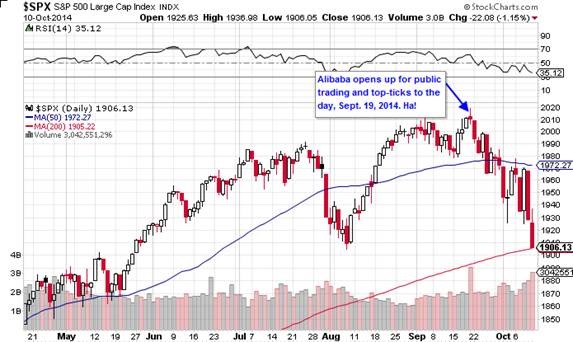
We’ll begin with Alibaba. It’s funny; there was article after article talking about how the BABA IPO may top-tick the market and yet not really much chatter at all from the financial sources about how BABA actually did top-tick. Like literally to the day, if somehow you were unaware of that. Have a look:
clip_image002

You can literally find dozens of articles on the subject. Some were written before September 19th. Others were written just a handful of days afterwards. One even had the gall to act as if some specific blogger nailed the top. To his credit the blogger did nail it to the hour, but it wasn’t exactly going out on a serious limb. Here’s a listing to go back and peruse:

1. www.marketwatch.com/story/did-alibabas-ipo-signal-a-top-in-the-stock-market-2014-09-23
2. blogs.wsj.com/moneybeat/2014/09/12/alibabas-ipo-not-necessarily-a-sign-of-market-top
3. www.usatoday.com/story/money/markets/2014/09/25/first-take-did-alibaba-ipo-mark-market-top/16225725/
4. finance.yahoo.com/video/alibaba-not-top-market-trader-160000682.html – here’s Ponytail Najarian “Gartmaning” the call on the short-term top
5. finance.yahoo.com/blogs/talking-numbers/why-the-alibaba-ipo-may-mark-a-top-for-stocks-182746661.html
6. www.mercenarytrader.com/2014/09/the-alibaba-debut-bears-uncanny-similarity-to-a-year-2007-top
7. finance.yahoo.com/news/stock-market-blogger-nailed-top-211049421.html – and here’s the top calling blogger at Philosophical Economics who did actually call it a top

BABA’s IPO really was a bell at the short-term top, not the long-term. I strongly feel this move is simply a correction allowing for further upside for the equity markets, as I laid out with my “chop & drop” charts. The real question is whether we get a V-shaped correction into a breakout of new highs as the bull trend resumes or is there further downside action. It’s hard for speculators to let go of 2013.
clip_image004

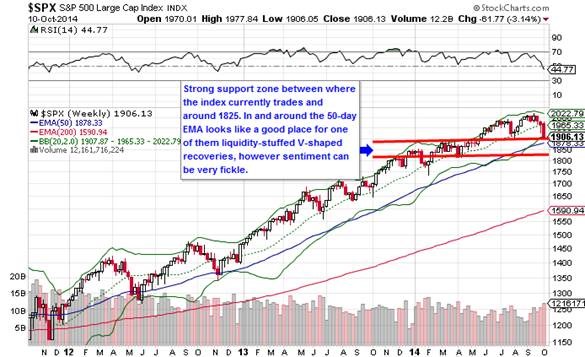
You can see that despite all the fuss being made over the 200-day MA being passed on a daily chart, there’s virtually no chance of that happening on a weekly chart(which has more meaning). Additionally, one can see that the 50-day on a weekly presented a natural support area. Subsequent price action proves that out.
clip_image006

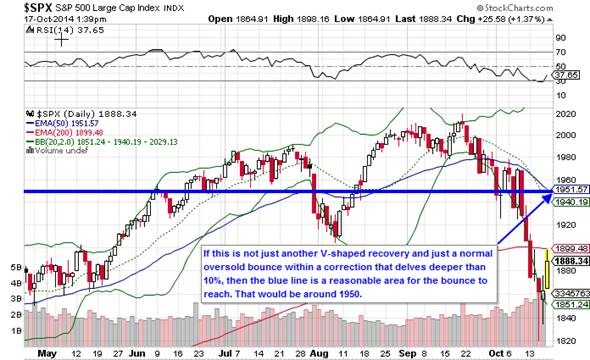
The sell-off reached extremes in so many names during the course of last week, that by Friday, we were due for an immediate bounce. This is perfectly normal behavior in a correction of over 10%. Yes, I say 10% because this one probably hasn’t reached its nadir yet. Using my drug-store technical analysis, the blue-line above represents a fairly basic resistance point for the S&P 500 to obtain in the bounce. Six months ago I shared my thoughts that in order for the S&P 500 to finally take a break, the market would need to see what I deemed to be all 3 legs of the “risk stool” to be kicked out. It started with biotech. Then moved on to small caps. Finally, high-yield fixed income sold off. Combine that with the liquidity vacuum of Alibaba in combination with some Ebola fears for the airlines, the darlings of hedge funds, and WHAMMY! The sell-off has greeted us in fine fashion to start the fall season.

The deflationary action in commodity prices, specifically oil, has compounded the speed of the move downward in equity markets. I think that will help to compound the fear a little longer, which is why I suspect we’ll see a bounce and resumption versus a V-shape move off the low. Fear has a predictive way of making people wait for a bounce and then selling off again at whatever profit can be garnered, further exacerbating the corrective action. About a week ago, SentimenTrader shared a chart displaying typical action in the VIX, “the fear gauge.” It showed price action over the last 20 years, anytime the VIX jumped 100% off its six-month low. The chart may be instructive because you can see that except for 1997 and 2006, there was always further to go before a bottom.

clip_image008

McClellan offered his opinion of the level of extremes based on his Summation Index. The oversold levels of the stock markets have already led to the beginning of a bounce, however it doesn’t mean we’re out of the woods yet. The same thing occurred back in 2011.

clip_image009

If you want to start nibbling at a wish list, then you can follow in the footsteps of many of the giants of finance. Even Uncle Warren said he was buying at these prices. As I’ve stated throughout this article, I don’t think this move is quite done yet and “discretion is the better part of valor.”

Let’s come back to JJG, the ETF holding corn, wheat, and soybeans. In an earlier post, I’d stated I would tell readers when I thought it was go-time on this commodity trade. Well that time is now. My go-to indicators are giving a buy signal. Yes, bumper crops are expected but as we know, supply and demand are not always the ultimate arbiters of value in futures pricing. Sentiment reached extremes and speculators are positioning accordingly. The price action may bounce around at bottom here for a bit, but the downside risk has been significantly reduced. Additionally, you’d hate yourself if you missed out on a coffee-style trade.

I also want to revisit my Delta Airlines short. That was liquidated for a profit, but it was a difficult one for me to stomach, as I irresponsibly held the position. It was a simple trade. I played some Calls on the Transports, and some Puts on Delta. You can debate the finer points of whether I was hedged or simply neutral. I didn’t run the trade through a monte carlo simulator while statistically evaluating the correlations, so forgive my lack of sophistication on this one. I made a move. It paid off, fortunately. The problem was that I profited much faster on the Transports and then closed the position leaving me unhedged in Delta. The unrealized loss in the position was quite extreme, but my analysis felt sound and the duration of the option gave my thesis plenty of time. That was very undisciplined and a trader should always mind their stops. Sometimes though, a human’s hunches get the best of them. I’m not different. This situation worked out.

clip_image011

Because along came Alibaba and Ebola and away we went with the downside move. I had stated that I thought $30 would be the profit point, and fortunately I was able to liquidate the holding for a tidy 50%. My analysis was sound, but I got lucky despite my lack of discipline in this particular trade. The total market catalysts really assisted the drive to profit, but I’ll take’em as they come.

Keep your eyes open and don’t get too jumpy on your shopping lists. If you have to buy, then ease into a position. That’s how the professionals allocate capital into holdings and you’d be wise to speculate in the same way when establishing a stake. Although I’ve called for a resumption of the downtrend to further lows, nobody should be surprised by a liquidity-backed V-shaped correction. Anything’s possible in today’s equity markets.

JJG Still Ain’t Ready

In my last post, I stated that I’d be sharing some thoughts on college football and I will later today with another post or no later than tomorrow. That’s a promise for any sports gambling addict readers who’ve been waiting with bated breath to read my words. I just wanted to share a couple of quick thoughts. One on JJG, which I wrote about a couple of months ago. Additionally, I wanted to share a note from the Price Action Lab blog as well. I regularly follow Mr. Harris’s work, but his note on Friday the 19th was the best work I’ve seen out of him.

For any readers who deign to label themselves technical analysts it’s a must-read. Really it’s a must read for any trader. In the very short but sweet article he covers these BTFD, V-shaped recoveries that started in 2012, agreeing with the timeline I also posited when squiggly-reading began losing its efficacy. Harris hypothesizes that this is due to central bank intervention. Have a look at the chart for yourself and consider back to the hard balance sheet expansion of the world’s central banks.

clip_image002

Harris goes on to opine that indexing’s time in the sun may have an abrupt shift into darkness. As for the last 5 years, he also basically states that what has been won’t always be. Take it for whatever it’s worth, but I recommend taking a few minutes to ingest the article.

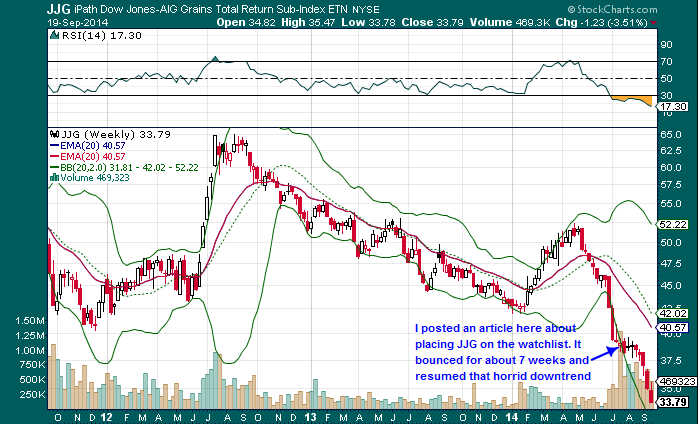
Regarding JJG, don’t feel bad if you tried to bottom-tick that one too early. Them’s the breaks. I had stated that the trade looked ripe but that my indicators weren’t giving me a go. I also stated that I would send out an update if the indicators give the green light. Now this ain’t the update for the green light, it’s just to let any readers know that we’re still keeping an eye on the ETF. Soybeans, corn, and wheat are getting destroyed. It’s serious destruction and the greater commodity index (CRB) just took a dip past support, so it’s not looking good for a trade anytime in the immediate future.

However, one of my indicators has flattened out and the other appears to be following. Even if they do shift, that may simply lead to some bottom bouncing consolidation for several months as opposed to a V-shaped rocket ride upward. I wouldn’t expect a coffee style abrupt turnaround, but anything’s possible. Have a look at the weekly JJG chart in case you haven’t in a while.

clip_image003

Once the indicators have turned in favor of an uptrend, then the HFT shops may just juice this thing for nice little return. I hope to have you along for the ride on the timing of that one. We’ll have to wait and see. For reference sake, let’s take a look back at coffee’s beautiful halt to its downtrend and abrupt rocket ride upwards for the lucky schleps(or skilled) who rode that trend to the bank.

clip_image004

Alright, so read that article from the Price Action Lab blog. Keep a wary eye on soybeans, corn, and wheat. And enjoy Saturday. College football is back, so go pay your bookie a visit and dare to be great.

PS: Marginrich.com does not condone nor endorse any illegal activity regarding unsanctioned and unlicensed sports wagering. If you are compelled beyond your will to place wagers on the outcome of any sporting event maybe it’s time to seek counseling and admit the problem is real. Read those two sentences really fast like the MicroMachines commercial guy with the moustache from the 80’s and it’ll sound real official. And for anyone who thinks I’m insensitive to the genuine sickness that is a gambling addiction and reads articles here, get real, I write about speculation regularly.

Two Trades for the Price of None

Okay, so the Toyota trade did not work out. It was a low risk, little scalp for a few easy bucks. If you put the trade on and were stopped out, well then I’m sorry but them’s the breaks. You’ll notice a little lower in that article, however, that the coffee trade was a 100% nailed and there’s still room to run. Might have been luck. Only the trading gods know.

Today though, I’m going to share what are by now two very obvious trades to the world of speculators. One is a short, and it’s move has already begun. The other is a long and the play is still setting up.

First the short, it’s Delta Airlines (DAL) or rather airlines in general. Keep in mind this stock has become a hedge fund hotel along with American Airlines (AAL), which can be either a positive or a negative. On the one hand, the large institutional support can provide a ton of liquidity for any potential pyramiding of the professional positions. Additionally, shorts can be easily squeezed with the amounts of money that could potentially be thrown at the position. However, the short float is exceptionally low at under 2% so nobody seems to be expecting any sort of real selloffs despite the 12% down-move over the last 4 weeks. In other words, there’s not a lot of kindling for a hard short squeeze.

Observe this partial list of the 50 most popular stocks amongst hedge funds as of the end of May 2014, courtesy of the WSJ’s Moneybeat via Goldman:

clip_image001

The airline stocks have enjoyed a tremendous run. From the fall of 2012 to the spring of 2014, Delta was a 4-bagger. American has treated investors well for those that held the equity and the debt too as it worked its way through bankruptcy. The new ticker AAL, post-merger with US Airways, is already up around 100% since the beginning of the year. Allegiant, who I was very wrong about in a friendly argument with a colleague a couple years ago, has been a 3-bagger since the spring of 2012. Mr. S.P. off in Deutschland, you were very right and I was very wrong. I hope you rode the stock for maximum profits.

The airlines have garnered a lot of momentum in what I think will ultimately be temporarily profitable situations. Unions have been re-bargained with. Fuel has been somewhat reasonable. And the fees for this, that, and the other have been a huge boon to the airlines’ income statements. Maybe the industry has entered the new normal along with developed world economies, and the airlines will all be immensely popular investment darlings. We can crown them as the core holdings in a new era Nifty Fifty alongside Tesla (TSLA), King Digital (KING), and Cynk Technology (CYNK), because if there’s one thing airlines are known for it is profitability.

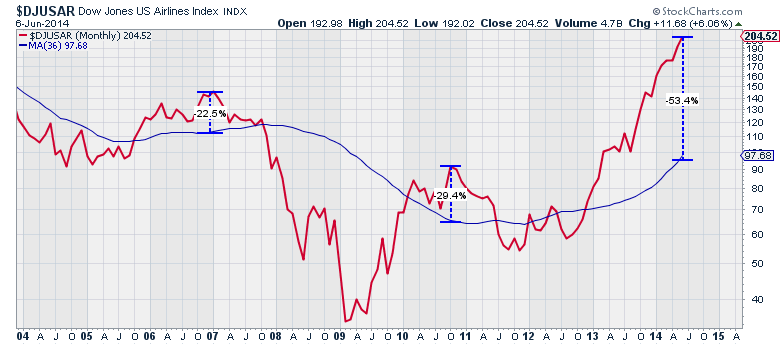
For my money though, I’m betting a little snap-back(or mean reversion as you pros like to call it) may be in the works. Valuations seem a bit stretched. Have a look at this chart from last month of the index of all the US airlines, courtesy of STA Wealth Management:

clip_image002

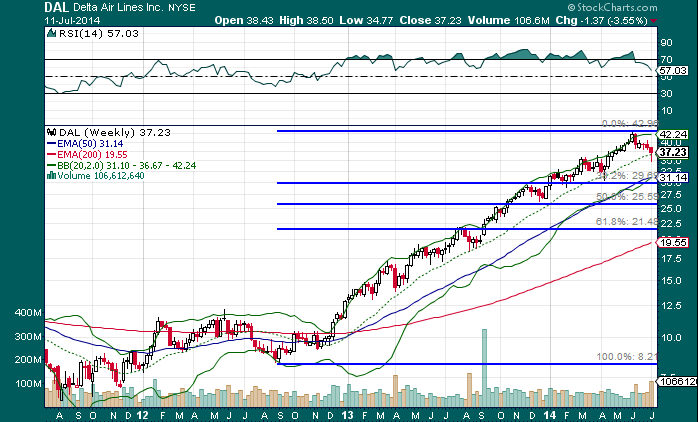
The blue line is the 36-month moving average. Does the chart say mean reversion or plow in for new highs? With no airline ETFs in existence anymore and the transport ETFs too diversified amongst all industries, you have to take your shot directly with an airline. With Delta forming its own little Eiffel Tower(on a linear scale chart), we have our short play. Observe the chart(logarithmic) below of Delta with Fibonacci retracements:

clip_image003

The 38.2% retracement target is essentially $30, so that makes for a reasonable 1st profit point on a short position. Winners have to be given room to run so you’ll have to consider the action in conjunction with the broader market along with your own stops before considering liquidating part or all of the position. My contention is that “Wood drastically underestimates the impact of…”; sorry about that. Had a Good Will Hunting flashback. No, my contention is that as market darlings the airlines could possibly lead a whole market sell-off, similar to biotech and social media a few months ago. Delta and American are already showing weakness, but especially Delta.

My two proprietary indicators gave a buy signal the week of June 30th. I almost never trade without their confirmation, unless I’m going for a quick scalp off the action of the tape. This is a real money move for me and I have already positioned into the short.

For you option players, be careful about the core strike of your strategy. For instance, $30 strikes for the September Puts and $35 for the Decembers have a ton of open interest. Things can get a little wonky around those areas so intelligently apply your tactics. Review your Greeks and determine the best course of action for this directional play.

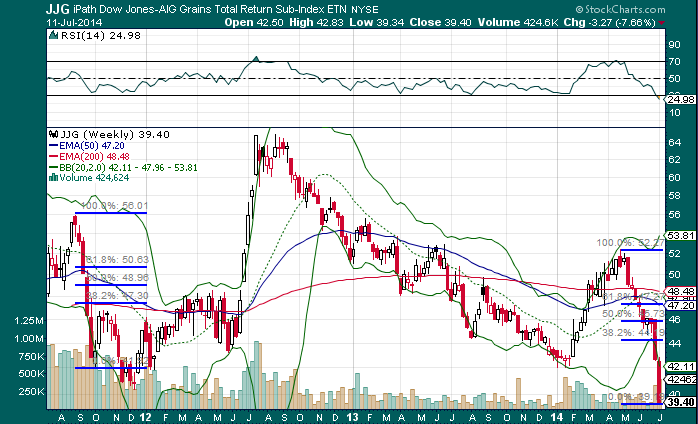
The long play is the grains. Specifically, when the time is right I’ll be using JJG as the ETF proxy. JJG is weighted to corn, soybeans, and wheat. If you’re comfortable with futures and want to focus your efforts into a single grain, then knock yourself out. For the purpose of this analysis though, I’ll be referring to the JJG as the grains equivalent. All three components have been beaten down badly the past several months in a very intense selloff. Observe the following chart. In it I have listed the current potential Fibonacci retracements if the sell-off subsides this week. I’ve also displayed the retracements for the selloff of similar magnitude back in 2011:

clip_image004

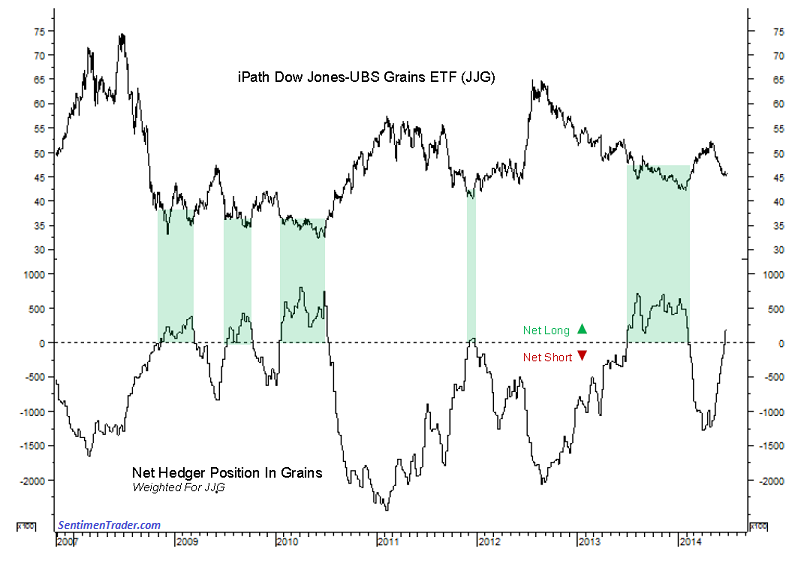
For the 2011 correction, it’s easy to observe how important the 38.2% area was for approximately 10 months. Will that be the case again? Past is not always prologue to the future, nowhere more so than in the markets. However, there is additional evidence courtesy of SentimenTrader. Jason Goepfert was able to compute a hedgers index for futures of the ETF’s components, which was based on each grains’ weighting within JJG. Here are the results:

clip_image005

Now you can review the CoT’s to assess your prospects for the futures, but for traders of the proxy, this is a handy representation. You can see that when hedgers reach a net long position this tends to be consistent with a bottoming process. As the ETF was only birthed in 2007, the 7 years of data should be statistically insignificant in theory. Relevance is relevance and performance is performance. The reason the net long is important is because some of the biggest traders in these markets are the commercial grains producers themselves. Their product sales inherently have them positioned long, so they constantly hedge their sales with short positions. When we see a net long position set-up like what we currently have, then a rally may not be far off.

There could be further downside action, but sentiment is so stretched that there may not be much selling energy left. The selloff was so extreme over the last couple of months that I think the snapback will occur soon providing a potentially profitable trade with $44 as the first Fibonacci target. I have not entered a position here. I really like the sentiment and the chance for a contrarian play, but my indicators have not confirmed the move. When they do, I’ll post an update stating that the move is on. For now keep your eyes closely on the grains for a chance to garner profits this summer.

Again With the Discounting Mechanism

One of the biggest ism’s on the Street that has been pounded to death by any and all financial sites is the fact that the stock market is the greatest discounting mechanism in finance and is always looking out 6 to 12 months. This may seem rational to all you EMH’ers out there and there is of course evidence that can be pointed out supporting the markets’ abilities to discount for future events. Feel free to scour the web for all data pertaining to this notion.

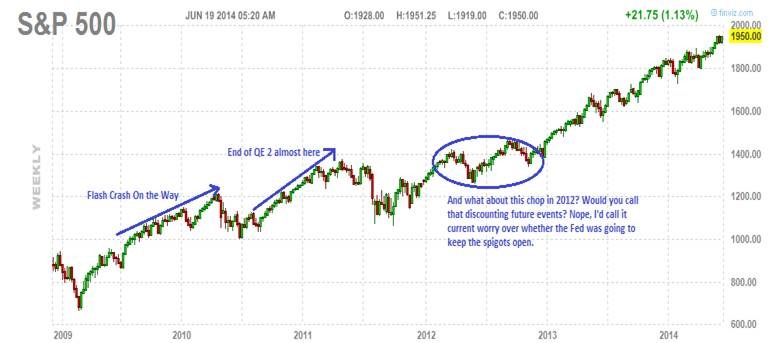
I’m not going to get into the facts and fiction of the mechanism. I just want to provide a little reminder that the forward looking ability of the markets gets a bit fuzzy at the extremes. Whether it’s is an epic crash, a normal correction, or a bottom-ticking nadir; at the extremes the markets don’t exactly send the clearest message. Have a look at the S&P 500 since 2009.

clip_image002

You can see that the Flash Crash came out of left field for a lot of speculators in 2010. That strong uptrend wasn’t giving anybody any kind of forward guidance regarding what was about to happen in May 2010. How about the end of QE 2 in 2011? The last “real” correction this market has seen. It too had a nice positive uptrend going before pulling the rug out in the summer. Sure the normal seasonal platitudes could have been rested on, but nobody saw the blowout in August coming. And finally, look at the choppy action in 2012. It was difficult to get a bead on how to allocate, because everyone was busy worrying if the Fed would keep the punch bowl spiked and the dj dropping the base.

Did that choppy action of 2012 tell you that 2013 was going to be a mega-homerun year for people who simply invested long? Hardly. Even though the Fed announced to the world that it would provide unparalleled levels of liquidity to market players, many a professional was caught off guard at the strength of the move.

The S&P 500 is setting new highs here and the NASDAQ is fast approaching its highs off the 2009 lows. One can paint any picture they see fit with any sets of data they choose. In the end, it’s about your experience and gut in combination with robust data. Not going into a bearish spiel, again I’m just reminding that at extremes the markets can be less than reliable discounters. Consider all the world events simply being shrugged off by investors:

1. Ukraine civil war – label it anyway you want but that sure looks like civil war to me
2. ISIS taking over a fair chunk of Iraq with US deployments to the Persian Gulf
3. Chinese Commodity Financing Deals (“CCFD”) and the budding re-hypothecation scandal
4. The approach of no quantitative easing – seriously think about that for a second – NO QE if the Fed follows through on their word; a full taper is most definitely not being discounted.
5. Potential liquidation fees imposed by The Fed at bond funds to “prevent” bond runs

We’ll just leave it at that. For good measure though I’ll present you with a snapshot of the Financial Times cover from Tuesday June 10th, 2014.

clip_image003

This has been bandied about all over the web as the “Contrarian Indicator of the Year”, with the FT extolling the virtues of Central Bankers’ abilities to remove volatility from the investment picture. I’m not here to debate the efficacy of the Magazine/Newspaper Cover Indicator. If, however, this cover proves to indicate a bottom in volatility in 2014, did the markets discount that?

Revisiting an Old Friend

Today, I’m just going to highlight the potential of some price action. It’s not often that I offer up a trade as the sole topic of a post. No talk of corrections. No sovereign debts. No interest rates. No belly-aching about complacency. Just gonna put up some plain old charts showing some price behavior that could be used for profit.

Way back, as in a year ago, I provided an opportunity to short Toyota. It was a nice, profitable little trade that paid off immediately. For such a steady behemoth of the automotive world, Toyota tends to consistently present tradable short-term set-ups despite any prevailing macro-outlook at the time.

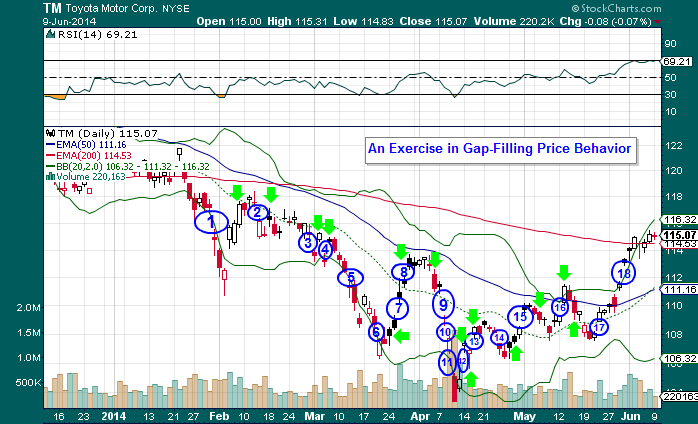
The pattern set-up is simply an exercise in gap-filling since the end of January. That’s it. No long-term backtesting of the pattern, which means that I’m not calculating probable odds with any statistical significance what so ever. In fact, it’s simply a read of the tape with a tight stop. Have a look at the chart. You’ll observe that since January 31st, TM has “gapped & filled” fairly quickly on 16 occasions(gaps at blue circled numbers – fills at green arrows). I may have left out a green arrow or two but the chart is convoluted enough. You get the point. A fill on gap numbers 17 and 18 is what we’re playing.

clip_image001

Shorting here at $115 with an expectation of a cover at $108. I leave it to the traders out there to calculate your own risk/reward numbers. We have a price behavior that has proven to occur 100% of the time, at least since the last day of January. Keep a stop of 10% to be relatively safe, which would essentially stop you out of the trade if it goes against the prediction and breaks out past the key number of $125.

You may be thinking that shorting here for a $7 move downward may not be worth the risk. A 10% chance of loss for a potential gain of only 6%? What gives? You can tighten the stop if you absolutely have to skew the risk/reward ratio in your favor. Let’s say the trade hits the objectives in 60 days. That 6% return on the short annualizes out to a 42% return. I think any professional trader will take 42% annual returns any day of the week.

There is of course the leverage of options, which is how I’ll personally play the set-up. I’ll leave you to your own personal devices when it comes to option strategies. Sorry. I ain’t Greg Harmon over here, throwing out Calendars, Spreads, Strangles, and Butterflies. For those that play the option game, do your thing. For those that don’t, stick with a simple short of the shares or perhaps buy a basic Put with an October strike, although beware the lack of a hedge on a straight Put purchase.

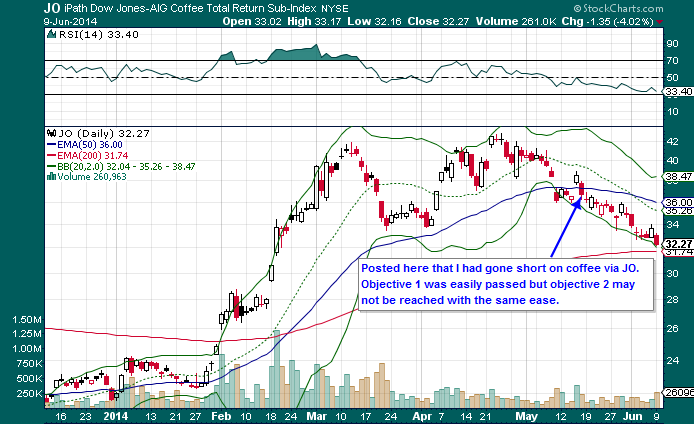
It is possible to go short in these markets. Dangerous, but still possible. Recall that I went short on coffee a couple of posts ago, on May 16th. Of course coffee is a commodity, but I used the ETF proxy.

clip_image002

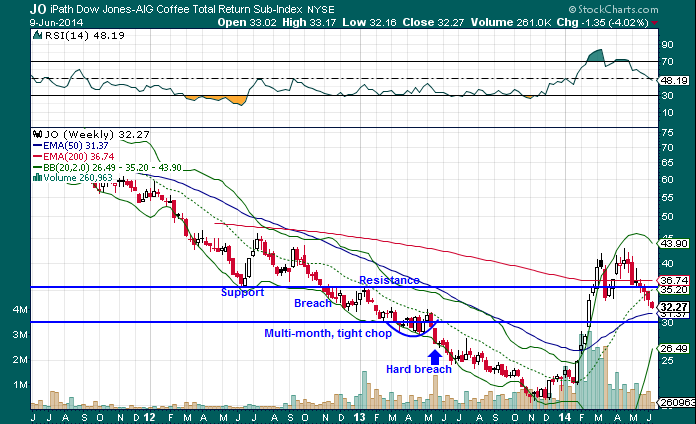
In initially determining my price objectives for the short, I utilized a weekly chart. Observe the chart below for the basic presentation:

clip_image003

And for you Fibonacci retracement addicts, using the weekly low off the first week of November, then 31.8% is $34 and change while $30 is tightly in between the 50% and 61.8% retracement levels. I felt safe in using $30 as a round number objective, especially in light of the high open interest at the expiration month for the primary asset in my own play. Coffee may retrace all the early 2014 gains in a full construction of an Eiffel Tower. If you’re in the coffee short then adhere to your risk parameters and enjoy the profit.

Getting back to Toyota, trading in a low volatility environment can be dangerous. I think there’s enough volatility in Toyota’s tape to warrant the short. As with a lot of trades, you risk a little to fill your pockets with some change. This trade is one of those singles that people forget to swing for after striking out for the umpteenth time on a grand slam attempt. Please visit my disclaimer before leaving and taking any action. Good luck out there.