Again With the Discounting Mechanism

One of the biggest ism’s on the Street that has been pounded to death by any and all financial sites is the fact that the stock market is the greatest discounting mechanism in finance and is always looking out 6 to 12 months. This may seem rational to all you EMH’ers out there and there is of course evidence that can be pointed out supporting the markets’ abilities to discount for future events. Feel free to scour the web for all data pertaining to this notion.

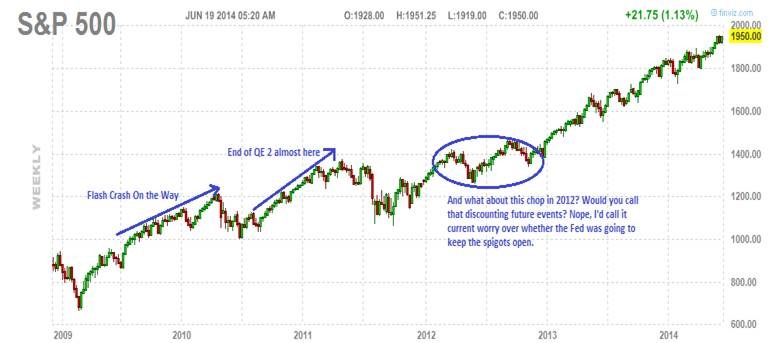
I’m not going to get into the facts and fiction of the mechanism. I just want to provide a little reminder that the forward looking ability of the markets gets a bit fuzzy at the extremes. Whether it’s is an epic crash, a normal correction, or a bottom-ticking nadir; at the extremes the markets don’t exactly send the clearest message. Have a look at the S&P 500 since 2009.

clip_image002

You can see that the Flash Crash came out of left field for a lot of speculators in 2010. That strong uptrend wasn’t giving anybody any kind of forward guidance regarding what was about to happen in May 2010. How about the end of QE 2 in 2011? The last “real” correction this market has seen. It too had a nice positive uptrend going before pulling the rug out in the summer. Sure the normal seasonal platitudes could have been rested on, but nobody saw the blowout in August coming. And finally, look at the choppy action in 2012. It was difficult to get a bead on how to allocate, because everyone was busy worrying if the Fed would keep the punch bowl spiked and the dj dropping the base.

Did that choppy action of 2012 tell you that 2013 was going to be a mega-homerun year for people who simply invested long? Hardly. Even though the Fed announced to the world that it would provide unparalleled levels of liquidity to market players, many a professional was caught off guard at the strength of the move.

The S&P 500 is setting new highs here and the NASDAQ is fast approaching its highs off the 2009 lows. One can paint any picture they see fit with any sets of data they choose. In the end, it’s about your experience and gut in combination with robust data. Not going into a bearish spiel, again I’m just reminding that at extremes the markets can be less than reliable discounters. Consider all the world events simply being shrugged off by investors:

1. Ukraine civil war – label it anyway you want but that sure looks like civil war to me
2. ISIS taking over a fair chunk of Iraq with US deployments to the Persian Gulf
3. Chinese Commodity Financing Deals (“CCFD”) and the budding re-hypothecation scandal
4. The approach of no quantitative easing – seriously think about that for a second – NO QE if the Fed follows through on their word; a full taper is most definitely not being discounted.
5. Potential liquidation fees imposed by The Fed at bond funds to “prevent” bond runs

We’ll just leave it at that. For good measure though I’ll present you with a snapshot of the Financial Times cover from Tuesday June 10th, 2014.

clip_image003

This has been bandied about all over the web as the “Contrarian Indicator of the Year”, with the FT extolling the virtues of Central Bankers’ abilities to remove volatility from the investment picture. I’m not here to debate the efficacy of the Magazine/Newspaper Cover Indicator. If, however, this cover proves to indicate a bottom in volatility in 2014, did the markets discount that?

Revisiting an Old Friend

Today, I’m just going to highlight the potential of some price action. It’s not often that I offer up a trade as the sole topic of a post. No talk of corrections. No sovereign debts. No interest rates. No belly-aching about complacency. Just gonna put up some plain old charts showing some price behavior that could be used for profit.

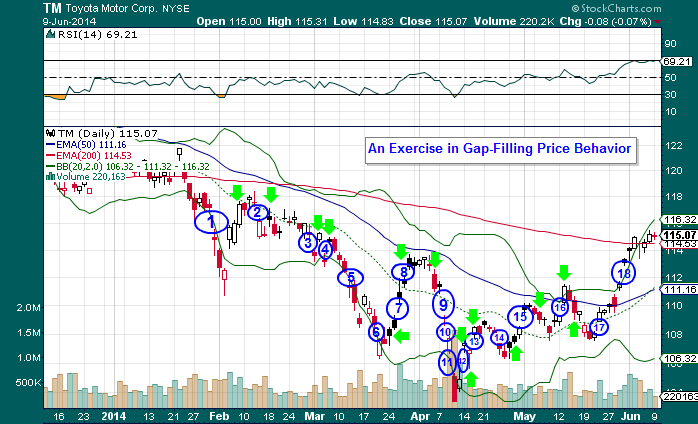
Way back, as in a year ago, I provided an opportunity to short Toyota. It was a nice, profitable little trade that paid off immediately. For such a steady behemoth of the automotive world, Toyota tends to consistently present tradable short-term set-ups despite any prevailing macro-outlook at the time.

The pattern set-up is simply an exercise in gap-filling since the end of January. That’s it. No long-term backtesting of the pattern, which means that I’m not calculating probable odds with any statistical significance what so ever. In fact, it’s simply a read of the tape with a tight stop. Have a look at the chart. You’ll observe that since January 31st, TM has “gapped & filled” fairly quickly on 16 occasions(gaps at blue circled numbers – fills at green arrows). I may have left out a green arrow or two but the chart is convoluted enough. You get the point. A fill on gap numbers 17 and 18 is what we’re playing.

clip_image001

Shorting here at $115 with an expectation of a cover at $108. I leave it to the traders out there to calculate your own risk/reward numbers. We have a price behavior that has proven to occur 100% of the time, at least since the last day of January. Keep a stop of 10% to be relatively safe, which would essentially stop you out of the trade if it goes against the prediction and breaks out past the key number of $125.

You may be thinking that shorting here for a $7 move downward may not be worth the risk. A 10% chance of loss for a potential gain of only 6%? What gives? You can tighten the stop if you absolutely have to skew the risk/reward ratio in your favor. Let’s say the trade hits the objectives in 60 days. That 6% return on the short annualizes out to a 42% return. I think any professional trader will take 42% annual returns any day of the week.

There is of course the leverage of options, which is how I’ll personally play the set-up. I’ll leave you to your own personal devices when it comes to option strategies. Sorry. I ain’t Greg Harmon over here, throwing out Calendars, Spreads, Strangles, and Butterflies. For those that play the option game, do your thing. For those that don’t, stick with a simple short of the shares or perhaps buy a basic Put with an October strike, although beware the lack of a hedge on a straight Put purchase.

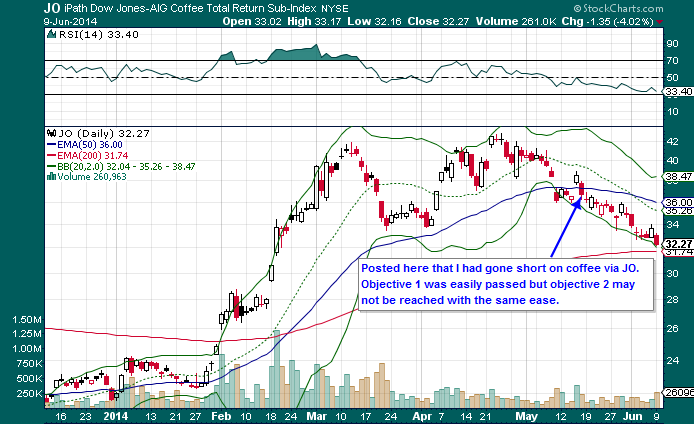
It is possible to go short in these markets. Dangerous, but still possible. Recall that I went short on coffee a couple of posts ago, on May 16th. Of course coffee is a commodity, but I used the ETF proxy.

clip_image002

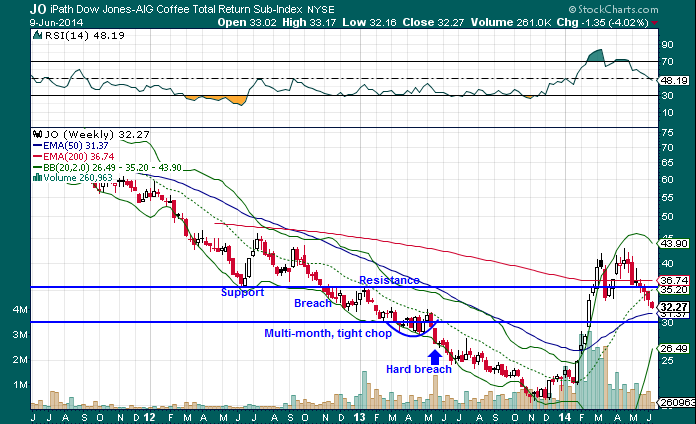
In initially determining my price objectives for the short, I utilized a weekly chart. Observe the chart below for the basic presentation:

clip_image003

And for you Fibonacci retracement addicts, using the weekly low off the first week of November, then 31.8% is $34 and change while $30 is tightly in between the 50% and 61.8% retracement levels. I felt safe in using $30 as a round number objective, especially in light of the high open interest at the expiration month for the primary asset in my own play. Coffee may retrace all the early 2014 gains in a full construction of an Eiffel Tower. If you’re in the coffee short then adhere to your risk parameters and enjoy the profit.

Getting back to Toyota, trading in a low volatility environment can be dangerous. I think there’s enough volatility in Toyota’s tape to warrant the short. As with a lot of trades, you risk a little to fill your pockets with some change. This trade is one of those singles that people forget to swing for after striking out for the umpteenth time on a grand slam attempt. Please visit my disclaimer before leaving and taking any action. Good luck out there.

Triple Top Into the Chop & Drop

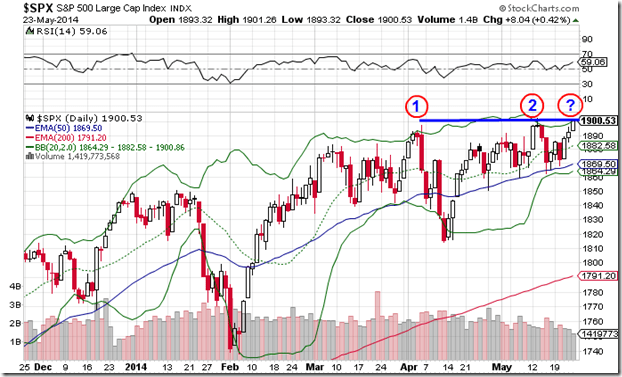
I hate to keep writing about corrections and being a fear mongerer. At this point, it’s pretty useless as the S&P 500 stays constantly bid under all conditions. The last little correction lasted a week exactly and took the SPX down approximately 4%. Before that was the approximate 6% correction we saw from January 23rd to February 3rd. That was 11 days and a casual observer of the market would have thought the rails had come off of everything the way sentiment crashed so quickly.

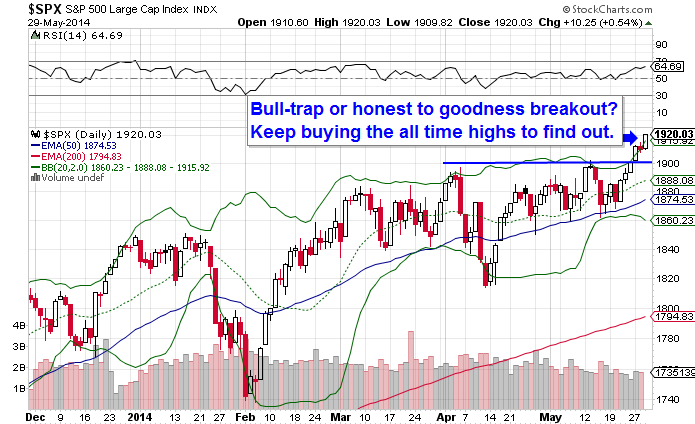
Honestly, I’m getting tired of hearing myself with the correction talk, so this will be my last post regarding correction or downturn talk for a little bit. I’ll find something else to entertain and possibly inform you with, because this subject is tired. Especially, when you consider the following charts. I originally titled this post as I meant to write it several days back, when the SPX looked like this:
clip_image001

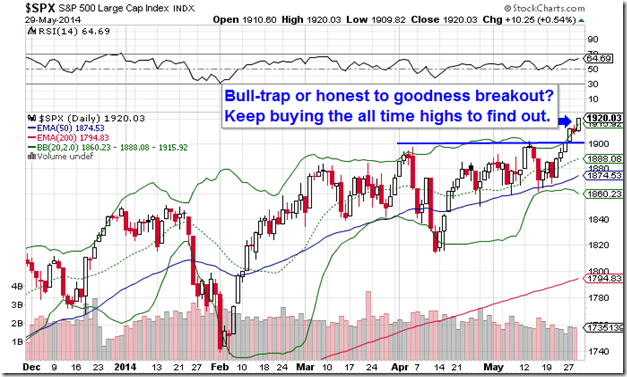
However, we seem to have experienced a “clear” breakout so we’re not technically talking about a triple-top anymore…unless it’s a bull trap. Is it a bull-trap? Hindsight will inform us. In my humble and probably very ignorant opinion, I think it’s a bull-trap. There’s just enough buying power left to draw in some last suckers before corrective action. It’s not unheard of for a third top in a triple top to be higher than the first two. The tape shouldn’t be ignored but neither should the myriad of signals running counter to the tape.
clip_image002

Of course, I could be wrong. I’ve been early to the short party before, and I took a couple lumps to my account and ego for being a wannabe, turn-calling notshot. I maintained tight stops so the damage was minimal, but top calling is a suckers bet that continues to be fun to make.

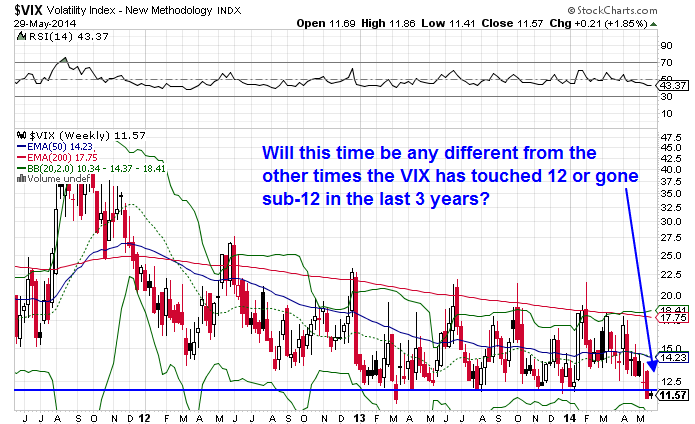
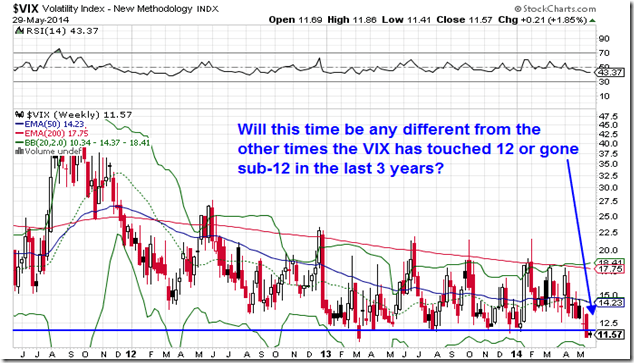
Complacency is the topic du jour around the financial blogosphere and professional commentaries. The VIX pushed under 12, as denoted by the blue line in the following chart. Recently, hitting or going sub-12 tends to be a precursor to a spike in volatility but it is far from indicating a definite, imminent move.
clip_image003

Many commentators and “experts” have been turning to more esoteric signals to ensure that the S&P 500’s new highs are a “legitimate” breakout in a positive trend. For the record, I happen to really enjoy and appreciate the consistently insightful commentary put out by the three sources I’m about to list. All the same, have a look at these 3 articles:

1. Chris Puplava – http://www.financialsense.com/contributors/chris-puplava/further-signs-market-bottom-building
2. Bespoke – http://www.bespokeinvest.com/thinkbig/2014/5/30/long-term-vix-chart.html (no mention of unprecedented easing the last 6 years)
3. Tom McClellan – http://www.mcoscillator.com/learning_center/weekly_chart/equity_options_vs._index_options/

Maybe it’s my lack of statistical sophistication or inexperience in professional money management, but these 3 articles seem to be really stretching for evidence that a significant correction is not going to occur this summer and the breakout in the S&P 500 is 100% the real deal. I like to keep things simple, by observing the obvious signals. Market leaders at the time(biotech and small caps) broke down several months ago. Now they’re retracing to perfectly natural Fib. areas before potentially continuing downward which I think will have the effect of finally pulling the S&P 500 with them. Volume is anemic. The VIX is saying, “Wait a second here.” Is it because it’s the start of summer? All sorts of economic indicators have given a red light or at least a yellow light, despite all the cheer leaders. High yield fixed income keeps getting bid higher and higher with no downturn in sight.

So many signals are readily apparent but we still need a trigger. In my last post, I thought that the high yield bond market may be the catalyst for a downturn in the S&P 500, but maybe it just finally gets pulled down with the risk indexes without junk correcting. What will the trigger be? Who knows? It could be anything. Maybe we get some sort of sell-off in another asset class causing a fixed income dash to cash, with the best returns being locked in from their high yield segments. Geopolitical activity may induce fears, although nobody in the markets seems to give a damn about the chess moves conducted by Russia or China. The markets continue to confound even the savviest.

“YEAH, YEAH, YEAH! We’ve heard all this non-sense in your last post! How does this apply to AND what the hell is a “chop & drop?”

Well “chop & drop” is a pattern that is seen typically before major dislocations. John Hussman, Ph. D, who is consistently labeled as a perma-bear and broken clock, generates very good and widely read commentary that does skew to a negative outlook. He just calls it how he sees it based on his extensive research. Everybody’s got an opinion. It’s just a matter of whether you value it or not. I happen to value his commentary, but I don’t base my decisions on how I speculate by any one market commentator. It’s all about taking in as much as possible from as many credible sources as possible to assist one in firming up their own mental picture of the state of things.

Anyways, he put out a piece recently titled, The Journeys of Sisyphus. Have a read if you’re in the mood for some confirming of your bias to your own negative outlook. In the piece he produces several Dow Industrial Jones charts leading up to the major downturns of the last 85 years. For the record, he did not comment on any chopping and dropping in the post. I only reference his work because of the charts. My commentary is in no way affiliated with Dr. Hussman, nor has he endorsed this post in any shape or form.

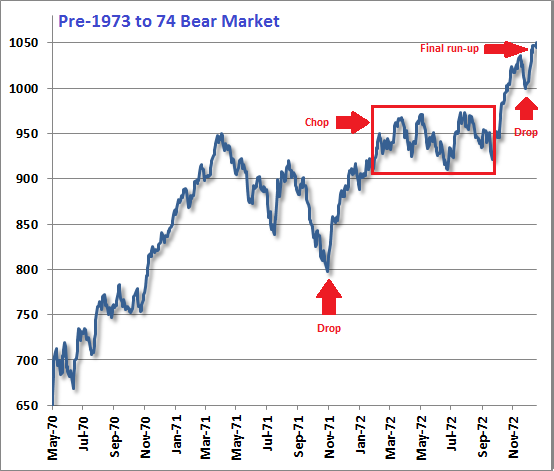
The first chart obviously displays 1929. In it you can observe the pattern of a notable correction with a recovery into some sideways chop followed by another notable correction leading into a final, euphoric run-up. This pattern of “chop & drop” almost always occurs in the final two years.

clip_image004

Before presenting the rest of the charts, I am fully aware of the human brain’s abilities in the area of pattern recognition. It’s one of the distinguishing factors of our intelligence as a species, and is a key differentiator from the unevolved brains of other species as well as machines…for now. These set-ups could just as easily be illusory conjunctions of patterns established by a biased mind attempting to create the ability to foresee market outcomes. In other words, I could just be full of it. Believe me, I get that. I’m still going to present the rest of the charts and you the reader can establish your own outlook.

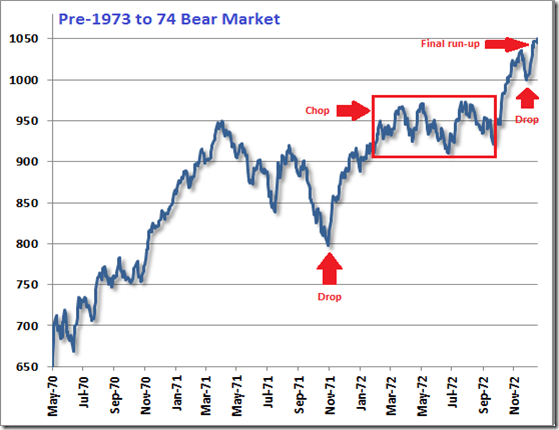
Here in 1972, we have the “chop & drop” but with a pseudo final run-up to sort of fakeout speculators. Compare this to 1929 where the chop went right into the final drop.
clip_image005

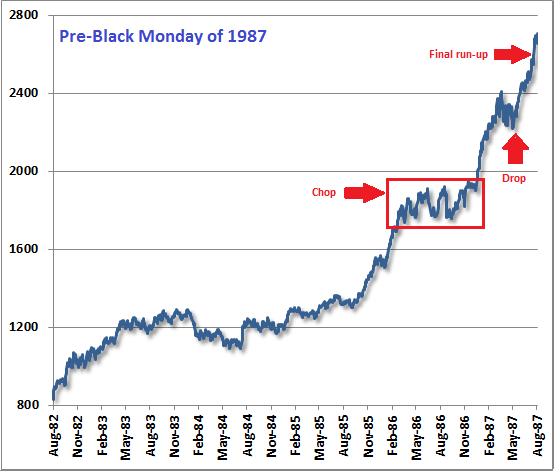
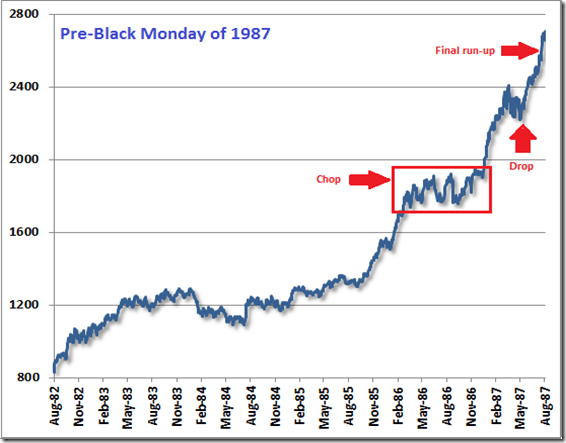
The action in 1987 lacked an initial heavy drop and recovery into the chop. Instead prices consolidated(or chopped) until that first drop before the extremely euphoric run-up prior to Black Monday.
clip_image006

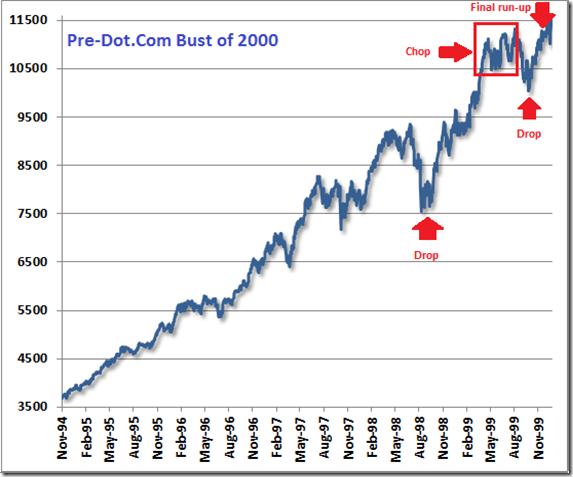
Finally, we’ve reached a time where a majority of readers may have actually had some money in play. The bust that started it all for a lot of us, the Dot.Com bust.
clip_image007

In 2007, the action was tight with the chopping and dropping occurring in less than a year. The outcome was still the same, a mega bust. In fact, if you think about the action of the dislocation it was kind of tight, too. All the action was essentially squeezed into 2008. Yes it began in November of 2007 and bottomed in March of 2009, but the real gut wrenching, heart breaking action occurred in 2008.

clip_image008

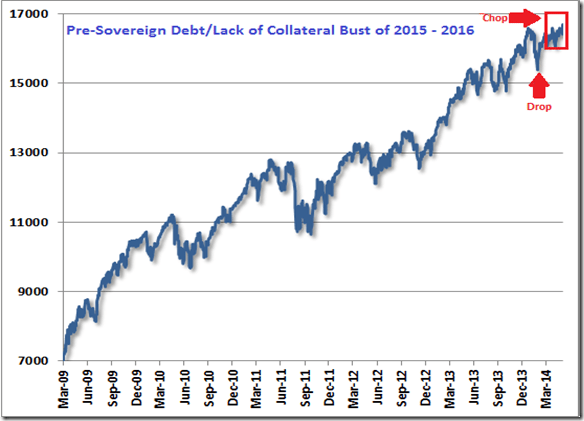
And finally we come to the present, 2014. Now remember this whole exercise is pure speculation, but what I think we saw in that 6% correction in February was the first drop. We already recovered and have chopped along since then. At some point in the summer we could then move into a more serious drop of at least 10%. I suspect this may signify the last major drop before recovering into the final euphoric run-up which could last into 2016 before a major dislocation.
clip_image009

Of course I run the risk of being wickedly wrong. But as I provide these posts free of charge and I do not manage money professionally, I’m ok with sticking my neck out and assessing the cycles of fear and greed as such. There’s no career risk. As for reputation risk, I’ll wait till my small following of readers can no longer be labeled small before I worry about my street cred.

Just for kicks, here’s some statistics and notes regarding the Triple Top pattern from forex-tribe.com. It’s a good site to use for a little education into basic technical analysis patterns. However, they do not list where they obtained their data and how it was quantified. I was reluctant to even share it, but it’s just for kicks. If you’re relying on old school patterns without quantifying risk and reward ahead of time, well then shame on you.

Alleged triple top statistics:
– In 85% of cases, there is a downward exit
– In 50% of cases, the target of the pattern is reached once the neckline broken
– In 84% of cases, a pullback occur
– In 85% of cases, there is a pursuit of the movement once the neckline broken

May closed out at a one-year high for the S&P 500. This is a very, very infrequent event; which is why the cliché “Sell in May and go away” even exists. Don’t be surprised if May selling just gets pushed back to June and July. Do not take your eye off the ball for any reason out there if you’re aggressively trading. For you long money players, take some time to consider the charts we reviewed today.

Don’t discount that sovereign debts are at all-time highs across all the developed nations. Don’t discount that every major economy is monetizing debts or manipulating currencies via swaps or taking some other related action to sway economic activities. Don’t discount that credit derivatives exist in the hundreds of trillions with multiple collateral lines traced to multiple counter parties amongst the holders of said derivatives. Don’t discount negative GDP reads in developed nations. Don’t discount anything. Nothing is what it seems in the markets anymore and it could pay big to be prepared well in advance of what historical price action has already told us.

I’m signing off but before I go, the biggest laugher of the week has to be that Italy and Great Britain are including prostitution and illegal drug sales in their respective GDP calculations. Seriously, you just can’t make this crap up anymore. Good day.
Whipsaw, Whipsaw

MAN ALIVE! That action on Monday is enough to make a trader fold up operations and go back to counting beans or selling un-needed crap to folks. That was seriously some hair-raising action. Did you get your stops ran? Did any of you traders get whipsawed by Monday’s action? Rest assured, you probably weren’t alone.

If you’re attempting to go short here across any of the indices and had your stops ran on Monday then kudos to you for maintaining discipline. However, you just may be missing out on more of the fun of a potential downmove. Hard to say because my crystal ball is in the shop and for some unforeseen reason I’m not omniscient. It really makes me mad that I can’t call the exact turns of the market. Oh well. I still think a downward short-term bias is in effect and eventually the perceived risk indexes(Russell 2000 & NASDAQ) will finally pull down the “Great Proxy”, the S&P 500.

So far, so good for the S&P 500 as it set new highs this week…and has promptly come off those highs. Is that strong price momentum? Have a look at the daily action in the VIX. It gapped down to start the week and within 3 days that gap has filled, but still yet, the VIX is still down around all-time lows.

clip_image002

The MACD has been a pretty simple and fair indicator to clue traders in when the volatility is going to start spiking. Observe at the green lines that every time the MACD turned upwards, the VIX was usually in the early stage of an up-move. Are we at another up-move right now? It feels like it. If things get dicey, a quick move up to 20 on the VIX could easily occur.

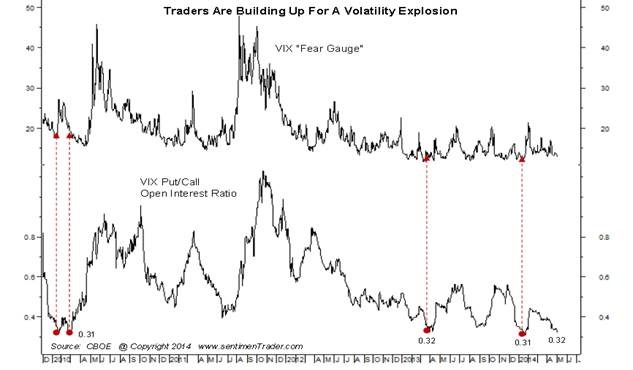
A couple of weeks ago, SentimentTrader shared a chart depicting the VIX Put/Call Open Interest Ratio. It puts on full display what the current option action on the VIX is saying about volatility. Judge for yourself:

clip_image004

There are plenty of messages being communicated very loudly and clearly by the markets. These aren’t esoteric signals that only the true professionals can divine. Anybody with the ability to read and some dial-up internet internet service can see these messages…more power to you if don’t have to result to a screeching connection via Juno or NetZero or whoever the hell provides dial-up these days. Also, to any readers who currently utilize dial-up to access this blog, please excuse my insensitivity.

Things are happening in the markets such as defensive rotation. Utilities have performed fantastically so far the past few months while the rotation to staples vs discretionary appears to have begun. Less and less issues are hitting 52-week highs despite the DOW and S&P 500 sitting near their own highs. Treasury rates continue to drop. Wal-Mart missed fairly big on YoY Q1 income. High-flying tech and small caps have already come off pretty hard and these are where the risk is allocated. Social media sites trading at P/E’s in the multi-hundreds. Biotech stories being sold on a wing and prayer for ridiculous valuations.

High-flying tech and small caps are part of what I call the 3-legged risk stool that are sort of propping up the animal spirits of the entire, current stock market. Two of those legs have been kicked out, so to speak, and yet still the S&P 500 hasn’t really shaken out the bulls. The third leg of the shaky risk stool and thus potentially the ultimate catalyst for a correction in the broader markets is junk bonds, I suspect.

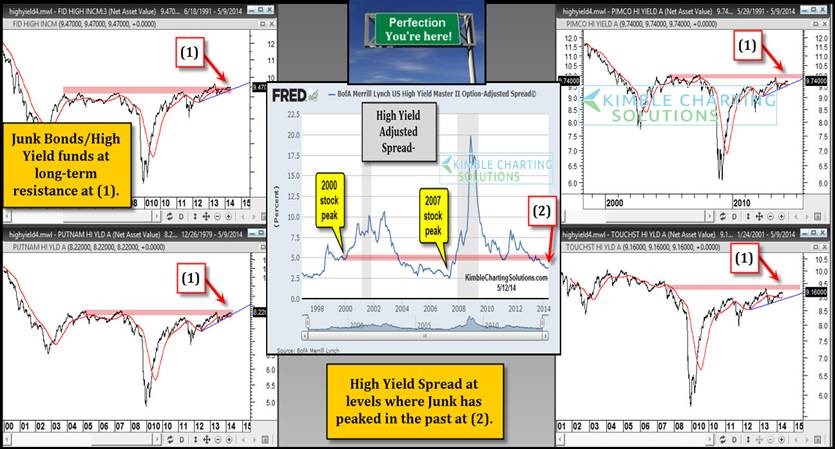
If junk bonds correct here within the next 14 to 60 days, with remaining weakness in the NDX and RUT, then things can get real hairy, real fast for people who are poorly positioned for the move. Have a look at what Kimble shared over at his site a few days ago,

clip_image006

So then what could be a catalyst besides stiff resistance? Oh I don’t know. Maybe the humongousest junk bond issuance in financial history. Anybody remember seeing this near the end of April?

clip_image008

The markets have a funny tendency to act a little wonky after the largest-ever of anything occurs.

The action this week has that sort of a backdraft feeling to it. In case you never saw the movie, a backdraft(as defined by the Collins English Dictionary) is “an explosion that occurs when air reaches a fire that has used up all the available oxygen, often occurring when a door is opened to the room containing the fire.” Buyers potentially get a final pull into risk assets before an explosion outwards for a fast and hard move down after the right catalysts make their presence known.

Despite the already well covered move down in the Russell 2000, it appears as if there is plenty of room for a continuation downward. If you’re trading IWM, then keep your stops at an appropriate level. Biotech’s IBB essentially bounced off it’s 38.2% retracement using the week of August 8th, 2011 as your starting point for a quick Fibonacci analysis. A cautious short in IBB with the potential for further selling down to between $200 and $205, may yield a nice return during this summer. In a previous post, I had stated that I thought coffee was setting up for a short but my favorite indicators were not providing a green light just yet. Well those indicators finally gave their green light. If you’re feeling brave you can follow me on a short of JO with approximate targets of $35 and $30, if the selling momentum really gets going.

The list of investing icons who are advising caution continues to build. We’ve had mutual fund heroes like Romick of FPA and Yactkman share their thoughts months ago on building cash levels. Klarman, Marks, and Grantham have given the thumbs down. Now we had David Tepper, Mr. Highest Paid 2013 Hedgie, providing his valued insight on these precarious markets. It may not pay to listen to or heed a blogger like myself. That’s for you to decide; but you can’t dispute that it pays to heed what these most esteemed gentlemen have to share.

The Potential Depth of the Corrective Action

Markets’ darling leaders sell off? Check. Defensive sectors rotate up? Check. Seasonality coming into play(if you believe such stuff)? Check. S&P 500 VIX spiking? Not check. We have yet to see the S&P 500 really start to come down off its highs for the year just yet. Although, the market action has probably felt terrible for those heavily weighted to the NASDAQ, we have yet to see some heart-wrenching downside action in the S&P 500.

SentimentTrader just shared a note about the lack of volatility in the VIX and the downside potential in the S&P 500, “There have only been two other times in the past 20 years that the Nasdaq Composite had dropped more than -8% from its 52-week high, but the VIX “fear gauge” was still below 17.5, a scenario we have now. It shows relative complacency in the face of a sell-off in higher-beta stocks. Those two occurrences were March 28, 2002 and May 15, 2008. The S&P 500 sold off more than -15% over the next three months both times.

As usual, the statistics suffer from a small sample size within a relatively short period.

However, the facts are the facts.

Add in that earnings season has been off to a fairly weak start and you have that much more evidence to make you pause and consider before allocating more long capital right now. For any readers who are EPS hounds and swear that stocks always follow earnings, here’s a snapshot courtesy of Thompson Reuters’s Alpha Now that also supports a pause in the action through the spring and potentially summer.

S&P 500: EARNINGS AND REVENUE GROWTH TREND

clip_image002

And to keep my confirmation bias fully intact, here’s a snippet from Louise Yamada courtesy of CNBC. I can’t believe I’m quoting material from the hack-shop CNBC, but Louise truly is a legend in the institutional research side of technical analysis. Anyways, she states, “I don’t think the pullback is already over. I think that it’s an interim pullback, and we’ve certainly seen what we’ve expected, in the Internet and biotechs coming off. And I think that although they may bounce, there’s probably still a little bit more to go on the downside…If we break that level(1,750 on the S&P 500), that will be the first lower low that we would have seen all the way back to 2011, really…Below 1,750, support lies at 1,650.

If we hit that 1,650ish area, then that’s approximately 10% to 12% off the highs for the year. But who’s to say we have to have a minimum 10% correction? I’ve been calling for that level of correction to clear things out a bit in the market. Many other commentaries have also focused on the need for at least a 10% correction in the S&P 500 to work off overbought levels.

Richard Dickson, Chief Market Analyst at Lowry Research, recently gave an interview at FinancialSense.com providing his outlook on the “need” for a correction of at least 10% in the S&P. If you’re unfamiliar with Lowry Research, they are one of the true OG’s in the game of institutional level technical analysis and the oldest firm in the US to provide such services. Dickson stated that:

We’ve already had two corrections well over 10% from 2010 to 2011 in this bull market and, historically, if you go back and look at the various bull markets and use the Dow Jones on a closing basis, we’ve never had more than one 10% correction in a bull market… Since 1940, we’ve never had more than one, so this has been a little unprecedented in the fact that we’ve already had two. So, to say “well, we need another one”…my response to that is we’ve already had two, how many do you want?… As things stand right now, any pullback, whether it’s 5% or 10%, in our opinion, would simply be a buying opportunity.

So there you have it. Buy the dip according to Dickson.

Still though, want some basic ideas on how to play some downside action? Buy VXX or leverage it up and buy some Calls on VXX. You can buy some Puts on the SPY or eliminate the risk of purchasing the optimal option and purchase the 3x leveraged SPXU from ProShares. It may be a little late, but utilities ETF’s such as XLU have been the home of the defensive minded for several weeks now. The typical disclaimer applies regarding your own trades.

I intended to share some thoughts and charts on the serious distortions to the financial landscape, as stated at the end of my last post. My apologies but you’ll just have to wait till the next post again, where I will definitely talk distortions. I promise. Bis spater.