Look For The Wick

I have come to utilize charting techniques less and less as their ability to help handicap asset price movements continues to wither away.

You’re either trading algorithmically in front of the market or you’re a trading loser.  Every single chart pattern and set of indicators in every conceivable combination has already been mathematically expressed by people smarter than technical analysts, and easy profits have been completely arbitraged out of the market from visual chart cues.

There will always be pockets of sheer luck.  There are always exceptions.  But earning consistent profits on price/indicator pictures…get real.

I have come to rely more and more on fundamental analysis, experience (see “gut”), and semi-quantitative tools to manage the risks of trading capital.  Like a degenerate heroine addict, I still chart.  I’ll never give it up, but it’s just another input.  Mostly noise.  Sometimes valued signal.

Despite all that, here’s one visual cue I think a lot of professionals are probably waiting for and that is a second long-stem on the S&P 500.  It could potentially indicate that risk appetites have returned.  If the HFTs see this then we could see a “schooling” move upward, like fish or a flock of birds, as the programs feed on each other’s momentum calls.

Take a look to better understand.  We are looking for a 2% to 3% wick below the weekly closing price.  That’s it.

Everybody's Waiting for a Stem - SPX (3-28-2018)

That might be all it takes to re-engage risk taking.  Not without increased volatility, of course, because liquidity is draining and conditions are tightening.

Flat or Bumpy: Choose Your Own Adventure

                                                                     The Abominable Volatility

Last week’s “whopping” 1.8% selloff on Wednesday shocked market players but was also blown way out of proportion.  The selloff also presented a nice little set-up to possibly scalp a few bucks out of the market over the next week or two.

Was Wednesday’s price action a precursor to some further weakness?  Or was it a one-inch pothole in the continued advance of this bull?

You choose the trade.  For you children of the 80’s, remember these books?  Hours of time wasted flipping back and forth as the protagonist.  The book reference is a good metaphor for the current state of the US stock markets.

                                            Volatility Hunter                 Don't Bother Trading

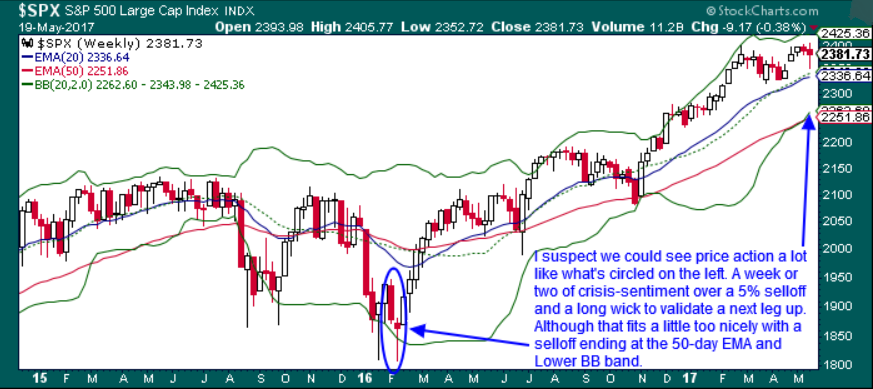
As I see it, the price action is saying we’re in for another little move downward.  I suspect no more than 5% down to around 2,260 on the S&P 500.  In the chart below, I’ve circled and described what I think can happen.

SPX Weekly (5-19-2017)

The recovery on Thursday and Friday are just small snapback moves for the real players and market makers to close out certain positions with a more positive effect on P&Ls.  Then the rug get’s pulled out from the crowd in a panic-inducing 5% “real” selloff.

This is just what the price action is telling me.  I’ve arbitrarily assigned a probability and bet (regional banks) and hedged (volatility) accordingly based on nothing but my hunch.

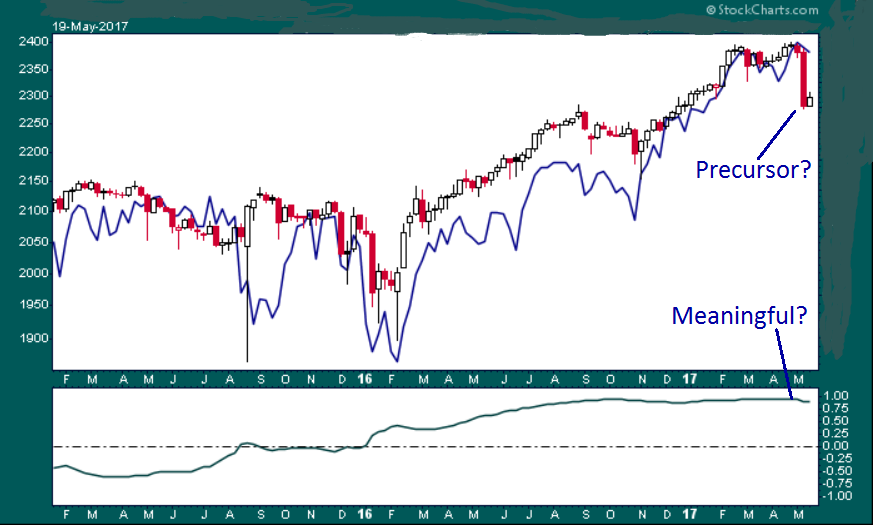
Incidentally, my old friend in the credit department thinks there’s room for a little further downside in the larger market.  Below is the chart of the action of what the credit-friend thinks.  Notice the tight correlation between the S&P 500 and my credit-friend.  It’s only over 90% positive, so maybe it’s nothing.

Friend in Credit (5-19-2017)

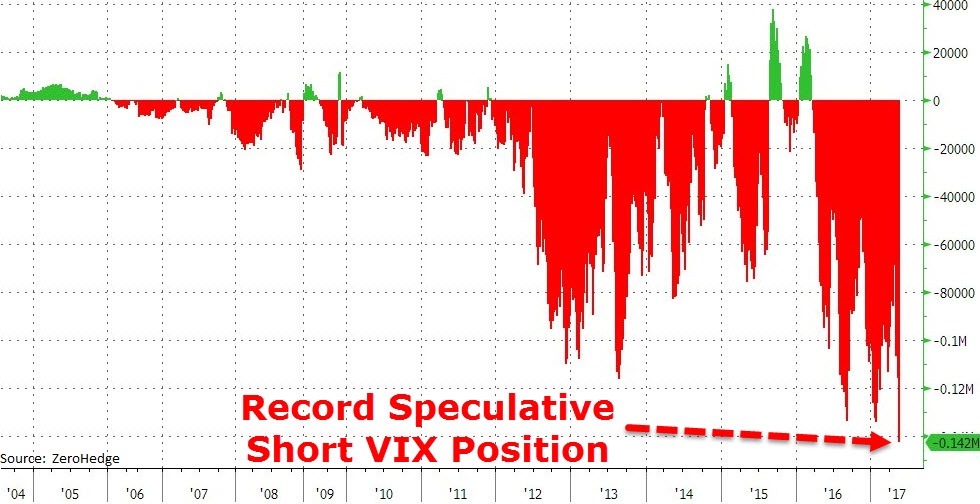
Besides my friend in credit, there is the alarming increase in vol shorts.  Or maybe the crowd is right.

VIX Shorts - ZH (5-21-2017)

To scalp or not to scalp?  You choose your own trading adventure the next couple of weeks.

The Last Gasp

As you know by now, I think we are in the final stages of the topping process in major markets.  This is going to be a multi-month affair.  I suspect the top and crash begins later next year, but so do many other pundits, pros, and bloggers which makes me leery.  There’s nothing worse than contrarian consensus by large groups in the game of speculation.

Like its predecessors, the crash won’t look like one at first.  Sure, players will get scared and react but then we’ll see a bounce off the first initial move to the downside.  This will be an opportune time to liquidate positions to make a final cash raise to either capitalize during the crash or wait for the inevitable value opportunities that will arise.

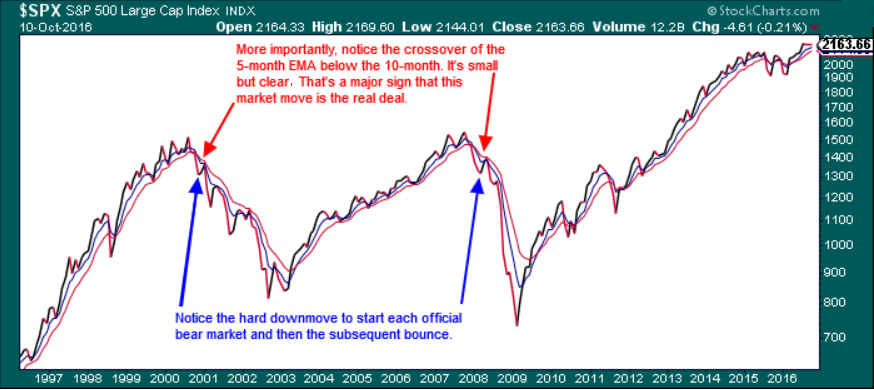
There is a set of indicators that go along with this move downward and bounce that has proven efficacy as a guide.  It’s the 5 month and 10 month Exponential Moving Average (“EMA”).  Observe.
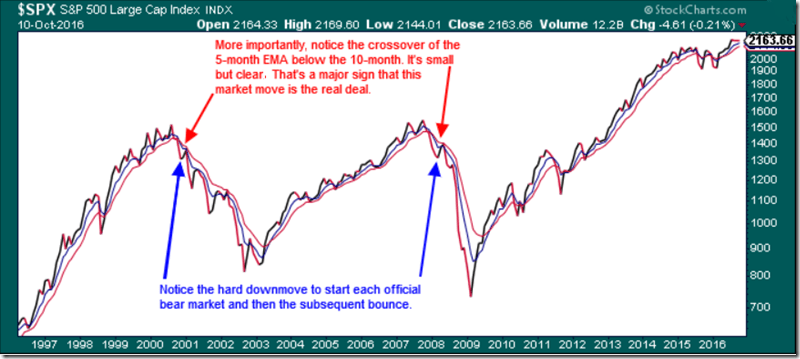
SPX - 5 & 10 Crossover (10-10-2016)

These aren’t magic indicators.  I’m not saying they are guaranteed to work.  I’m only saying they’ve proven themselves as guides when a real bear move has begun.  There are a multitude of economic and financial indicators that I also like to use along with anecdotal evidence, too.  Keeping an eye on this particular set of EMAs however can potentially keep your losses to between 10% and 15%, assuming you act.

In a bear market where there’s the potential for a halving of portfolios, I’d say 15% in losses is solid.

Volatility in the biggest asset classes will be unimaginable.  The algorithmic, high frequency trading operations in combination with central banks have broken all markets.  There will be no liquidity for the big timers when the bear begins.

HFTs are the true market makers and all algorithms are written to pull away and sell when bottoms fall out of markets.  Look at the S&P 500 in May of 2010.  That was really the first indication that markets would never liquidate in a typical fashion ever again, until HFTs are properly regulated, taxed, or removed from existence in markets.

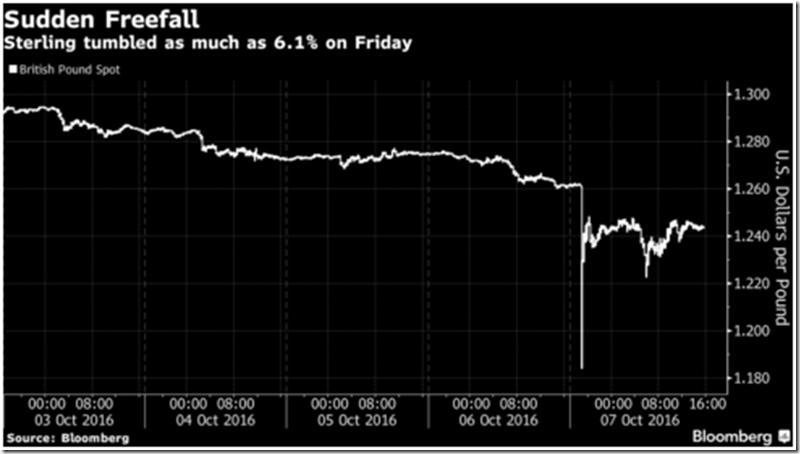
There are plenty of examples between May of 2010 and now, but the move in the pound sterling at the start of October provides such a fine illustration.  What’s more liquid than the currency markets of the most developed and powerful Western nations?

Nothing.  And yet still we see the destructive power of HFT on any market.  Does this look normal in a power currency?

Sterling Madness (10-16-2016)

In earlier Asian trading, the intraday damage was even worse.  Observe this bit of madness.
image

These moves are a product of liquidity being immediately vacuumed from the asset classes where all the largest players play.  This will happen again and again when the markets make their final turn.

You can liken it to a hull breach for an astronaut in space without a suit on.  One second astronaut HYG is floating around the lab in a jump suit, happily conducting experiments with OPM.  But OPM in high-yield instruments in a low-yield environment can be a volatile material if not handled appropriately in a proper setting and an explosion occurs breaching the hull, sucking HYG out into the liquidity-free vacuum immediately to death.

Did I say liquidity?  I meant oxygen.

You get the point.

Coming back to what a last gasp means; it means there will be a final run in risk assets to squeeze out the final profits of this bull.  Many, including myself, have called it a melt-up, but I grow weary of the term.

Please don’t be fooled by some of the ignorance being freely proffered out there that we are in the early years of a cyclical bull, similar to 1982.  We are not.  The evidence is broad, clear, deep, and obvious.  One needn’t a fancy finance degree or years managing wealth in order to see this.

The end game is here, but not before that last gasp for profits that I keep describing.  I suspect that many of the sectors that powered this bull market prior to 2016 may reassert themselves to take us home.  Why is that?

Interest rates.  Plain and simple.

Those with access to leverage at these historically low rates will borrow capital to fund buyouts and takeovers which will drive asset prices upward.  The upward move will then draw in speculators looking to hop on the trend or front-run it.  This quest for yield whether in debt, equity, or private equity i.e. IRR, will be the fuel for the last gasp up in asset prices.

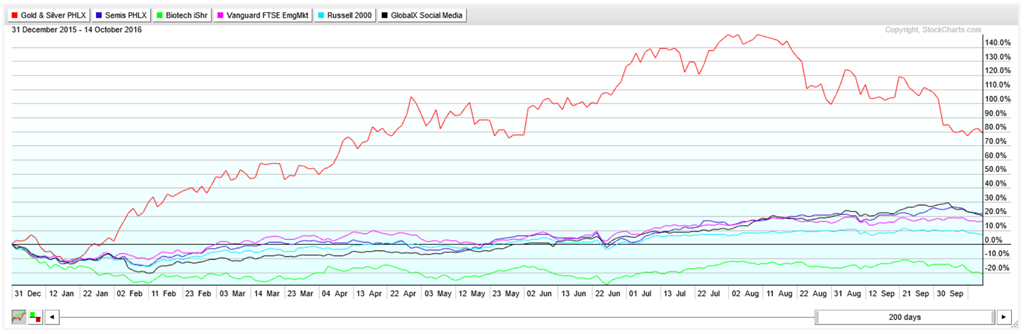
Despite what I think may happen in semiconductors or social or biotech or emerging markets as risk-on gains speed, keep your eyes on the one asset class that has taken out all comers in 2016.  The Rocky Balboa asset class for the year.  You know what I’m referring to and this is even with the recent sell-off.

2016 Performance Chart (10-16-2016)

Precious metals.  You don’t have to love them or hate them.  Opinions don’t have to be binary.  Be agnostic when speculating.  Follow the trends.  Follow the money.  More importantly, follow central banking and political lunacy.

Let’s look at one more chart that potentially validates that this bull market is long in the tooth.  It depicts the times over the last 50 years when payouts to equity investors have exceeded  profits.

Total Payouts via ZH (10-11-2016)

You can ignore what is glaringly obvious or you can prepare.

Speaking of obvious, let’s begin to wrap this post up with another pithy little ditty of a quote, this time from one of the world’s great speculators.  It’s been reprinted time and again, but it’s simple yet brilliant message is timeless.

I just wait until there is money lying in the corner, and all I have to do is go over there and pick it up.  I do nothing in the meantime.

– Jim Rogers

I haven’t touched on trading since the summer and I just wanted to share some set-ups that appear to potentially be building little piles of money in a corner waiting to be picked up.

Keep an eye on these sectors, either short or long:

Short:  sugar, energy(big 3), US dollar, and technology

Long:  grains, bouncing precious metals, and the pound sterling

Despite your opinions, never forget about counter-trend rallies, even in the face of what appears to be an unstoppable trend.

It’s Like the Old Days in Commodities

For the traders out there, action in commodities has been highly volatile presenting opportunities as if it was the 80’s.  Basic technical analysis has been rather effective, especially within the softs and agriculturals.  Now the precious metals swell appears to be breaking, if only to regroup for the next move

It’s important to remember that large-scale traders and high-frequency traders are the beginning, middle, and end when it comes to trading.  Not only do they control breakouts and breakdowns, but they often make the market, too.  It’s important to exercise patience before positioning into a play.  Before a larger breakout or breakdown is firmly established, there can be see-sawing volatility that can jar traders out of position.  Patience allows you to skip a few waves before finding that swell you decide to ride.

What’s been hotter than the precious metals or related investments in 2016?  Not a whole heckuva lot, and silver has been on mad recent run but price action says it’s time for a pause.  The price of silver has already started turning over the last two weeks.  Because of the intrinsic volatility in the metal, it could be a quick ride down to the breakout point around $17.75.  I think this breakout in the precious metals is the real deal and I suspect we could see a sort of V-bounce right back up to the two-year highs once the breakout point is retested.

Silver Weekly (7-21-2016)

One of the calls I made in my last post was that sugar was looking blow-offy.  I wasn’t precise on the timing but clearly the action is looking corrective.  More importantly, the price action has been controlled to squeeze final long-profits and allow positions to be lightened.

Sugar ETF Weekly (7-21-2015)

I think sugar’s action could go one of two ways.  One, it could be like in the chart above where we see a downmove and then a bounce where final profits are taken and it gets sold off pretty hard down to a natural support point.  Or the market-controlling speculators could just sell the sweet stuff down in a hard, volatile move.  My gut tells me the first option is the probable play.  If you haven’t positioned for a sugar short, there’s still time.

Trading intense moves in an asset class is a lot like trying to catch a metro train.  You may have missed it going away on a long, but you can always catch it when it comes back on a short.

I don’t know nor can I explain why basic resistance/support chart analysis has been working so effectively since late 2015.  Maybe it’s the patience.  Maybe I’ve learned to read the action with HFT-tinted glasses before executing.  I don’t know.  All I know is that I don’t feel like I’m doing a whole lot different from most other years, but 2016 has been one for my own trading record book.  Who knows?  Maybe that whole 10,000 hours thing actually means something.

Let’s take a final look at bonds.  They’ve been driven up right along stocks.  In a bizarro turn, American equities are being viewed with virtually the same risk premium as corporate bonds and even treasuries, primarily because of solid credit ratings coinciding with high relative yields and developed-world central bank backing.

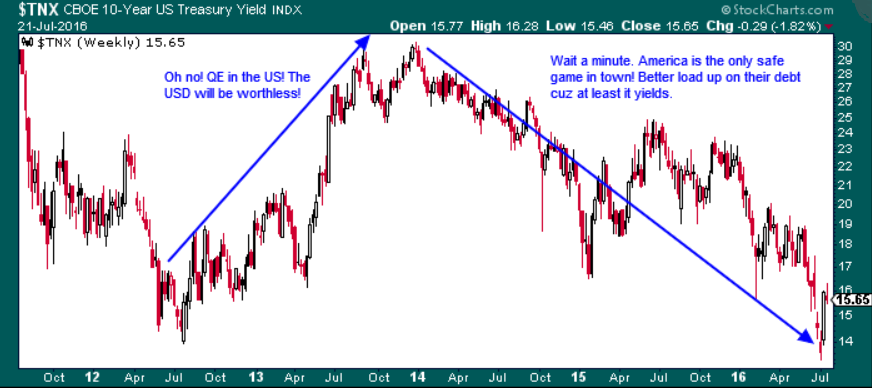
However, the boat is awfully crowded on the one side of interest rate direction.  The world has negative rates everywhere.  The crowd thinks there’s no way rates can move upwards just because the central banks are not in a position to act.  That is fallacious logic.  Observe:

10-Year Yields Weekly (7-21-20156)

Remember, the Fed’s final QE announcement in 2012.  You see that upmove in 10-year rates?  That was a market-driven move, not Fed-driven.  And yet money is allocated today as if there ain’t no way the market can drive rates up again in any sort of treasury selloff.  There is a widely held belief that American debt is one of the only pure safe havens, and it is to an extent.  That doesn’t mean that market controllers won’t inflict maximum pain for bettors letting their guard down.

We’ve already seen a sharp move up in rates recently.  Is there more to come?  I’d bet that the odds favor a continued, but possibly choppy ascent in interest rates.  This provides logical plays shorting TLT.

It’s not just developed sovereign debt that has seen a run.  Corporate debt has been plowed into as well.  Trading the exuberance on US corporate debt is as easy as some puts on LQD.  Have a look at the upward spike since Brexit:

LQD Weekly (7-21-2016)

LQD is already beginning to turn.  It may not fall down to support but hedging within a structured option play is well documented and easy to execute.

For my few followers out there, don’t give up on me.  I’ve been extremely busy with very little personal time.  I hope to post more regularly in H2 of 2016.  Have fun out there with your money.  Just don’t blow it.

When Last We Was Trading…

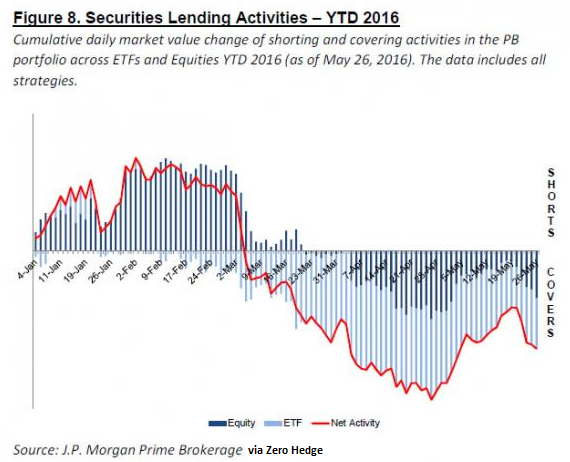
…I’d shared some thoughts on trading volatility and the action of the S&P 500. I was right about the down-move in the S&P 500. I thought a small move was possible of no more than 5% and a 3% percent move down is what we got, then a continuance of the sideways consolidation. However, I was very wrong about volatility. I suspect the reason is because the trade was simply too crowded. Volatility became a trade du jour as the intense bounce that had started in February had obviously grown long in the tooth.

But crowded trades are a trading fool’s errand and my thesis was wrong. And so ended one of the greatest 6-month runs I’ve ever had in reading the tape, but now I’ll just have to start fresh on a new run of prognostications. The crowded trade of long volatility and short the S&P 500 was skewered by the “market making” bot shops. Even Mr. Bonds himself, Gundlach, came out and stated during a Reuters interview that from the 20th of May and on the action in the stock markets felt like a short squeeze. JPM backed that assessment as one of the largest broker dealers out there. Observe a chart they released verifying the quick spike at the end of May in short covering.

clip_image001

As this short-covering burst has squeezed a chunk of the volatility hedging, too, we still very well may get a correction of 5%ish down to just below 2,000 on the S&P 500. Volatility is still worth watching for a quick scalp if enough weak hands have been washed out and the robots let some negative momentum push the S&P 500 down and volatility up.

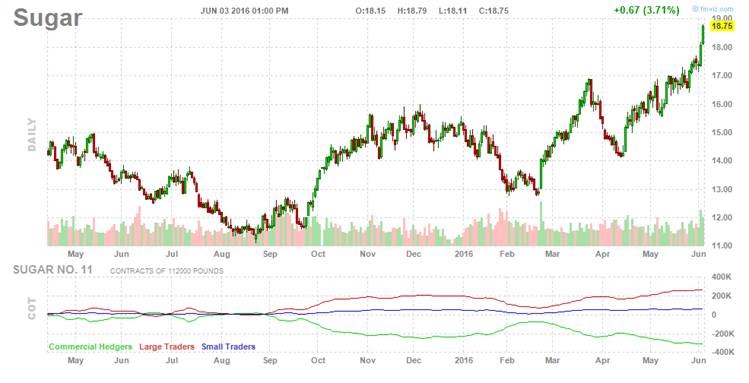
Let’s return to the soft commodities market as sugar has just been on a silly tear. Observe:

clip_image003

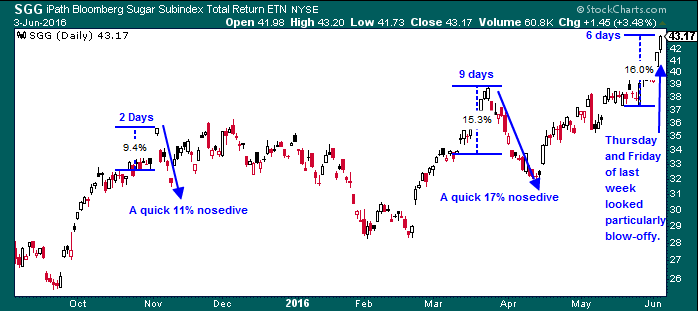
Just look at the last week, specifically. Talk about momentum ignition. The Commercial Hedgers have gone supremely short but this softy keeps ripping higher, moving 16% in the last week. Crazy. But the last two trading days look suspiciously like blow-offs. Have a look at what’s happened during the last two blow-offs in sugar over the past 9 months.

clip_image004

You can see that prior to each of the blow-offs there were frenzied gains in very short time periods, but then astute traders could have made a nice rip quickly shorting sugar for 2 to 4 weeks. Has another opportunity presented itself for one of those rips? It sure looks like it. Go elsewhere for your farm reports, international weather patterns, crop output, regional flood potential, yada, yada, yada. This is straight up tape reading.

Using the futures proxy ETF of SGG, it is clear to see that $36 is an important number for sugar. Magnetic almost.

clip_image005

Using Fibonacci from the August 2015 low to the current June high, $36 also happens to be the 38.2% retracement point on the weekly chart. Tread lightly, if you’re inclined, as the action in sugar has been fast and furious. Just look at that whipsawing action since the start of 2015. Hedge. Trade with discipline. Manage the position.

One final note from a macroeconomic standpoint, have a look at this chart of negative yield curves in Germany and Japan.

clip_image007

If this doesn’t scream insanity to you then nothing can phase you. Maybe all the developed world’s central bankers have been secretly, partially lobotomized. A little frontal lobe here, a little hippocampus there, and you have a compliant banker with the inability to remember what negative rates actually mean and the lack of cognition to act effectively. Germany and Japan combined equal approximately two-thirds of the US economy. Which means their economies matter. A lot. Germany has negative yields out to a decade and Japan out to 14 years, just screaming recession is near if not already present in those two countries. You think the US is in better shape economically because we don’t have negative yields? These are different and unique times, folks. The kind of times that are remembered with head shaking and derisive snorts by future students of the economic past. Trade smart. Build cash. Stay disciplined. New highs are coming, but new lows are closer than you think.