USPS – The Private, Self-Sustaining Wonder-Entity

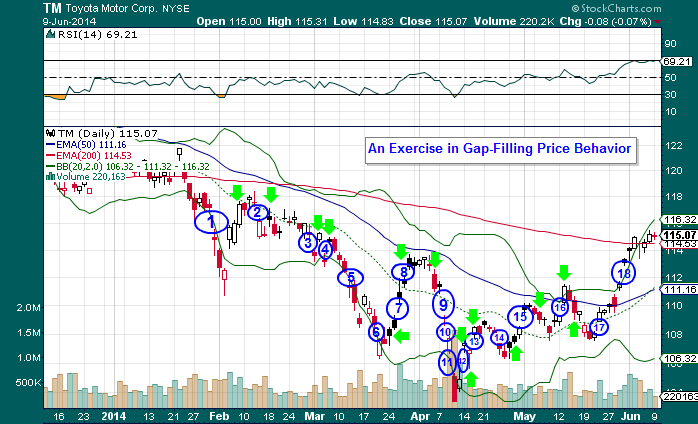
So far, so wrong on my Toyota trade for some gap filling reversion. That’s ok. My stop hasn’t been triggered and even though I’d like a rush on the potential profit, there’s no hurry.

Every now and then I like to go off base on subject matter that I find interesting. The USPS is far from interesting material for most Americans, but recently, my wife had a friendly argument with a friend about the United States Postal System. Now this friend is highly intelligent. She graduated cum laude with a JD from Georgetown. She’s definitely no intellectual slouch. She contends and stands firm that the USPS is a private entity that does not draw on public funds in order to continue operating.

I happen to wholeheartedly disagree with my wife’s friend. So I thought, geez, if an enlightened intellect such as hers could maintain that rationale despite a tremendous amount of opposing evidence; then what does the rest of America think? I thought I’d lay out some facts for any readers interested in the debate. And if you have an opposing view, then feel free to leave a comment regarding your own thoughts on one of America’s oldest institutions. This debate is not new at all and the USPS is on the record on its own website stating it does not rely on any taxpayer funds.

Yes, the USPS claims to not be funded by taxpayer dollars as it is an “independent” and “private” entity that suckles at the teats of its master, the United States Congress. Despite the ability of the USPS to generate over $65 billion in annual revenues, we know that they continue to also generate substantial annual operating losses. This is primarily due to having to pre-fund, by Congressional mandate, the retirement healthcare benefits for its fat and bloated union.

The USPS makes a big deal about this prepayment obligation but that’s how the rest of the private sector operates, at least the small amount that still do prefund. Every entity that has defined benefit plans providing healthcare in retirement for its employees generally prepays into the benefit plan, but is under no legal obligation to do so. The USPS doesn’t want to have to prepay. Basically they want their cake and eat it too…all the benefits of a government entity without being officially labeled a government entity. Unfortunately for them, that’s not the way it works in Amurrica.

The government readily admits that the USPS has a surplus in the defined benefit system of approximately $50 to $75 billion, but that is to fund future healthcare benefits for USPS retirees. Those funds are not to cover operating losses. That would just be robbing Peter to pay Paul, which is what the USPS wants to do and obviously would only work for 10 to 15 years. The outcome at the end of the day is still insolvency.

Now before addressing the real argument of whether the USPS is a taxpayer funded entity or not, here are some useful links:
1. https://www.fas.org/sgp/crs/misc/R41024.pdf
2. http://www.gao.gov/highrisk/restructuring_postal/why_did_study#t=1
3. http://www.gao.gov/products/GAO-11-926T

As far as the indisputable proof of the fact that taxpayers do fund the USPS by providing for funds to cover the substantial losses, it’s all readily ascertainable in the 2013 audit report of the Federal Financing Bank by the Office of Inspector General. The Federal Financing Bank “borrows from Treasury and lends to Federal agencies and private borrowers(aka USPS) that have Federal guarantees. The Bank also has a debt obligation to the Civil Service Retirement and Disability Fund.” (First paragraph, page 6 of the PDF)

If you go to page 8 of the PDF, you’ll find all that you need to know about USPS financing. The Federal Financing Bank essentially provides a $15 billion revolver(revolving debt). As the operating losses are generally less than $10 billion annually, this is sufficient to cover operating losses. However, all entities involved understand that the revolver is by no means a long-term viable fix to the solvency issues and that Congress(in all its impotence) will have to do a whole lot more to help the USPS outta this financial pickle.

For the record, the Federal Financing Bank borrows its funds from the Treasury. I’m a little rusty on the income generating abilities of the Treasury, but for the most part they earn income in primarily two ways. The primary way is through tax receipts, and the other way is through debt auctions.  At this point, debt auctions are debt monetization i.e. printing money out of thin air; a subject already well covered by so many sources. The mechanism for this is completed through the Federal Reserve and is essentially an accounting transaction on the books only. It allows for magical money to appear on the balance sheet of the Treasury. Unless the Treasury can prove beyond a shadow of doubt that all funds allocated to the USPS come from debt auctions, then taxpayer funds are being utilized to cover the annual losses generated by the USPS.

I know I sound pretty sure of myself, but I may be mistaken on some of the items or have an incomplete understanding of certain processes, procedures, or mechanisms. To my knowledge, this is how the game works for the USPS and stating that no taxpayer funds are utilized is simply a lame attempt at a red herring by the USPS that can be overcome with minimal research. It took me more time to write this post than actually find the facts.

I happen to be a proponent of privatizing the United States Postal System. Everybody knows efficiency truly exists in the private sector and the free market; not in the hands of bureaucrats. Short of that, I do not believe government employees should be allowed to organize which is a humongous reason why the postal system is in the position it is in today. These are of course different topics for a different argument.

I stand by my contention that the USPS is publicly funded by taxpayers. Anybody out there who feels differently, feel free to let me know.
Again With the Discounting Mechanism

One of the biggest ism’s on the Street that has been pounded to death by any and all financial sites is the fact that the stock market is the greatest discounting mechanism in finance and is always looking out 6 to 12 months. This may seem rational to all you EMH’ers out there and there is of course evidence that can be pointed out supporting the markets’ abilities to discount for future events. Feel free to scour the web for all data pertaining to this notion.

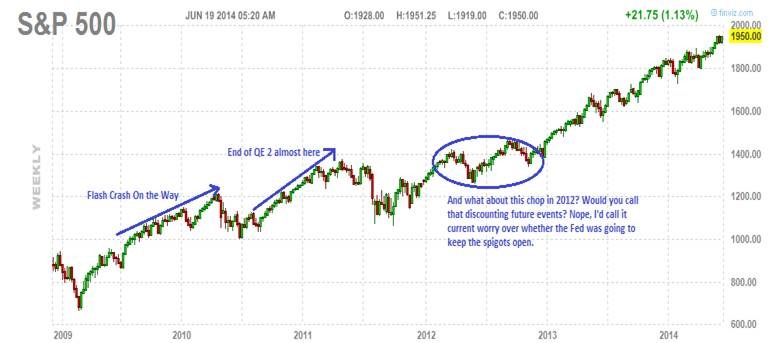
I’m not going to get into the facts and fiction of the mechanism. I just want to provide a little reminder that the forward looking ability of the markets gets a bit fuzzy at the extremes. Whether it’s is an epic crash, a normal correction, or a bottom-ticking nadir; at the extremes the markets don’t exactly send the clearest message. Have a look at the S&P 500 since 2009.

clip_image002

You can see that the Flash Crash came out of left field for a lot of speculators in 2010. That strong uptrend wasn’t giving anybody any kind of forward guidance regarding what was about to happen in May 2010. How about the end of QE 2 in 2011? The last “real” correction this market has seen. It too had a nice positive uptrend going before pulling the rug out in the summer. Sure the normal seasonal platitudes could have been rested on, but nobody saw the blowout in August coming. And finally, look at the choppy action in 2012. It was difficult to get a bead on how to allocate, because everyone was busy worrying if the Fed would keep the punch bowl spiked and the dj dropping the base.

Did that choppy action of 2012 tell you that 2013 was going to be a mega-homerun year for people who simply invested long? Hardly. Even though the Fed announced to the world that it would provide unparalleled levels of liquidity to market players, many a professional was caught off guard at the strength of the move.

The S&P 500 is setting new highs here and the NASDAQ is fast approaching its highs off the 2009 lows. One can paint any picture they see fit with any sets of data they choose. In the end, it’s about your experience and gut in combination with robust data. Not going into a bearish spiel, again I’m just reminding that at extremes the markets can be less than reliable discounters. Consider all the world events simply being shrugged off by investors:

1. Ukraine civil war – label it anyway you want but that sure looks like civil war to me
2. ISIS taking over a fair chunk of Iraq with US deployments to the Persian Gulf
3. Chinese Commodity Financing Deals (“CCFD”) and the budding re-hypothecation scandal
4. The approach of no quantitative easing – seriously think about that for a second – NO QE if the Fed follows through on their word; a full taper is most definitely not being discounted.
5. Potential liquidation fees imposed by The Fed at bond funds to “prevent” bond runs

We’ll just leave it at that. For good measure though I’ll present you with a snapshot of the Financial Times cover from Tuesday June 10th, 2014.

clip_image003

This has been bandied about all over the web as the “Contrarian Indicator of the Year”, with the FT extolling the virtues of Central Bankers’ abilities to remove volatility from the investment picture. I’m not here to debate the efficacy of the Magazine/Newspaper Cover Indicator. If, however, this cover proves to indicate a bottom in volatility in 2014, did the markets discount that?

Revisiting an Old Friend

Today, I’m just going to highlight the potential of some price action. It’s not often that I offer up a trade as the sole topic of a post. No talk of corrections. No sovereign debts. No interest rates. No belly-aching about complacency. Just gonna put up some plain old charts showing some price behavior that could be used for profit.

Way back, as in a year ago, I provided an opportunity to short Toyota. It was a nice, profitable little trade that paid off immediately. For such a steady behemoth of the automotive world, Toyota tends to consistently present tradable short-term set-ups despite any prevailing macro-outlook at the time.

The pattern set-up is simply an exercise in gap-filling since the end of January. That’s it. No long-term backtesting of the pattern, which means that I’m not calculating probable odds with any statistical significance what so ever. In fact, it’s simply a read of the tape with a tight stop. Have a look at the chart. You’ll observe that since January 31st, TM has “gapped & filled” fairly quickly on 16 occasions(gaps at blue circled numbers – fills at green arrows). I may have left out a green arrow or two but the chart is convoluted enough. You get the point. A fill on gap numbers 17 and 18 is what we’re playing.

clip_image001

Shorting here at $115 with an expectation of a cover at $108. I leave it to the traders out there to calculate your own risk/reward numbers. We have a price behavior that has proven to occur 100% of the time, at least since the last day of January. Keep a stop of 10% to be relatively safe, which would essentially stop you out of the trade if it goes against the prediction and breaks out past the key number of $125.

You may be thinking that shorting here for a $7 move downward may not be worth the risk. A 10% chance of loss for a potential gain of only 6%? What gives? You can tighten the stop if you absolutely have to skew the risk/reward ratio in your favor. Let’s say the trade hits the objectives in 60 days. That 6% return on the short annualizes out to a 42% return. I think any professional trader will take 42% annual returns any day of the week.

There is of course the leverage of options, which is how I’ll personally play the set-up. I’ll leave you to your own personal devices when it comes to option strategies. Sorry. I ain’t Greg Harmon over here, throwing out Calendars, Spreads, Strangles, and Butterflies. For those that play the option game, do your thing. For those that don’t, stick with a simple short of the shares or perhaps buy a basic Put with an October strike, although beware the lack of a hedge on a straight Put purchase.

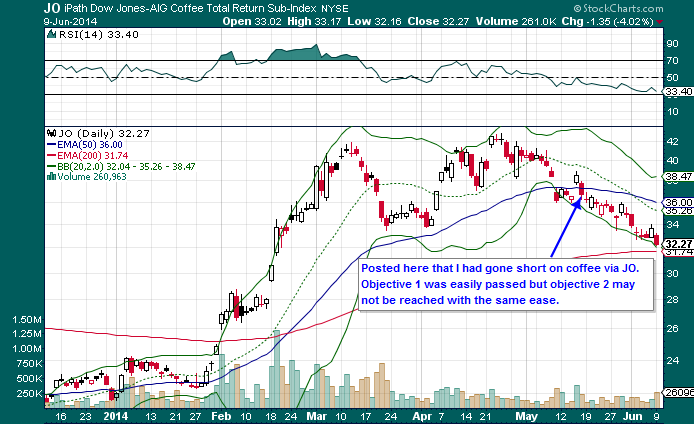
It is possible to go short in these markets. Dangerous, but still possible. Recall that I went short on coffee a couple of posts ago, on May 16th. Of course coffee is a commodity, but I used the ETF proxy.

clip_image002

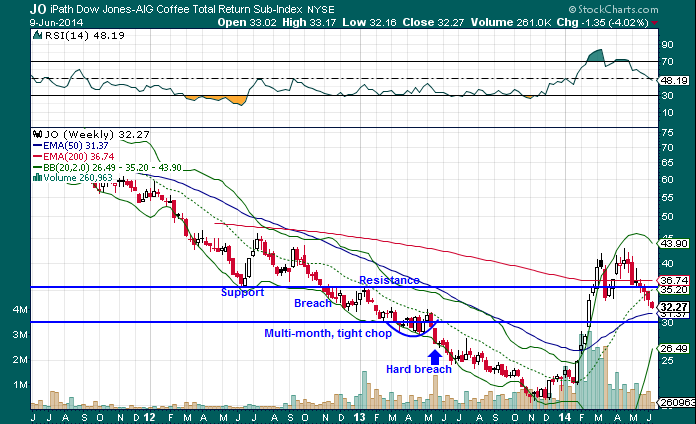
In initially determining my price objectives for the short, I utilized a weekly chart. Observe the chart below for the basic presentation:

clip_image003

And for you Fibonacci retracement addicts, using the weekly low off the first week of November, then 31.8% is $34 and change while $30 is tightly in between the 50% and 61.8% retracement levels. I felt safe in using $30 as a round number objective, especially in light of the high open interest at the expiration month for the primary asset in my own play. Coffee may retrace all the early 2014 gains in a full construction of an Eiffel Tower. If you’re in the coffee short then adhere to your risk parameters and enjoy the profit.

Getting back to Toyota, trading in a low volatility environment can be dangerous. I think there’s enough volatility in Toyota’s tape to warrant the short. As with a lot of trades, you risk a little to fill your pockets with some change. This trade is one of those singles that people forget to swing for after striking out for the umpteenth time on a grand slam attempt. Please visit my disclaimer before leaving and taking any action. Good luck out there.