Inflation & Recession: Strategic and Tactical Reads

It’s probably safe to say that most people who play in any capacity in the markets right now, regardless of discipline, are feeling unsure.  That’s why cash levels are so high.  Treasuries and money market accounts are a go-to.

While at the same time, equity markets are resilient.  Bond volatility is moderating, while liquidity is getting soaked up.  Precious metals may be in for a breather right in time for everyone to lose temporary faith in the dollar.  Could be more downside in oil and copper.

But not much.  Oil has been consolidating in a tight range for what feels like forever, but $65-$70 should serve as a new long-term base for some time with plenty of macro-factors as tailwinds.  Copper danced along $4.20 and appears to be correcting in time around that number.  Everyone sees and understands what’s going on in copper, but it sure doesn’t feel like real capital gets it yet.  The banks and trading houses will force a change of perspective for everyone as supply/demand fundamentals begin to grind the price higher for the “greening” of the world.

We’ve got the rest of Spring and the Summer for economic activity to surprise to the upside in the US, just like Q1.  I think the positive animal spirits of consumers are going to catch a lot of investors sideways.  Between low unemployment, the wealth-effect on a continued equities rally (after a pause), and the amplification of credit card usage, the US consumer is just going to want to enjoy the Summer with a sense of normalcy.  That normalcy will translate to surprising economic strength through the Summer and into the Fall, despite all the leading indicators showing recession is baked in but not sharing when.

I surmise the end of Q3 or Q4 is when the consumer retrenches.  And if that ends up being the case, forget about Santa’s rally.  It feels like the Fed has reached it’s last increase to the critical 5% rate.  Now it will sit on that to let the lag continue to wend its way through the economy.  My guess is that the recession rears its head in the Winter.

However, since we only identify recessions after the fact, I suspect the Fed will sit on its hands to stimulate the economy via its usual methods until sometime in Q2 of 2024.  Banks’ asset quality reserve the right to interfere with timelines.  If West Texas crude is north of $90/barrel and copper north of $4.5/lb. then the Fed will be pulled in both directions.  The pending elections will ensure that monetary stimuli are chosen over inflation abatement, as behind closed doors, one has to believe that “they” know inflation will not be curtailed but instead wash over the world in rolling waves for the rest of the decade.

That cat’s out of the bag.  Actually, it’s more like a boxer trying to wrangle a chicken in a pen.  Central bankers and politicians may nab it at some point, but not before a whole lot more price pain in commodities which should co-lead US Dollar repudiation as a reserve asset.  Geo-politics will take care of the rest.

So 2024 brings potential recession and definite US elections.  While the banks bring their exposure to CRE and an incomprehensible lack of cognizance around rates sensitivity to their credit portfolios.  Should make for some spicy times that long-term, large capital probably won’t have the tactical agility to operate effectively in.  This will present a constant stream of opportunities for prepared traders.

I thought the environment we’ve been in since inflation took off was going to happen after 2008.  Many did, hence gold’s run after the GFC.  Even though I wasn’t even born when the 70’s inflation kicked off and was only a toddler when it was finally snuffed out, I’ve been preparing for this investment environment that the world currently finds itself in.

In order for long-term capital to outperform during the rest of this decade, I think strategic hedging via tactical trading and exposure to less traditional asset classes will be critical.  Despite their tough year in 2023, CTAs should continue to be a top performer through the 2020s.

All capital has to independently quantify what that looks like for portfolio construction.  Basically, if a portfolio manager is sitting on long equity positions where basis and dividends say to hold and if their long RE holdings or other real assets that must be held during inflation were purchased with low WACCs, then it will be critical to allocate capital to volatility strategies where the asymmetric returns offset paper losses of the long-term holdings.

This mindset will not take hold en masse by nearly enough asset managers, but those that do take this approach will probably see their AUM thrive while others are bleeding.

The volatility has to be embraced, not forsaken, as it is a critical component in understanding capital flows.

So what does that mean for portfolio construction?  Hold equity in high-quality, cash-flowing businesses with resilient brands and position at opportune times.  No shit, right?  Save yourself some time using YCharts visualizations of valuation-ratios.  Between the financials and the trend(s) of EV/EBITDA, P/S, P/B, P/FCF, etc., one can save a ton of time on due diligence.  One could have picked up some CLX and CRM several months ago right before 40% and 60% runs, respectively.

Novo Nordisk and Eli Lilly look like no-brainer long-term holdings and the hard/soft cycle of P&C insurance continues to present good opportunities, especially with rates stabilizing.

I like productive land or land with high optionality over buildings, but obviously buildings provide more consistent cash flows.  The yield in multi-family will persist as supply/demand fundamentals in housing virtually guarantee it as long as the cost of capital was or is reasonable.

The recent action in precious metals has a hint of USD repudiation behind it.  It just has that musk.  Can’t explain it.  Can’t quantify it.  Just a feeling.  But it looks and feels like precious metals time may have finally arrived.  Riding shotgun will be crypto assets.  Whether one believes it or not, the progress and development in Ethereum-based projects appear to be leading ETH to a potential seat at the table of reserves.  Impossible to see how the protocol’s adoption rate develops, but between freedom of choice and potential ease of commerce, I can see how ETH’s price goes significantly higher from its relatively recent low of $1000/coin with the network effect already in place.

And of course…commodities.  I think copper is the easy play here to have meaningful exposure.  Between futures, trading houses, and large miners, there’s plenty of high-liquidity options that will allow one to capitalize on copper’s potential price rise.

The world is only at the early phases of inflation and electrification.  It doesn’t feel like enough capital believes copper prices can move meaningfully higher.  And that may be the case.  Maybe copper just peaceably stays between $3 to $5/lb. for the next several years, but I don’t see it.  The supply/demand fundamentals certainly don’t say it.

I like to rationalize copper’s potential against oil’s price action.  In just the last 3 years alone, we’ve seen crude oil go from a negative price, where one was paid to take the most critical commodity on the planet off of the hands of others, to a high of $130/barrel.  Everyone, everywhere uses oil and look at that volatility.

And yet somehow copper won’t be able to double?  Or copper couldn’t move 50% higher from it’s high of $5/lb.?  To me, these price moves seem very plausible.  Very feasible.  Exposure to this asset class appears poised to continue its outperformance in the coming years.

I contend that electrification and the build-out of infrastructure across the US will be how Main Street gets bailed out during the next crisis.  Taxpayer dollars will be used to develop projects around these two key areas in order to provide critical jobs to large swaths of the population at a time when jobs may be hard to come by.  Demand for copper should be even more inelastic and at higher prices.  Then economics plus greed should take care of the rest in copper.

Elections.  World war.  Dollar repudiation.  Inflation.  Societal strife.  Lagging and inconsistent monetary policy.  Embrace volatility or potentially watch your return-profile lag this decade.
Hey Gold, Don’t Get Cocky!

Gold Fever - Article Header

Seen this movie?  If not, it appears to be starting another theatrical run.

With the recent action in gold, the precious metals bugs are all stirred up.  Price action has been constructive.  Big time asset management names are mentioning it and the metal is definitely conveying a message.  New songbirds are putting their price calls out there for short-term and long-term destinations.  The old songbirds are putting their same old calls out there as they suffer permanently from the fever.

There’s no fever like gold fever, and I’m an expert in the symptoms.

We’re already seeing the $10,000 and up per oz. calls for gold.  What’s funny is you see the same old reasons for why precious metals are going to boom.  Everybody was selling the same handful of points in the last gold bull run and those same points are being tossed out there again as if they have meaning or truth.

– Negative real interest rates

– Excessive debt loads

– Accommodating monetary policy by central banks

– US Dollar losing value via debasement

– Inflation expectations

– Supply shortcomings

This is folly.  These are not reasons for anything; merely convenient sales pitches that still work on the zealous subset of speculators that are looking for either a reason to stay devoted to the precious metals or believe an amazing amount of money will be made by a small speculation.

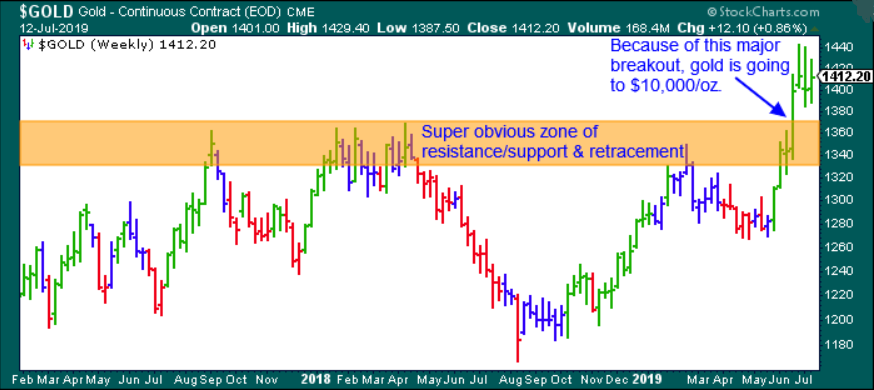
From a technical analysis standpoint, it’s time for a rally and the price action hasn’t disappointed thus far.  However, technical analysis has virtually no merit any more due to the advent of the internet.  This has been statistically proven.  Tape-reading still has merit in conjunction with technical analysis and fundamental analysis, but it takes real talent and luck to fight the machines.  Here’s a Captain Obvious chart of gold proving higher prices in the making.

Snarky Gold Chart (7-13-2019)

But there’s only one thing that could potentially drive the price of gold and the precious metals to those high price levels so blithely forecasted.  Here it is in plain, bold English:

A HIGH PERCENTAGE LOSS OF RESERVE STATUS IN THE USD

That’s it.  I believe that to be the only driver that will get gold up over $5,000/oz. or higher.  Something in the order of the USD losing perhaps 35% or more of it’s reserve status which will coincide with decreased use of dollar-settlement in international trade.  Or said another way, chaos.  Because if the rest of the world decides to shift part of the USD’s reserve status to another currency whether it’s gold, Bitcoin, SDR, yuan, etc.; you can bet those in power in the US will be wreaking havoc as a result.  This will be adjoined to the financial/economic chaos that will already be in place.

There still exists old-world faith in the precious metals, and blockchain currencies do not have enough cumulative faith by investors to reel in allocation decisions.  This is the path for significantly higher prices in gold, silver, and the PGM complex; potentially even for the commodity complex.

Regime changes in currency reserves are not fast.  They don’t just happen like a stock market correction.  Many powerful and wealthy nations have a vested interest in the USD maintaining it’s ultimate reserve status.  Just bear that in mind as we watch the dynamics between all asset classes, markets, economies, and countries play out in real time going forward.

It’s tough to visualize if you can’t foresee a world where the USD loses place and face.  But hell, don’t take my word for it.  Google and consider the opinions about the subject of some of the most powerful financial insiders in the world:  Larry Fink – Head of Blackrock, Ray Dalio – Largest principal in the largest hedge fund in the world, and Mark Carney – Head of the Bank of England.

Ain’t no fever like gold fever.  Keep your wits goldbugs.

Are You Prepared?

Fear sells.  It’s one of those unfortunate, steadfast truths of life.  Just look at the rise of politicians like Trump and the other fear mongers around the world.  Look at the news.  People love to be scared.

Fear is not what I’m selling.  Rational thinking.  Clear analysis.  Proper asset allocation.  But mostly, cognizance and comprehension.  These are concepts being sold in today’s post.

I wanted to take some time to break down how I think this current economic-business-investment cycle, which started off of the 2009 lows, reaches its peak.  This post may be a bit lengthy, so consider yourself duly warned.  Read it in chunks if the need to go catch a virtual critter or watch some naked dating is simply eating at you like a heroine withdrawal.

In a world where blog readers want the meaning of the universe in under 800 words, this post will take some time to layout how arguably the most important component of the banking system works.  Specifically, I want to visit swaps, repo, and the collateral needed to fund the whole party.  I want to explain for the people that don’t know; the lay people.  People that have no idea about finance, accounting, and economics.  People that watched The Big Short and have an inkling but need a legitimate breakdown of what’s really going on in the financial system.

What’s most annoying for me about the investment fear mongering today is that there’s no clear how or why we can expect a major market crash across all asset classes.  Numerous potential causes are cited.  Some say extended valuations.  Others say central bank intervention has lost it’s efficacy.  Still, others say a black swan will reveal itself to cause entire markets to be re-priced.

These are rational, true hypotheses and I agree that all three will hasten a great crash, but the fact of the matter is they all fall under the umbrella of debt.  Debt was taken off of the private balance sheets(publicly traded entities) and shifted to the public balance sheets(sovereigns).  All the owners of associated derivatives tied to that debt were either made whole or have continued to utilize the current system to keep the party going.

Worldwide debt levels are and will be the cause of the next crash.  Debt sits like a boa constrictor with its coils wrapped around the world, slowly squeezing the economic life out of all markets.  Think of the snake in The Jungle Book cartoon with its mesmerizing eyes.  “Trust in meeeeeee.”  Debt beckoned and the world heeded the call, only now there’s no escape and it’s getting harder and harder to breathe.

This is sort of a revelation for some who are just beginning to truly understand the error of the central banking cabal’s ways.  The negative rates.  The buying of investment grade assets and equities with taxpayer funds.  The backstopping of public, systemically dangerous banks with taxpayer funds.  The waterfall of money creation.  The thought process that more debt on top of debt will somehow cure a situation caused by excess debt.

At this point of the post, any pros reading this are probably rolling their eyes and thinking “Go buy another gold bar you doomsday schmuck.”

No matter.  I want my friends, family, and financially unsophisticated to gain some insight.

Where’d all this debt come from?  It went from the private coffers to the public coffers.  From the publicly-held, systemically important financial institutions (“SIFI”) to the central banks.  And now that the developed sovereigns are sitting on all of it and then some from the 2008 system-save, the SIFIs have continued their unaccountable ways and the financial system is sauntering closer to the edge.

There’s nobody for the central banks to turn to.  There isn’t an intergalactic central bank out on the edge of the solar system just waiting to be a lender of last resort to planets where the dominant sentient species decides to muck the whole financial system up.

Why did every single SIFI have to survive (except for Lehman, of course) after 2008?  If the banking system blows up, there’s zero way to process sales transactions?  People aren’t going to continue buying at Wal-Mart, Amazon, Kroger, and other retailers?  Oil won’t be burned?  Businesses will never hire and never expand again?  Tightening the belt is not the same as eliminating altogether, but that’s not the picture painted by the players in control.

Just ask Charlie Munger or any other uber-wealthy and they’ll tell you how close the whole American system was to utter annihilation.  It’s easy to take that stance when you have rainy day cash in the billions just waiting for an investment yielding 10% with a 100% government backstop.

The people that constantly state not to bet against American resiliency and determination, did just that by supporting SIFI bail-outs.

But those who lean towards the Austrian school of economic thinking, have long had a grasp on the consequences of current central banking Keynesian policies.  And those consequences are now beginning to painfully avail themselves to a larger and larger percentage of the world’s population.

The good news is that the crash is not imminent.  I know this because investor psychology dictates that we have a last-gasp, melt-up in the broader stock market.  Not to mention, everybody is currently inclined to say that the game is over right now.  Sell everything!

As I’ve said before, bull markets don’t end with everyone staring right at it while expressing their negative sentiments.  We’ll need that final push upward in the S&P 500 to the range of 2,400ish.  Who knows?  Maybe even higher, but about 10% to 15% higher than 2,125 which proved to be such a strong area of resistance.

If you’re strong of gut, stay positioned to the top.  If prudence guides your investment principals then it is way past time to have begun increasing cash levels.

When nobody’s looking, something’ll go down over a weekend; a major event or perhaps some sort of Western government proclamation.  And on Monday, panic will likely ensue to get the real party started.

It’s been suggested that it will be the banking system, specifically a major bank such as Deustche Bank or an institution of similar magnitude that will stop the music.  I disagree.

I think it’s going to be a country.  Either via a currency policy error or an outright repudiation of debt or both or some other ill fated decision involving a SIFI, but I suspect a major developed country will be the entity that kills the dance music via a one in “ten-thousand year” tail-event.

The system-altering crash is not going to happen tomorrow.  Crashes are like being pantsed.  A pantser doesn’t pull down the trousers of the victim while the potential pantsee is looking them right in the eye.  No.  A pantser waits until the pantsee is not looking and in a position for considerable embarrassment before striking fast to yank down the pantsee’s trousers, inflicting maximum damage to the victim’s psyche.

That’s a market crash in a nutshell.

So investment portfolio’s are safe for now, but let me share some charts just to get readers’ old fear-juices flowing.  Gotta break the monotony of my prattling.

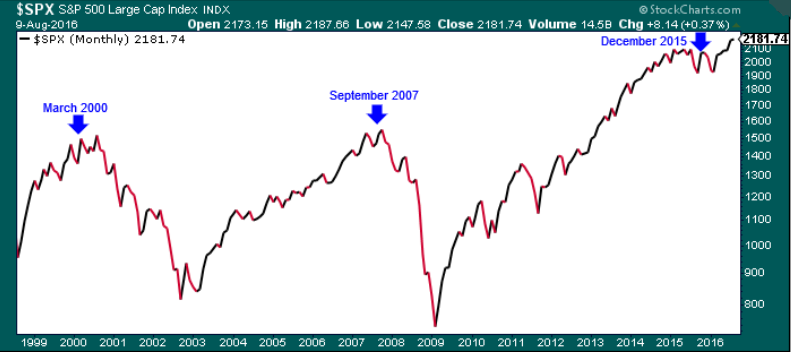
It’s critical when making comparisons to previous market-tops to only go back about 18 years, because that’s when true financialization took over the world with the passing of Graham-Leach-Bliley.  That gave immeasurable power to the banking system and set us on the path we’re currently on.  Everything before that was during an entirely different era.  Sure, you could point to 1971’s USD unhitching and the creation of the credit destiny or 1986 and the MBS birth or Greenspan’s run, but the lead-up to the Dot.com crash is my preferred beginning comparison point.

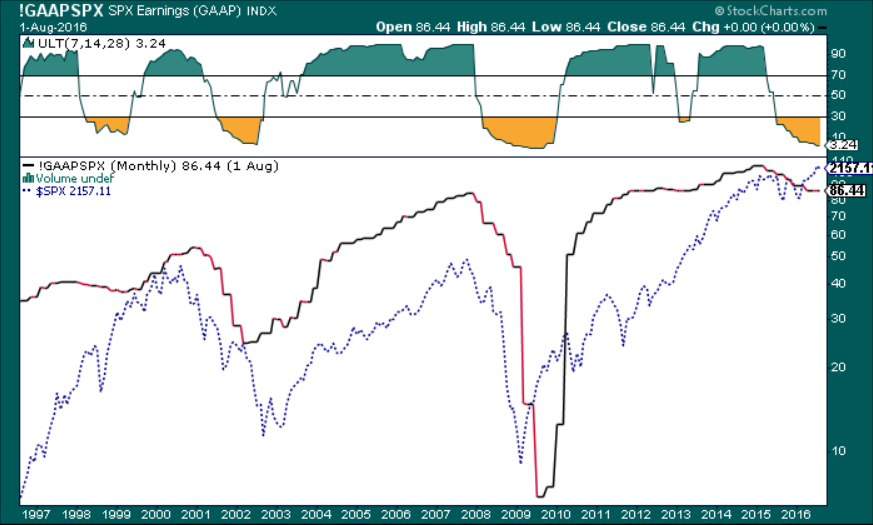
The first chart I’d like to share is the divergence between earnings in the S&P 500 and the performance of the S&P 500 on a monthly chart with the Ultimate Oscillator (“ULT”).   You’ve probably already seen this one in some iteration around the web.  Am I the only one that thinks that divergence in earnings and the index’s price action looks a little off?

GAAP Earnings Recession and the Ultimate Ossy (8-2-2016)

Yes, the index is sitting right at new highs while earnings continue downward, but look at the ULT.  The depth and duration the indicator is hitting has only been seen two other times in the last 20 years…subsequent to the 2000 and 2008 market crashes.  And yet here we are at highs across multiple financial assets classes and no recession in sight.

PHEW!!!  We’re good then.  End of post.

Actually, let’s look at another chart, courtesy of SentimenTrader.  Want to know what those red arrows indicate?  Then buy a subscription to Jason Goepfert’s site.  It just may be the best research value available.  SentimenTrader’s value is so good that I’d liken it to a stock with a $5 billion dollar market cap that trades for less than the cash on it’s balance sheet.  It’s that undervalued.

Margin Debt - S&P 500 Within 1% and MD More than 10% (July 2016)

Those arrows indicate each time in the last 25 years that the S&P 500 was within 1% of its all-time high and margin debt was more than 10% below its all-time high.  Definitely ominous, but ultimately may mean nothing, however I’m willing to bet that this signal is far from meaningless.

Feel reassured about your current asset allocation yet?  I’ll wager that you don’t have nearly enough exposure to the precious metals space.

Ready for another scary picture?

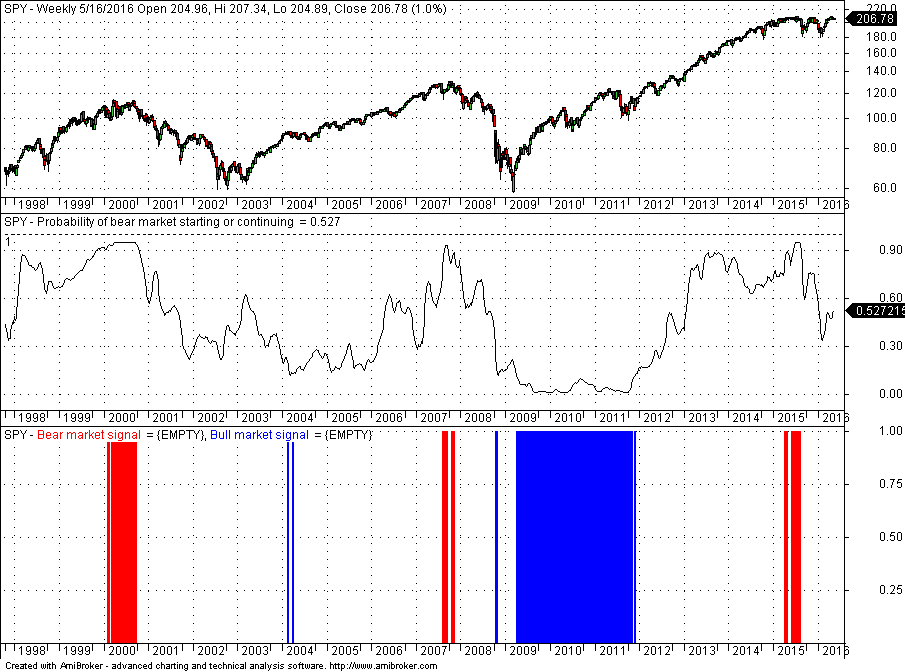
Back in May of this year, Michael Harris of the Price Action Lab shared a post about his Bear Market Probability indicator (“BMP”).  You can see that over the last 20 years and for the last two major market meltdowns, the BMP was highly accurate.

Bear Market Signal - PAL (5-17-2016)

In 2000 and 2007, the BMP would have gotten you out with plenty of time to spare to take profits and shift your portfolio allocations accordingly.  Each time the indicator has cleared a probability of 0.90, a true bear market followed shortly there after.  Our current market cleared 0.90 in late summer last year just before all the fireworks.  I don’t think it’s a false signal in the least.  The BMP’s efficacy is proven.

The bear-market delay is in all likelihood due to ridiculously low interest rates and accommodative monetary policy by the developed players of the world.  But the bear will be staved off for only so long and not very long at that.

The Price Action Lab (“PAL”) software is another incredible value readily available for market research.  I am not a subscriber however their software packages provide a window of access to the plebs of the world who want to see and know how the pro’s find trading opportunities.  If you are statistically inclined and serious about trading your account or OPM, then PAL software can help you find an edge.

Additionally, the PAL blog is not only insightful but pretty funny.  Harris consistently puts technical analysts, like myself, and over-exuberant quants in their place.  Great site.  Great content.  I plug it and SentimenTrader often.  Read’em.

Let’s look at a few more charts to really get you thinking that the end of this bull market just may be near.  Afterwards, we’ll segue to the plumbing of liquidity within the financial system.

The following two charts are courtesy of the Leuthold Group.  The top chart depicts the percent of publicly traded companies with rising YoY earnings per share.  Not too healthy looking.  And you can see what happened the last time we crossed under the 55 line in 2008.

Two Signs of Recession - Leuthold (Q2 2016)

The bottom chart is the HWOL via The Conference Board.  As for the indicator’s composition,

The Conference Board Help Wanted OnLine®Data Series (HWOL) measures the number of new, first-time online jobs and jobs reposted from the previous month for over 16,000 Internet job boards, corporate boards and smaller job sites that serve niche markets and smaller geographic areas.”

Just more compelling, supporting evidence of what’s in store for the world-wide financial system.

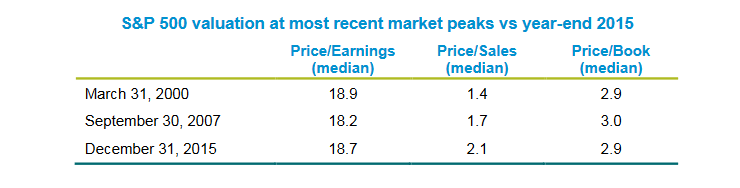
This next chart is a little dated from the end of last year but these common valuation ratios still stand in the same over-valued condition.  Observe how close to the top these values in the PE, PS, and PB existed.

Valuation Ratios - FPA Crescent (12-31-2015)

SPX Dates Lining up Crescent Valuation Chart (August 2016)

The common denominator is once again debt.  Easy money policies and the continued backstopping of all markets via sovereign debt issuance is really the only thing holding confidence together.  Once the confidence goes and liquidity dries up, you’re going to wish you’d heeded charts like the ones in this post.

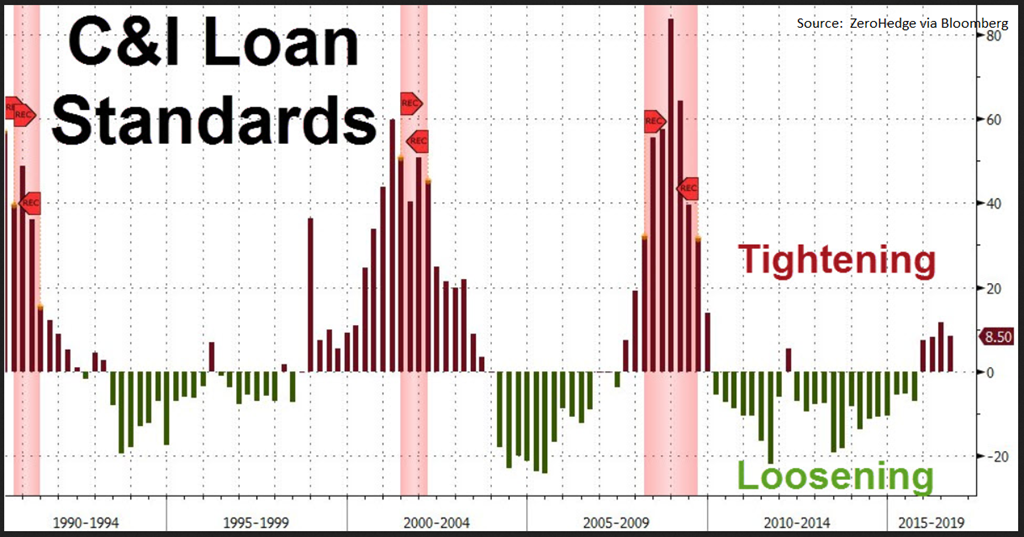
The last chart selling market fear illustrates loan issuance drying up in the commercial and industrial space in the US.  The Federal Reserve releases a survey of Senior Loan Officers every quarter and what we are currently seeing is 4 straight quarters of tightening loan standards in the commercial and industrial space.  This is something only seen at the outset of recessions, literally.

ZH - Fed Senior Loan Officer Survey C&I Q2 2016

Care to guess why these condition exist and yet we are “not” in a recession in the US?  That’s right.  Excess debt issuance.  Cheap money backstops.  And a cost of capital that has been perverted for far too long.

The charts all paint a clear picture.  Ignore them at your own risk.  Is a crash imminent?  No, but you better be socking away some cash for value opportunities and you better be taking profits on positions that are starting to run out of steam anyways.

Let’s move on to the banking system.  No, let’s take a break.  My next post will be on the banking system and how it will exacerbate the shock to the financial system when whatever sovereign does what it’s going to do.  Specifically, I’ll expound on liquidity.  How it works and why every pro in the world already knows the danger it presents when it dries up.

Are you fearful?  Based on average portfolio construction out there, the average investor is not nearly scared enough.  Remember asset allocation only works over long durations.  Diversification in the short term is just as susceptible as any other investment approach.  Sure, the strategy is to offset so you lose less than the stock market as a whole.  But if you’re near retirement, there’s not a lot of solace in thinking about how well asset allocation models hold up over several decades.

You know what also holds up over the decades?  Intelligent trend following and value.  Craftily insert risk assets that can carry your portfolio returns when times get rough.  Don’t give in to the fear and don’t give up on the markets as new highs are being hit but now is the time to start questioning all your allocations in preparation.

Standby for part 2 on liquidity within the banking system.

Evaluating Markets Not Called Stocks

In my last financial post, I stated that I thought the market would move sideways for approximately 7 weeks before a catalyst would present itself to drive the market higher going into the beginning of the summer. So far, so good. Yes, the market is up about 1.5% but it appears to be the start of a sideways consolidation as the market exhales some energy.

I suspect we see a little downside move over the next week or two, as part of the sideways action, followed by a move back up to current levels about 3 maybe 4 weeks from now. By then, that catalyst should present itself for the resumption of the trend back up to new highs. Will my hot streak continue? If past is prologue…

clip_image001

Right now, I want to talk about the US dollar and its potential effects on various commodities. Specifically, we want to watch oil, precious metals, and the grains.

clip_image002

It’s easy to observe the stiff support at $94 and I think this time is no different. I suspect we get a slight bounce of about $4 up to about $98. This is in line with previous bounces off of $94 during this 15-month consolidation. There are plenty of analysts out there who think the USD bull will renew to move a lot higher. The thesis of the trade being a fear-based allocation in light of a pessimistic international outlook to various economies and the worthless, respective monetary policies currently employed by central banks.

I disagree. When the big one hits, the real correction across all markets, the USD will at first be a bastion of relative strength but that sentiment will be temporary. The problem with the thesis that we are in the early phases of a USD bull is that it runs counter to the other widely held thesis that the next financial crisis will be co-focused around an international collapse in confidence in the USD. That’s a discussion for a future post.

I believe the momentum has shifted for commodities. I suspect the worm has turned in the precious metals complex. Corn, wheat, and soybeans are potentially at the beginning of a spike. Oil has been unstoppable, but that DOHA meeting of the controlling powers will have a heavy influence on trading behaviors. It’s not inconceivable that the USD and commodities could run in the same direction but that belies decade’s worth of a consistently negatively correlated relationship.

Specifically, I’m referring to short-term action. Months not years. But let’s look at multi-year charts for gold and the grains, of which I’ll use my typical go-to trading medium of JJG.

Gold:

clip_image003

What goes up generally comes down. Gold has held strong with a sideways move off the hard spike higher to start the year, but with the pending move in the USD, I think we’ll finally see the correction that many have been calling for. You can see that around $1,140 represents a stiff area of support. I suspect that could be gold’s next destination over the next several weeks or months, however that still represents a higher-low leaving a new uptrend intact. If one were inclined to trade, that’s $100 of movement to design a short-term, multi-month play as it moves lower and then begins a recovery. One pattern to watch, if you believe in such hokum, is the little head & shoulders that has formed since February. Will the break of the right shoulder-base be a catalyst?

Grains:

clip_image004

I have had a lot of luck trading this grains ETF. Some of my biggest returns in the shortest amount of time have come from scalping the market for a nice rip on these multi-month grain rallies. Sentiment, professional hedging, and seasonality point towards the potential of another run. More importantly though, price action agrees. It looks like a based-low was established to start the year and last week represented a possible higher low. The price action was especially promising to end the week. Position accordingly.

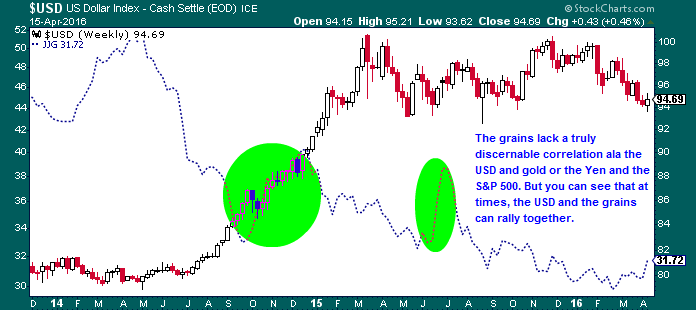
But if the USD is about to bounce, won’t that hurt commodities? Even agriculturals? Not necessarily. Oil will very likely be affected but again the speculator positioning by huge players could potentially cause another squeeze as much as the DOHA meeting could negatively affect prices. Gold sentiment was stretched anyways. But the grains don’t always run counter to the dollar. In fact correlations between the USD and grains do not share an easily deciphered message. Grains can and do run in lockstep with the dollar at times. Have a look below.

clip_image005

In two of the last 3 rallies, the grains (blue-dotted) ran concurrent with the USD. Even though the USD is potentially beginning a bounce, so could be the grains.

As stocks continue their consolidation, the USD should be the dominant theme in the markets as it moves upward over the next several weeks. Watch associated commodities. If you’re feeling really brave, try trading the other currencies with a rising USD as your foundation for analyses. Good luck out there.

Indicator Currencies

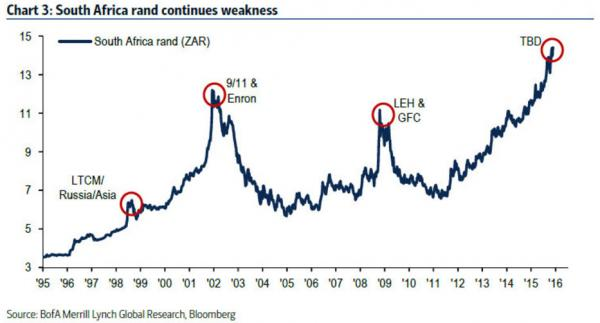
A couple of weeks ago on ZeroHedge, I happened to read a chart they nicked from BofA Merrill Lynch. Observe:

clip_image001

And just to be Captain Obvious, the chart is inverted as the South African Rand is not exactly a bastion of strength in light of the continued run on commodities. Inverting a chart allows for an alternative perspective, which we know is needed more than ever in these days of literally any trading edge being arbitraged into oblivion within a co-located microsecond. We’ll have to wait and see if Rand correlation to world markets continues to lead up to major market events, but there is no denying the importance of currency analyses in a macro outlook.

Speaking of Captain Obvious, this inverted Rand chart made me want to take another look at an inverted chart of the USD. I keep reading perspective after perspective about how the tightening of the US currency will lead to continued strength in the dollar as the US continues to be the strongest developed economy in the world. Safety, safety, safety will drive the USD trade according to expert analysts. This is in light of the fact that trader commits have already been showing some backing off in the long USD trade.

I am by no means an expert in currency trading, or for that matter, examining international capital flows. However, I pulled up an inverted monthly chart of the USD over the last 15 years and included a couple of indicators that I rarely use. The top indicator is the standard Ultimate Oscillator (ULT) with default periods of 7, 14, and 28. The bottom indicator is simply the 9-month of Rate of Change (ROC). There were some potentially telling relationships.

clip_image002

As denoted by the green circles, trouble was usually on the horizon once the ROC worked its way up to 10 or higher and then back down to crossover the zero-line. The lone exception over the last 5 occurrences was the late 2012 to early 2014 consolidation with heavy chop. Recently, the 9-month ROC just began to crossover below the zero-line again.

The ULT follows a similar path in that once it has breached a reading of 60 or higher and then began to work its way downward, USD price action generally began to deteriorate. Observe the price action in the dollar at each of the downward sloping blue arrows.

Despite what the indicators have proven to communicate on previous occasions, this is an obvious case of data mining and thus cannot be truly relied upon for making large scale investment decisions. None the less, I found the observations interesting as part of a larger overall analysis.

There are many highly-correlated relationships recognized between currencies and asset classes. Some of the obvious ones are the USD and commodities (inverse), CAD and AUD and commodities (direct), Yen and SPX (inverse), but it’s the dollar’s relationship with the Swiss Franc and gold that has me intrigued for a potential move.

The franc and gold have a long documented relationship of synchronous movement. Not perfectly, but with consistently high correlation. While the dollar tends to move opposite the franc and gold. Again, not perfectly but with consistent negative correlation. Observe this time-tested relationship for yourself.

clip_image003

Could the action be telling market players to expect some fireworks in the USD, franc, and gold in the first half of next year? There are a multitude of low-risk ways to go long or short the currencies using futures, ETFs, and options. I leave it up to the reader to decide how to potentially risk any capital.

Another relationship to watch out for due to USD correlation, is the ratio of the S&P 500 index to the CRB commodities index. Kimble Charting Solutions pointed out the “Eiffelesqueness” of this particular ratio. With the world economy continuing to slow down, it does appear as if there is no hope for iron ore, oil, and copper but we are at multi-year extremes and a close eye is warranted. They’re called counter-trend rallies and the adroit can exploit.

clip_image004

I hope you had a wonderful Christmas and I sincerely wish that 2016 truly brings good tidings to all Margin Rich readers…and profits, too!