Correction Starting or Continued New Highs

Nowadays, you can’t go a single day without reading a financial opinion about how a major dislocation is imminent or that the economy is on the mend and this generational bull is still intact. The fact that the US stock markets have been so choppy to start the year has confused not only some columnists and bloggers(myself included), but some professional money managers as well. As I stated a couple of posts ago, there are plenty of short-term signals showing that now may be time to show caution. On the other hand, long-term price action does continue to show strength and the bull fundamentals do not appear impaired as the path of least resistance for the markets continues to be upward.

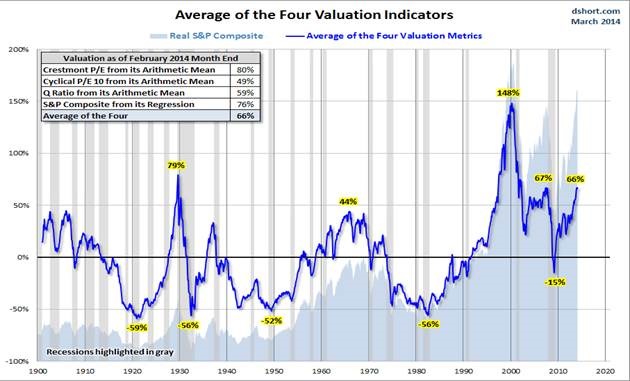
Depending on what measures you favor, valuations can appear a bit stretched currently; especially in the biotech and social media sectors. Doug Short, over at Advisor Perspectives, provides a monthly update of the chart below. Chris Kimble, of Kimble Charting Solutions, likes to add his own flair to it every now and then as well. The chart takes an average of four popular means of determining valuation for the S&P 500:

clip_image002

So based on this chart, we’re rapidly approaching 1929 levels of overvaluation of 79%, already passed the late 60’s peak of 44%, and are right back to 2007 levels at 66%. Do I think a soul crushing dislocation is imminent? Not at all. The chart also shows that things can get a lot more frothy ala 2000 and its 148% overvaluation level for all things dot.com and tech. Jeremy Grantham, via a recent Barron’s article, agrees that the market is 65% overvalued currently but that it would need to rise another 30% before he would consider it true bubble territory. For the arithmetically challenged, that puts the S&P 500 over 2,300. So according to J-Grizzle, there’s a lot of dancing left to do while the beat keeps bumping.

The S&P 500 hasn’t seen a correction of any real significance in about 2 years. When you throw in the fact that this bull recently turned 5 years old, nervous traders start to think that we just gotta see something to the downside soon. Maybe. Maybe not. Maybe f@$# yourself. My theory on the market is that it’s like a little kid. Feed it a bunch of sugar and watch it run like crazy. Thank you, Marky Mark. Despite the tapering, the Fed is still plugging a ton of sugar monthly into treasuries and MBS to keep these markets liquefied and rising.

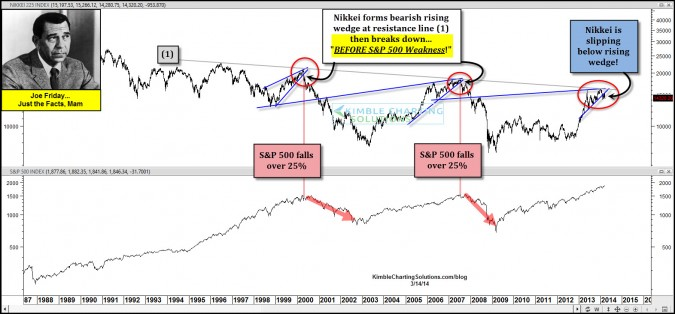
I already went on the record stating that I thought we could see downside action all the way to the 1,650ish area, which is approximately 12% off the highs. Kimble provided a chart last Friday showing the long-term action correlation between the Nikkei and S&P 500 since 2000. Observe:

clip_image003

So if the action is to be believed, then watch out. BUT WAIT! The S&P 500 is breaching all-time highs. Aside from risk management, buying into strength is a common message you’ll read in any and almost all of the great trading books. Well Goepfert at SentimentTrader shared some thoughts on the current price action too, “On Thursday, the S&P 500 rallied more than 0.5% to close within 0.5% of a 52-week high, yet more stocks declined than rose on the NYSE. That shows a lack of broad participation, despite a couple of important sectors (semis, financials) doing extremely well and breaking out to new highs. This has occurred 24 other times since 1940, and the S&P has struggled in the weeks following.”

Add to that biotech, a sector leader and market darling, is starting to show some real weakness. I think biotech is an easy short here using BIS or buying some Puts on a market leader such Amgen or Gilead. On a different note, there are some commodities now showing weakness as well. Coffee has been ripping in 2014, but this week has seen that momentum stopped in its tracks. It may just be a breather before it continues higher or it may see further downside action to eat up a nice chunk of those “easy”, early returns. The coffee ETF, JO, is an adequate proxy for those looking to trade the action without dabbling in futures. Either way and despite the current price action, my favorite indicators say that it’s not quite time to go short coffee yet. If they do give a signal, then it’s possible to see gap-filling action(on a weekly chart) all the way down to $28 or possibly $25 depending on the momentum.

Whether you lean optimistic or pessimistic is irrelevant. If you’re trading, then mind your stops. Managing your risks is all important.

A Read of the Tea Leaves and an Update to the ETF Portfolios

Well how about that correction in the S&P 500? Everyone suffered the 6% downward move and now we can all resume earning wealth…or can we? Is there some negative energy left in these markets? The tea leaves tell me that the corrective move is not over. As a reminder, just reading the tea leaves is about as antiquated as can get for a method of analysis. Looking at some squiggles on a chart and then making wholesale investment decisions is dangerous, but still, I think it’s one of the practical components on the speculator’s tool belt.

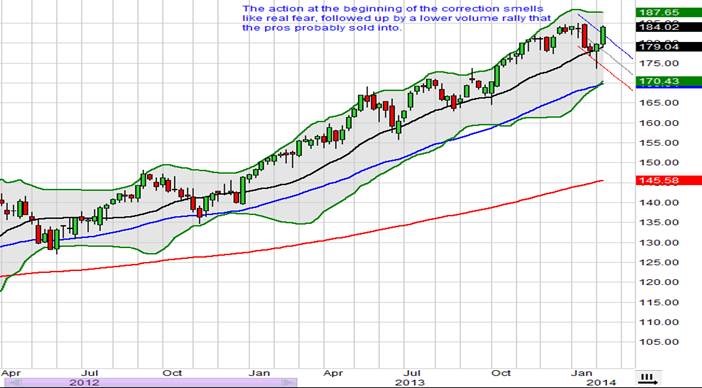
Let’s start by taking a look at the S&P 500, using SPY(weekly) as our proxy, and then we’ll move into some complimentary areas that may help shape the analysis. Bear in mind with Plunge Protection out there and HFT pace-setting through momentum ignition, all analysis is completely nullified should new highs be strongly set and the uptrend is fully resumed. Now prepare to be over-charted.

clip_image002

I think when this correction resumes, we’re looking at an endpoint underneath the 50-Day EMA(blue line). I think it’ll kiss that into the 165ish area before bottoming out. I just don’t believe that a 6% move down is the end of it. In 2013, all the corrective moves capitulated at the Bollinger mid-point. From the wide ranging fear that I observed, that just doesn’t feel appropriate for the correction here to start 2014.

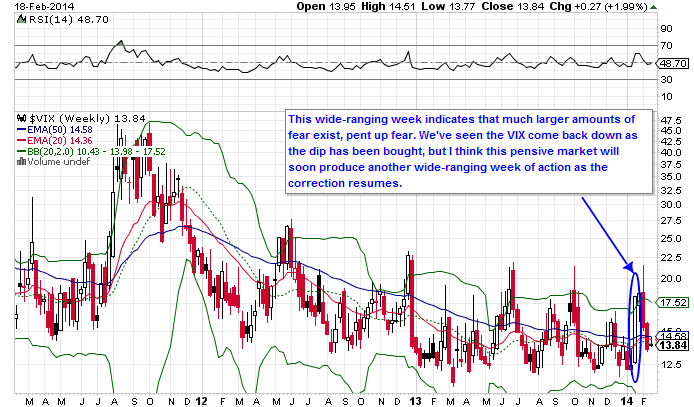
Take a look at the VIX for moment. Yeah, yeah, I know the VIX is played out but it still provides clues as just one chart of many in attempting to get a better feel for market action.

clip_image003

The markets haven’t seen fear like that since 2011. Another one of my favorite indicators, the NYMO, is indicating some further weakness. I’ve previously commented on the NYMO’s ability to help traders get positioned for market action. It’s hitting not one, but two indicators providing a signal for a resumption to the downside. Observe:

clip_image004

I have no worries that the major uptrend will resume after the corrective washout. These markets have been in need of a steam release for some time, but the obvious path of least resistance is upward. Those little exhalations near the end of 2013 essentially counted as non-moves, so a little fear and loathing is healthy for the uptrend to renew with some vigor going into the 2nd quarter. There are a couple of additional asset classes that may potentially shed a little light as to further direction subsequent to the completion of the corrective move. First, there is the yield on the 10-year Treasuries:

clip_image005

Okay, all kidding aside on my make-believe and totally fake “Rhombus of Hades” pattern, a downside move in yields in combination with ZIRP will continue to push market players into equities; especially if that yield pushes much lower to potentially 2.4% or even as low as 2%. I’m not saying that yields aren’t going to go higher in the long-term, just that the near-term outlook is presenting a potentially downward path in yields.

The Nikkei has maintained a fairly solid correlation with the S&P 500 and its action looks constructive as it may be basing for a resumption of its own uptrend. The two indicators below are the MACD and Full Stokes.

clip_image007

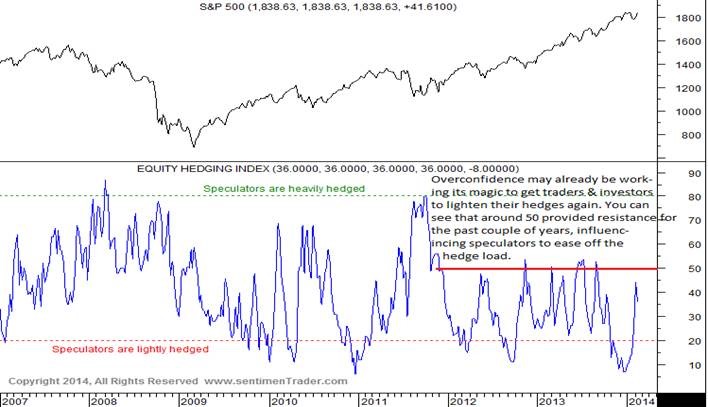
One last set of charts I’d like to share is the Equity Hedging Index(“EHI”). The EHI is one of the many proprietary models that can be found at SentimentTrader.com. It’s a contrary indicator, meaning lower extremes in the chart should produce a rally in the markets and vice versa. The EHI aggregates several inputs such as cash raising, Put purchases, and various other factors in order to construct a usable indicator. For more details, visit the site and take a free trial to see if the service is right for you. As I’ve stated on numerous occasions, I do not receive any compensation from them and I’m quite confident they don’t even know the MarginRich blog exists. Fortunately for my readers, Jason Goepfert, proprietor of SentimentTrader, is cool enough to allow people to republish his work as long as it’s not excessive and the work is credited.

Here’s a current read of the EHI.

clip_image009

And in case you need a visual on how well the EHI has performed in assisting traders see where some of the bigger turns have been occurring, observe the following chart from January 14th, 2014.

clip_image011

It’s not perfect, but then again, no single indicator is. If using technical analysis, it’s best to observe a wide variety of charts and cumulatively interpret them, so that one may obtain a more productive assessment. But this is all rubbish really because bias inherently sways emotions and thought process, and thus the analytical outcome must be considered questionable. If this sort of analysis is all you rely on, such as what I do here for the blog, then more power to you. For the record, before committing my own capital I analyze a broad swath of data; not just squiggles. Occasionally, squiggles may be all it takes to ascertain that a function-able trade has presented itself, but I like to mix fundamental analysis in combination with micro or macro economic reads.

It is decidedly better to test quantifiable inputs to statistically determine, so to speak, probable outcomes when attempting to make valid trading decisions. Have a read of this Price Action Lab blog entry. Based on his analysis, Mr. Harris states that the market is in mean-reverting mode. Long story short, he basically states that the market is fragile and so any suitable catalyst could cause a correction.

My conclusion is that I wouldn’t pick now to be throwing all my chips into the middle of the table as if everything is all clear. There are enough signals out there stating that one should trade with caution, especially if attempting to position long. It may be best to wait in cash, but if you gots the stones and the know-how, then it appears a nice set-up is forming for shorting or Put option strategies.

Before I bid you adieu, just want to let readers know that I’ve created a new link up top called Portfolio Updates. That’s where I’ll be placing the ETF portfolio updates from the January post titled, A Few Sample ETF Portfolios to Watch. I would describe the results thus far as interesting, but not all that compelling just yet. If you haven’t read the article then click the link and have a read, then check the updates to see how they are stacking up.

Are We Gonna Get a Correction or What?!!!

I have called for a 10% to 15% correction since July 30th. Instead, all we’ve seen are back to back 5% corrections. Maybe I can just add them together and claim omniscience. This market just keeps climbing and climbing. BTATFH? It would seem that is the obvious trade du jour, but I just can’t bring myself to not bet against the momentum. My gut tells me to go short. And hell, since I’ve followed tea leaves and chicken bones before why not follow my gut, too. Speculating on your gut is not exactly a profitable path so we’ll get back to a couple of pieces of evidence in support of a short on the S&P 500, in a moment.

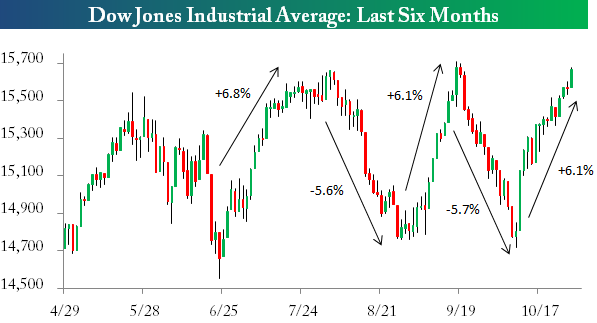
One thing that I think is important to consider when looking for a contrarian stance or to front-run the broader market, is to observe anecdotal evidence. It’s good to just read around the investment universe of websites and try to maybe obtain the aggregate stance. Unfortunately, one’s thoughts are already biased towards a certain action and this is where it is doubly important to consider the source of the opinion. Here’s a stance that raised my radar. Bespoke performed a study and shared the following chart with the market:

clip_image002

This chart was then shared by Jon Markman and Louis Basenese in separate articles days later. Essentially, they stated the markets have plenty of room to potentially run and can run higher than you may think. That’s reasonable on the surface and I agree that this market has plenty of room to run in light of the oceans of liquidity flooding across the earth.

But a 10% to 15% potential correction within a bull just won’t stop nagging at me. For good measure, Bespoke also posted this chart which leads speculators to believe a trend change may be upon us. Doesn’t that last candle look a touch toppy?

clip_image003

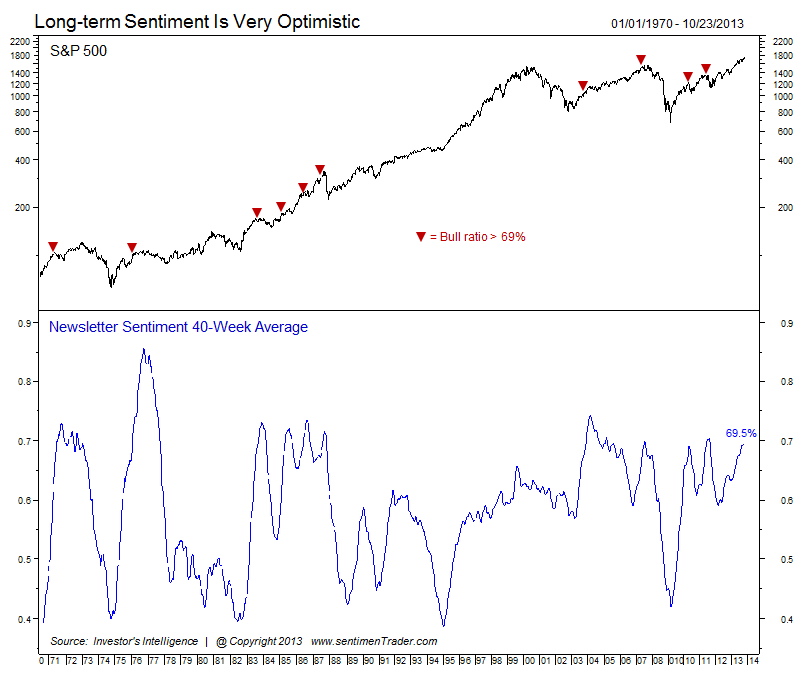
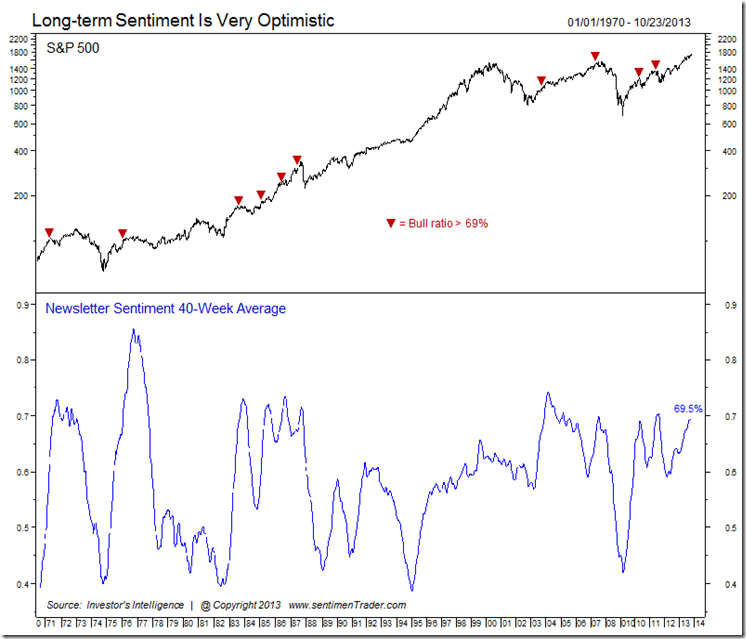
And then there’s the kings of anecdotal, the newsletter writers. The Investor’s Intelligence survey, as a contrarian signal, is leading us to believe that a corrective move may be in the cards for the markets. Observe the following chart, courtesy of SentimentTrader.com.
clip_image004

It shows that a Bull Ratio of 69% or higher is the Mendoza line for this indicator and the last 3 times this number was breached, a correction followed shortly thereafter; including the big one of 2008. As I’ve stated in numerous previous posts, I don’t think a giant crash is in order. Just a let off of some steam and the soiling of some trader’s pants.

Well charts are all well and nice, but I also like to review what some of the top value oriented managers in the game are doing with their cash. Are they building cash levels or allocating to new positions? Cash level buildup by the trusted brains in the value space of asset management is another solid indicator that something may be up. Bloomberg recently ran an article covering that exact notion. Below are some key excerpts from the article sharing the actions and thoughts of money managers such as Yacktman, Weitz, and De Vaulx.

From Bloomberg:
“It’s more fun to be finding great new ideas,” Weitz, whose $1.1 billion Weitz Value Fund (WVALX) had 29 percent of assets in cash and Treasury bills as of Sept. 30, said in a telephone interview from Omaha, Nebraska. “But we take what the market gives us, and right now it is not giving us anything.”

Weitz, whose cash allocation is close to the highest it’s been in his three-decade career, joins peers Donald Yacktman and Charles de Vaulx in calling bargains elusive with stocks near record highs. They’re willing to sacrifice top performance for the safety of cash as stocks rally for a fourth year in five.

“We will need prices to be down 15 to 20 percent for us to put most of our cash to work,” De Vaulx, co-manager of the $9.2 billion IVA Worldwide Fund (IVWAX), said in a telephone interview from New York, where International Value Advisers LLC is based. The fund, which outperformed 54 percent of competitors in the past five years, had 31 percent of assets in cash and equivalents as of Sept. 30, according to its website.

-Yacktman, 72, president of Austin, Texas-based Yacktman Asset Management Co…whose cash level rose to 21 percent as of Sept. 30 from 1.4 percent at the end of 2008, bested 92 percent of competitors in the past five years. “We are having a more difficult time finding bargains,” Yacktman said in an e-mail.

MarginRich here – Seth Klarman of Baupost has raised his cash levels to over 30% when he normally keeps the fund’s level at around 20%. Additionally, he’s planning on returning several billion dollars back to investors at the end of the year, as bargains are scarce.

Steve Romick, of FPA and their $14B in AUM, shared similar thoughts in the FPA Capital Q3 letter to investors:

In a normal year, and clearly this is not a normal year, we would expect to add four or five new companies to the portfolio. Hence, our antenna remains acutely tuned to capture any signal that alerts us to highly attractive investment opportunities, but our equipment is mostly picking up the noise of bull hoofs rampaging wildly as Ben Bernanke pours endless liquidity into the capital market. Speaking of Mr. Bernanke and the Federal Reserve, we would immensely appreciate it if he and his cohorts would explain to the American people what would happen if the Fed stopped buying $85 billion worth of Treasury and mortgage securities every month. Does the Fed believe the U.S. economy would collapse sending all of us into the poorhouse? Do they think the stock market would nosedive and wipeout trillions of dollars of wealth? Do they think interest rates will rise substantially and by enough to snuff out the recovering residential real estate market? If the answer is yes to any or all of the above, then our economic foundation is shakier than many might believe…We continued to take advantage of strong upward momentum in the market place and trimmed a number of positions. When the market is trading at rich multiples, we trim or sell our positions. Currently, the market is expensive so we have more cash than usual. We are absolute value managers so we will stay on the sidelines as long as it takes and husband our cash until excellent investment opportunities become available. On the other hand, we will quickly deploy capital into investments if they are attractive – like we have done on three separate occasions this year.

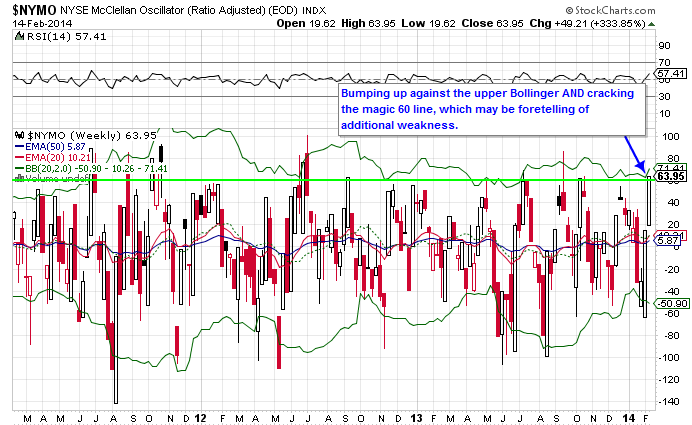
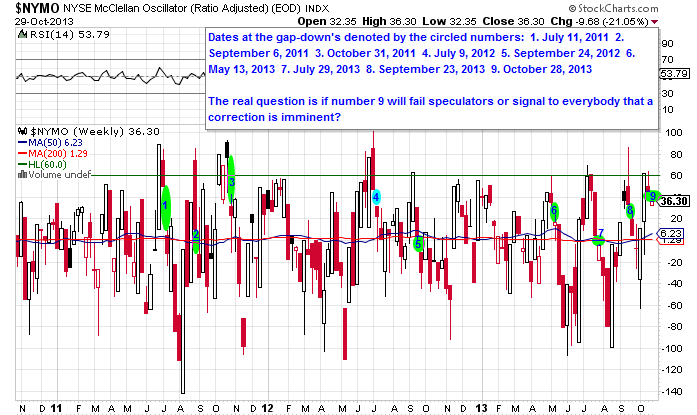
You get the point. There’s a significant amount of compelling anecdotal evidence, but let’s get back to the charts. I was reading an article last week from Stansberry Research, by their in-house trading expert, Jeff Clark. In the piece, Clark extolled the virtues of the NYSE McClellan Oscillator (NYMO) as a timing indicator for this year. I decided to go back a couple more years and gauge the NYMO’s timing ability to the S&P 500. The correlation is quite robust. Observe the following charts of the NYMO and the S&P 500 going back to 2011.

clip_image005

Since November of 2010, almost every time the NYMO hits 60, as denoted by the green line, then the subsequent gap down marked the beginning of a correction. It did not work on July 9th, 2012 and it wasn’t worth using on September 6th, 2011. Still, this indicator could have been traded profitably on the short side in 8 of the last 9 occurrences…and this week marks the 9th occurrence. Are you ready to go short?

clip_image006

I know, I know. Don’t fight the Fed. Don’t fight the trend. Don’t fight the market. I know all these things, and yet like a moth attracted to a light, I just can’t resist the potential of front running a corrective move. I know that waiting for a trend change is the prudent move, but the volatility has consistently swung so quickly this year and whipsawed so violently in some cases, that a hedged trade with a disciplined stop just may be the right move.

Another indicator that should be making traders at least stop and consider is the CBOE SKEW. Over at his Acting Man blog, Pater Tenebraum shared some insightful commentary regarding the option-based indicator that has a knack for front-running the VIX. From the article:

One of our readers pointed out to us last week that the recent strong rise in the so-called CBOE SKEW index should also be counted among the various divergences that make the stock market’s current advance suspect. Skew  measures the perceived tail risk of the market via the pricing of out-of-the-money options. Generally, a rise in skew indicates that ‘crash protection’ is in demand among institutional investors (institutional/professional investors are the biggest traders in SPX options). The basic idea is similar to the CSFB ‘fear index’ or the Ansbacher index (which compares the premiums paid on equidistant calls and puts). A unusual move in the skew index (which historically oscillates approximately between a value of 100 and 150) is especially interesting when it diverges strongly from the VIX, which measures at the money and close to the money front month SPX option premiums. Basically what a ‘low VIX/high skew’ combination is saying is: ‘the market overall is complacent, but big investors perceive far more tail risk than usually’ (it is exactly the other way around when the VIX is high and SKEW is low). In other words, a surprising increase in realized volatility may not be too far away. Below is a chart showing the current SKEW/VIX combination.

clip_image008

MarginRich here again – It should also be noted that 135 is the sort of magic number for the SKEW. Generally once that level is breached, then the potential for some action really heats up. So if you agree with what you have read here today, then the only question is how to structure a trade. There’s the old straight short of the SPY. You could sell some Calls and fund a Puts purchase. Or who says you have to specifically trade the information? Maybe you decide to take some risk off of the table.

Above all else, I recognize that the analysis could just as easily be nullified instead of confirmed, which would simply make this article entertaining(or annoying) and me wrong once again. If the index continues to set more all-time highs and breakout to another stratosphere, then the analysis is negated. None the less, with full disclosure, I intend to structure a trade off of this data.