Hardest Time in History to Speculate

One of the themes I continue to hit on is the importance behind attempting to fill one’s noggin with as much knowledge as possible, so as to attempt to speculate as intelligently as possible. No easy task considering the quantity and depth of material that exists. I wanted to provide a couple of recent examples of what the average amateur speculator is up against from the world of professionals. Keep in mind that these example-providers aren’t billionaire fund managers; just investment professionals who operate successful businesses and publish outstanding investment blogs.

The first example is from MercenaryTrader.com. In my previous post I touched on an idea regarding the Baltic Dry and the potential for some short ideas. It turned out to be correct, but was it luck or quality analysis? I can’t truly quantify how I came to the decision. I review certain indicators. Observe past price action. Note the extremes and their duration. Extrapolate data and choose to establish a play. My analysis shared on MarginRich was not exactly deep, especially when compared to the MT team’s post titled, Tanker Stocks Have Triple-Digit Upside (If They Survive). A little self-deprecation is in order when I say that their analysis of the Baltic Dry and the dry shippers makes my post look like a donkey wrote it. The MarginRich post may have been prescient but I wouldn’t exactly give myself an A+ for thoroughness. All the same, I just wanted to briefly provide a tradable idea for readers. Mission accomplished. And in pointing out MT’s article, I am looking to illustrate the analytical skillset of what the average amateur speculator is up against.

The second example is from the Price Action Lab blog. Michael Harris is the creator and proprietor of Price Action Lab software, which is geared to the professional speculator. The software allows for systematic, algorithmic trading which is very simply the trading world we live in today. I don’t utilize an algorithmic approach which is probably very hazardous to my financial health, but I also don’t blindly follow patterns recognized 80 to 100 years ago and fully exploited by the 80’s and 90’s. A double-bottom or a heads & shoulder may be indicating something or the pattern may just be telling you that you’re about to get your face ripped off. That’s where the ability to fundamentally assess an equity or truly evaluate the macro-economic outlook for a particular ETF or commodity can provide a potential edge when going up against the algos. Mr. Harris provided a great illustration of that utilizing Google in his most recent post, Naive Chartists Get Crashed Shorting Google.

Defining your edge and ensuring it is truly robust is more important than ever if you’re going to play the game. Thousands of hedge funds sprang up between the late 90’s and now…and thousands have closed up shop. Even really and truly bright fund managers with a great educational background combined with an advantageous family lineage are consistently getting burned, having to pay out and close up. Don’t agree with my post’s title heading? Here’s some content from an interview with Stanley Druckenmiller that made its way around the web during the summer. The interview content is courtesy of ZeroHedge via Hugo Scott-Gall of Goldman Sachs. No matter what you think of his political ideologies or anything else about the man, Druckenmiller’s success speaks for itself and his commentary is always worth a listen. Druckenmiller states about speculating:

It has become harder for me, because the importance of my skills is receding. Part of my advantage, is that my strength is economic forecasting, but that only works in free markets, when markets are smarter than people. That’s how I started. I watched the stock market, how equities reacted to change in levels of economic activity and I could understand how price signals worked and how to forecast them. Today, all these price signals are compromised and I’m seriously questioning whether I have any competitive advantage left. Ten years ago, if the stock market had done what it has just done now, I could practically guarantee you that growth was going to accelerate. Now, it’s a possibility, but I would rather say that the market is rigged and people are chasing these assets, without growth necessarily backing confidence. It’s not predicting anything the way it used to and that really makes me reconsider my ability to generate superior returns. If the most important price in the most important economy in the world is being rigged, and everything else is priced off it, what am I supposed to read into other price movements?

For most it is simply not practical to be actively managing your funds. Now with the recent announcement of the dismal science Nobel winners, EMH and passive indexing are making the heavy rounds around the web. For good reason too, when you consider all the recent performance data. There is always more than one way to skin a cat and the truly resourceful(but “un-utilityful”) will continue to discover profitable ways of moving money around to generate profit. Build your knowledge base, simplify your financial life, and find that edge if you really think you have the chops to beat the market.

Prediction Record Thus Far and a New(er) Observation

Thought it might be a good idea from time to time to review the MarginRich prediction track record. Not every post has a prediction included, but for what has been put out there, I might as well provide a quick once over on the results. It’s not something one see’s too often from un-skin-in-the-game blogger-types who simply publish their thoughts and then move on to the next prognostication. As previously stated, I don’t profess to have any clairvoyance. I simply read the tape and share my thoughts. With that being said, the MarginRich site is currently 4-1-1 (with the oil call being essentially flat). Here’s the exact record:

1. TM – Winner
2. EEM – Winner
3. GLD – Winner
4. SPY – Winner & Loser: Predicted a correction in the S&P 500. It corrected approximately 3% but then went on to make a new high, and yet here we are in slight correction mode again. The downward energy is being stifled and that can be a dangerous thing to contend with.
5. WTIC – Flat for the most part; ostensibly range bound with no hard breakouts to the upside or downside since the post
6. FXA – Loser: However, may have just been early…aka wrong. Believe me, I know.

And as for Japan’s equity market and gasoline, there weren’t any predictions made in regards to their price movements. There were only simple observations put forward for the reader to consider. So to recap, 4 out of the 6 were in the money while oil and the Aussie dollar still present opportunities. Now onto another opportunity…

Once upon a time, long, long ago before the price discovery mechanism for virtually all markets was distorted beyond belief, there was an index that credibly served as a sort of “canary in the coalmine.” It’s canary-like qualities have ceased to function as a viable predictor of economic direction but there are still opportunities to be garnered from the late, great shipping index known as the Baltic Dry. Now even if the index is less than robust in providing leading intel on economic direction, a parabolic move is still a parabolic move, and one can see in the YChart below a rocket ride in index pricing. The breakout occurred during the week of August 23rd, but the real upward explosion occurred about a month ago exactly.

clip_image002

Now gravity has a funny way of bringing rocket rides back down to earth. The Baltic Dry may be legitimately breaking out as supply/demand fundamentals across the pricing space in shipping may warrant a move higher. My guess though is that a little steam is going to have to be let out first. This will of course affect the shippers, whose own shares have enjoyed nice upward movements as well by riding the BDI rocket. Observe the following YTD charts of a few prominent shipping companies (for the record I suck at inserting small, clear snapshots but the companies are EGLE, GNK, & DRYS):

clip_image004clip_image006clip_image008

We’re talking over 100% moves in a matter of weeks. Now the average speculator probably missed these moves which have no doubt been driven to the extreme by every investor’s best friend to true price discovery…the high frequency trader. It makes no difference. The algo’s are programmed by humans and extremes have been reached. So if you missed out it appears we now have the BDI beginning to peter-out a bit, and the opportunity to go short has presented itself. For myself, I played DRYS cold off the charts because it went from heavily range bound, unlike the other two, to an absolute take-off. As luck would have it, they announced a financing and thus the market sold it off bringing the play into the green before any true downward momentum can truly factor into the trade. The BDI has been covered extensively around the web for the past 4 weeks so anybody looking in the right corners (hint: links under Some Favorites) could have easily joined in on the fun, even if you weren’t scanning via your charting software or subscription.

It’s a bit tricky to be trading right now off the tape. There’s nothing wrong with sitting on the sidelines in cash while the action defines itself…but where’s the fun in that? Oh yeah, it’s in the protection of your capital and safety in principal. Naturally, there’s money to be made long or short but just to help disperse a little more fear for the long-only’s, here’s a few charts courtesy of CitiFX, Kimble, and ZeroHedge that communicate a message of caution.

CitiFX:clip_image009

Kimble Charting Solutions:clip_image011

Zero Hedge:  Top Chart – 2007, Middle Chart – 2011, Bottom Chart – Currentclip_image013

Now that you’re sufficiently scared of a major market correction, understand that now may be an appropriate time to take some risk off of the table or add additional hedges where appropriate. In a previous post, I had stated it appeared as if a 10% to 15% correction may be in the cards and it doesn’t seem as if we’re quite out of the woods yet. The big debate on the debt ceiling in conjunction with comments from bankers and financial thought leaders has helped to produce even more fear. Stay sharp.

Read, Read, and Read some more. Good luck out there.

Burning Trash – It’s the Green Thing to Do

Were you aware that waste to energy (WTE) also known as energy from waste (EfW) is considered a “green” renewable energy source by the EPA? Yeah, it’s not exactly earth shattering news as the past 10 years have brought many advances in this field. In fact, incinerating municipal waste or biomass has been in use since the 1880’s with the advent of incinerators. Air quality control standards were just a touch lax back then and for approximately the next 75 years. In fact here’s a quick history lesson, courtesy of the EPA:

The first US incinerator was built in 1885 on Governors Island in New York, NY. By the mid-20th Century hundreds of incinerators were in operation in the United States but until the 1960s little was known about the environmental impacts of the water discharges and air emissions from these incinerators. When the Clean Air Act (CAA) was enacted in 1970, existing incineration facilities became subject to new standards that banned the uncontrolled burning of municipal solid waste (MSW) and placed restrictions on particulate emissions. The facilities that did not install the technology needed to meet the CAA requirements were closed. Combustion of MSW grew in the 1980s, with more than 15 percent of all U.S. MSW being combusted by the early 1990s.  The majority of the non-hazardous waste incinerators were recovering energy by this time and had installed pollution control equipment.  With the newly recognized threats posed by mercury and dioxin emissions, the EPA enacted the Maximum Achievable Control Technology (MACT) regulations in the 1990s.  As a result, most existing facilities had to be retrofitted with air pollution control systems or be shut down.

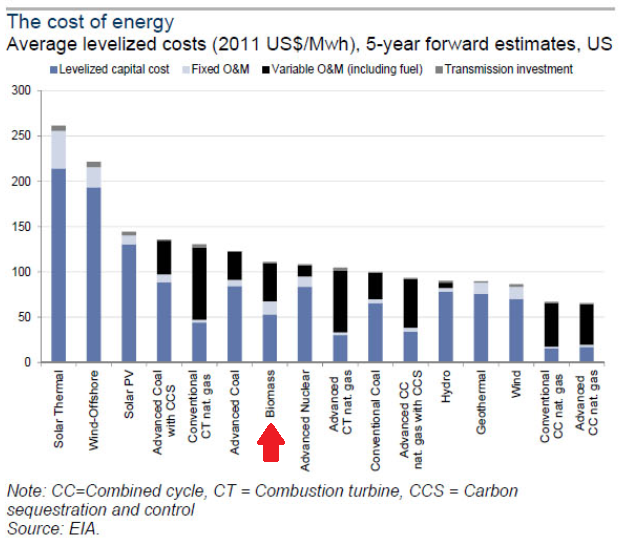
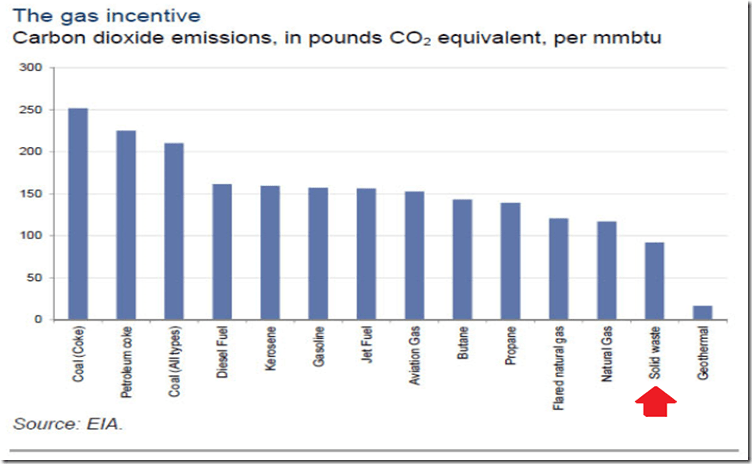
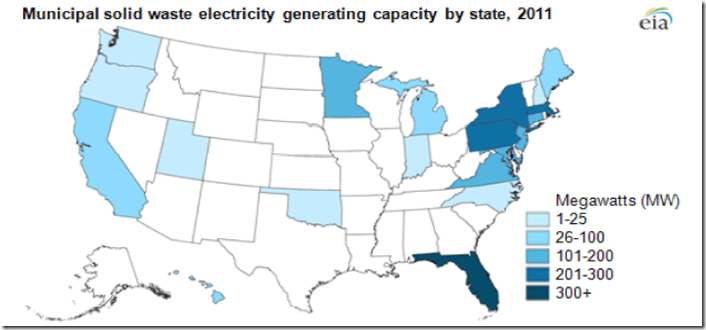
There. Now you know everything there is to know about the history of burning waste for the provision of energy. I’ve always been intrigued by the notion of WTE. Not that I’m fascinated with trash and fire, but you have to admit it’s a neat concept that kills several birds with one stone. Back in August during my daily travels around the web, I came across some particularly interesting charts regarding CO2 emissions and costs by energy source. Observe the following pair of charts courtesy of ZeroHedge via Goldman via the EIA (a division of the DOE).clip_image001Solid waste? I thought for a second that it couldn’t be right, but the reason that waste is considered such a “clean” source of energy is because solid waste does not include all types of trash. Obviously tires and plastics or any other sorts of waste generated from petroleum are not included in that category as they are not renewable. Then there’s the cost in USD per megawatt hour in the chart below. You can see that biomass incineration is not all that more expensive than some of the recognized cheaper options that we are all familiar with, such as conventional coal, some forms of natural gas, or nuclear. Hell, it’s never going to be cheaper than wind or hydro but it’s not terribly more expensive either, considering the additional benefits garnered. Hydro or wind don’t help to decrease landfill space utilization or provide recyclable ferrous and non-ferrous metals. The ash leftover from the process takes up approximately 10% of the space in the landfill that the un-incinerated waste would have utilized.clip_image002Now I know that you may be thinking that isn’t biomass wood pellets or other organic forms of energy sources, such as waste from the wood mills or agricultural residues. Sure, but the biomass class of energy also includes the biogenic waste that gets tossed out with all the rest of the trash on a daily basis i.e. recyclable paper products, food waste (which us Americanos are notorious for), yard clippings, etc. There seem to be more pro’s compared to cons for an increased employ of WTE technology in the US. Why is it that there is only about 90 WTE plants in the US, with the vast majority concentrated on the east coast? We have about 90 of these facilities for approximately 300M people but the European Union countries have about 400 WTE facilities for their approximate 500M people.
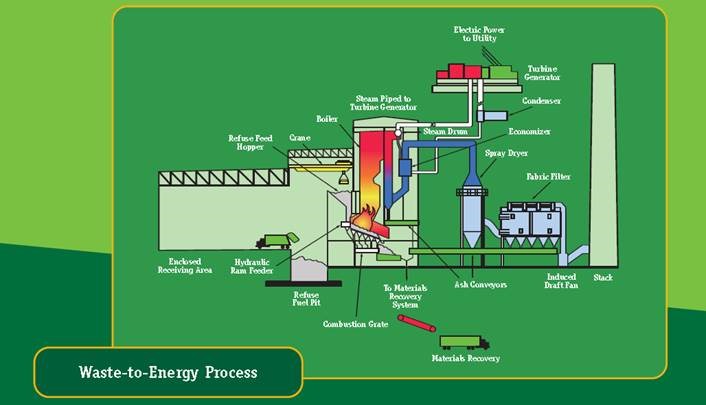
It just seems to me like there’s an opportunity there for cities, counties, or states to take advantage of the multiple benefits of utilizing WTE facilities within their jurisdictions. The following chart, from the EIA, depicts America’s total disregard for the WTE option (there’s a lot of white):clip_image003The Clean Air Act amendment back in 1990 essentially forced the hand of the WTE industry to shape up the emission standards which is how the energy is now considered renewable. It’s not just about CO2. The dioxins and furans, which are so toxic, and yet were so prevalent previously are virtually a thing of the past with current emission technology. Compliance with federal regulations for emission standards set the stage for WTE facilities, which now employ multiple levels of filtration during the process and through the flue stack to generate a “clean” emission. Here’s a picture of the process, courtesy of Waste Management:clip_image005The technology advancements in the final stages of the process are truly remarkable. And I absolutely refuse to believe the lack of facilities is about the economics of constructing a plant that renders the WTE option unfeasible for so many cities and counties. I recognize that every municipality has their own financial situation to deal with but what about all the damn sports stadiums built at a cost of a billion or more over the last 20 years. The taxpayers generally fund a considerable portion of those stadiums. Those stadiums do bring jobs, tax revenues, and often tourism to the community but they provide virtually no benefit in the form of carbon footprint reduction, power generation, or metals recovery. For the most part, it would seem as if the major culprit behind the lack of WTE utilization in the US is politics. It’s a general statement but I’ll provide you with a perfect recent example.
The city of Cleveland, as of the summer of 2013, shot down a plan to commission a WTE facility. The facility would have cost $180M, which breaks down to approximately $782 per ton of waste annually. That’s actually on the lower end of the cost scale when compared to international WTE facility cost analyses. Now when you factor in 30 year contracts for trash haul and power generation combined with a captive audience for your customer base along with materials recovery, you’re telling me the economics can’t work? Can Cleveland do any worse in the management of their municipal waste at this point? Anybody can go on the city site and take a quick look at the 2011 books (the last available) and see that the city’s Division of Waste Collection and Disposal had revenues of $14M against expenditures of $24M. Now I ain’t exactly tip-top on my governmental fund accounting, but the last I checked that was called a deficit of $10M. Money couldn’t be any cheaper right now so it can’t be the cost of capital for a city the size of Cleveland and a potential bond issuance, with A1, A2, and A3 ratings by Moody’s for a series of bonds. What about equity partnership? Certainly Waste Management, Covanta, or Veolia would be a viable partner with plenty of access to capital and resources to facilitate funding. How about private equity? The revenues would be very small to the comparative asset base for players such as Brookfield Asset Management or Blackstone, but access to guaranteed income streams that could perform in the face of potential inflation are pretty attractive investment options these days for plenty of players.

Ultimately, it comes downs to politics. A certain group of constituents, armed with all the wrong information but definitely all the right votes, voiced their opinions loud enough to get the project essentially declared dead. No doubt after the city had wasted hundreds of thousands of dollars or potentially millions on those “oh-so-important” consultants exploring WTE project options to cover the rear ends of anybody involved…gutless councilmen, city planners, and the like. I find it hard to believe that the biggest cities in Denmark, Germany, France and the other Euro area players have such different information about emission dangers and are so much less informed than Cleveland and her constituents.

While we’re on bad politics and just to beat a dead horse even deader, what about all those lame-brained schemes by Obama’s boys at the DOE to fund all those ingenious solar power and electric car operations? Let’s just do a quick run-down and see how the costs of those mistakes compare to Cleveland’s potential WTE facility.

1. DOE loan of $529M to Fisker Automotive in 2009 – TOTAL LOSS
2. DOE loan of $527M to Solyndra in 2009 – TOTAL LOSS
3. DOE loan guarantee of $400M to Abound Solar in 2010 of which only $68M was drawn – TOTAL LOSS
4. DOE loan guarantee of $2.1B to Solar Trust in 2011 of which none was drawn; but proves ignorance of the administration in making “green” capital allocation decisions
5. DOE grant of $249M to A123 Systems of which $130M had been granted as reimbursable expenses – TOTAL LOSS
6. DOE grant of $118M to Ener1 in 2009, bankrupt in 2012 – TOTAL LOSS
7. DOE grant to Ecotality of $133M, bankrupt in 2013 – TOTAL LOSS

Apparently, it never occurred to the current administration to seek out high potential WTE opportunities across the US that I’m positive could have benefitted from some of that money that was essentially flushed down the toilet a few years back.

It’s amazing how a rant can sort of take on a life of its own in one’s brain. Anyways, from an investment standpoint there isn’t a whole lot of compelling options. Covanta is by the far the number one WTE player in the US with approximately 50% market share. A distant second, you have Waste Management but they are more focused on the gas produced from their landfills, for which they definitely have the dominant position. WTE plants aren’t really WM’s thing. Veolia has an incredibly large international presence but they are highly focused on water and municipal transportation management in the US as opposed to WTE. The political aspect leaves the players in the game of WTE almost too much at the mercy of others.

However, from a pure investment standpoint Waste Management presents a long-term compelling opportunity because of its overall market share in the trash space and consistent cash generation. Even if we’re only talking about WTE then Covanta does have its merits. Sam Zell is the Chairman and largest shareholder. Marty Whitman, of the Third Avenue fame, has a huge chunk. They have a little under $400M in NOL’s to utilize and they consistently generate over $200M in free cash flows, which is enough to service that fairly large debt level compared to their current cash level. The dividend yield is around 3%. Aside from those merits though, is the fact that the short percentage of the float is over 10%. Plus, a lot of the normal valuation standards show that it’s a little bit rich at these prices and ROE suggests potentially poor allocation of capital by management.

The point I was trying to make was not to expound on the investment merits of the WTE space. Instead, I simply wanted to share my curiosity as to why WTE’s American presence is so weak. Why is this not a higher growth industry? There are only a handful of points presented here behind my marked bias, so if you’re interested in obtaining a bit more depth in the WTE industry or the companies therein then get out there and do some research.

Read, Read, and Read some more.

A Quick Market Update With Some More Low-Rent TA

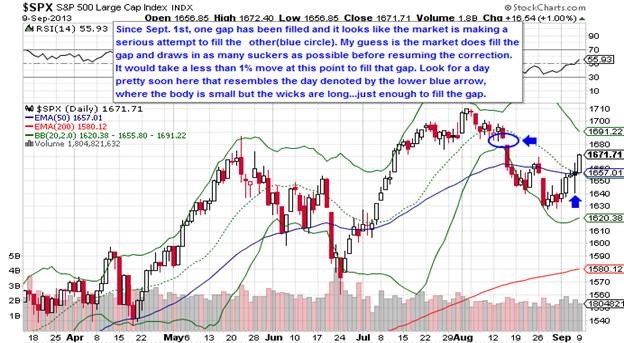
Well it would appear as if we are in the middle of the meal of that correction stew, so there’s no better time to use some more drugstore technical analysis and see if the chicken bones(or tea leaves if you prefer) can give us a little hint on further direction. Observe the first daily chart of the S&P 500:

clip_image002

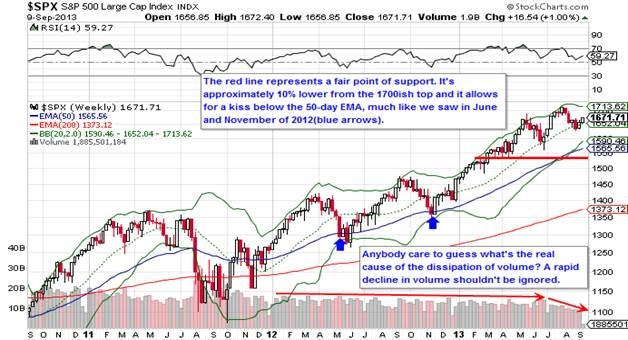
The market’s power to fill gaps never ceases to amaze me. Gap-fill is a very tradable concept. Fair warning that I shouldn’t have to provide but will anyways, gaps don’t always fill so please don’t take the previous comment as some sort of end-all-be-all rhetoric on the ability of the market to “always” fill gaps. That being said, gaps do seem to get filled a fair amount of the time. Now if we move down to the weekly chart of the S&P 500, we’ll see one potential ending point of this correction.

clip_image004

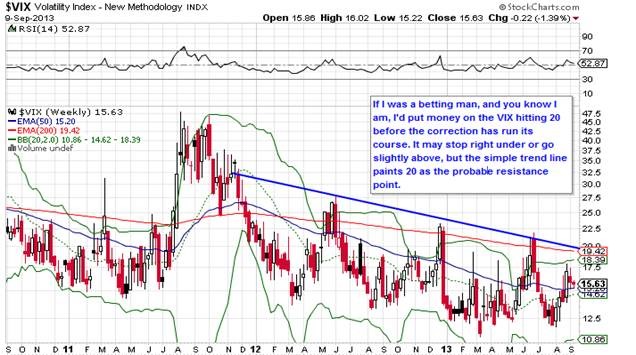
Now that you know where the correction ends, just buy your near term $1,530 Puts on the SPY and pair them with some near term Calls on the VXX at $20. It’s guaranteed to work. Just kidding of course, but there’s nothing funny about that precipitous decline in the volume of the S&P 500. It starts seriously dropping off in June. Want to take a stab at false correlation as to the reason for the drop in volume? Allow me: 1. HFT 2. Real Wall St. players are on holiday 3. Threat of global nuclear war as the US conducts an “unbelievably small” strike on Damascus. Or maybe those are all correct reasons in combination with each other. Irrespective of the cause, the drop in volume is worth noting. If you’re actually considering that pair trade with the VIX, then get your brain checked, but also consider the chart below of the VIX:

clip_image006

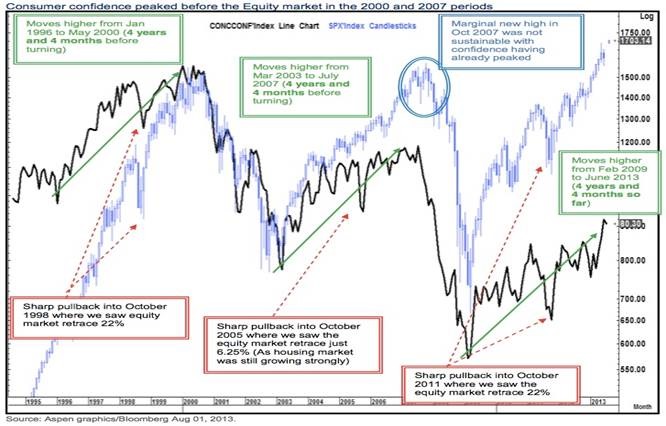
The VXX is the VIX equivalent so it tracks closely enough for a bet. The following chart is from Tom Fitzpatrick & team at Citi and is decidedly un-low-rent. It examines the correlation of Consumer Confidence to the S&P 500 from 1995 to the present. It was posted at multiple sites I frequent but since I saw it first at KWN, I’ll hat-tip Mr. King. It looks fairly foreboding for the market similar to the Debt Margin chart I shared in the “correction stew” post. I’ll reiterate that I think if these charts(CCI & Debt Margin) are painting a picture of a serious down-move similar to 2000 and 2007, then they are very early. None the less, the chart tells a very interesting story.

clip_image008

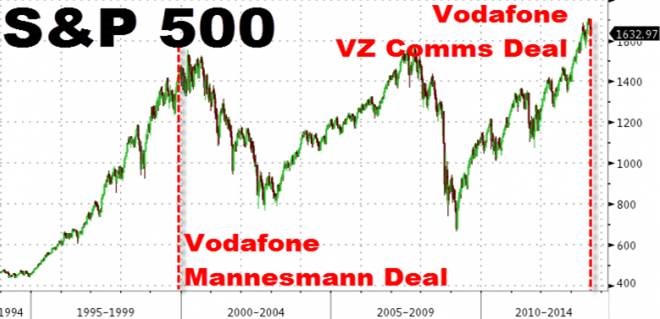
Recently, Vodaphone and Verizon completed the biggest M&A transaction in the markets since well Vodaphone and Mannessmann back in 2000. The chart below, courtesy of Zero Hedge, shows the market action of the S&P 500 subsequent to the 2000 mega deal, denoted by the first dotted red line.

clip_image010

So obviously, this 2nd Vodafone deal signals the top and you better sell everything. Move your 401k’s, 403b’s, Keogh’s, and IRA’s to bonds and bond funds because the end is nigh. Get out of stocks because this M&A indicator has spoken. I love charts like this that can be interpreted in such an extreme way by the unsuspecting user. Are stocks a value at these prices? Do we have a multi-year run left in the stock market? Is it in the early stages of a big secular bull start like in 82? Nobody has any answers. Just continue to utilize sound strategies that fit within your investment/speculating comfort zone; and when visiting sites such as MarginRich, make sure to take any message with a gigantesco grano de sal and you’ll be okay.

Read, Read, and Read some more. Good luck out there.

Fear of Patience or Haste? Some Light Reading May Be Just What You Need

One of the notions I come across in conversations regarding the game of investing is the fear of making mistakes due to missing out(lack of action) or not waiting long enough(lack of patience). Bear in mind, we’re not talking about seasoned investment professionals(including myself). Oftentimes, this person is like many other hard-working individuals just trying to build something for the future. For the most part, that fear is completely unfounded as it generally stems from a person’s desire to invest or speculate outside of their competence levels. Why do people do that? Greed? Idiocy? Hubris? Ignorance? Naiveté? Who knows, but it definitely occurs on a daily basis with the retail set.

Two qualities that help to destroy the fear are knowledge and experience. With a healthy foundation of knowledge laid comes confidence. When combined with practical experience, one gets that level of seasoning that can lead to consistent investment success whether one is a pro or amateur. You may be thinking to yourself, “But I don’t have an MBA in finance from Wharton.” So what. Neither do a lot of successful professional investors. You going to work on Wall St.? No? Then who cares. There’s an endless supply of readily available books on everything one needs to at least complete the knowledge-half of the equation to start gaining investment confidence. The experience-half of the equation simply comes with practice, which obviously comes with time and repetition. Do you care enough about your financial future to put in the requisite time?

It all starts with one book, and if you really catch the bug, then it’ll turn into dozens or hundreds as you endeavor to consume as much information as possible to round out your self-education. Feel free to visit the MarginRich Books & Educational Content link at the top of the page(or click here if you suffer from acute wrist fatigue) to see some of the books that had the most positive influence on my own investing or speculating abilities. One can argue that there are better books or I should have read more economics or history or whatever. That’s true, but based on the population of books I have read so far, these had the most impact. When combined with regular perusal of relevant sites on the WWW, one can begin to reach that comfort level with taking appropriate action at the appropriate time based on a quality base of knowledge. Obviously, it’s my opinion that the list of links in Some Favorites off to the side or at the bottom on a mobile device, is a great place to start for web sources of relevant market information.

It is my experience that most people are simply too lazy to take the time to read or research. That’s why they listen to their Fidelity 401k advisor or their 2-bit Schwab financial advisor and wonder why they get average returns. It’s certainly true that just passively indexing in the recent past would have blown away many “complex” strategies, but any real downside protection is effectively eliminated in a down-move bust of the regular market cycle. Strategies really come down to timelines, so whether your horizon is way out or just ahead, it pays to be financially educated enough to truly take matters into your own hands. Building the foundation of knowledge and continuing to add to it will allow one to see value when it truly exists or determine extreme levels when potential outcomes are stretched; hence the tagline at the bottom of all the missives of “Read, Read, and Read some more.”

And let’s not forget the blue-blooded, Ivy League knuckleheads, allegedly the most educated financial professionals on the planet, that virtually blew up the whole system. I’ll never be convinced that it takes their magical, special sort of smarts to run a billion-dollar portfolio for an elite bank or large-scale insurance company and idiotically allow an excessive amount of funds to be gambled in the complex universe of the most esoteric derivatives all over the counter without any central clearing or oversight what so ever to potential worldwide ramifications. GTFOH with that! These fools almost blew it all up once, and you can be sure, the next time they’ll succeed…but life will go on and markets will continue to exist. Pick up a book you’ve been meaning to read and start perusing it. Whether it’s about investing or economics or history or anything, as long as it’s going to positively impact your overall investment skill set. Just…

Read, Read, and Read some more. Good luck out there.