Who’s Got 2 Thumbs & Went Out Like a Chump Last Week…

So if you read my article last week on handicapping, you might have thought that I might know a thing or two about betting on college football. My proclaimed, private record against the spread to start the season was stellar, but as soon as I go on the public record; my skills were a dud. It happens from time to time. Much like in trading, risk management is paramount so that you don’t wipe out your wagering stack in one weekend of idiocy.

Out of the 14 NCAA football picks I tossed out there, assorted between against the spread (“ATS”) and over/under (“O/U”) straight up bets as well as some parlays, I managed to choose a whopping 6 correct for an earth-shattering win-rate of 42%. For the 3 NFL picks, I only nailed one. Feel free to do the win-rate math in your head on that. Pretty damn weak stuff and it was enough to piss me off into posting this week with some more public picks, simply to assuage my own embarrassment. Whether I biff this weekend up or not, this’ll be the last public post(for awhile at least) on handicapping football.

There’s a few incidental details I’d like to share before posting my picks for the week. In regards to the 13 teams I follow as my ATS horses, they went a collective 6 – 3 last weekend. I’ll take a 67% win rate any time, anywhere. For the season thus far, the 13 teams are a collective 36 – 11 ATS. That’s a 76% win rate for you arithmetically challenged. Several of the teams have already had byes which is why the game totals do not equal 52. Now I gave you 5 of the teams in that last article. If you’re interested in the other 8, feel free to do the research.

Another annoying fact for me last week, was that I shared only my real-money picks. It’s very difficult to make good money picking 40 – 50 games and making 25 bets. It’s just not gonna happen. You have to be selective and so what I shared were what I thought were my best ideas. However, I also maintain a non-money weekly listing of total picks for the NCAA’s and the NFL, just to test my handicapping skills across a larger sample of games. Have a look at how I did in my real-money plus non-money picks for the NFL.

Total Picks from last weekend including the real money picks:clip_image001

Again, these totals also include the real-money bets. There was only 1 college game I did not bet on and that was the Oregon game to cover. Good thing too as Mike Leach always seem to have those damn Cougars prepared for the big games but overlooking any small fry. Anyways, what really jumps out is the sea of green on the NFL side. I made 11 correct calls last weekend in the NFL for an 86% win rate. Unfortunately, I only bet 3 in a parlay and of the 3, two of them were my only incorrect choices. It takes real genius to pick winners and only place money on your losers. Normally, I’m pretty average at NFL handicapping but as the saying goes, on any given Sunday I may have a breakout weekend. This of course leads to a false sense of security due to misplaced hubris and the subsequent weekend tends to bring me back down to earth.

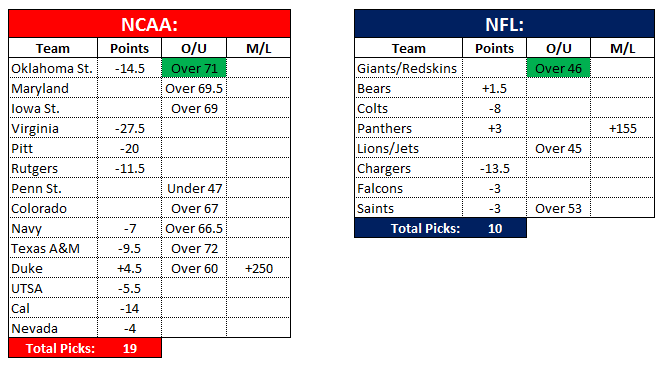
Well, enough complaining about my sub-par performance last weekend. Here’s this weekend’s real-money-only picks and total picks.

1. Real Money:clip_image002Remember, these are real money picks that are bet either straight up or parlayed.

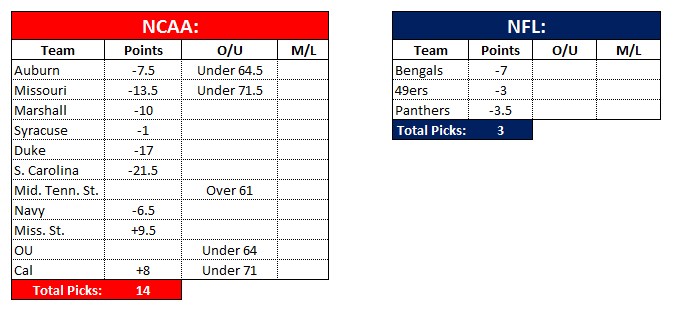
2. Total Picks(including real-money and non-money):clip_image003

You can see that I went 1 – 1 already this Thursday in the real money and 2 – 1 in the total picks. Oh yeah, I almost forgot to mention the locks of the week. The locks of the week for this weekend are the over in the Baylor/Iowa St. game and the Falcons at minus 3 over the Vikings. Better tread carefully with those so called locks though as last week I went 0 – 2 with each “Lock of the Week.” Well I hope you enjoyed this little break from the finance game. With the markets showing weakness there’s plenty to comment on. I hope you raised your cash levels like I’ve commented on in the past several months. There some juicy ideas getting juicier for some long positions. Enjoy your weekend.

How’s Your Handicapping?

Most people hear the word handicap and instantly think of golf, but not us degenerates of the world. We hear handicap and we think spreads, over-unders, and money lines. Betting has as long of a tradition as you’ll find. It’s probably not older than prostitution, but as far as entertainment vices go, wagering has millennia under its belt.

If you want a discourse into the history of sports wagering, have a stop by this site. It’ll give you the skinny with an easy-to-read little comprehensive history of sports gambling. I just want to talk college football today. It’s the only sport for which I truly indulge my gambling urges. I put a little action on the NFL, too, but the asymmetric opportunities are simply not as prevalent as the college version.

So for any US readers that are unaware, sports wagering is currently only occurring in Nevada, Jersey, and Delaware. Technically, it’s legal in Montana and Oregon as they were grandfathered in during the passing of the PASPA aka the Bradley Act back in 92. Sporting events that are exempt from the act are horse racing, dog racing, and jai alai. Everyone else has to lay the casual wager against friends or family or use a bookie. As I stated before, here at Marginrich.com we do not condone nor endorse any illegal or unsanctioned sports wagering. However, human beings are going to be human beings and a bookie isn’t that hard to find.

Just be careful who you deal with. I probably wouldn’t lay any cash with Sal from Queens and his 200% vig. Plus, you don’t wanna a visit from Carmine, Sal’s 6’5 350lb knee-breaker who collects weekly. So if you really want to gamble on sporting outcomes, then be resourceful and be smart.

Now back to college football handicapping. For the sake of an all-encompassing reference, the bookmakers I’ll be referring to are the Vegas casino sports books. Their odds are readily ascertainable on dozens of websites. In just a moment, I’ll get to some useful sites to utilize as resources.

You have to understand that in going up against the books, it’s like traders going up against high-frequency trading shops. The books utilize advanced algorithms to determine their lines. Additionally, the most sophisticated bettors and betting syndicates all utilize sophisticated, algorithmic systems for determining opportunities. Despite that, the books can still be beaten regularly. First and foremost, you have to possess fairly in-depth knowledge of the sport. You can’t be laying money down and winning 55% plus without a solid knowledge base from which to work.

The devil is always in the details. You need to know the make-up of a roster before the season begins. How many starters return? What key positions? Are they Seniors? Is the coach new and what’s his experience? How was the recruiting class? Is this a rebuilding year? Will the formerly pass happy offense be shifted mainly to a ground attack in light of lost personnel? These are just some of the basic questions you have to explore and answer to establish a base from which to move forward from in handicapping against the books.

From that base of information, then you can obtain all the wagering statistics of any team that you need from a multitude of sites. My personal favorite website for college football is VegasInsider.com. Now this site alone has darn near everything you need to successfully wager against the books. Of course they have all the odds, but they also provide free insight into a great many of the games for the week. You can find Against-the-Spread (“ATS”) records and ATS trends for various factors such as: road or away, coach’s time in position, or performance at a stadium. This really is my number one resource for college football handicapping help.

Another must-reference site is Covers.com. It provides an easy to read PDF sheet listing all the week’s match-ups along with average scoring when home or away as well as the ATS record. Even the casinos offer this sheet up free of charge to patrons who manually pick up the sports book’s betting sheets. Rivals.com at Yahoo is very handy for getting quality information at a site dedicated to a specific college team. There you can find more specific updates on a team’s activities leading up to the game. Finally, I check the SportsConnection site, courtesy of Station, for quick injury updates on any key players. You don’t want to be laying money blind on a team that is sitting a star player or just lost someone for the year during a practice. There are dozens and dozens of sites for you to enhance your handicapping ability. These just happen to be my 4 go-to sites. Additionally, The Wiz of Odds is a very handy resource as sort of a catch-all site that offers up a little bit of everything for the bettor.

Now armed with a load of information, you’re ready to take on the books. Even if you don’t have the last 60 years’ worth of data or complex databases crunching everything for you, the brain will suffice to process enough relevant info to win more than you lose. Remember, the sports book is not trying to get everybody to lose so they can keep all the money and pay nothing. Sure it’s nice when bettors lose, but the books are trying to maximize the total amount of bettors laying action every week. That way they maximize their commission which is built into the payout structure. They have to toe the line on odds closely enough to draw the bettors in but can’t make it so hard to win that bettors take their funds elsewhere or stop wagering altogether. That toeing of the line is what makes it possible to win at a greater frequency than lose.

ATS this year, I’m winning at a 64% clip. Week 1 – 58%. Week 2 – 68%. Week 3 – 64%. Now you say, so what? But you really only have to average about 55% to generate solid positive cash. You start winning against the book at over a 60% rate, and depending on amounts or methods utilized, you can make some serious cash. Obviously, if you can successfully parlay some bets versus just playing straight-up ATS wins then you’re going to significantly impact your bankroll.

For the uninitiated, parlaying is simply combining wagers into one overall bet. For example, you take OU on the points, Alabama in the Under, and East Carolina on the points. If you were to bet each of those individually at a sports book at $20 a bet, you’d have the chance of winning around $55 in profit. Parlaying those three together takes your payout up to $120 for one single $20 bet, but obviously you exponentially increase the risk of loss of capital. That’s why the books are so ready to parlay. Additionally, the money-line is a play that every once in a while will present a great opportunity to garner a juicier payout. The money-line dog play is almost always a loser, but when you catch one, you can often get 1.5, 2, or 3 to one on your bet.

It’s easy to go online and make a claim. But I’m willing to toss my picks out there to see if, at least for this week, I can walk the walk. I have found that the books consistently underrate and overrate scenarios regarding offenses, defenses, upper-classmen, returning players, coaching, the “saltiness” of a team, and many other factors. These misratings of risk are what create the asymmetric opportunities for generating profit. Have a look at the Auburn/Kansas St. game. I played the under as both defenses are stout with heavy run-based attacks. They scored a total of 34. Winner, Winner…except I failed with the Auburn pick on the points.

All that being said, allow me to list out my picks for not only the NCAA but the NFL too, just for kicks.

clip_image001

Now to be an even bigger douche-bag, I’ve been picking one “lock of the week.” Historically, my “lock picks of the week” perform terribly. I’m much better collectively than I am at singling out what I think is the best pick. For some reason in 2014 though, I’m 3 – 0 in the NCAA this year and 2 – 0 in the NFL. So consider yourself warned regarding my history of “locks of the week” but the locks for this week are Missouri against Indiana, and the 49ers against the Cardinals. Although I feel good about those choices, I’m going to refrain from saying “take those to the bank.”

I use Excel to keep track of everything. If you’re just casually betting, no need to track anything. But if you take a more serious approach and you can’t afford to lose your funds, then you need to be tracking every move you make. It will allow you to establish trends and better manage your risks.

Speaking of trends, before each season I like to evaluate essentially all the FBS teams and attempt to ascertain which have the potential to consistently beat the spread during the season. I did not do well at all in choosing teams for that to start 2014. The teams were: Navy, Washington St., Iowa St., Mississippi St., University of Texas-San Antonio, Utah St., Cal, Iowa, Northwestern, and Indiana. Their collective record was 11 – 16 against the spread through the first 3 weeks of the college football season. It must be noted though that Cal covered both their games and Navy, Iowa St, and UTSA covered 2 out of the 3 games, so those 4 are worth keeping an eye on. Incidentally, Texas-San Antonio is returning 21 out of 22 starters. Thirty-seven of their players are seniors and they’re coached by Larry Coker. Yeah you read that right, LARRY COKER, as in the guy who assembled the most talented college football team in history, the 2001 Champion Miami Hurricanes. Seventeen players from that Miami squad went in the first round of the NFL draft. At least six of them were Pro Bowlers. That squad was silly good and I don’t know what Coker is doing in San Antonio, but I like his chances to cover in a bunch of games this season.

So after week 2, I revised my list of teams I’ll be either observing or laying money on as I think they’ll have greater odds to consistently cover, and that list of squads has performed admirably. Their collective record against the spread in the first 3 weeks of the season is 20 – 4, going 7 – 1 in week 1 and a perfect 8 – 0 last week. The data is out there for anyone to collect and disseminate should one so choose.

Even if you don’t like to bet, college football is such a great sport to spectate. Really I have a love for most of the college sports because the game is played with a genuine passion and pride before the money and fame jades the young athlete. Hope you liked my quick spin on sports wagering and the break from the stock market, even if it was just to talk about another market. For a nice little discourse on successfully handicapping, feel free to read this article at About.com. It’s short, fairly thorough, and touches on a little more overall detail. Good luck out there this weekend and enjoy the match-ups.

JJG Still Ain’t Ready

In my last post, I stated that I’d be sharing some thoughts on college football and I will later today with another post or no later than tomorrow. That’s a promise for any sports gambling addict readers who’ve been waiting with bated breath to read my words. I just wanted to share a couple of quick thoughts. One on JJG, which I wrote about a couple of months ago. Additionally, I wanted to share a note from the Price Action Lab blog as well. I regularly follow Mr. Harris’s work, but his note on Friday the 19th was the best work I’ve seen out of him.

For any readers who deign to label themselves technical analysts it’s a must-read. Really it’s a must read for any trader. In the very short but sweet article he covers these BTFD, V-shaped recoveries that started in 2012, agreeing with the timeline I also posited when squiggly-reading began losing its efficacy. Harris hypothesizes that this is due to central bank intervention. Have a look at the chart for yourself and consider back to the hard balance sheet expansion of the world’s central banks.

clip_image002

Harris goes on to opine that indexing’s time in the sun may have an abrupt shift into darkness. As for the last 5 years, he also basically states that what has been won’t always be. Take it for whatever it’s worth, but I recommend taking a few minutes to ingest the article.

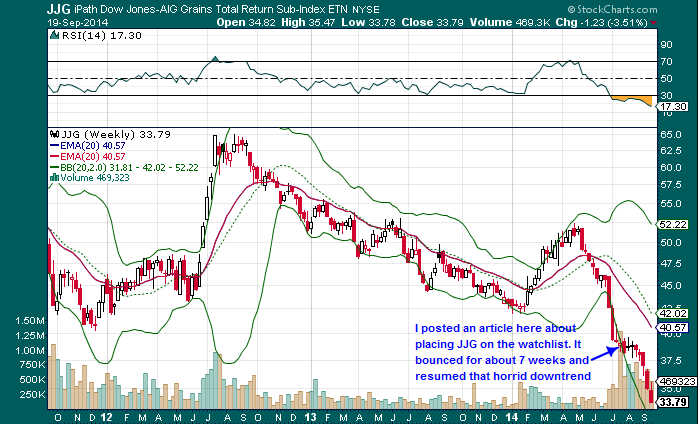
Regarding JJG, don’t feel bad if you tried to bottom-tick that one too early. Them’s the breaks. I had stated that the trade looked ripe but that my indicators weren’t giving me a go. I also stated that I would send out an update if the indicators give the green light. Now this ain’t the update for the green light, it’s just to let any readers know that we’re still keeping an eye on the ETF. Soybeans, corn, and wheat are getting destroyed. It’s serious destruction and the greater commodity index (CRB) just took a dip past support, so it’s not looking good for a trade anytime in the immediate future.

However, one of my indicators has flattened out and the other appears to be following. Even if they do shift, that may simply lead to some bottom bouncing consolidation for several months as opposed to a V-shaped rocket ride upward. I wouldn’t expect a coffee style abrupt turnaround, but anything’s possible. Have a look at the weekly JJG chart in case you haven’t in a while.

clip_image003

Once the indicators have turned in favor of an uptrend, then the HFT shops may just juice this thing for nice little return. I hope to have you along for the ride on the timing of that one. We’ll have to wait and see. For reference sake, let’s take a look back at coffee’s beautiful halt to its downtrend and abrupt rocket ride upwards for the lucky schleps(or skilled) who rode that trend to the bank.

clip_image004

Alright, so read that article from the Price Action Lab blog. Keep a wary eye on soybeans, corn, and wheat. And enjoy Saturday. College football is back, so go pay your bookie a visit and dare to be great.

PS: Marginrich.com does not condone nor endorse any illegal activity regarding unsanctioned and unlicensed sports wagering. If you are compelled beyond your will to place wagers on the outcome of any sporting event maybe it’s time to seek counseling and admit the problem is real. Read those two sentences really fast like the MicroMachines commercial guy with the moustache from the 80’s and it’ll sound real official. And for anyone who thinks I’m insensitive to the genuine sickness that is a gambling addiction and reads articles here, get real, I write about speculation regularly.

A Rising Tide Lifts All Boats

There’s a ton of divergences occurring. According to some “expert” voices in the blogosphere, the divergences don’t matter. That’s nonsense. Divergences do matter. They provide signals that can assist speculators on when to or when not to allocate capital. Additionally, maybe certain divergences signal to take some risk off the table. Sure a perma-bear or perma-bull can find enough signals in any nook or cranny they search to warrant their stated opinions, but that’s the nature of data and confirmation bias.

I would say caution is warranted across multiple markets. High-yield bonds i.e. junk bonds finally sold off with a recovery into a potential double top for JNK & HYG and in an earlier post, I had stated that junk selling may be the final piece the markets would need to see for a significant correction to occur. That may still be the case, but there are enough other factors to justify a cautious stance. Everything happens so rapidly in the markets now, so if you’re not nimble then say goodnight to any short profits. The NYSE A/D line was descending but has since resumed its climb to reach a new all-time high. Small caps(Russell 2000) sold off 8% during that last month’s downmove and many published analysts thought that may be the extent of the move. Turns out they were right…for now. My go-to indicators show strong potential for a continued down-move, however one of the indicators is flattening in the short-term. If long-term resistance gets broken on the RUT? Well then more damage could be on the horizon for a larger swath of the markets’ asset classes.

Preferreds can sometimes be a leading indicator of deteriorating credit conditions, reason being because they’re primarily issued by financial institutions and REITS. Along with most everything else, we saw preferred stock funds temporarily turn down but have since recovered into a lower zone that’s been essentially flat for the last few weeks. There were some major M&A deals that were scrapped last month, but who cares. Who cares about anything in the game of speculation if it isn’t related to a central bank, right? Seriously, who cares anymore? Everything just goes up anyway. Who cares about technical analysis? You can’t trade without volatility. There couldn’t be a worse time in modern financial history for a trader to try and stake his or her claim in the world by beating the markets.

Before you assume it’s all sour grapes with me because of my own trading results, please understand that like any other prudent asset allocator I maintain multiple portfolios for various strategies. Most are dedicated to sound asset allocation strategy as well as conservative stock selection across the best companies in the world; the kind of companies that can weather any storm. As much as I enjoy fundamental analysis and good old stock picking through the breakdown of a company’s financial statements and filings, I get more of a kick out of trading on the price action. My smallest portfolio is my trading portfolio and thus that helps to mitigate the damage of the strategies I’ve been utilizing the past couple of years. So no I’m not entirely bitter because the big bad bully market took all my marbles. I’ve still gots me marbles and I’m still playing the game. Strategies have to be shifted in light of the current environment where HFT and central bank support dictates market movements and investor sentiment. I’m certainly not alone in my mediocre trading results of the past couple years.

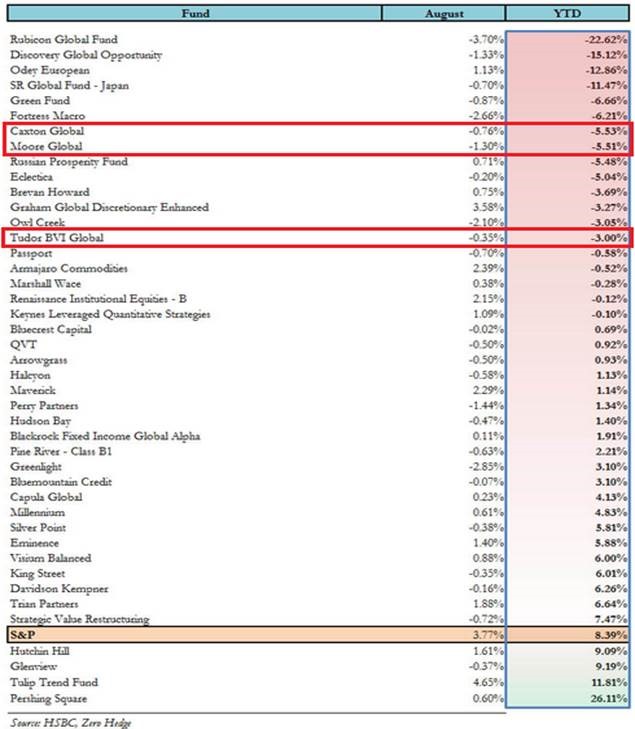
Up until 2012, the arcane magic of technical analysis still worked quite nicely. You could still use decades old strategies based on squiggly patterns of price & volume to regularly snag profits out of the market. But what does it say to you when some of the most respected traders of all time are consistently losing? What does it say to you when three of Schwager’s Market Wizards who run billions in AUM continue to come up with negative performance that is far below even the S&P 500 index? You have to really question why the hell you’re not holding a simple double or triple long ETF of the S&P 500 or why you think you can outsmart a rigged market. Have a look at HSBC’s latest scorecard of hedge fund performance. Observe the performance of the individually legendary Tudor, Kovner, and Bacon:

clip_image002

It’s this sort of performance and environment that takes some of the fun out of the game. Intrinsically, trading is a competitive endeavor so there’s no giving up on the fight to earn profits against the world, but right now is not a time to be fighting if you’re not winning consistently. It’s a time for reflection on strategies, skillset, and the overall approach to your trading business.

The lack of any real movement in the markets could be a seasonal effect. It could be a product of the gross market manipulations. Or it could be that something worse may be on the horizon. By now the CNBC interview with Sam Zell has been shared and commented on by virtually everyone in the financial media and blogosphere. I won’t beat it to death here, but his comments are worth noting. He’s not some chump billionaire always looking for the limelight or setting up a book sale or political career. He’s the original “Grave Dancer” and he took Blackstone to school in the $39B sale of his company, Equity Office Properties Trust, at the top back in 2007. His words are worth heeding, but as with every other expert, not following blindly.

These are the key points he made on Squawk Box:

“The stock market is at an all-time, but economic activity is not at an all-time. People have no place else to put their money, and the stock market is getting more than its share. It’s very likely that something has to give here.”

“I don’t remember any time in my career where there have been as many wildcards floating out there that have the potential to be very significant and alter people’s thinking. If there’s a change in confidence or some international event that changes the dynamics, people could in effect take a different position with reference to the market.”

– “It’s almost every company that’s missed has missed on the revenue side, which is a reflection that there’s a demand issue. When you got a demand issue it’s hard to imagine the stock market at an all-time high.”

– “This is the first time I ever remember where having cash isn’t such a terrible thing, despite the fact that interest rates are as low as they are.”

So forgive my redundancy for reposting what’s already been reposted a million times, but the original link and interview can be found at: http://finance.yahoo.com/news/sam-zell-stock-market-correction-124350576.html#

Just to provide a little graphical support to the bullet points by Zell, take a gander at the following chart shared by professor Mark Perry of the Carpe Diem blog:

clip_image003

Meaningful or meaningless? You know the answer.

Coming back to underperforming professionals, it’s not just trader hedgies having a rough go. Even the plain old vanilla mutual fund managers in the large-cap space continue to also underperform a benchmark of the S&P 500. In a recent MoneyBeat column, David Kostin was quoted: “Only 23% of large-cap mutual fund managers have outperformed the S&P 500 this year, rivaling the worst performance in the past decade, according to the chief U.S. equity strategist at Goldman. By comparison, about 37% of fund managers have outperformed the benchmark since 2003. Only performances in 2006, 2010 and 2011 have been as bad or worse than the current year’s pace.”

In times like these where the US ZIRP and the Euro NIRP forces money into stocks, Siegel’s Stocks For the Long Run probably sounds better and better for many investors if they haven’t already shoved all their retirement funds into Vanguard’s warm embrace. I want to take a moment here to plug the research of Stansberry Research & Associates. Specifically, I want to call out the work of Porter Stansberry, Dr. Steve Sjuggerud, and Dan Ferris. If you are unfamiliar with their work then maybe it’s time you familiarized yourself with them, if you intend to be individually selecting stocks for your portfolio(s). I have been using their services for close to a decade. And in today’s market environment, they continue to be on the leading edge of most all of the macroeconomic happenings while also providing some of the highest quality deep research on equity selection out there. With a subscription to their advisories, I can honestly say you’d probably be getting the best bang for buck out there in the newsletter game. Having read plenty of samples of sell-side research from Wall St., these guys stack up and will assuredly enhance your ability to safely build a profitable equity portfolio.

Full disclosure, I have absolutely no relationship with Stansberry Research & Associates in any other capacity than as a satisfied subscriber. Like other services I have touted, I’m certain they don’t even know this blog exists. Additionally, that link to their site does not pay me some sort of commission. I truly just enjoy the quality of their products and wanted to take a moment to share that with my own readers. In my much younger days, I tried most every newsletter out there…Motley, everything under Agora, Richard Russell, amongst many others as I was learning the game and was simply too lazy at the time to open a book to teach myself just yet. For the last several years, these guys are the only equity research I rely on aside from my own. So I would recommend you visit their site and maybe try a subscription or two, I’m confident you won’t be sorry.

In the meantime, the markets are boring. No volatility; just summer flatness. Even the financial media and blogosphere are completely boring. No originality in content and certainly nothing new or profound being reported…and that includes Marginrich.com. I’ll keep posting my thoughts on various market observations but my next post I intend to share my thoughts on a different type of speculation, and that is sports betting specifically on college football. Having evaluated all the major sports, NCAA football is the one sport that consistently provides asymmetrical profit opportunities against any sportsbook whether it’s online or at a casino. Don’t get me wrong it ain’t easy, but if you do the research and have a quality understanding of the variables that go into some basic handicapping, then profits can be made.

Be safe and allocate intelligently because a rising tide does lift all boats. Just don’t take your eye off the ball for any reason while throwing money around willy-nilly…and I’m sorry for being gone so long. Life happens.

This Blog Lives…I Promise

To any readers that actually miss the content produced here at Marginrich.com, I truly apologize for the lack of output. Between vacation, moving, and business travel, I simply haven’t prioritized the creation of new posts. Please stick with your regular visits as I intend to get back on track this week.

Usually, I’m able to produce a post about every 10 days. I’d like to post more regularly and consistently, but it is what it is. Thanks for continuing to stop by the site to check for updates or read an old article. I appreciate your eyeballs and I’ll have something for you soon.