American Assets Discounting European Politics

Last summer, I shared some thoughts on the stock markets’ abilities as a discounting mechanism for future events. The gist was that stocks may provide a murky read some times when it comes to prophesying.

Reading the current macro signals is a tough endeavor for any speculator, and with today’s volatility, all the more dangerous when making bets based on those signals.

That being said, I get the feeling that last week’s action in some of the rate-sensitive sectors in combination with general stock market consolidation is portending a positive outcome in the Greece/Europe situation. Bear in mind these thoughts are pure suppositions based on nothing more than a hunch. I’ve been wrong before. I’ll be wrong again. As the old Soros saw goes, “It’s not whether you’re right or wrong that’s important, but how much money you make when you’re right and how much you lose when you’re wrong.”

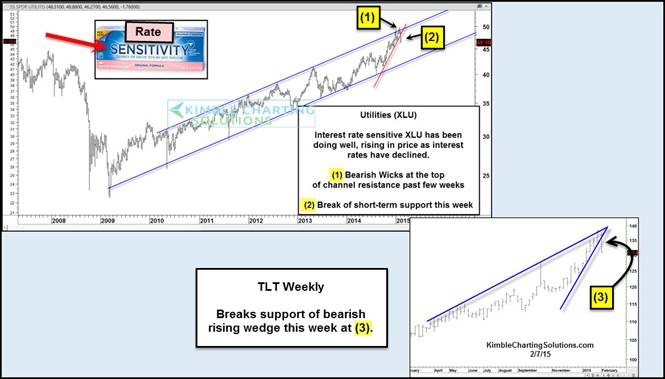
Kimble recently provided a long-term view of two key sectors.
clip_image002

We’ll revisit the impact of the breakdowns in those sectors, but the whole world of finance is focused on the potential resolution of Greece’s debt-financing problems. We have Goliath, the Troika(ECB, IMF, and European Commission “EC”), attempting to dictate the how, what, and when to David aka Greece. Right now a political game of poker is being played with the potential for worldwide ramifications. Greece’s new management is playing the hand it’s been dealt in what appears to be a very transparent fashion. Basically, they’re happy to stay in the euro as long as fair terms are met in a reworking of current debts to the Troika.

The Troika, god I hate saying that word but it does beat out typing the three entities, is really trying to play hardball with Greece but they have no leverage. None. Ok, maybe the smallest amount; just to play chicken. In my estimation, 98% of the leveraging power belongs to Greece. Dijsselbloem, EC head finmin, and Schauble, German Minister of Finance, have both been bellowing the fiery rhetoric from the tops of their lungs, “Greece better pay or else!” Or else what? They’re going to let Greece depart the euro? Ok. Yeah, sure.

Greece isn’t going back to the drachma in an exit from the euro, at least not this year, because the markets would be roiled. There are simply too many things that could go wrong to upend the European status quo for a Grexit to happen. Let’s just logically play out a generic sequence of events. Europe can’t let Greece totally default. For the owners of Greek debt and of course credit default swaps on the debt, credit events would be triggered across a multitude of financial institutions which could in turn then trigger counterparty liquidity risks which would instantly panic the financial universe. This instant panic would hit all the developed stock markets but with a focus on the European stock markets, which would negate the positive effects of the trillion-euro QE plan before it even had a chance. Too me, that’s enough to know that even if the deadline for a Greek debt resolution is pushed out, it’s still going to end with Europe caving but in a manner which saves as much face as possible.

Germany’s account surplus is so ridiculously large that I don’t really think they are going to tell Greece to go souvlaki itself. German total employment is high and exports continue to be robust. Pushing Greece to exit the euro would create an environment of fear where recession could rear its ugly head at a time when German companies are rolling. While Greece has all the appearances of being the linchpin holding the euro together, they’re really just a very, very important lugnut. Italy is the real linchpin. Their debt has the potential to topple the world. Which is why Europe doesn’t want to easily concede to Greece and open the door for Italy to dictate revised terms of its sovereign debts. Aside from Italy, there is obviously still Spain, Portugal, and Ireland; but Italy is the megaton nuke that can change everything.

Aside from the financial obstacles for Europe, there are the more important political complexities that must be addressed in pushing Greece too far, too hard. Russia has already extended an olive branch for Greek funding and Greece officials are reporting that China has now offered a helping hand. The world knows that China possesses the funds to help provide a financial backstop for Greece. I suspect the world may doubt how much funding Russia can lend in light of its own domestic problems concerning the ruble’s decline alongside oil’s rout. I contend that doubt would be misplaced. Does anyone really believe that Europe would simply push Greece into Russia’s waiting and open arms, where after, Greece will be free to negotiate any number of fear-inducing considerations like the usage of Greek ports for the Russian navy. Or how about land or sea allowances for petroleum energy pipelines. Maybe missile battery emplacements “for protection” on the northern Greek borders.

These are extreme examples as Greece is still a NATO participant, but it is unknowable with which the speed of certain actions could be taken should political alliances be shifted over this money. Consider how fast Russia appropriated the Crimean peninsula. All the angles have to be considered and with Merkel’s established relationship with Putin, I don’t see the Troika being allowed to precipitate negative financial and geopolitical outcomes.

What is difficult to reason, for me at least, is how the US will come to bear its influence in this whole game of thrones. America will have its say on bailing out Greece, but how and where and with what level of impact is a challenging thought experiment.

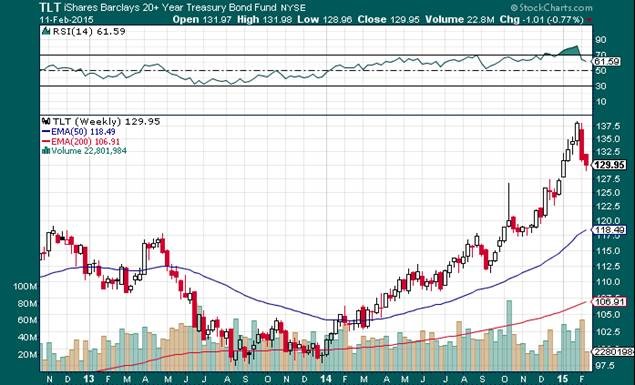
Coming back to American assets and their ability to discount the European outcomes, I think the speed with which the rate-sensitive sectors dropped last week are the tell-tell signs. Examine the two following weekly charts of TLT and XLU.
clip_image004

After a stellar run in 2014, that was a precipitous drop last week. The overall trend remains up, but the situation is very fluid as we have to consider the interrelationships between markets, especially the dollar and implied volatility across Treasury yields.

clip_image006

A familiar market adage is that Utilities tends to be a precursor for the greater stock markets. Any correlation is possible at any given time in the markets, however, we live in an age with remarkable volatility across asset classes. Thus, old interrelationships that once used to prove semi-reliable, may just not be so consistent. I think the Utilities, Treasuries, and yields are telling us that the general market environment is about to go risk-on with another leg-up in the greater stock markets.

There has been no shortage of writing on the significant perils in the market. I have read many a sound analysis that a major dislocation is “near.” But that’s the problem with using a word like “near” or any of its synonyms. Near is a relative term. It’s a word that gets used in a sentence and can mean anything from 1 day to 3 months to 2 years or whatever. Most analysts, bloggers, and general market commentators aren’t willing to stick their necks out and provide a more precise timeframe based on their opinions. They just point to a lot of evidence that says it’s “near.”

I agree that the next major leg down in the markets that began with the Great Recession in 2008 is near. I’ve long-stated that I thought 2015 – 2016 were going to be the years that major catalysts presented themselves for an epic sell-off, but I don’t think that time is upon us. I’m convinced that the markets will draw in a lot more participants first. I want to get that 1999 and 2007 feeling first. You know the feeling I’m talking about; that feeling that the markets will never go down and speculating in the stock market is a can’t lose venture.

The danger of deflationary forces is reasonably priced into the markets. Japan is still easing while the Fed is continuing to roll assets and now we have the ECB embarking on a trillion dollar extravaganza. I have read analysis that the efficacy of the ECB’s easing is highly questionable due to negative rates around the continent. I say nonsense. Animal spirits only care about a liquidity buffer to fill voids. Besides in a risk-on environment, yields will rise as higher levels of capital will flow into equities in a sector-rotational chase for alpha.

Risk-on is not mutually exclusive of risk management, no matter what. Countless interviews with billionaires around the world back up the fact that risk management is the number one key to successful speculation and investing. That being said, look for the general stock markets to pick up a little speed in advance of a potential workout between Europe and Greece. In just the last few days we’ve had two US hedge fund billionaires share their opinions on a Grexit. Dan Loeb, of Third Point, thinks there’s a lot of risk associated with these markets and has lowered net exposures across his funds so far this year. David Tepper, of Appaloosa, thinks there is nothing to worry about if Greece exits the euro. He basically stated that there’s a handful of percentage points of loss to worry about, but that the markets are strong enough to overcome a negative outcome. Loeb is prudent. Tepper believes in his analysis. I think the GermansEuropeans will reach an accord with Greece sometime soon(another relative term) and the stock markets will eat it up.

There is still that little matter of the dollar, euro, and their extreme levels in sentiment. Carry trades continue to be wonky in light of the dollar strength. Maintain a close eye on these currencies as they will enhance a risk-on move. Whether you believe the markets are discounting future events or not, there is a persistence of extreme movements. A European resolution with Greece and a shift in dollar sentiment may just provide a profitable environment for stock market participants.
Much Ado About Snapdragon

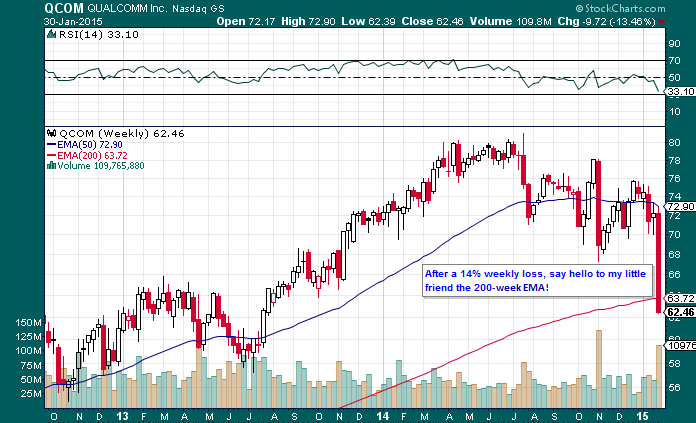
Since the start of the 2nd half of 2014, Qualcomm has had a rough go of it. After peaking at $81.05/share, it’s been all chop and drop. Just look at that massive 14% drop in the share price last week subsequent to beating earnings estimates but confirming that Samsung will drop Qualcomm’s Snapdragon chipset and go in-house with its own proprietary technology for the new Galaxy release.

clip_image001

The loss of that one particular Samsung line caused Qualcomm to lower guidance for 2015 revenues by $800 million. Stop the presses! You mean Qualcomm may, as in possibly but not certainly, have 3% less in revenues than what was projected for the entire year?! That’s definitely grounds for revaluing a business lower by 14% within days, because your valuation models weren’t skewed before and this new information means everything. You have to love the market. It consistently puts great businesses on sale during a year. You just have to have a list, understand the fundamental values, and be patient.

It’s not just the loss of Snapdragon in the new Galaxy and lower guidance. It’s also the uncertainty of the antitrust probes that have been reopened by China, Europe, and the US. Qualcomm’s market-share in mobile technology is so vast that the issue may never be fully put to rest. Countries can and will continue to reopen cases regarding Qualcomm’s trade practices as long as they continue to maintain such a strong hold of the market with their wide-ranging patent portfolio that gives them such a huge cut of the telecommunications action. Reminds me of the scene in Goodfellas, where Ray Liotta’s character explains what it’s like to go into business with the mob. Slow sales? FU, pay me! R&D too high? FU, pay me! Having trouble innovating? FU, pay me! I don’t want to mischaracterize Qualcomm as I truly appreciate their business model, but you get the point.

Qualcomm is the emperor of all that is 3G technology. Their patent portfolio is so immense that there is a never-ending line of vendors waiting to kiss the ring and pass along envelopes filled with cash. That’s one of the many reasons Qualcomm is so great. Their lordship over CDMA is simply a money mint and all of their competitors around the globe can’t stand it. It appears as if the China anti-trust issue will soon be put to rest with minimal damage, from a relative standpoint. With any luck, they’ll pay their fine of around $1 billion or less and lose some concessions but still be in the game in the ever-important Chinese market. No government is going to kill a golden goose like Qualcomm and all the tax revenues that they represent. I suspect the EU and the US may even just end their own probes with very little in the way of remediation, but that is pure conjecture.

These fears surrounding Qualcomm are not completely unfounded as a worldwide attack on the company’s ability to extract royalties is a clear and present danger. However, as I noted before, Qualcomm is a cash cow and in light of the cronyism that runs rampant through the developed world do we really think this is the company where regulators stand up and decide to fight for something? Really, I suspect a great deal of the matter depends on the strength of the relationships of Qualcomm’s competitors with government bodies to possibly influence the regulatory inquiries.

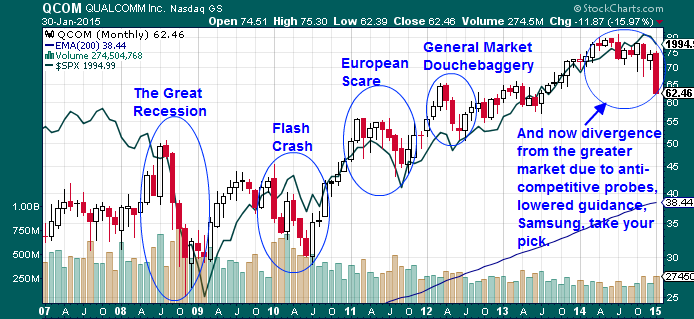
Over the last 8 years, Qualcomm’s corrections have essentially kept time with the greater market. Observe the price action on the following chart. More recently, the stock price has corrected approximately 23% while the market has continued its ascent. I am not inferring anything here, we’re simply reviewing the relationship between the greater market and Qualcomm while noting the current divergence in light of the company’s own gravity-inducing catalysts.

clip_image002

Qualcomm has faced pressures from sovereign entities as recently as 2009 with South Korea and 2007 with the European Commission. The effects to the company’s ability to generate free cash flow have been utterly negligible. Let’s take a look at the last 3 years’ worth of free cash flow results.

2014 – $7.7 billion (OH NO! That’s the same as 2013! Please.)

2013 – $7.7 billion

2012 – $4.7 billion

All that cash and no long-term debt equals the ability to deploy capital in a shareholder friendly manner. The current dividend yield is now approaching 3%, which would imply a price per share of $55 if it reaches that point. These colossal free cash flows are a product of a royalty portfolio that accounts for 30% of the company’s revenues but over 85% of earnings before taxes.

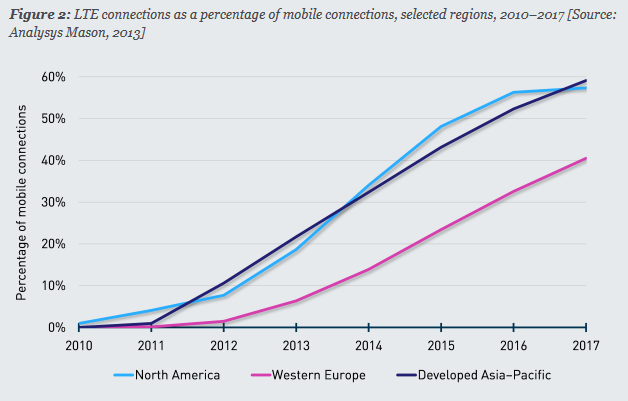
One of the most persistent questions about Qualcomm’s future profit generating ability is what happens as the wireless telecommunications space evolves(spectrum and equipment). That’s a reasonable concern in light of LTE’s advance. However, LTE is nowhere near to reaching maximum penetration around the world yet. Additionally, 3G compatibility within LTE devices will keep the royalty portfolio pumping cash for years to come. This is due to the fact that voice is still primarily handled via 3G while LTE is focused on data. Furthermore, the adoption of LTE has been very slow in Europe which leaves a very rich opportunity for continued penetration of Qualcomm chipsets in higher income per capita regions. Observe the potential in this chart from Analysys Mason, one of the leading international consultancies to the telecommunications industry.

clip_image003

For a long-term portfolio option, these prices at the 52-week low appear to be quite reasonable to begin establishing a position. There are plenty of risks to assess before allocating capital, but the moat they have created around their business model in conjunction with the consistent eruption of free cash flow creates a very enticing opportunity. At this current share price their EV/EBITDA is at a reasonable 9 and they are approaching an EV/FCF of 10. Despite all the negativity surrounding their fiscal Q1 results, revenues and net income were still up YoY by 3% and 26%, respectively.

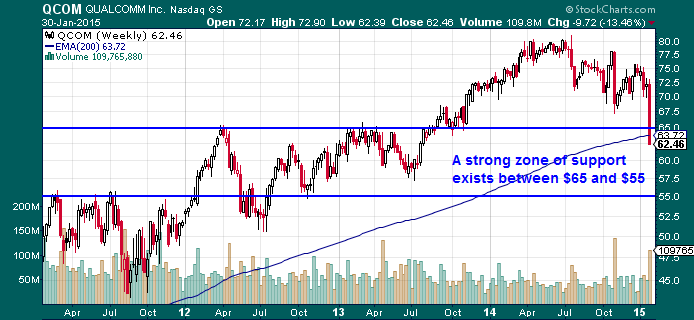
Valuation depends on the variables in your model and what factors you prefer to place the most influence. As a potential long-term addition to portfolios, these share prices warrant a look. Let’s take one last look at the technicals. Qualcomm has dipped its toes into what appears to be a very strong support zone. As always, anything is possible in these highly volatile markets, so tread carefully.

clip_image004

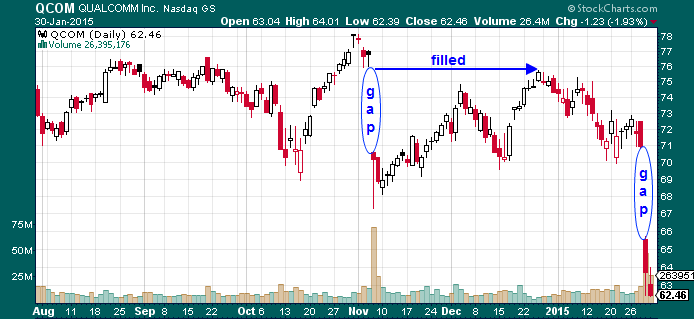
For true fiends out for any action, have a look at QCOM’s daily chart. It’s presenting the potential for a gap fill and long-time readers know how much I love the action of the snap-back. No further comment is necessary. The chart says it all.

clip_image005

If you feel the need to trade last week’s gap then bear in mind the gap fills at approximately $71. Simple strategy, simple stop, but delivering profit may be a touch more complex.

In summary, Qualcomm has the moat, prodigious free cash flows, and share price action that lends itself to constructively researching a potential investment. Last week’s ado may in fact just be about nothing. Allow the price action to inform you.

Oil & Economics – All Q, No A

Almost nobody saw the crash in oil coming. A handful of savvy investors and analysts shared this thesis but were largely ignored. For all intents and purposes, “nobody” foresaw the action in oil which is the essence of the dumb crowd missing it again. Not inferring that I am not an occasional member of that dumb crowd, just commenting on the oil industry.

When oil prices dropped, the instant message that was and continues to be bellowed across the financial landscape is that the drop would provide a pseudo-tax cut for the great unwashed in the form of lower gasoline prices. Along this line of thought is that the commoners will spread this saved gas money throughout the economy in various outlets. This should in turn support GDP levels, which is of course fallacious. Through Q3 of 2014, the US is annualizing 5% GDP growth. WHOOOOO! Gonna get some cold cuts based on that level of growth!

The problem with the thesis that lower gasoline prices should support or maybe even boost GDP levels discounts two very important factors to the economy. Number one, nobody can predict the level of the money saved from lower gasoline prices that will go into personal savings. Number two and more importantly, the importance of the oil industry to national employment and economic growth has been totally discounted by far too many educated parties. Just look at how important the oil industry has been to America’s employment recovery.

clip_image001
(chart courtesy of Prof. Mark Perry)

Now add in North Dakota and it’s growth in employment thanks to the Bakken. Last month the Joint Economic Committee provided an update courtesy of the BLS. Since February of 2010, the national low point in private sector employment, North Dakota added 102,500 private sector jobs. A vast majority of those went to petroleum related companies, making the “US Employment Minus Texas” numbers look even worse. Maybe you’re one of those thinking in your head with a Patrick the starfish voice, “Yeah, but a percentage of that job growth for Texas and N. Dakota is dedicated to non-oil like teaching, retailing, food services, etc.” Sure there’s growth in those areas too but an overwhelming majority of the growth has come in industries like mining, logging, transportation, utilities, and construction; where the pay has been significantly higher on average than in the non-oil industries. An argument could even be made that a high percentage of the growth in non-petroleum based jobs was simply derivative growth from the petroleum industry.

Well what’s the point? There are a couple of points, actually. Talking to one’s self consistently is a strong precursor to madness, so at least I’ve got that going for me…which is nice. Seriously though, one of my points is where does the job growth come from in America now that the oil patch growth and development has fallen off of a cliff? Amazon DC part-timers? Wal-Mart part-timers? McDonald’s part-timers? Maybe I’m failing to notice a forest through some trees here but I’m having a hard time seeing the downward trend in unemployment continue its happy descent into “full employment.” And for the 1 plus 1 crowd, if there’s less people employed then there’s less people to buy things. Maybe there will be enough growth across all the other non-oil and gas industries, but that chart up above sure says a lot about placing too much faith in that thesis.

The second point, which may be even more relevant, is where will the growth in US corporate capital expenditures now occur? It’s very late in this business cycle coming out of the Great Recession and capex output is still relatively weak compared to previous cycle recoveries at the same stage. Capex has been essentially carried by energy. Let’s look at some facts regarding US capex and the oil industry. Energy(primarily oil and gas) accounts for approximately a third of all capex in the S&P 500. That means it’s virtually irreplaceable. Need a visual? No problem.

clip_image002
(chart courtesy of Zero Hedge via Deutsche Bank and the Bureau of Economic Analysis)

So if I’m understanding the basic tenets of the TV economists’ argument, US GDP will be just fine despite the oil industry tightening their belts because American consumers will use all that money they saved at the gas pumps at their favorite retailer, service provider, or online. BOOM! Problem solved.

I just can’t reconcile that thesis with the facts as they are presented via the press releases of major oil companies. ConocoPhillips has already announced it’s slashing its capex budget by 20% for 2015, which means $3 billion less than 2014. Suncor, Canada’s largest company by revenue, is slashing it’s capex budget by $1 billion dollars for 2015 while also cutting operating expenses by up to $800 million in addition to a 1,000 person reduction in the workforce. Conoco did not announce layoffs in their presser regarding capex but you can be sure there will be layoffs there and across the board. We have yet to hear from the two giant US elephants of petroleum energy, Exxon and Chevron. Analysts are essentially expecting an average decrease of 25% in investment spending by energy companies.

This subject has been covered extensively at Zero Hedge. You can obtain additional details and their always-optimistic opinion right here and here. There are some blog and finance news snobs out there who look down their nose at Zero Hedge, but the fact of the matter is they do a good job credibly covering a wide swath of financial, economic, and geopolitical news; and literally everybody reads it. None the less, for you financy snobs that need a Wall St. bank’s take on capex, here’s a September 26th, 2014 report courtesy of UBS with impeccably timed commentary on capex. Here’s a couple of gems from their Equity Strategy team: 1. “Capex rising thesis still intact”, and 2. “…business fixed investment is forecasted by UBS economists to rise by 6.2% in 2014 and 7.8% in 2015.”

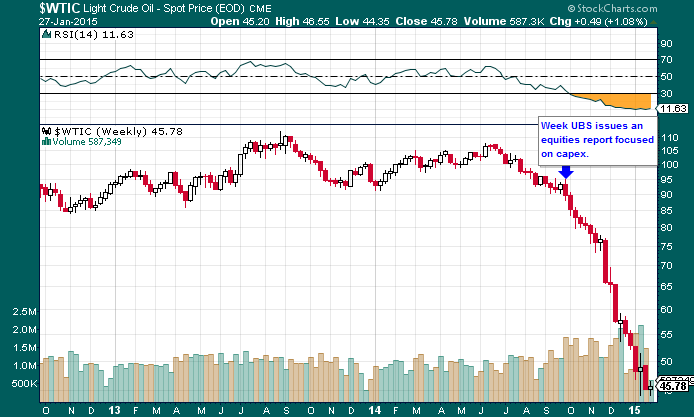
Let’s just see how the timing of that report’s issue coincides with the fall in the price of West Texas Intermediate Crude.

clip_image003

Does 7.8% growth in 2015 capex sound credible now? Well done UBS Wealth Management. Positive guidance on capex right before capex is about to be gutted via a 50% slide in the oil price. Let’s do some basic, rough arithmetic based on the Deutsche Bank chart up above. Thirty-two percent of $685 billion is $220 billion. Twenty-five percent of $220 billion is $55 billion. So approximately $55 billion of what was to be potentially spent in 2015 is going to be eliminated and yet employment or GDP should be unaffected as the economy is recovering in the US. That’ll be what gets sold by the main stream media.

Oil and gas notwithstanding, the capital expenditure reports coming out of the Federal Reserve branches were laughable. It’s all IT spending. Go read the December 3rd, 2014 Beige Book to see for yourself. Here’s an exercise for those who refuse to read the sleep-inducing report. Click that Beige Book link and search(hit ctrl-F) the document for “capital expenditure” and simply read the surrounding text. It’s mostly IT. I’m pretty sure that network upgrades and addressing cyber security concerns aren’t going to carry the US economy in conjunction with consumer spending, but we’ll have to wait for 2015 to play out.

The bottom line is that 2015 is going to be a most interesting year for the US economy and the rest of the world for that matter, too. Just look at the volatility we’ve already seen across currencies, central banking behaviors, geopolitics, etc. I’m still seeing plenty of rosy projections for the US economy, coming off that 5% read, and maybe I just need somebody to crack me in the head to help me see the data in a better light.

It Ain’t a Trend Until it’s a Trend

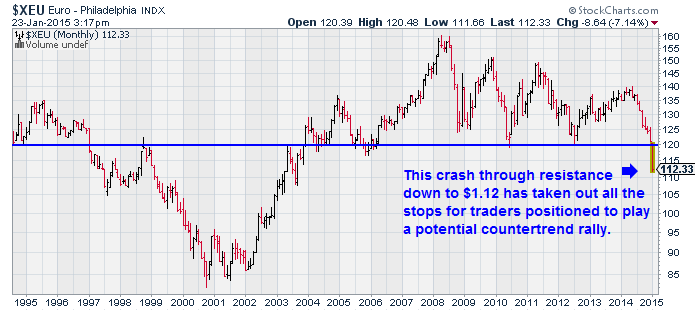
The euro and the dollar both looked ripe for countertrend rallies. Still do, actually. In my last post, I shared some charts that showed what I thought were very good set-ups for what at least could be some short-term trend reversals in the two currencies. This was of course well before the monetary nuke dropped by the Swiss National Bank that they would no longer be pegging the franc to the euro. Subsequent to this announcement, the franc took off like a rocket and the euro has dived well past support.

clip_image001

The rocket launch of the franc has seen plenty of banks, forex shops, hedge funds, and various financial institutions cumulatively lose billions of dollars; and the total damage has yet to be seen from all the short franc trades around the world. Those who may have positioned early on the euro or dollar reversals would almost assuredly have been stopped out. I was fortunate to not have taken a position in either currency. Specifically, I stated on January 5th, “I have not positioned in a trade yet as I haven’t observed a very usable signal just yet, but we are very close.”

Adhering to the discipline of waiting for confirmation from my go-to signals versus taking a chance on the price action based on trend lines saved me from a loss; even if the loss only would have been minimal due to stop-discipline. The same thing could be achieved by simply waiting for the price action to confirm the trend reversals. One notion that many of the best traders consistently follow is simply letting go of trying to time 100% of a move. There is enough profit made by catching 80% of a move by letting a trend establish itself. This concept is age-old and time-tested.

I prefer the indicators in conjunction with the price action, but if you’re going to be trading then you should have a methodology or technique that allows you to safely enter into a trade. You shouldn’t be throwing money around willy nilly simply off of squiggly lines and 100 year old patterns. The indicators I like to follow are very common and used by virtually everyone, however, I have specific chart timing I like to utilize. Additionally, I have a subtle difference of viewing the indicators for confirming signals. For the indicators I like to follow, most traders are still using crossovers but that simply doesn’t work anymore due to the mainframe warehouses being able to program out their market efficacy. This is my edge. It’s been backtested over several years and many trades. It’s not some guaranteed profit magic item I consult before each trade. I get stopped out and whipsawed too. It’s simply a go-to tool to help me mitigate risk. If you don’t have or know your edge, stop and rethink what you are doing and why you are doing it.

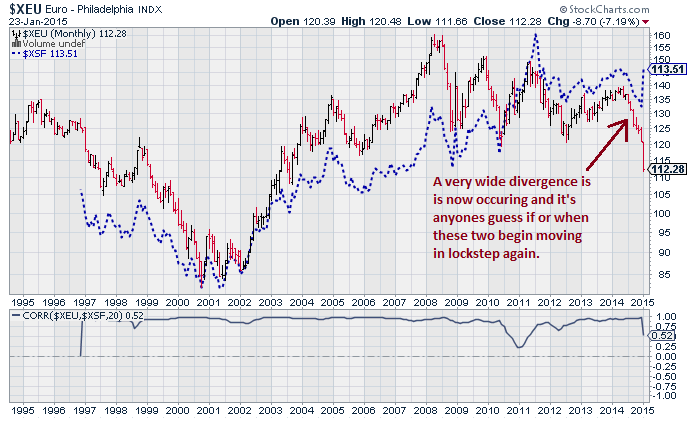
I will be keeping an eye on the euro and the dollar along with every other market player in the world. With the franc front running a very obvious move for QE by the ECB, the downtrend in the euro and the uptrend in the dollar may be entrenched for a while longer. A counter-trend catalyst could present itself at any point so keep your eyes peeled, as even shorts can be squeezed unbelievably faster than what was conventionally thought for a currency trade. There is a lot of uncertainty between the franc and the euro, which generally move quite closely with each other.

clip_image002

The franc’s shift in perception back to safe-haven status while the euro is weakened by the ECB’s proposed monetary inflation has helped to muddy the waters, so to speak, in how to effectively trade them in the current environment.

On another subject, Intel (INTC) is a stock that is often commented on as being a leading indicator of the S&P 500. The same can be said for many other economically sensitive stocks such as: Caterpillar (CAT), Wal-Mart (WMT), McDonalds (MCD), FedEx (FDX), and Amazon (AMZN). I could keep going, but you get the picture. These companies are fully integrated across the entire North American landscape so that the performance of these companies can be viewed as economic indicators and thus potential leading indicators for the S&P 500.

This theory has of course been backtested and the correlations examined extensively, so I leave it up to readers to indulge their curiosities by searching the web for additional information.

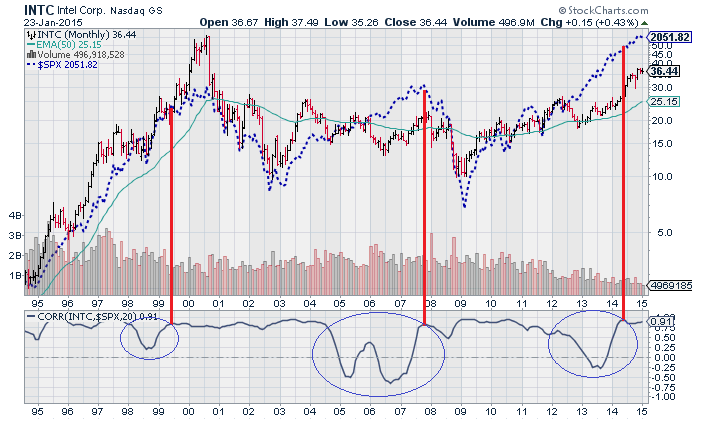
Anyways, coming back to INTC; in viewing a chart of its performance and correlation to the S&P 500 over the last 20 years I did notice something curious. As 20 years is probably statistically insignificant, I wouldn’t place too much importance on what I’m about to point out but it’s still curious. Have a look.

clip_image003

Using a 20-month correlation, it can be seen that a majority of the time the two are highly correlated between .80 and 1.0. However, before the start of each of the major crashes in 2000 and 2007, it can be seen that correlations between INTC and the S&P 500 took a dive towards zero and even negative correlations before recovering back up over .80. When this happened in 1999, the recovery in correlation preceded the actual correction in the larger index by about 15 months. That is only because most of the action of that period was in the NASDAQ and the recovery in correlation between INTC and the S&P 500 actually preceded the beginning of the NASDAQ’s downturn by 6 months. The NASDAQ began its implosion several months earlier than the rest of the indexes as it was the focus of the dot.com era.

For 2007’s crisis, it can be observed that the recovery in correlation back up over .80 between the two pretty much nailed the exact top in the S&P 500 to the month. And now we can see that between May and June of 2014, we saw another recovery to at least .80 in the correlation of INTC and the S&P 500 after a year-long dip. Again, I’m not implying that this is a usable signal to discern that we are near a major top in the equity markets. The last two crises had unique fundamental backgrounds and triggers, just like the next will have its own. In 2000 and 2001, we saw the bust of the tech boom exacerbated by 9/11 and the beginning of the never-ending war on terrorism. In the middle of the decade, we saw real estate financing and associated derivative leverage hasten a credit crisis that nearly took down the entire economic system. For the next one, it could very well be sovereign debt, central bank incompetence, and derivative leverage once again that initiates difficulties. I’m simply pointing out that the 20-month correlation of Intel and the S&P 500 provides an interesting signal.

Obviously, the correlation coefficient can be set to any number of months, weeks, days or minutes based on the period used for your charts. Twenty is the default parameter utilized by Stockcharts.com. Sixty is also prominently used and in the case of Intel and the S&P 500, when using 60 months, that leading pattern does not exist. So take the indicator for what it is; a simple signal of interest. Nothing more. Incidentally, if you gauge the correlation of each of the economically sensitive stocks I listed above, no early-warning signal exists between them and S&P 500. That pattern in the correlation for the potential of an early-warning of greater market direction only existed with INTC. Happy trading, speculating, investing, winning, and losing.

Dollar Strength and Euro Weakness – Trends Within Trends

You keep hearing the same message from source after source and then your trading spidey-senses start tingling with contrarian ambitions. That’s what has been going on for me with the Euro and the Dollar the last several weeks. Plenty of financial print has been dedicated to the strength of the dollar’s ascent and the weakness of the euro’s countertrend towards parity. Right now dollar strength is being bandied about due to it being a “safe haven” play for some reason(I don’t know against what current dangers) in conjunction with the cliché of America’s economy being the “cleanest dirty shirt.”

The current dollar and euro trends are glaringly obvious to all market players. Literally, every single trader and market player on the planet is watching these currencies. Which means we have a highly liquid trade opportunity availing itself and I have been waiting for some indicators to line up with my thesis to provide a lower-risk entry. There’s no sense positioning too early simply to have the mainframe warehouses wipe out the potential of the trade by running all the stops and igniting a sell-off. This could in turn create a short covering rally but utilizing multiple signals for entry points helps mitigate the whipsaws.

Make no mistake, in the long-term anything can happen with these two currencies but senseless extrapolation across multiple time frames can often create profit-delivering opportunities. Let’s observe a series of charts before the suggestion of some simple plays.

The first chart is a monthly chart of the euro going back the last 18 years. There are some simple markups on the chart. The first feature that should jump out at you is what we’ll call “The Power Line” at $1.20. This price acted as stiff resistance in the late 90’s and early 00’s (“Oh-Oh’s”), but for the last 10 years has acted as reliable support. The second feature is the potentially bearish descending triangle with “The Power Line” as the base of that triangle. Now for trading purposes, I’m betting the euro bounces here again towards that upper line of the triangle. However, one can see that as this triangle plays out and should it be broken to the downside in the future, the potential target would blow well past parity with the dollar to about $0.89. But that is another story for another day.

clip_image001

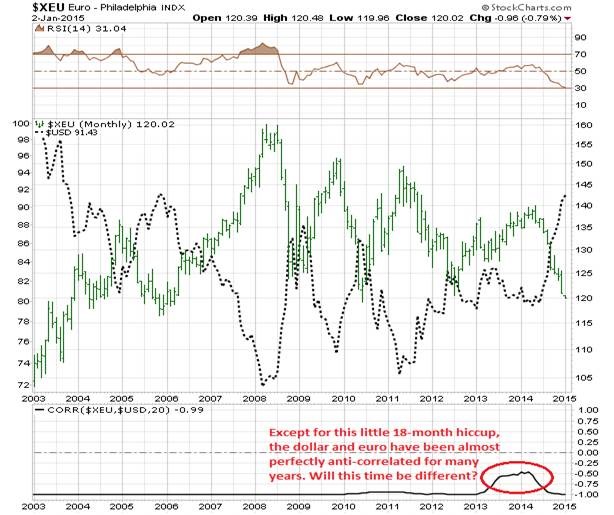
While the euro appears to be possibly setting up for a bounce off strong support, the dollar is running up against potentially strong resistance around 91 which also happens to have held for the last 10 years. This sets up a virtually perfect pair-trade between the euro and the dollar. Observe the dollar and euro’s nearly perfect negative correlation.

clip_image003

Aside from price action, sentiment indicators also look favorable. Observe the following Optix Indexes courtesy of SentimenTrader.com. The always savvy Jason Goepfert creates sentiment indexes based on an amalgamation of surveys and various sentiment indicators and applies them to a multitude of asset classes. Below are the Optix Indexes for the euro and the USD.

clip_image005

Over the last 5 years, when the euro Optix spent 4 to 6 months in the “Excessive pessimism” zone, then a countertrend usually presented itself in the short-term or intermediate term. The opposite pattern can be observed in the US dollar.

clip_image007

Can the dollar continue its vertical joyride? Possibly, but that would run counter to what have been some fairly reliable patterns that have held for several years now. Throw in the fact that the mainstream media continues to extol the virtues of the wondrously strong dollar and a small measure of mean reversion seems in order.

If one were inclined to attempt to profit on a pair trade, there are a few simple ways to go about it. There are of course the futures contracts which are generally the realm of the professionals. If you’re an armchair speculator, you can buy some of FXE and short some UUP. You can leverage that same play with some Calls on FXE and Puts on UUP. Perhaps you want to keep things simple with some ETFs going long the euro with ULE and short the dollar with UDN. If you’re inclined, play it anyway you feel comfortable. Be especially careful with ULE as average volumes are exceptionally light. I have not positioned in a trade yet as I haven’t observed a very usable signal just yet, but we are very close.

For you Fibonacci believers, here’s some potential retracements for the euro.

clip_image008

The 38.2% retracement, assuming $1.20ish is the low, is around $1.28 which was very strong support during 2013 so this makes for a good initial profit point. The trade has all the appearances of a money-laying-in-the-corner trade as sentiment has become extended, however, if it appears too obvious then it can’t be true. Right? Not necessarily. The pattern may be delayed as a final sell-off occurs to run all the stops between $1.20 and $1.17 over the next several weeks or possibly months, so the trade set-up may require some patience. That’s the discipline in swing or position trading.

If any readers choose to enter a position then good luck to you. There is a lot of doom and gloom about the euro due to the “Grexit” talk, Russian sanctions, and the ECB’s impotence amongst other things. I’m not saying to ignore any of these notions, but the charts above should hopefully spell out what the price action and sentiment are trying to communicate in light of all this bad news. I suspect the worst for the euro may already be priced into the currency, for the short-term at least.

As for 2014, I hope you ended the year in style without too many tax losses and may 2015 bring some additional prosperity to your life.