Lo and Behold

Back on October 8th of last year I shared the following chart in the post, Here’s What’s Going to Happen.

clip_image001

Specifically, I stated:

The reason this scenario works and will again is because of good old fashioned herd mentality. Markets correct. The experienced players advise to stay out and expect a rebound with a retest of lows before jumping back in. The low gets retested and everyone rejoices by betting on red and black, then the rug gets pulled out one more time. The strength of the current bounce is prognosticating another dip before the markets put the climbing gear back on.

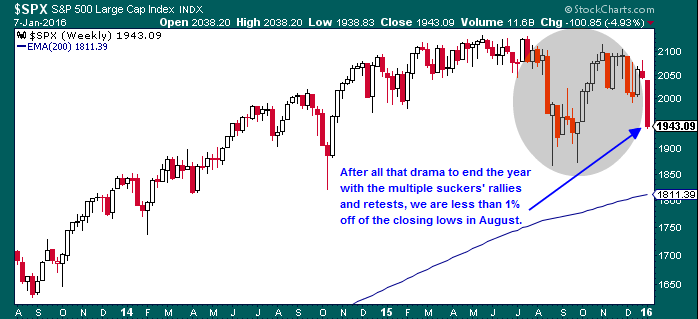
And as of yesterday, 1-7-2016, here’s what the action in the S&P 500 looked like.

clip_image002

The herd will steer you wrong virtually 100% of the time. It has literally never been more critical to think independently and see the facts and circumstances as they are within the markets. It is difficult to filter out noise but your retirement portfolios demand that you try. How many fund closures have you read about since December? Even the smartest people in finance are having a very hard time at this game and forecasting is incredibly difficult.

I think this selloff is close to running out of steam and I feel quite confident that the S&P 500 will easily set new highs going into the first half of 2016. I still contend that the Fall of 2015 was the beginning of the larger stock market topping process that will fully avail itself to the investing public in 2016, but not while everyone is staring straight at it. And certainly not while every major bank in existence is publicly sharing all their fears. We need some snapback based on the debt monetization and interest rate levels in other developed markets. When everyone is comfortable again and everyone suspects that 2016 could finish 8% to 12% higher than 2015, then the negative-event-based-fears should muster to create an environment rife with opportunity.

Not that the 4th quarter didn’t present plenty of opportunities. For traders, that whipping volatility was either whipsawing you out of your positions or filling the coffers based on what have recently been traditional patterns of market behaviors. Unfortunately, long-term only investors may have been suckered into new positions having been brainwashed to “fly into the light” and simply buy the dip. For the value types, it was certainly a good quarter to simply sit back and allow the war chest to continue to build.

Lest you think I actually believe that my forecasting skills are somehow less daft than the next bloke’s, allow me to share with you some of my on-the-record prognostications over the past couple of years. I have double the amount of flubs compared to correct calls. It was nice to get the sucker’s rally call right for the current market, but unfortunately, I have been wrong more often than not when attempting to make a bold call.

Flubs:
1. EPC outperforming ENR (Spinoffs)
2. S&P 500 correction from March 26; bottom-ticked the market (Short-term Equity Risks)
3. IBB correcting; went up 3% after call then erased the 3% then went up 9% erasing that gain with a 9% drawdown (Short-term Equity Risks)
4. Canada can beat a S. American squad for the Pan-Am gold (Canada)
5. Europe caving on debt on resolution with Greece; Greece folded and I was so wrong (American Assets)
6. Another leg up in the S&P 500; totally wrong as market chopped exactly sideways until the Sept. corrections (American Assets)
7. QCOM addition to long-term portfolios; price is approximately 25% lower than where I said it was good area to start nibbling; of course it’s a matter of perspective based on time frame (Snapdragon)
8. Bounce and resumption of correction in the S&P 500 (The Correction and a Trade)
9. Going on the record with NCAA football and NFL betting picks; one word…disaster (Handicapping)
10. Shorting Toyota based on gap fills; technically I was right but the action took months when I expected weeks (Revisiting an Old Friend)
11. Bulltrap before a correction in the S&P 500 (Triple-top)
12. S&P 500 could correct all the way to 1650ish (Tea Leaves)

Corrects:
1. TLT and XLU chopping for 3 weeks from March 26 (Short-term Equity Risks)
2. Greece not going back to the Drachma or exiting the Euro in 2015 (American Assets)
3. QCOM filling the gap on a snapback trade up to $71 a share (Snapdragon)
4. JJG ripped higher by 16% after making call to enter trade on October 18th (The Correction and a Trade)
5. DAL falling down to $30 a share for a short trade; thank you kindly ebola (Two Trades)
6. Shorting coffee with JO down to $35 (Whipsaw)

Sorta Right:
1. S&P 500 would correct more than 7% on a closing basis in October 2014; partially right in that it went down another half a percent and then ripped 11% higher; basically wrong but not technically because I’m lame (Some Musings)

As for a final forecast before wrapping up this post, remember to always filter out the noise which so clearly applies to Marginrich.com, too. Want to know who gets paid for forecasting? People who earn salaries for that specific role at a financial institution. Want to know who makes real money off of forecasting? Traders and investors with billions in AUM.

I will reiterate that I think this selloff peters out relatively soon and then begins a higher lows walk upwards. There will be a lot of backing and filling as so much fear exists but I feel very strongly that the all-time intraday high in the S&P 500 of 2,134 will be taken out before Q1 is over.

Bet accordingly.

Update:  April 21, 2016
Well doggone it!  I was wrong about new highs during Q1.  The intraday high for Q1 was 2,072 on March 30th.  About 63 points off of my call, and as of this writing, we still haven’t touched new highs.  I’m a little off on my timing.  That’s ok.  I can live with accurately and publicly calling the intensity of the recent snapback rally while also harvesting the trading profits that went with the call.

Indicator Currencies

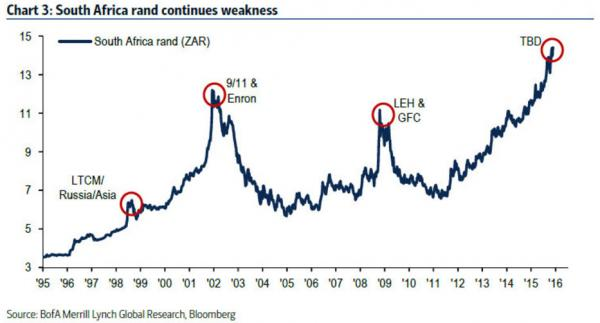
A couple of weeks ago on ZeroHedge, I happened to read a chart they nicked from BofA Merrill Lynch. Observe:

clip_image001

And just to be Captain Obvious, the chart is inverted as the South African Rand is not exactly a bastion of strength in light of the continued run on commodities. Inverting a chart allows for an alternative perspective, which we know is needed more than ever in these days of literally any trading edge being arbitraged into oblivion within a co-located microsecond. We’ll have to wait and see if Rand correlation to world markets continues to lead up to major market events, but there is no denying the importance of currency analyses in a macro outlook.

Speaking of Captain Obvious, this inverted Rand chart made me want to take another look at an inverted chart of the USD. I keep reading perspective after perspective about how the tightening of the US currency will lead to continued strength in the dollar as the US continues to be the strongest developed economy in the world. Safety, safety, safety will drive the USD trade according to expert analysts. This is in light of the fact that trader commits have already been showing some backing off in the long USD trade.

I am by no means an expert in currency trading, or for that matter, examining international capital flows. However, I pulled up an inverted monthly chart of the USD over the last 15 years and included a couple of indicators that I rarely use. The top indicator is the standard Ultimate Oscillator (ULT) with default periods of 7, 14, and 28. The bottom indicator is simply the 9-month of Rate of Change (ROC). There were some potentially telling relationships.

clip_image002

As denoted by the green circles, trouble was usually on the horizon once the ROC worked its way up to 10 or higher and then back down to crossover the zero-line. The lone exception over the last 5 occurrences was the late 2012 to early 2014 consolidation with heavy chop. Recently, the 9-month ROC just began to crossover below the zero-line again.

The ULT follows a similar path in that once it has breached a reading of 60 or higher and then began to work its way downward, USD price action generally began to deteriorate. Observe the price action in the dollar at each of the downward sloping blue arrows.

Despite what the indicators have proven to communicate on previous occasions, this is an obvious case of data mining and thus cannot be truly relied upon for making large scale investment decisions. None the less, I found the observations interesting as part of a larger overall analysis.

There are many highly-correlated relationships recognized between currencies and asset classes. Some of the obvious ones are the USD and commodities (inverse), CAD and AUD and commodities (direct), Yen and SPX (inverse), but it’s the dollar’s relationship with the Swiss Franc and gold that has me intrigued for a potential move.

The franc and gold have a long documented relationship of synchronous movement. Not perfectly, but with consistently high correlation. While the dollar tends to move opposite the franc and gold. Again, not perfectly but with consistent negative correlation. Observe this time-tested relationship for yourself.

clip_image003

Could the action be telling market players to expect some fireworks in the USD, franc, and gold in the first half of next year? There are a multitude of low-risk ways to go long or short the currencies using futures, ETFs, and options. I leave it up to the reader to decide how to potentially risk any capital.

Another relationship to watch out for due to USD correlation, is the ratio of the S&P 500 index to the CRB commodities index. Kimble Charting Solutions pointed out the “Eiffelesqueness” of this particular ratio. With the world economy continuing to slow down, it does appear as if there is no hope for iron ore, oil, and copper but we are at multi-year extremes and a close eye is warranted. They’re called counter-trend rallies and the adroit can exploit.

clip_image004

I hope you had a wonderful Christmas and I sincerely wish that 2016 truly brings good tidings to all Margin Rich readers…and profits, too!

A Travel Hacking Example for the Uninformed, Scared, or Lazy

Let me preface this post by stating that if you’re an experienced travel hacker then this example may be a touch old-hat. There are literally countless articles online from countless bloggers on the subject of travel hacking, so lord knows the world doesn’t need my two-cents on the subject. This post is more of a reference for those who know me so that they may glean a little more knowledge on the process. However, all readers are welcome to Marginrich.com even if it’s just to obtain yet another story about travel hacking a trip.

Unfortunately, this post does not contain any market or economic thoughts. And I know how much those are missed.

I deem traveling totally on one’s own dime to be a complete waste of money. The opportunity cost of compounded investment capital wasted on flights and hotels is a concept that really just sticks in my craw. Why blow thousands of dollars for travel when with a little planning and some credit card sign-ups, one could travel for free or at least at a significant discount and in luxury no less?

Travel hacking aka using travel reward points offers via credit cards and other promotions is a simple methodology to fund a larger-than-life travel experience primarily on some bank or corporation’s dime. If one is credit worthy and has a sufficient monthly spend, then literally, credit card companies are giving away free money to fund the trip of a person’s lifetime or several person’s lifetimes. Who doesn’t like free money, even if you are wealthy enough to freely spend on first class travel? Full disclosure, I ain’ts well-ta-do…or educated in proper grammar apparently.

Through general observation, I have ascertained three primary reasons as to why more people who are able to travel hack, don’t travel hack. One, people are lazy i.e. they don’t want to be bothered with keeping track of multiple credit cards. They don’t want to have to switch credit card usage between multiple carriers to use at various businesses depending on the current offer(s) or monitor their monthly spend. Also, signing up for multiple loyalty reward programs across various hotels and airlines is just too much work.

I got one word for that…spreadsheet.

Two, people get intimidated by the process and the initial time needed. Yes it takes some time to sign-up for the many different loyalty programs and submit credit card applications but that time is small compared to the value of a magnificent trip that could be earned. Plus, you can only take advantage of so many offers at a time. Widen the process. Credit card reward offerings generally need to be spread out a little to allow for adequate time to earn into a points bonus.

The fact of the matter is that you have what the credit card companies want and that’s usage for fee-driving. The user is in the catbird seat in this process so no need to be intimidated by any aspects.

Number three, the myth of the negative effect on credit scores for credit inquiries. I have noticed through conversations that people have a tendency to think that if they sign up for too many credit cards, which creates the credit inquiries, then that may have a negative impact on their credit score. It’s as if people think their 750+ score is going to go to 550. I swear people treat inquiries as if they were a bankruptcy or foreclosure and that is simply not the case.

I haven’t been travel hacking for long but I’ve never had a negative hit to my credit score when applying for 3 or 4 credit cards at once. Neither has my wife. Where there is the potential for a negative impact is if you need to take out some sort of loan in the very near-term.

Auto, home, business, whatever. Then the lender is going to prudently ascertain how responsible you are with credit usage and assess your credit profile for risk, but other than that, the negative effect on credit scores for application purposes is essentially null and void.

So let’s get to the example. In the fall of 2014, the Mrs. and I decided to take a close to three-week trip to northern Europe for some fast driving, great eats and coffee, beautiful old cities, and just straight-up relaxation. Our first stop would be Koln, Germany which means flying into Dusseldorf. Which by the way I always recommend over Frankfurt unless you’re specifically flying first class, because Dusseldorf is much less busy and so much easier to navigate through customs. It’s just a smooth process from baggage to car rental to hitting the autobahn.

Ok, so we decided to fly in and out of Dusseldorf, Germany. We intended to see a fair chunk of northern Germany’s biggest cities by doing a loop from Koln up and around to the east to Berlin and then back to Dusseldorf to fly out, with side trips to Holland and Denmark. The trip to Denmark ended up getting nixed due to logistics but it’s irrelevant for the sake of the example.

I had informed the wife that if we wait till the next year we could accumulate a ton of free miles utilizing credit cards and fly business class for 90% off the price and stay at most of our hotels for free. She was skeptical to say the least but she was supportive as I dived into and facilitated everything. She just wanted to fly coach for free and have all the hotels fully paid for with points and maybe the car rental, too. I wanted to fly business class but was willing to pay for a few rooms and maybe the car. I mean come on, if it’s no big deal to you to sit up straight for 8 to 10 hours and have little leg room to boot, then more power to you. I much prefer to lay flat whenever I feel like and drink unlimited booze, all while getting unceasing quality service from the crew.

Flying into Germany meant flying Lufthansa. That meant signing up for the Miles and More rewards program from Lufthansa. We then signed up for the Miles and More MasterCard when they were offering the 50,000 miles bonus. The minimum spend to qualify for the offer was $3,000 within 90 days, which is pretty standard. However, minimum spends vary by credit card and reward partners. Sometimes it’s as low $1,000 or $2,000 but the time-frame to obtain the bonus offer is almost always 90 days.

By the way when you click on links on travel hacking blogger sites, the blogger almost always gets a commission for you visiting and signing up for whatever offer the link leads to, but that is not the case here. I hyperlinked just for reference.

We then signed up for every travel hacker’s trusty go-to card, the Starwood Rewards Guest (SPG) American Express Card. Obviously, you’ll need to sign up for the SPG loyalty program as well. The SPG Amex came with a bonus offer of 25,000 points if you spent $3,000 within the first 3 months. Sometimes Amex will kick the bonus up to 35,000 so if you’re patient and can wait then take advantage of that. Another couple of reasons travelers love SPG is they have so many partners with which to transfer SPG points to and almost always at a one to one ratio plus if you transfer points in increments of 20,000 or higher then SPG kicks in another 5,000 points for free.

In other words, that 25,000 bonus points became 30,000 bonus points when I transferred it to Miles and More. And just like that we had 80,000 Miles and More points.

Now Lufthansa is not the best airline for redeeming rewards as their fees for “fuel and surcharges” are downright outrageous compared to their competitors. For economy seating, you end up paying approximately $650 out of pocket to use your points for one round-trip free flight and for business class it’s $950. However, they make up for it by offering crazy cheap travel specials every month.

Business class out of O’Hare to Dusseldorf is only 55,000 rewards points with their discount special. So it only takes 110,000 points for 2 seats and $1,900 out of pocket. You may think that’s expensive but consider that normal coach seats tend to retail for $799 plus fees and taxes on the cheap end. Business class tends to go for about $10,500 for a single round trip ticket to Dusseldorf out of Chicago, so $950 plus the requisite Miles and More points is essentially getting the ticket for a 90% discount. Plus as a B-class ticket holder you get access to the business class lounge where there is Wi-Fi, food & beverages, and well beer, wine, and alcohol for free.

I communicated with several businesses that assist travel hackers with obtaining the cheapest travel possible and not a single one could beat what I came up with using Miles and More to travel business class to Germany, based on the points balances we possessed. We rounded out our Miles and More rewards balance with our monthly spend and easily surpassed the 110,000 points needed for business class flights. We used the leftover points to book a room for a couple of nights in Amsterdam.

As for hotel accommodations, Marriott is our preferred provider and fortunately they partner up with Visa to offer a very nice rewards credit card. Normally, the Marriott Rewards Visa offers 50,000 Marriott Rewards points if you spend $2,000 within the first 3 months but we were fortunate. They were offering 80,000 points at the time we signed up. Factoring in our travel for personal and business reasons, we were able to accumulate enough points to cover 14 hotel nights. We did have to come out of pocket for 5 nights, but that was only because there was not enough Marriott’s with availability in every single city we visited but I’d say two-weeks’ worth of nights for free is still pretty dang stellar. Another reason for why we had to come of pocket for even 5 nights is because we picked an especially luxurious stay at the Hotel Am Steinplatz while in Berlin. And it was worth every excess point we spent for it.

The rental car came out of pocket too, but we paid less than $500 to Avis for a Ford Mondeo wagon for almost 3 whole weeks at a rate of less than $30 a day. The Mondeo is basically the European equivalent of the Fusion here in the states. And “if you haven’t driven a Ford lately”, it was a really nice ride. We were moderately surprised at the quality. Our last time in Germany for the Oktoberfest, we rented a 5-series Beemer wagon because we got a killer deal but after taxes and euro-area fees it definitely was not that good of a deal in USD terms. This time we rented ahead of time and did not upgrade. I found that the Mondeo, although obviously not as fast as the BMW, performed quite handily and had great pick-up speed when needed.

Let’s summarize:
1. $1,900 for 2 round-trip business-class tickets on Lufthansa to Germany with an actual retail price of $21,000
2. 14 free hotel nights (let’s apply a modest $125 average value)
3. 5 nights out of pocket hotel at same average rate of $125
4. Car rental for close to 3 weeks at a total of $425.

So getting to Europe, staying in Europe, and getting around Europe only cost us approximately $2,950 out of pocket. The value is actually less based on some of the Accor properties we stayed at but for the sake of the example I’ll just stick with the $125 average rate on the hotels. Compare that to the actual cost of around $24,000 and I’d say we travel hacked a pretty good trip at a damn good price. Of course, there is food and beverage to consider as well as kitschy crap as additional expenditures but we still came in way under any normal budget for that kind of a trip.

Don’t want to do Europe? Prefer fruity drinks and sandy beaches? No problem, British Airways is offering 100,000 Avios points for signing up for their branded Visa and the terms are very liberal. British Airways and American Airlines are tight partners so you can use those Avios points to fund AA flights to Hawaii and still have plenty leftover. Guess who’s going to Hawaii, soon?

One last thing to remember regarding credit card bonus offers. You have to wait 2 years from the time of card cancellation according to the banks in order to re-sign up for a specific credit card to get a travel rewards bonus again. That is how people keep taking these trips over and over as long as they continue to qualify. This is standard across the industry except for American Express where you only get to take advantage of the offer once and only once. Those bastards.

So the next time your travel bug is itching real hard, fight that impulse to go on Orbitz or Expedia or Priceline. Instead, take a breath and hop on the web to see what credit offerings are available and what would make sense to sign up for based on where you want to travel. Anybody with a decent credit score, decent income, and some organizational skills can travel hack the ultimate trip at the ultimate price. What you sacrifice in spontaneity, you can definitely make up for in quality.
Believe Your Eyes and Ears, Not the Data

The evidence continues to mount that the US is entering into a recessionary environment. Really, it’s old news however it’s also unsupported by official data. It’s a slow descent into a recession, because we know that the “data” will not be displayed to show the recession in real time. It will be ex post facto revisions from the BEA that finally let the cat out of the bag, so to speak, sometime next year by my estimation.

When it comes to markets and macro-data, people often assume that a forecast of possible events means the event is absolutely imminent. We are moving into a recessionary environment in total and even if this is yet to be supported by official government data sources, the real-world business data is painting a fairly clear picture. Caterpillar has been tanking for how many quarters now? Fastenal, a leading industrial supplier with close to $4B in revenues, recently had the pleasure of having its newly promoted CEO, Daniel Florness, exclaim to the investing world just exactly what kind of economic environment the company is currently operating in.

In a recent Q3 conference call with analysts, Florness unleashed the following gems, “…I would argue that anybody selling into the industrial market is not selling into a non-recessionary environment…The industrial environment is in a recession – I don’t care what anybody says, because nobody knows that market better than we do.”

Want a larger business as proof? Take Grainger’s guidance then. Grainger is in a similar business however they do almost 3 times as much revenue and own a larger share of the MRO (maintenance, repair, operations) supplier market. Additionally, a full third of Grainger’s business is earned via government, retail, and commercial businesses versus just manufacturing and other industrial segments.

Grainger has lowered earnings guidance after each quarter in 2015. Their margins are being squeezed and they’ve comped down again in Q3 top line sales. The CEO, Jim Ryan, continues to communicate that Grainger’s results “reflect the challenging industrial economy in North America.”

Opposing opinions will point to the 2 very obvious elephants weighing down US economic results, which are the continued rout in petroleum energy and the strength in the US dollar. The fact of the matter is that petroleum-based energy sources are not the only commodities sold and moved through the US. Self-evident? Sure energy companies have taken a major hit, but look what cheap oil and gas has done for everybody that uses the product. Wasn’t the savings from cheap gasoline supposed to drive retail sales? Are airlines not actually producing record profits on the back of cheap jet fuel?

Let’s take a look at the AAR monthly rail traffic report through most of the 3rd quarter.

clip_image002

Observe how carload and intermodal traffic are beginning to tip over. For the sake of unfamiliar readers, carloads are what commodities such as coal, grain, etc. are transported in. Intermodal is utilized for consumer goods like appliances, TV, clothes, and all the other goodies that credit cards get maxed out for. If you visit the AAR site and just drill down on carloads, the data is significantly more alarming. The funny thing about commodities is that they’re the input that the manufacturers consume in order to create an output the end-users consume. Reduced end-user consumption, reduced commodity consumption. Basic economics, right?

The drop-off in traffic for carloads only is vast. Intermodal continues to grow but how much of that traffic can be attributed to excess inventory buildup for a holiday sales party that may never materialize? Come on Black Friday don’t fail us now!

I know how important energy is to total market earnings and how petroleum has skewed the data downward. That data is readily available for all to see the impact.

clip_image004

However, the rail traffic, commodity prices, wholesaler and retail sales are supposed to simply take a backseat to oil and the dollar when it comes to analysis of the US economy?

Wal-Mart rocked the entire stock market single-handedly when it guided that 2016 profits would drop by as much as 12% next year as the behemoth spends heavily to increase wages, improve the store experience, and build out and expand its online presence, all while dropping a cool $20B over the next couple years in share buybacks…which is not to support earnings of course. Managing earnings would be unethical. Putting salt on the wound, management also shared that they expected sales to be flat as opposed to previous estimates of 1% to 2% sales growth.

Let’s find a bright spot somewhere. Do a dance around your sombrero for Mickey D’s reporting positive comps in sales, finally, of less than 1% but I’d still be a whole lot more worried about what Wal-Mart’s performance in Q4 could mean from a macro standpoint.

All the information examined so far is widely reported, but let’s take a closer look at a less orthodox indicator. The hospitality industry, specifically hotels, reports all sorts of proprietary business information. One of the leading aggregators of this data is STR Global. They produce reports that can be drilled down to specific markets and segments.

As these reports are proprietary, STR of course sells this information to whomever would find it useful and are known in the industry as Star reports. Some of the specific knowledge shared is figures on Average Daily Room Rate (“ADR”), Revenue Per Available Room (“RevPAR”), and Rooms Available (“Supply”). ADR is a simple calculation of the average rate paid for rooms which is calculated by dividing room revenue by rooms sold. RevPAR is similar in that it is the total guest room revenue divided by the total number of available rooms, but the sticking point is “available rooms.”

Hotel properties can report to STR that they have decreased their supply of rooms. This will of course positively affect a property’s STR revenue-based metrics. How is this done? Simply. Let’s say a hotel has 500 rooms on the property. Business may be exceptionally slow and cannot support current labor levels. So the GM simply puts 250 rooms out of service indefinitely. Now when data is uploaded to STR, room supply is halved but ADR and RevPAR at the very least maintain but more probably improve due to a lower bar being set for occupancy based room supply.

Where does this begin to affect the greater economy? In the suppliers to the hospitality industry. Less rooms in use means less cleaning supplies needed, less turnover in linens & terry, FF&E investment diminishes and so on. But what’s worse is that suppliers, whether they are manufacturers or wholesale suppliers may create or modify business operations based on STR market data. Revenue goals at suppliers may be maintained at artificial levels despite decreasing occupancy levels in various hospitality markets. There are continued knock-on effects to be rationalized. I leave those effects to readers’ imaginations.

Do you think this is not happening, that rooms are simply identified as “out of service” so that results can be manipulated? I assure you this is happening. Room supply is one of those very important pieces of information that gets completely overlooked as long as ADR and RevPAR are steady or increasing. It’s absurd. You’d think sharp, experienced minds would see through this kind of thing but it is regularly glossed over, much like budget timing cycles in evaluating an underperforming sales person who may simply be having a tough time attaining goals due to the timing cycle after coming off of a monster year, as opposed to an actual lack of effort or skill.

I have multiple, highly reliable sources that have assured me of this practice but it’s not like it’s a secret or some sort of industry cover-up. It will be openly talked about if addressed by the appropriate parties. None the less, this behavior of massaging hospitality data can be misleading in one of the US’s leading service-based industries.

For an idea of how important hospitality is to the US economy, have a read of the following blurb right on the front page of the Select USA travel, tourism, and hospitality site administered by the Department of Commerce,

The travel and tourism industry in the United States generated nearly $1.5 trillion in economic output in 2013. This activity supported 7.8 million U.S. jobs, and accounted for more than 9 percent of all U.S. exports. One out of every 18 Americans is employed, either directly or indirectly, in a travel or tourism-related industry. In 2014, U.S. travel and tourism output represented 2.6 percent of gross domestic product.

Hospitality matters and data integrity across all industries and entities is critical in making accurate business and economic assessments. But let’s come back to the larger markets.

I would venture that there are only a handful of quarters left at best where debt issuance will be seen as “cheap and easy” in order for companies to fund share buybacks. Once that jig is up, then actual sales, profits, and responsible allocation of free cash flow will have to continue to push that game forward. You willing to continue betting your hard earned cash on the responsibility of corporate CEOs in a world already overflowing with debt?

The question, as always, is how is all this actionable? And the answer is that inaction is the action. Continue raising cash. I’ve been sharing that same tired message for a little over 18 months and I’ll continue to reiterate it. I’m still highly allocated to the equity markets. I continue to actively trade albeit much, much more selectively now. The strategy is not go to all-cash, it’s raise cash. There is little doubt in my mind that cash-poise will be rewarded with asset-prosperity.

Coming back to what all this data talk is focused on, the BEA releases the advance estimate for GDP tomorrow morning at 8:30am EDT. Let’s see if a convergence begins with the real world compared to official-statistics world. The 3.9% revision in Q2 from the negative Q1 was eye-opening. I’d say get ready for some volatility tomorrow either way the estimate reads.

Here’s What’s Going to Happen

The S&P 500 is going to test one more time around the recent lows. Then it’s going to climb a wall of worry and easily establish new highs in 2016. How do I know? Because markets don’t enter catastrophic downturns when every investor is expecting it. That’s how you get a correction and then a resumption of an uptrend. There is plenty of technical damage to work off, but look at the facts.

The zero bound continues. Cheap money still exists and that money is going to get spread around in one last gasp to extract economic rents from as many greater fools as possible. The world is drowning in debt but that won’t matter until the last breath is drawn and the final game of musical chairs is played.

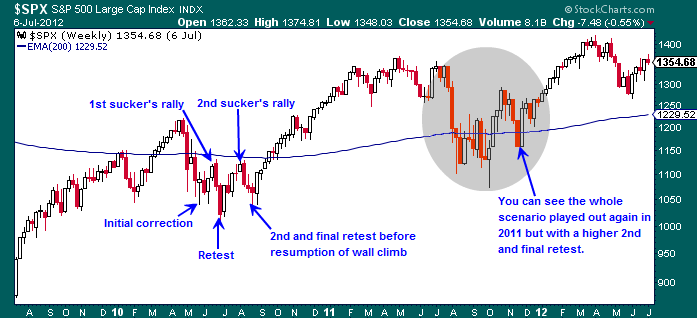
Regarding the current situation, 2010 and 2011 illustrated perfectly how the large money will sucker investors twice before supporting the next leg up of this market. Technicians call them inverted heads & shoulders. I call them inverted STFU. Observe.

clip_image001

Watch for the same set-up before allocating any hard-earned capital. The reason this scenario works and will again is because of good old fashioned herd mentality. Markets correct. The experienced players advise to stay out and expect a rebound with a retest of lows before jumping back in. The low gets retested and everyone rejoices by betting on red and black, then the rug gets pulled out one more time. The strength of the current bounce is prognosticating another dip before the markets put the climbing gear back on.

Bet accordingly.