Do You Really Think They Won’t Be Bailed Out?

DB Logo

C’mon world of finance!  Get a grip.  Lehman comparisons.  End of world talk.  It’s all so laughable.  While Deustche Bank going down in flames within weeks would certainly step up the timetable on a global depression; ask yourself.  Does that seem logical?

No, of course not.  They will be bailed out.  Just because Merkel came out and said that a direct bailout of Europe’s largest public bank is untenable, doesn’t mean it’s not going to happen.  Remember.  “When it becomes serious.  You have to lie.”  Period.  End of story.  Politics 101.

A backdoor bailout of Deustche Bank will occur.  It’s guaranteed.

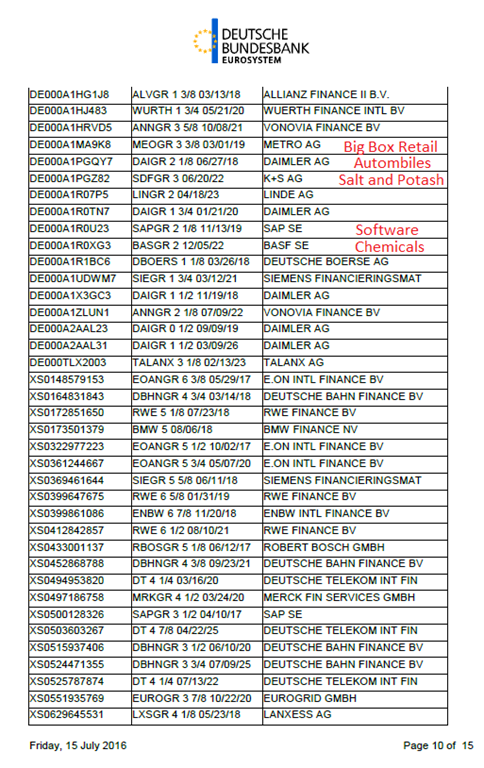
Anybody remember this little document put out by the German central bank in July, just a couple of months ago?  It’s the inaugural listing by the Deutsche Bundesbank sharing their listings of investment grade bonds they purchased.  Who say’s they can not purchase junk bonds?  Equities are on the table.  When you’re pumping out that much stimulus via the ECB, it has to go into something as there simply isn’t enough supply of quality sovereign debt to purchase.

Enter the following:

image

The bonds of the staples of the German business world and economy are on the German central bank’s balance sheet available for lending.  Which from my last post, you know what that means.

I suspect because the issue is so white hot, front and center to the world that the Bundesbank will not directly purchase a new bond issue or equity rights offering from Deutsche Bank.  However, that doesn’t mean that the ECB can’t put together a syndicate of Deutsche Bank counterparties to their insane derivative book and insure wholesale funding for purchases of dilutive financing or share issuances to support Deutsche Bank’s capital level.

I’m sure it wouldn’t be too hard to convince JPM, Citi, Goldman, BofA, HSBC, and let’s throw in Belgium too to come up with wholesale funding in order to buy newly issued debt and shares.  It’ll be perceived as the banking world trying to maintain the safety of the entire banking system and world economy.  Really, it’s just a grab for more time to stave off the inevitable market and economic collapse.

So relax.  Deustche Bank ain’t going down yet.  Go short those Deutsche Bank credit default swaps zipping up in value currently?  Close out your put strategies.  The music will continue to play and you must get up and dance.  DANCE PUPPETS!

Take a Break From the Markets and Enjoy Some Footage of MMA’s Potentially Next Big Thing at 135/145

Currencies are swinging with volatility. The S&P 500 continues to confound with its flat run for the year. Commodities are blowing apart everybody’s theory on hard asset alternative investments. So what to do? Have a short look at Boston Salmon

With a name like Boston Salmon, he’s just gotta be star. Right? If you’re a fight fan, then keep an eye on this young Hawaiian. He hasn’t been called up to the UFC yet as he’s still paying his dues in RFA, which is one of the minor-league feeders up to the main event. Their promotions usually air on AXS, which is generally offered as part of a basic package by local cable or satellite providers. It won’t be long before Dana comes’a calling for Mr. Salmon, though.

This youngster possesses super-crisp boxing, like many of the Hawaiian mixed martial artists. Shoots! But Salmon has extreme KO power to go with the boxing skills. He’s already one of the best combo throwers I’ve seen in a long time, but again, that’s not against the world’s best fighters yet. He’s also very skilled at takedown defense and the times I’ve witnessed a shot work on him, he just gets right back up ala The Iceman in his prime.

What really makes me love Boston Salmon’s skills though is his deadly-accurate, ultra-fast kick to the liver. Boston is a southpaw so he doesn’t have to utilize a switch before throwing it with power. The southpaw stance also allows him to whip the kick with more speed into the unsuspecting opponent’s liver. It easy to tell that this kid has practiced this kick tens of thousands of time in his life. It’s the best I’ve ever seen and I’ve been watching MMA fighting since it was only accessible on VHS back in 1995. Trust me when I tell you, I’ve seen my fair share of devastating liver kicks. Salmon uses his to perfection.

Against fellow stand-up bangers, he’ll soften them up with the left kick to the body and then it’s only a matter of time before the final outcome. What he’ll have to watch out for is when he’s up against the world-class ground guys who are superb at countering kicks with a shot or catch. It’ll be interesting to observe Boston Salmon’s progression. Impressive, athletic bangers aren’t always guaranteed stars. See Uriah Hall.

If you’re unfamiliar with Salmon, have a two-minute watch of 3 of his highlights.

Canada Be Ballin

I thought I’d take another sports break from the markets. Don’t worry it’s not more gambling advice but my calls may be just as implausible as those NCAA football picks from last fall.

Don’t look now but Canada is putting together an exceptionally talented basketball team to compete on the world stage. The battle is routinely just for second place behind the NBA’s traveling all-star team every two years, but with their youth and athleticism, Canada’s ready to really upend the international basketball hierarchy. Spain, Argentina, and France are aging and if the Canucks can put together the right type of offensive and defensive schemes from a chemistry standpoint, then Canada just may have a slim chance at the championship games at the Olympics next year and the World Cup in 18.

It may be hard to wrap your mind around right now considering that Steve Nash passed on even playing for them due to a total lack of competitive ability by the national team. Plus c’mon, Canada is the land of hockey and always will be. But consider, the last two #1 overall NBA draft picks were Andrew Wiggins and Anthony Bennett, both Canadian. To genuine fans of the sport of basketball, Canada’s potential rise in the world ranks should not come as a surprise. We’ve been watching top-level talent filter down into the NCAA programs for several years now.

Assuming contracts and obligations allow for participation, here’s the roster I’d like to see Canada field for the foreseeable future. The statistics are for the current NBA season, except for the 3 players at the bottom who do not play in the league.
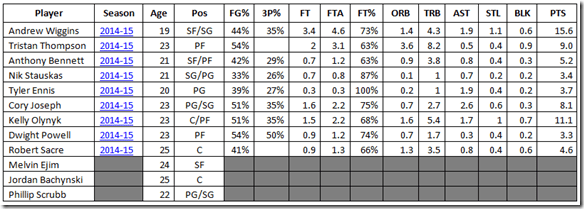
clip_image001

All of the players except for Sacre and Bachynski can play at least one position bigger or smaller, so the team is highly versatile from a size and capability standpoint. This current roster seriously lacks in international experience and the average age of the team is only 22 years old. However, that overall youthfulness may play in their favor if they have the sheer energy and stamina to outpace teams. That’s going to be tough going up against the seasoned countries previously listed whose ball control and championship experience may negate any favorable age difference that Canada brings to a game.

The only player that really jumps out for most fans is probably Andrew Wiggins as he’s the clear front runner for rookie of the year, but the world stage may be all that some of these other players really need to showcase their respective skill-sets. Wiggins is a proven commodity. Bennett wasn’t a number one overall pick for no reason. The kid was dominant in his single season of college as a freshman at UNLV. He’s dealt with some unusual injury issues and there are questions about his stamina at the pro level but this summer may provide a window into what he may finally be capable of in the NBA. Sometimes all it takes is a spark of confidence to build some momentum with a young talent.

I think Thompson may be the most unappreciated talent out of everybody. Half of his rebounds are offensive which is simply incredible. I hate to use hyperbole here but I haven’t seen a nose for the ball like Tristan Thompson’s since watching Dennis Rodman. I think Thompson has the athleticism and skills to lead the NBA in rebounding for several seasons. He just needs starter minutes and the confidence to go after that title as the best rebounder in the league. He’s beastly as a power forward and I really think he’s going to open a lot of eyes next year at the Olympics; maybe even in the playoffs this season.

Stauskas and Ennis have made virtually no impact in their very young NBA careers thus far, but that doesn’t mean anything as repping your country and having the confidence of the coach to really put your talents to use without fear of retribution can potentially help these two youngsters blossom. Stauskas was the Big Ten player of the year and he pretty much scored at will against some of the toughest teams in the NCAA. He’s a willing passer who can make savvy plays as a 6’6 sharpshooter. Ennis was unfortunately drafted onto a Suns team that already had 3 stud point guards which has appeared to have dampened his confidence. The player I watched as a freshman at Syracuse last year was the best freshman point guard in all of Division 1. He only averaged 12 points a game, but the poise and confidence that he played with belied his age and experience. It’s my hope we get that level of control on full display while representing Canada.

Cory Joseph really just started to hit his stride last season for the Spurs. When Patty Mills went down, that gave Joseph a ton of backup minutes to Tony Parker and you can tell that coach Popovich’s confidence in Joseph really helped him breakout. Joseph is having a nice season this year for the Spurs. That championship experience will be extraordinarily important as Joseph will most likely be the leader of this young Canadian roster. I am looking for him to be the key guard on this team and expect him to get a lot of looks as a scoring playmaker.

Olynyk is a nice stretch big man who should be the key “pick & pop” man for the team. I can see how he may be labeled a little soft as he’s only averaging 5 rebounds a game as a 7-footer, but the same could be said for a majority of Caucasian foreign-born big men playing in the NBA. He’s not a rim-guarder like Tyson Chandler but he has proven his serviceability on defense. This Canadian team will rely on Olynyk more for his scoring than defense as the other two 7-footers on the possible-roster are simply defensive additions for the sake of rotation. Dwight Powell has shown some decent potential. I like his size. I like how he played at Stanford. He’ll learn a lot this year with Dallas that will hopefully help him make a strong contribution to the Canadian team.

Even though Sacre makes a very minimal contribution to the Lakers and Bachynski is not even in the league, these offseason opportunities give these kinds of players the chance to really prove what their capable of and maybe relive some of their old college glory. It’s my hope that they step up to the high level of competition and play at the maximum that their talent levels afford. If they do that then Canada will have gotten all they need out of these two. As far as additional big men go, I could easily substitute Andrew Nicholson for Bachynski here but he’s been in the dog house and I worry his confidence may be shot. Plus, he’s a full five inches shorter than Bachynski, however, his athleticism and length could quite possibly make up for the height differential. With him being a former stud-college player and then falling into the dog house after a very solid rookie year, I just worried about how Nicholson would perceive his role on this roster. Bachynski has nothing to lose and should very well know exactly where he fits on this team especially since zone defense is common at the international level. How else are you gonna offset the size, strength, speed, and sheer athleticism of the US team?

There’s also the intriging potential of Kentucky freshman Trey Lyles. At 6’10 and 250 lbs. and one of the top contributors on that deep Wildcat team, he would make another fine young addition, but I’m not sure where Calipari stands or the school for that matter in allowing Nash to potentially add Lyles so again I’m sticking with Bachynski here…but I fully recognize Nicholson and Lyles as the much better talents. Undoubtedly, Lyles will be a big-man mainstay for the Canadian program for years to come; hopefully as early as 2016 but probably beginning in 2018.

Melvin Ejim and Phillip Scrubb are very interesting. Ejim played for a very tough Iowa State team last year that went 28 – 8. Ejim was part of a 3-headed attack alongside DeAndre Kane and Georges Niang that was very difficult to defend by any team in the NCAA let alone other Big 12 squads. He averaged 18 points a game and was the Big 12 player of the year. Unfortunately, he failed to get drafted and didn’t make enough of an impression as a free agent to stick with an NBA roster. He’s a tweener and he plays bigger than his height. He averaged 8 rebounds a game so he can bang the boards with anybody despite being only 6’6. The problem is that at that height, you have to be highly effective on the perimeter. Otherwise you might as well just go to Europe which is exactly where he is right now. I think he makes an interesting pairing with Tristan Thompson at SF and PF when they’re on the floor together. I watched a lot of Iowa St. games last year and Ejim can really play.

Scrubb is currently a senior at Carleton University in the CIS. In case you were unaware, the CIS stands for Canadian Interuniversity Sport and it’s the Canadian equivalent to the NCAA. There’s approximately 47 schools that are in the CIS. Carleton University is the Canadian equivalent to UCLA from the 1960’s and 1970’s. They’ve won 10 out of the last 12 CIS championships and Phillip Scrubb is the 3-time reigning CIS player of the year. The dude can straight-up ball with any kid down in the US. Why he skipped a higher profile position at a Division 1 school is anybody’s guess but here’s a sampling of some of the torchings he’s put on American universities over the last few years.

In 2012, Scrubb dropped 28 on Northeastern. Ok, so what. Northeastern sucks. But then he embarrassed Jay Wright’s Villanova guards for 32 points in a loss. In 2013 against a then 12th ranked Wisconsin Badger team, he threw down 30 points while dishing out 12 assists. That same year he had 14 points and six assists in an overtime loss to a very good Syracuse team. Last year he put up 24 against Illinois-Chicago and then back to back 30 point efforts against Memphis. There is no doubt about this kid’s skills but he continues to fly under the radar because of his choice to stay in Canada.

This year has been a little off for him. He’s only averaging 16 a game for Carleton and the rest of his numbers are a little lower, too. For some reason he’s only playing around 24 minutes per game despite the fact that he’s played in every game except 1 this year. For a back to back to back player of the year, you’d think he’d be clocking at least 32 minutes a game at a minimum as the CIS games consist of 2 twenty-minute halves just like the NCAA. So really I guess his reduced output is a matter of perspective as he’s putting up 16.5 points, 4.5 assists, and 3.5 rebounds despite only playing 24 minutes a game. The CIS 3-point line is the same as FIBA’s which is just a few inches shorter than the NCAA’s. Scrubb shoots 3’s at a 47% clip. He’s gotta stroke and if he plays with as much poise against some of the world’s best as he did against the D1 squads, then I think he’ll make a nice contribution as a 3-point bomber. This is assuming he gets enough minutes to make a solid contribution, again, he is the only non-pro on my preferred Canadian roster.

The Pan-American games are in Canada this summer and it will give the Canadian team a chance to garner some crucial time together against other internationals while in their own backyard. Steve Nash is the GM of this squad and I trust that him and his head coach, Jay Triano, will pair down the roster to the most talented and capable of winning. I think the roster I laid out can take out all comers at the Pan-AM’s. The US usually skips it, so Puerto Rico won the last one. I feel confident that the roster laid out above or one very close to it can easily take out any South American or Caribbean team for the gold as long as Argentina sends its B-squad, which it should. From the Pan-AM’s it will be the final qualifying FIBA tournament in Mexico in the later part of the summer. The two finalists in Mexico will earn a berth to the Olympics, which would be Canada’s first in 16 years.

There are some very big questions to consider here, of course. What if these players that have had a tougher time in the NBA or abroad don’t play up to the talent they displayed in college? What if each individual fails to understand their role within the team and instead jeopardize success by trying to show off what they can do as a tactic in contract negotiation? Team success takes sacrifice and the lack of experience by this squad means this roster is going to need to understand that in a hurry. Most importantly, will Canada ever reverse its stance on insuring its players against injuries when they’re representing the country. Most of the other top FIBA teams do and it would go a long way towards ensuring that the best talent available is able to represent Canadian basketball.

Currently, the Canadian team is ranked 25th in the world by FIBA. After the 2016 Olympics and the World Cup in 2018, I have no doubt this team will be ranked in the top 10. You never know. Depending on how things come together, we may just see this new golden era of Canadian basketball see the team play its way into a top 5 world ranking. Full disclosure, I do have dual citizenship in Canada and the US thanks to my pops, but I was born and raised in the US so you can’t exactly label me a homer. I just really like the potential of Canadian basketball to shake up the FIBA status quo and I look forward to what the future will bring for the team.

You didn’t really think I’d sign off without mentioning any markets, did you? Be sure to maintain a close-eye on 10-year Treasury yields, TLT, XLU, and the US dollar. With the strength of the finish in equity markets this past month, I suspect those 4 categories will tell a very strong story of where equity markets are headed going into the spring. Volatility has really tapered off and there are many indications that the smart money is sniffing something around the corner. Nothing huge, but something none the less. Trade intelligently. Currencies and fixed income are singing a tune worth listening to…and GO CANADA BASKETBALL!

A Rising Tide Lifts All Boats

There’s a ton of divergences occurring. According to some “expert” voices in the blogosphere, the divergences don’t matter. That’s nonsense. Divergences do matter. They provide signals that can assist speculators on when to or when not to allocate capital. Additionally, maybe certain divergences signal to take some risk off the table. Sure a perma-bear or perma-bull can find enough signals in any nook or cranny they search to warrant their stated opinions, but that’s the nature of data and confirmation bias.

I would say caution is warranted across multiple markets. High-yield bonds i.e. junk bonds finally sold off with a recovery into a potential double top for JNK & HYG and in an earlier post, I had stated that junk selling may be the final piece the markets would need to see for a significant correction to occur. That may still be the case, but there are enough other factors to justify a cautious stance. Everything happens so rapidly in the markets now, so if you’re not nimble then say goodnight to any short profits. The NYSE A/D line was descending but has since resumed its climb to reach a new all-time high. Small caps(Russell 2000) sold off 8% during that last month’s downmove and many published analysts thought that may be the extent of the move. Turns out they were right…for now. My go-to indicators show strong potential for a continued down-move, however one of the indicators is flattening in the short-term. If long-term resistance gets broken on the RUT? Well then more damage could be on the horizon for a larger swath of the markets’ asset classes.

Preferreds can sometimes be a leading indicator of deteriorating credit conditions, reason being because they’re primarily issued by financial institutions and REITS. Along with most everything else, we saw preferred stock funds temporarily turn down but have since recovered into a lower zone that’s been essentially flat for the last few weeks. There were some major M&A deals that were scrapped last month, but who cares. Who cares about anything in the game of speculation if it isn’t related to a central bank, right? Seriously, who cares anymore? Everything just goes up anyway. Who cares about technical analysis? You can’t trade without volatility. There couldn’t be a worse time in modern financial history for a trader to try and stake his or her claim in the world by beating the markets.

Before you assume it’s all sour grapes with me because of my own trading results, please understand that like any other prudent asset allocator I maintain multiple portfolios for various strategies. Most are dedicated to sound asset allocation strategy as well as conservative stock selection across the best companies in the world; the kind of companies that can weather any storm. As much as I enjoy fundamental analysis and good old stock picking through the breakdown of a company’s financial statements and filings, I get more of a kick out of trading on the price action. My smallest portfolio is my trading portfolio and thus that helps to mitigate the damage of the strategies I’ve been utilizing the past couple of years. So no I’m not entirely bitter because the big bad bully market took all my marbles. I’ve still gots me marbles and I’m still playing the game. Strategies have to be shifted in light of the current environment where HFT and central bank support dictates market movements and investor sentiment. I’m certainly not alone in my mediocre trading results of the past couple years.

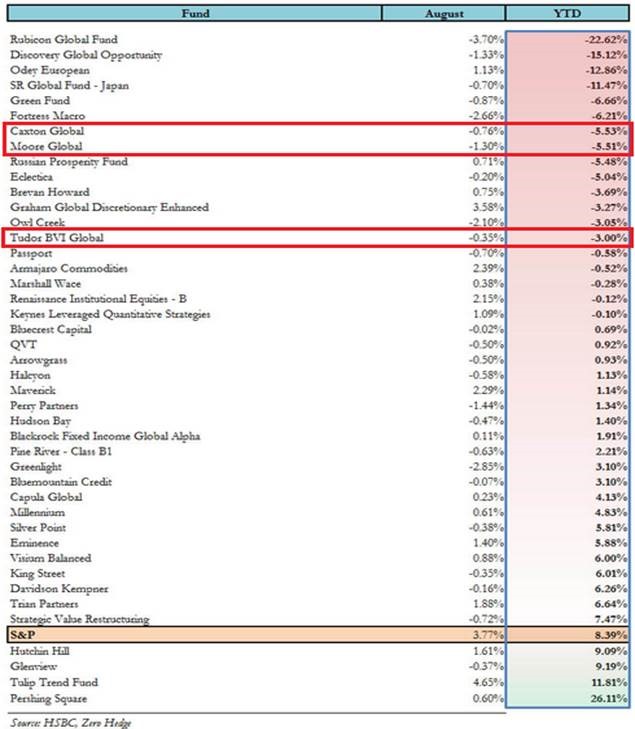
Up until 2012, the arcane magic of technical analysis still worked quite nicely. You could still use decades old strategies based on squiggly patterns of price & volume to regularly snag profits out of the market. But what does it say to you when some of the most respected traders of all time are consistently losing? What does it say to you when three of Schwager’s Market Wizards who run billions in AUM continue to come up with negative performance that is far below even the S&P 500 index? You have to really question why the hell you’re not holding a simple double or triple long ETF of the S&P 500 or why you think you can outsmart a rigged market. Have a look at HSBC’s latest scorecard of hedge fund performance. Observe the performance of the individually legendary Tudor, Kovner, and Bacon:

clip_image002

It’s this sort of performance and environment that takes some of the fun out of the game. Intrinsically, trading is a competitive endeavor so there’s no giving up on the fight to earn profits against the world, but right now is not a time to be fighting if you’re not winning consistently. It’s a time for reflection on strategies, skillset, and the overall approach to your trading business.

The lack of any real movement in the markets could be a seasonal effect. It could be a product of the gross market manipulations. Or it could be that something worse may be on the horizon. By now the CNBC interview with Sam Zell has been shared and commented on by virtually everyone in the financial media and blogosphere. I won’t beat it to death here, but his comments are worth noting. He’s not some chump billionaire always looking for the limelight or setting up a book sale or political career. He’s the original “Grave Dancer” and he took Blackstone to school in the $39B sale of his company, Equity Office Properties Trust, at the top back in 2007. His words are worth heeding, but as with every other expert, not following blindly.

These are the key points he made on Squawk Box:

“The stock market is at an all-time, but economic activity is not at an all-time. People have no place else to put their money, and the stock market is getting more than its share. It’s very likely that something has to give here.”

“I don’t remember any time in my career where there have been as many wildcards floating out there that have the potential to be very significant and alter people’s thinking. If there’s a change in confidence or some international event that changes the dynamics, people could in effect take a different position with reference to the market.”

– “It’s almost every company that’s missed has missed on the revenue side, which is a reflection that there’s a demand issue. When you got a demand issue it’s hard to imagine the stock market at an all-time high.”

– “This is the first time I ever remember where having cash isn’t such a terrible thing, despite the fact that interest rates are as low as they are.”

So forgive my redundancy for reposting what’s already been reposted a million times, but the original link and interview can be found at: http://finance.yahoo.com/news/sam-zell-stock-market-correction-124350576.html#

Just to provide a little graphical support to the bullet points by Zell, take a gander at the following chart shared by professor Mark Perry of the Carpe Diem blog:

clip_image003

Meaningful or meaningless? You know the answer.

Coming back to underperforming professionals, it’s not just trader hedgies having a rough go. Even the plain old vanilla mutual fund managers in the large-cap space continue to also underperform a benchmark of the S&P 500. In a recent MoneyBeat column, David Kostin was quoted: “Only 23% of large-cap mutual fund managers have outperformed the S&P 500 this year, rivaling the worst performance in the past decade, according to the chief U.S. equity strategist at Goldman. By comparison, about 37% of fund managers have outperformed the benchmark since 2003. Only performances in 2006, 2010 and 2011 have been as bad or worse than the current year’s pace.”

In times like these where the US ZIRP and the Euro NIRP forces money into stocks, Siegel’s Stocks For the Long Run probably sounds better and better for many investors if they haven’t already shoved all their retirement funds into Vanguard’s warm embrace. I want to take a moment here to plug the research of Stansberry Research & Associates. Specifically, I want to call out the work of Porter Stansberry, Dr. Steve Sjuggerud, and Dan Ferris. If you are unfamiliar with their work then maybe it’s time you familiarized yourself with them, if you intend to be individually selecting stocks for your portfolio(s). I have been using their services for close to a decade. And in today’s market environment, they continue to be on the leading edge of most all of the macroeconomic happenings while also providing some of the highest quality deep research on equity selection out there. With a subscription to their advisories, I can honestly say you’d probably be getting the best bang for buck out there in the newsletter game. Having read plenty of samples of sell-side research from Wall St., these guys stack up and will assuredly enhance your ability to safely build a profitable equity portfolio.

Full disclosure, I have absolutely no relationship with Stansberry Research & Associates in any other capacity than as a satisfied subscriber. Like other services I have touted, I’m certain they don’t even know this blog exists. Additionally, that link to their site does not pay me some sort of commission. I truly just enjoy the quality of their products and wanted to take a moment to share that with my own readers. In my much younger days, I tried most every newsletter out there…Motley, everything under Agora, Richard Russell, amongst many others as I was learning the game and was simply too lazy at the time to open a book to teach myself just yet. For the last several years, these guys are the only equity research I rely on aside from my own. So I would recommend you visit their site and maybe try a subscription or two, I’m confident you won’t be sorry.

In the meantime, the markets are boring. No volatility; just summer flatness. Even the financial media and blogosphere are completely boring. No originality in content and certainly nothing new or profound being reported…and that includes Marginrich.com. I’ll keep posting my thoughts on various market observations but my next post I intend to share my thoughts on a different type of speculation, and that is sports betting specifically on college football. Having evaluated all the major sports, NCAA football is the one sport that consistently provides asymmetrical profit opportunities against any sportsbook whether it’s online or at a casino. Don’t get me wrong it ain’t easy, but if you do the research and have a quality understanding of the variables that go into some basic handicapping, then profits can be made.

Be safe and allocate intelligently because a rising tide does lift all boats. Just don’t take your eye off the ball for any reason while throwing money around willy-nilly…and I’m sorry for being gone so long. Life happens.

This Blog Lives…I Promise

To any readers that actually miss the content produced here at Marginrich.com, I truly apologize for the lack of output. Between vacation, moving, and business travel, I simply haven’t prioritized the creation of new posts. Please stick with your regular visits as I intend to get back on track this week.

Usually, I’m able to produce a post about every 10 days. I’d like to post more regularly and consistently, but it is what it is. Thanks for continuing to stop by the site to check for updates or read an old article. I appreciate your eyeballs and I’ll have something for you soon.