Much Ado About Snapdragon

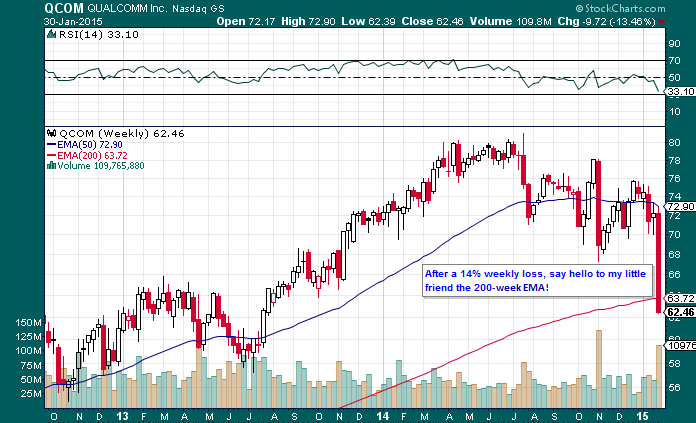
Since the start of the 2nd half of 2014, Qualcomm has had a rough go of it. After peaking at $81.05/share, it’s been all chop and drop. Just look at that massive 14% drop in the share price last week subsequent to beating earnings estimates but confirming that Samsung will drop Qualcomm’s Snapdragon chipset and go in-house with its own proprietary technology for the new Galaxy release.
clip_image001

The loss of that one particular Samsung line caused Qualcomm to lower guidance for 2015 revenues by $800 million. Stop the presses! You mean Qualcomm may, as in possibly but not certainly, have 3% less in revenues than what was projected for the entire year?! That’s definitely grounds for revaluing a business lower by 14% within days, because your valuation models weren’t skewed before and this new information means everything. You have to love the market. It consistently puts great businesses on sale during a year. You just have to have a list, understand the fundamental values, and be patient.

It’s not just the loss of Snapdragon in the new Galaxy and lower guidance. It’s also the uncertainty of the antitrust probes that have been reopened by China, Europe, and the US. Qualcomm’s market-share in mobile technology is so vast that the issue may never be fully put to rest. Countries can and will continue to reopen cases regarding Qualcomm’s trade practices as long as they continue to maintain such a strong hold of the market with their wide-ranging patent portfolio that gives them such a huge cut of the telecommunications action. Reminds me of the scene in Goodfellas, where Ray Liotta’s character explains what it’s like to go into business with the mob. Slow sales? FU, pay me! R&D too high? FU, pay me! Having trouble innovating? FU, pay me! I don’t want to mischaracterize Qualcomm as I truly appreciate their business model, but you get the point.

Qualcomm is the emperor of all that is 3G technology. Their patent portfolio is so immense that there is a never-ending line of vendors waiting to kiss the ring and pass along envelopes filled with cash. That’s one of the many reasons Qualcomm is so great. Their lordship over CDMA is simply a money mint and all of their competitors around the globe can’t stand it. It appears as if the China anti-trust issue will soon be put to rest with minimal damage, from a relative standpoint. With any luck, they’ll pay their fine of around $1 billion or less and lose some concessions but still be in the game in the ever-important Chinese market. No government is going to kill a golden goose like Qualcomm and all the tax revenues that they represent. I suspect the EU and the US may even just end their own probes with very little in the way of remediation, but that is pure conjecture.

These fears surrounding Qualcomm are not completely unfounded as a worldwide attack on the company’s ability to extract royalties is a clear and present danger. However, as I noted before, Qualcomm is a cash cow and in light of the cronyism that runs rampant through the developed world do we really think this is the company where regulators stand up and decide to fight for something? Really, I suspect a great deal of the matter depends on the strength of the relationships of Qualcomm’s competitors with government bodies to possibly influence the regulatory inquiries.

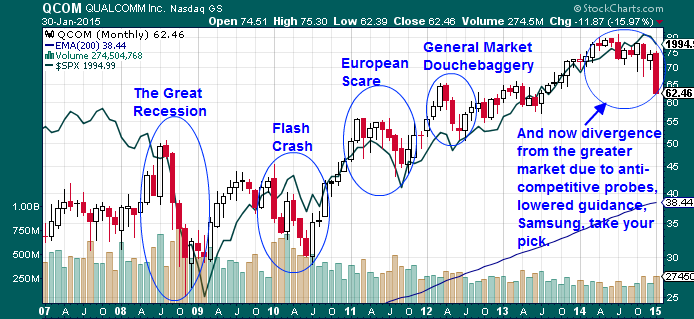
Over the last 8 years, Qualcomm’s corrections have essentially kept time with the greater market. Observe the price action on the following chart. More recently, the stock price has corrected approximately 23% while the market has continued its ascent. I am not inferring anything here, we’re simply reviewing the relationship between the greater market and Qualcomm while noting the current divergence in light of the company’s own gravity-inducing catalysts.
clip_image002

Qualcomm has faced pressures from sovereign entities as recently as 2009 with South Korea and 2007 with the European Commission. The effects to the company’s ability to generate free cash flow have been utterly negligible. Let’s take a look at the last 3 years’ worth of free cash flow results.

2014 – $7.7 billion (OH NO! That’s the same as 2013! Please.)

2013 – $7.7 billion

2012 – $4.7 billion

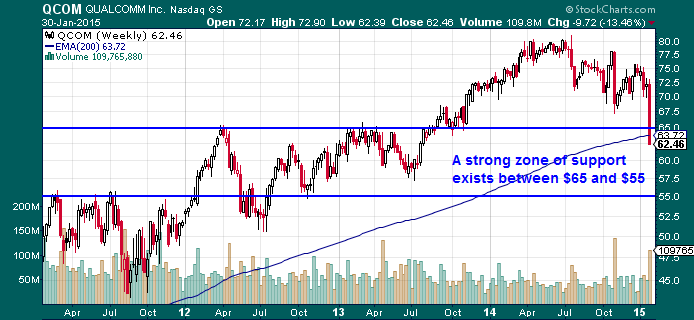
All that cash and no long-term debt equals the ability to deploy capital in a shareholder friendly manner. The current dividend yield is now approaching 3%, which would imply a price per share of $55 if it reaches that point. These colossal free cash flows are a product of a royalty portfolio that accounts for 30% of the company’s revenues but over 85% of earnings before taxes.

One of the most persistent questions about Qualcomm’s future profit generating ability is what happens as the wireless telecommunications space evolves(spectrum and equipment). That’s a reasonable concern in light of LTE’s advance. However, LTE is nowhere near to reaching maximum penetration around the world yet. Additionally, 3G compatibility within LTE devices will keep the royalty portfolio pumping cash for years to come. This is due to the fact that voice is still primarily handled via 3G while LTE is focused on data. Furthermore, the adoption of LTE has been very slow in Europe which leaves a very rich opportunity for continued penetration of Qualcomm chipsets in higher income per capita regions. Observe the potential in this chart from Analysys Mason, one of the leading international consultancies to the telecommunications industry.

clip_image003

For a long-term portfolio option, these prices at the 52-week low appear to be quite reasonable to begin establishing a position. There are plenty of risks to assess before allocating capital, but the moat they have created around their business model in conjunction with the consistent eruption of free cash flow creates a very enticing opportunity. At this current share price their EV/EBITDA is at a reasonable 9 and they are approaching an EV/FCF of 10. Despite all the negativity surrounding their fiscal Q1 results, revenues and net income were still up YoY by 3% and 26%, respectively.

Valuation depends on the variables in your model and what factors you prefer to place the most influence. As a potential long-term addition to portfolios, these share prices warrant a look. Let’s take one last look at the technicals. Qualcomm has dipped its toes into what appears to be a very strong support zone. As always, anything is possible in these highly volatile markets, so tread carefully.
clip_image004

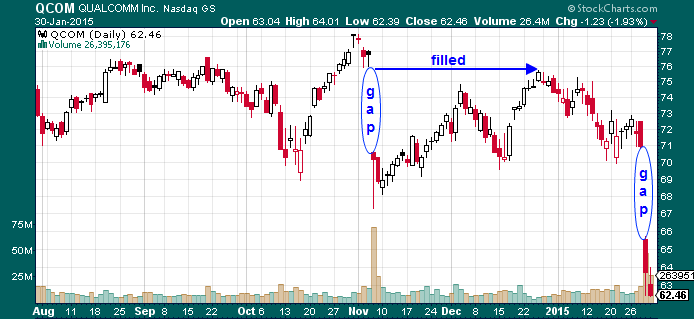
For true fiends out for any action, have a look at QCOM’s daily chart. It’s presenting the potential for a gap fill and long-time readers know how much I love the action of the snap-back. No further comment is necessary. The chart says it all.
clip_image005

If you feel the need to trade last week’s gap then bear in mind the gap fills at approximately $71. Simple strategy, simple stop, but delivering profit may be a touch more complex.

In summary, Qualcomm has the moat, prodigious free cash flows, and share price action that lends itself to constructively researching a potential investment. Last week’s ado may in fact just be about nothing. Allow the price action to inform you.
It Ain’t a Trend Until it’s a Trend

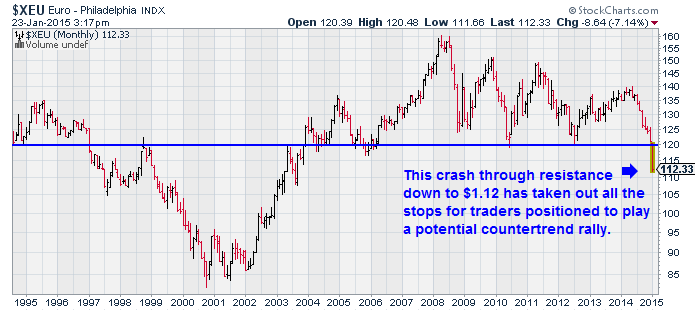
The euro and the dollar both looked ripe for countertrend rallies. Still do, actually. In my last post, I shared some charts that showed what I thought were very good set-ups for what at least could be some short-term trend reversals in the two currencies. This was of course well before the monetary nuke dropped by the Swiss National Bank that they would no longer be pegging the franc to the euro. Subsequent to this announcement, the franc took off like a rocket and the euro has dived well past support.

clip_image001

The rocket launch of the franc has seen plenty of banks, forex shops, hedge funds, and various financial institutions cumulatively lose billions of dollars; and the total damage has yet to be seen from all the short franc trades around the world. Those who may have positioned early on the euro or dollar reversals would almost assuredly have been stopped out. I was fortunate to not have taken a position in either currency. Specifically, I stated on January 5th, “I have not positioned in a trade yet as I haven’t observed a very usable signal just yet, but we are very close.”

Adhering to the discipline of waiting for confirmation from my go-to signals versus taking a chance on the price action based on trend lines saved me from a loss; even if the loss only would have been minimal due to stop-discipline. The same thing could be achieved by simply waiting for the price action to confirm the trend reversals. One notion that many of the best traders consistently follow is simply letting go of trying to time 100% of a move. There is enough profit made by catching 80% of a move by letting a trend establish itself. This concept is age-old and time-tested.

I prefer the indicators in conjunction with the price action, but if you’re going to be trading then you should have a methodology or technique that allows you to safely enter into a trade. You shouldn’t be throwing money around willy nilly simply off of squiggly lines and 100 year old patterns. The indicators I like to follow are very common and used by virtually everyone, however, I have specific chart timing I like to utilize. Additionally, I have a subtle difference of viewing the indicators for confirming signals. For the indicators I like to follow, most traders are still using crossovers but that simply doesn’t work anymore due to the mainframe warehouses being able to program out their market efficacy. This is my edge. It’s been backtested over several years and many trades. It’s not some guaranteed profit magic item I consult before each trade. I get stopped out and whipsawed too. It’s simply a go-to tool to help me mitigate risk. If you don’t have or know your edge, stop and rethink what you are doing and why you are doing it.

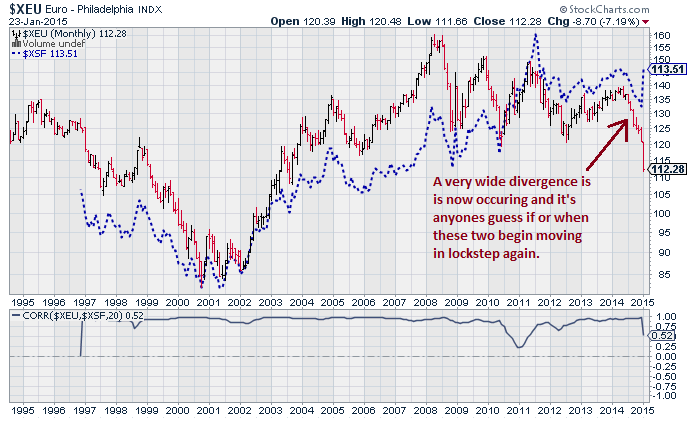
I will be keeping an eye on the euro and the dollar along with every other market player in the world. With the franc front running a very obvious move for QE by the ECB, the downtrend in the euro and the uptrend in the dollar may be entrenched for a while longer. A counter-trend catalyst could present itself at any point so keep your eyes peeled, as even shorts can be squeezed unbelievably faster than what was conventionally thought for a currency trade. There is a lot of uncertainty between the franc and the euro, which generally move quite closely with each other.

clip_image002

The franc’s shift in perception back to safe-haven status while the euro is weakened by the ECB’s proposed monetary inflation has helped to muddy the waters, so to speak, in how to effectively trade them in the current environment.

On another subject, Intel (INTC) is a stock that is often commented on as being a leading indicator of the S&P 500. The same can be said for many other economically sensitive stocks such as: Caterpillar (CAT), Wal-Mart (WMT), McDonalds (MCD), FedEx (FDX), and Amazon (AMZN). I could keep going, but you get the picture. These companies are fully integrated across the entire North American landscape so that the performance of these companies can be viewed as economic indicators and thus potential leading indicators for the S&P 500.

This theory has of course been backtested and the correlations examined extensively, so I leave it up to readers to indulge their curiosities by searching the web for additional information.

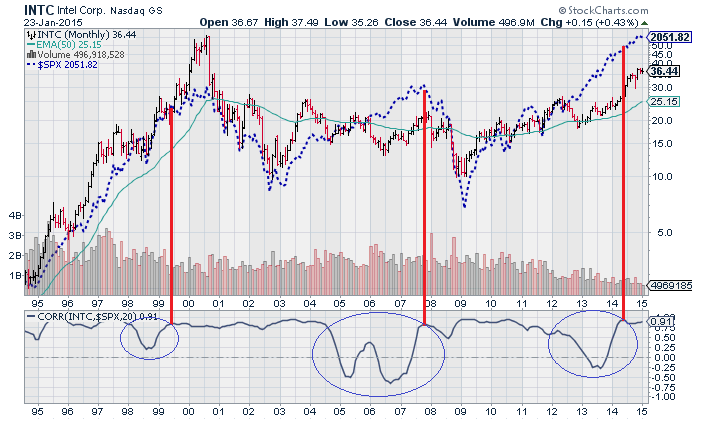
Anyways, coming back to INTC; in viewing a chart of its performance and correlation to the S&P 500 over the last 20 years I did notice something curious. As 20 years is probably statistically insignificant, I wouldn’t place too much importance on what I’m about to point out but it’s still curious. Have a look.

clip_image003

Using a 20-month correlation, it can be seen that a majority of the time the two are highly correlated between .80 and 1.0. However, before the start of each of the major crashes in 2000 and 2007, it can be seen that correlations between INTC and the S&P 500 took a dive towards zero and even negative correlations before recovering back up over .80. When this happened in 1999, the recovery in correlation preceded the actual correction in the larger index by about 15 months. That is only because most of the action of that period was in the NASDAQ and the recovery in correlation between INTC and the S&P 500 actually preceded the beginning of the NASDAQ’s downturn by 6 months. The NASDAQ began its implosion several months earlier than the rest of the indexes as it was the focus of the dot.com era.

For 2007’s crisis, it can be observed that the recovery in correlation back up over .80 between the two pretty much nailed the exact top in the S&P 500 to the month. And now we can see that between May and June of 2014, we saw another recovery to at least .80 in the correlation of INTC and the S&P 500 after a year-long dip. Again, I’m not implying that this is a usable signal to discern that we are near a major top in the equity markets. The last two crises had unique fundamental backgrounds and triggers, just like the next will have its own. In 2000 and 2001, we saw the bust of the tech boom exacerbated by 9/11 and the beginning of the never-ending war on terrorism. In the middle of the decade, we saw real estate financing and associated derivative leverage hasten a credit crisis that nearly took down the entire economic system. For the next one, it could very well be sovereign debt, central bank incompetence, and derivative leverage once again that initiates difficulties. I’m simply pointing out that the 20-month correlation of Intel and the S&P 500 provides an interesting signal.

Obviously, the correlation coefficient can be set to any number of months, weeks, days or minutes based on the period used for your charts. Twenty is the default parameter utilized by Stockcharts.com. Sixty is also prominently used and in the case of Intel and the S&P 500, when using 60 months, that leading pattern does not exist. So take the indicator for what it is; a simple signal of interest. Nothing more. Incidentally, if you gauge the correlation of each of the economically sensitive stocks I listed above, no early-warning signal exists between them and S&P 500. That pattern in the correlation for the potential of an early-warning of greater market direction only existed with INTC. Happy trading, speculating, investing, winning, and losing.

Dollar Strength and Euro Weakness – Trends Within Trends

You keep hearing the same message from source after source and then your trading spidey-senses start tingling with contrarian ambitions. That’s what has been going on for me with the Euro and the Dollar the last several weeks. Plenty of financial print has been dedicated to the strength of the dollar’s ascent and the weakness of the euro’s countertrend towards parity. Right now dollar strength is being bandied about due to it being a “safe haven” play for some reason(I don’t know against what current dangers) in conjunction with the cliché of America’s economy being the “cleanest dirty shirt.”

The current dollar and euro trends are glaringly obvious to all market players. Literally, every single trader and market player on the planet is watching these currencies. Which means we have a highly liquid trade opportunity availing itself and I have been waiting for some indicators to line up with my thesis to provide a lower-risk entry. There’s no sense positioning too early simply to have the mainframe warehouses wipe out the potential of the trade by running all the stops and igniting a sell-off. This could in turn create a short covering rally but utilizing multiple signals for entry points helps mitigate the whipsaws.

Make no mistake, in the long-term anything can happen with these two currencies but senseless extrapolation across multiple time frames can often create profit-delivering opportunities. Let’s observe a series of charts before the suggestion of some simple plays.

The first chart is a monthly chart of the euro going back the last 18 years. There are some simple markups on the chart. The first feature that should jump out at you is what we’ll call “The Power Line” at $1.20. This price acted as stiff resistance in the late 90’s and early 00’s (“Oh-Oh’s”), but for the last 10 years has acted as reliable support. The second feature is the potentially bearish descending triangle with “The Power Line” as the base of that triangle. Now for trading purposes, I’m betting the euro bounces here again towards that upper line of the triangle. However, one can see that as this triangle plays out and should it be broken to the downside in the future, the potential target would blow well past parity with the dollar to about $0.89. But that is another story for another day.

clip_image001

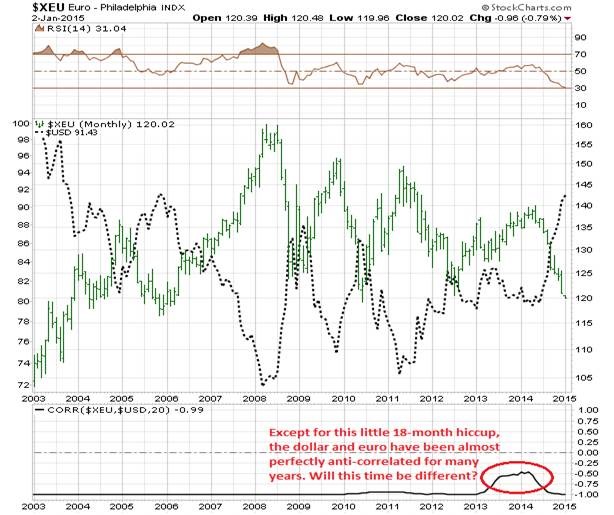
While the euro appears to be possibly setting up for a bounce off strong support, the dollar is running up against potentially strong resistance around 91 which also happens to have held for the last 10 years. This sets up a virtually perfect pair-trade between the euro and the dollar. Observe the dollar and euro’s nearly perfect negative correlation.

clip_image003

Aside from price action, sentiment indicators also look favorable. Observe the following Optix Indexes courtesy of SentimenTrader.com. The always savvy Jason Goepfert creates sentiment indexes based on an amalgamation of surveys and various sentiment indicators and applies them to a multitude of asset classes. Below are the Optix Indexes for the euro and the USD.

clip_image005

Over the last 5 years, when the euro Optix spent 4 to 6 months in the “Excessive pessimism” zone, then a countertrend usually presented itself in the short-term or intermediate term. The opposite pattern can be observed in the US dollar.

clip_image007

Can the dollar continue its vertical joyride? Possibly, but that would run counter to what have been some fairly reliable patterns that have held for several years now. Throw in the fact that the mainstream media continues to extol the virtues of the wondrously strong dollar and a small measure of mean reversion seems in order.

If one were inclined to attempt to profit on a pair trade, there are a few simple ways to go about it. There are of course the futures contracts which are generally the realm of the professionals. If you’re an armchair speculator, you can buy some of FXE and short some UUP. You can leverage that same play with some Calls on FXE and Puts on UUP. Perhaps you want to keep things simple with some ETFs going long the euro with ULE and short the dollar with UDN. If you’re inclined, play it anyway you feel comfortable. Be especially careful with ULE as average volumes are exceptionally light. I have not positioned in a trade yet as I haven’t observed a very usable signal just yet, but we are very close.

For you Fibonacci believers, here’s some potential retracements for the euro.

clip_image008

The 38.2% retracement, assuming $1.20ish is the low, is around $1.28 which was very strong support during 2013 so this makes for a good initial profit point. The trade has all the appearances of a money-laying-in-the-corner trade as sentiment has become extended, however, if it appears too obvious then it can’t be true. Right? Not necessarily. The pattern may be delayed as a final sell-off occurs to run all the stops between $1.20 and $1.17 over the next several weeks or possibly months, so the trade set-up may require some patience. That’s the discipline in swing or position trading.

If any readers choose to enter a position then good luck to you. There is a lot of doom and gloom about the euro due to the “Grexit” talk, Russian sanctions, and the ECB’s impotence amongst other things. I’m not saying to ignore any of these notions, but the charts above should hopefully spell out what the price action and sentiment are trying to communicate in light of all this bad news. I suspect the worst for the euro may already be priced into the currency, for the short-term at least.

As for 2014, I hope you ended the year in style without too many tax losses and may 2015 bring some additional prosperity to your life.

A Green Island in a Sea of Red

Like many a speculator, I’ve dabbled in the juniors. Specifically, I’m referring to junior gold and silver explorers and miners. Before 2011 it was a successful endeavor, post 2011, not so much. One of the things I did before altogether stopping the placement of new capital in any juniors was to compile a list of what I deemed to be some of the top opportunities for when precious metals finally make their turn back to positive. For the record, I don’t know when that’s going to be. The gold price languished for 20 years in the 80’s and 90’s. Do I think we’re in that type of 20-year-bear? No, but I don’t have a clue as to when the ship will right itself.

I simply believe in the long-term thesis for holding gold, but more importantly, I believe in the cyclicality of the commodity markets and historical precedence. There are any number of arguments in favor of allocating capital into precious metals, but for most speculators, the current price action in gold and silver pretty much tells the entire story. A declining market is not exactly the best moment to deploy new capital into the most riskiest ventures of a loss-leading sector. Thusly, it’s been at least 2 years since I speculated with any capital in a junior.

Which brings me to the list. One of the companies I had kept a passive eye on was Duluth Minerals. If you’re unfamiliar with their story, they’re the proud majority-owners of some prime property through a joint venture in the Twin Metals complex in Minnesota. Their land package and joint venture partner was what first attracted me to them. Duluth possesses one of the most promising platinum group metals (“PGM”) resources outside of Africa or Russia. In fact in North America, there’s really only two primary PGM producers of consequence, and they are Stillwater Mining and North American Palladium. So access to a nice PGM resource in a jurisdiction like North America is coveted.

However, PGM’s won’t even be the primary metals mined at Twin Metals. It’s primarily a copper and nickel mine. The PGM’s are a just a very nice by-product. Hence Antofagasta’s interest and investment in Duluth. Just a little background on Antofagasta (“Anto”), they are one of the largest, pure copper players in the world. Based in Chile with 4 operating mines, 90% of the company’s revenues are derived from mining operations. In 2013, they generated approximately $6 billion in revenue which is in line with large US copper player Southern Copper (SCCO) but far below the diversified mining giants such as Vale (VALE), Rio Tinto (RIO), or Freeport-McMoRan (FCX).

Before getting to the point of this post, some additional background is in order. So we have a major copper player with concentrated interests in Chile attempting to diversify their portfolio with the Twin Metals joint venture. In 2010, Antofagasta partnered with Duluth and over the next few years provided approximately $220 million in funds in order for Duluth to develop the properties. Duluth completed a ton of drilling to really prove out the potential of Twin Metals. They contracted with Bechtel, one of the largest and most powerful privately owned corporations in the US, to assist with the planning for the build-out of a mine.

But by 2014, Duluth had not done enough to build investor sentiment behind their company and access to capital was drying up in light of overall commodity underperformance, let alone precious metals performance. The stock price was badly languishing. Duluth’s cash reserves were drying up fast, and in July, Anto neglected to capitalize on an additional financing round that would have increased their ownership stake in the mine and provide much needed capital for Duluth. Clearly, Anto saw the writing on the wall and knew a better opportunity would avail itself very shortly.

One month later in August of this year, Duluth released a highly detailed presser of its Pre-feasibility Study (“PFS”) for the Twin Metals. The PFS was essentially a disaster as expectations were way too large. The stock price, trading at $0.40 a share the day before the PFS release, dropped 25% down to $0.30 a share on the day of the release. I think too many speculators in Duluth thought an outlandish estimate of PGM production was going to be reported, and that was obviously foolish. I sincerely believe that speculators really thought Twin Metals could annually pump out 300k or 400k ounces of PGM’s along with a couple million ounces total of combined silver/gold output.

The numbers were very solid, though. Specifically, the report estimated a 30 year mine life with total estimated production of 5.8 billion pounds of copper, 1.2 billion pounds of nickel, 1.5 million ounces of platinum, 4.0 million ounces of palladium, 1.0 million ounces of gold, and 25.2 million ounces of silver. Annually, that breaks down to approximately 88,000 tonnes of copper, 18,000 tonnes of nickel, 50,000 ounces of platinum, 133,000 ounces of palladium, 33,000 ounces of gold, and 840,000 ounces of silver. At spot prices for each of these commodities as of August 20th, that would’ve resulted in approximately $612M in copper revenues, $340M in nickel revenues, $187M in total PGM revenues, and $59M in gold & silver revenues. All product sales would theoretically total about $1.2 billion at those prices if the August 20th spot prices were the average for an operating year.

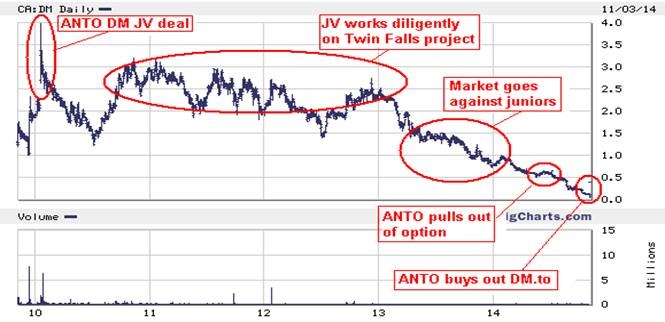
Now I don’t know about you, but for the right price, that’s definitely a resource I’d like to have my hands on. And that’s exactly why Anto did not participate in the July scheduled financing. They figured why bother. They’d already funded over $200M in project development. Duluth management was floundering while swirling the drain of bad finance options. Why not strike at the opportune moment and simply own the entire asset versus partnering in a JV. Just 9 days ago, that’s precisely what happened. This chart, courtesy of Inka Kola News, tells the story via price action.

clip_image002

The PFS calculated a net present value of the Twin Metals project at $1.4 billion USD using an 8% discount rate. Anto already owned approximately 10% of Duluth. So Anto already invested approximately $220M into Twin Metals and only has to come up with roughly another $85M(including convertible debt and additional operating funds) to own the asset outright. That’s an absolute steal and congratulations to Anto’s management for deftly structuring the deal in obtaining the buy-in of Duluth’s board and of Wallbridge as well.

Now the reason this little sale is a green island in a sea of red is because I was able to perfectly time this trade. I watched the stock languish all year and when I saw that move two Friday’s ago, where Duluth dropped from 12 cents a share to 7 cents a share, I decided it was time to pull the trigger. I maintain a portfolio for my children’s future. It’s reserved for only the best businesses with the best long-term outlook that possess the best brands and continue to raise dividends decade after decade; names like Hershey and McDonalds. However, I thought why not buy a several-thousand block of shares as a little lottery ticket. At $0.07 a share, I simply thought the risk-reward was well justified for my wee ones in light of the quality of the underlying asset.

The wager paid off a lot faster than I expected. Waking up the following Monday morning and reading various headlines from various sites I frequent, I read that Duluth was selling itself to Anto. I immediately jumped over to Yahoo Finance to see this:

clip_image004

Well, hot damn! From a percentage gain standpoint, this is by far the most I’ve ever earned in a single trade for only holding a single trading day. I won’t annualize it as I’m sure I’ll probably never get this lucky again. Of course, the net income off the trade is minimal in light of the total amount of capital risked, but still it’s a nice little boost for the year to my children’s future. I haven’t actually realized the gain yet as I’m holding for a little currency translation to work in my favor first. Mistake? I don’t think so, as I think Canada will approve the sale of Duluth so I have the $0.38 locked in at today’s Loonie rates. The dollar looks set for a little breather and I suspect that just may translate into the higher liquidation price I’m reaching for.

Coming back to Anto and what the future holds for Twin Metals. They’ve admitted they have a long way to go, with their own projections putting production out to 2020 at the earliest and possibly even farther. The next step from the PFS is the Bankable Feasibility Report (“BFS”). It’s this report which will allow Anto to secure financing for the construction of the mine. Actually, they probably won’t even bother. Consider that the pre-fease reported mine construction expenses at $2.8 billion. We know that’s aggressive, so I think it’s safe to arbitrarily add another $400 million onto that total. Conservatively, building the mine is going to cost approximately $3.2 billion. But even with a staggering expense number like that, Anto should have no issues securing financing.

This is especially so if the cost of capital continues to stay cheap for players with access to the liquidity. Looking at free cash flow (“FCF”) for Anto, they’ve averaged $1.9 billion USD in FCF for the last 4 years. With that kind of cash generation, I don’t think they’re going to have a hard time obtaining financing at favorable rates. The money is not the issue. What’s more worrisome is of course receiving all the requisite permits to construct and operate the mine. The project is located in a state that calls itself “the land of a 1,000 lakes.” That’s a lot of water ways that can be affected. There will be a tremendous amount of pushback from environmentalists who will attempt to deter Anto. Just look at Pebble and the fight in Alaska. However, with a safe and environmentally friendly construction plan along with a superabundance of funds allocated to remediation of the lands, I feel confident Anto will pull it off. Just not without a fight. Although they do have this going for them:

clip_image006

When you have a day named after you in a state, I think it’s pretty safe to assume that the state is going to be very cooperative in light of the economic benefits to be garnered.

Just remember, you had a chance to own a fractional share in a billion dollar mine for a little over a nickel a share. The junior space is beginning to heat up as quality assets are beginning to be circled. The sharks are starting to get restless as a vast majority of the juniors simply will not be able to obtain sustainable financing in light of their current share prices. We’re talking about companies that simply throw cash down a hole with zero immediate economic return and too much G&A digging into value creation. New Gold snatched up Bayfield to round out its Rainy River package. Nord Gold is positioning on Columbus. Romarco just received all of its final permitting and negotiated a $200M dollar debt package that will allow them to begin construction immediately on their Haile mine. How long before a bidding war starts on their potential 150k ounce per year mine?

There’s value to be had and money to be made in the junior space, but it’s highly dangerous and not worth the capital risk for the average investor. I’ve been fortunate on a few junior trades in this terrible gold market with Romarco, Lake Shore, and now Duluth. I could easily replace the word fortunate with lucky, however, I did my homework on those companies. I’ve also screwed the pooch in names like Aurcana, Kaminak, and McEwen Mining with poorly timed purchases. All companies that have very good potential if or when the precious metals resume a bull market.

Despite my luck in the Duluth trade, I am a strong proponent of buying the right stocks for long-term holdings. As I stated before, that means companies with mega-brands who produce enormous amounts of free cash flow and consistently raise their dividends. Buying these kinds of companies when they go on sale is essentially a sure-fire bet to building wealth, but a little flyer every now and then is worth the risk.

The Correction and a Trade Update

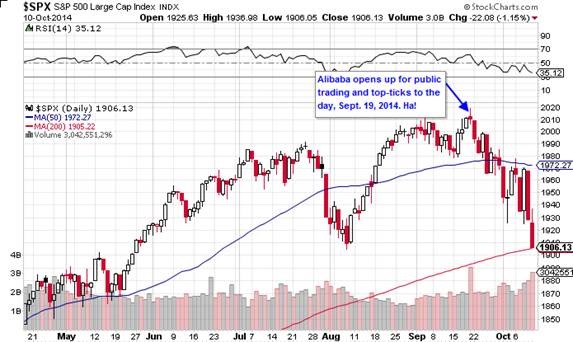
We’ll begin with Alibaba. It’s funny; there was article after article talking about how the BABA IPO may top-tick the market and yet not really much chatter at all from the financial sources about how BABA actually did top-tick. Like literally to the day, if somehow you were unaware of that. Have a look:

clip_image002

You can literally find dozens of articles on the subject. Some were written before September 19th. Others were written just a handful of days afterwards. One even had the gall to act as if some specific blogger nailed the top. To his credit the blogger did nail it to the hour, but it wasn’t exactly going out on a serious limb. Here’s a listing to go back and peruse:

1. www.marketwatch.com/story/did-alibabas-ipo-signal-a-top-in-the-stock-market-2014-09-23
2. blogs.wsj.com/moneybeat/2014/09/12/alibabas-ipo-not-necessarily-a-sign-of-market-top
3. www.usatoday.com/story/money/markets/2014/09/25/first-take-did-alibaba-ipo-mark-market-top/16225725/
4. finance.yahoo.com/video/alibaba-not-top-market-trader-160000682.html – here’s Ponytail Najarian “Gartmaning” the call on the short-term top
5. finance.yahoo.com/blogs/talking-numbers/why-the-alibaba-ipo-may-mark-a-top-for-stocks-182746661.html
6. www.mercenarytrader.com/2014/09/the-alibaba-debut-bears-uncanny-similarity-to-a-year-2007-top
7. finance.yahoo.com/news/stock-market-blogger-nailed-top-211049421.html – and here’s the top calling blogger at Philosophical Economics who did actually call it a top

BABA’s IPO really was a bell at the short-term top, not the long-term. I strongly feel this move is simply a correction allowing for further upside for the equity markets, as I laid out with my “chop & drop” charts. The real question is whether we get a V-shaped correction into a breakout of new highs as the bull trend resumes or is there further downside action. It’s hard for speculators to let go of 2013.

clip_image004

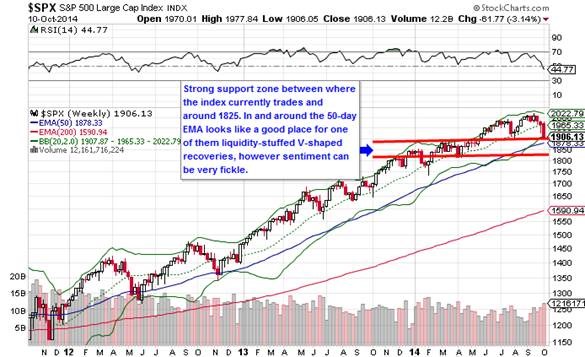
You can see that despite all the fuss being made over the 200-day MA being passed on a daily chart, there’s virtually no chance of that happening on a weekly chart(which has more meaning). Additionally, one can see that the 50-day on a weekly presented a natural support area. Subsequent price action proves that out.

clip_image006

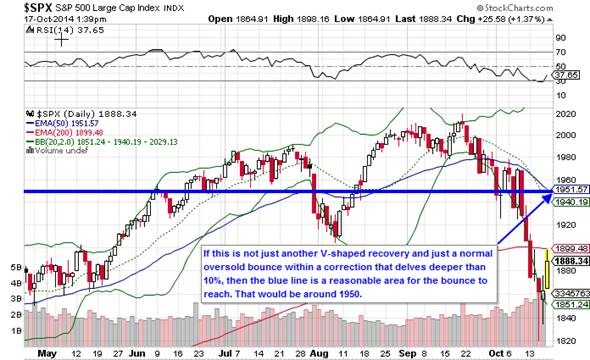
The sell-off reached extremes in so many names during the course of last week, that by Friday, we were due for an immediate bounce. This is perfectly normal behavior in a correction of over 10%. Yes, I say 10% because this one probably hasn’t reached its nadir yet. Using my drug-store technical analysis, the blue-line above represents a fairly basic resistance point for the S&P 500 to obtain in the bounce. Six months ago I shared my thoughts that in order for the S&P 500 to finally take a break, the market would need to see what I deemed to be all 3 legs of the “risk stool” to be kicked out. It started with biotech. Then moved on to small caps. Finally, high-yield fixed income sold off. Combine that with the liquidity vacuum of Alibaba in combination with some Ebola fears for the airlines, the darlings of hedge funds, and WHAMMY! The sell-off has greeted us in fine fashion to start the fall season.

The deflationary action in commodity prices, specifically oil, has compounded the speed of the move downward in equity markets. I think that will help to compound the fear a little longer, which is why I suspect we’ll see a bounce and resumption versus a V-shape move off the low. Fear has a predictive way of making people wait for a bounce and then selling off again at whatever profit can be garnered, further exacerbating the corrective action. About a week ago, SentimenTrader shared a chart displaying typical action in the VIX, “the fear gauge.” It showed price action over the last 20 years, anytime the VIX jumped 100% off its six-month low. The chart may be instructive because you can see that except for 1997 and 2006, there was always further to go before a bottom.

clip_image008

McClellan offered his opinion of the level of extremes based on his Summation Index. The oversold levels of the stock markets have already led to the beginning of a bounce, however it doesn’t mean we’re out of the woods yet. The same thing occurred back in 2011.

clip_image009

If you want to start nibbling at a wish list, then you can follow in the footsteps of many of the giants of finance. Even Uncle Warren said he was buying at these prices. As I’ve stated throughout this article, I don’t think this move is quite done yet and “discretion is the better part of valor.”

Let’s come back to JJG, the ETF holding corn, wheat, and soybeans. In an earlier post, I’d stated I would tell readers when I thought it was go-time on this commodity trade. Well that time is now. My go-to indicators are giving a buy signal. Yes, bumper crops are expected but as we know, supply and demand are not always the ultimate arbiters of value in futures pricing. Sentiment reached extremes and speculators are positioning accordingly. The price action may bounce around at bottom here for a bit, but the downside risk has been significantly reduced. Additionally, you’d hate yourself if you missed out on a coffee-style trade.

I also want to revisit my Delta Airlines short. That was liquidated for a profit, but it was a difficult one for me to stomach, as I irresponsibly held the position. It was a simple trade. I played some Calls on the Transports, and some Puts on Delta. You can debate the finer points of whether I was hedged or simply neutral. I didn’t run the trade through a monte carlo simulator while statistically evaluating the correlations, so forgive my lack of sophistication on this one. I made a move. It paid off, fortunately. The problem was that I profited much faster on the Transports and then closed the position leaving me unhedged in Delta. The unrealized loss in the position was quite extreme, but my analysis felt sound and the duration of the option gave my thesis plenty of time. That was very undisciplined and a trader should always mind their stops. Sometimes though, a human’s hunches get the best of them. I’m not different. This situation worked out.

clip_image011

Because along came Alibaba and Ebola and away we went with the downside move. I had stated that I thought $30 would be the profit point, and fortunately I was able to liquidate the holding for a tidy 50%. My analysis was sound, but I got lucky despite my lack of discipline in this particular trade. The total market catalysts really assisted the drive to profit, but I’ll take’em as they come.

Keep your eyes open and don’t get too jumpy on your shopping lists. If you have to buy, then ease into a position. That’s how the professionals allocate capital into holdings and you’d be wise to speculate in the same way when establishing a stake. Although I’ve called for a resumption of the downtrend to further lows, nobody should be surprised by a liquidity-backed V-shaped correction. Anything’s possible in today’s equity markets.