Potential Snapback or Another Sign of Market Deterioration

Look out below!

clip_image001

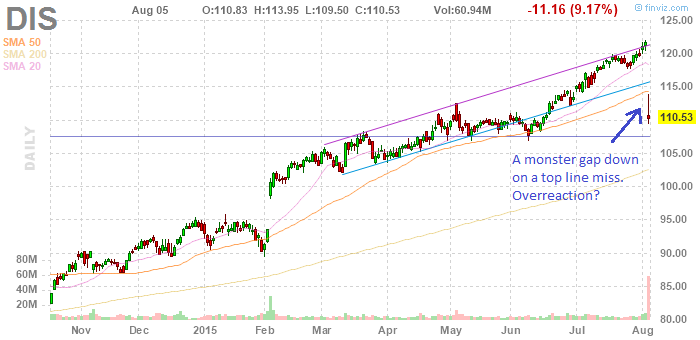
Disney (DIS) took a header yesterday. I’ve written about these moments before for various high-quality stocks. Inevitably, every year like clockwork the stock markets decide to put high quality businesses on sale in an overreaction to this, that, or the other. The reason for Disney’s 9% nosedive was a falloff in top lines from analyst expectations and fear for their cable revenues. Utter nonsense.

Last time I checked Bob Iger was still running the place. This man cut his teeth at Capital Cities and is as gifted as they come in the media executive space. Just look at his track record since taking over. By fully capitalizing on the cheap-money era, Iger has guided Disney into 3 of the smartest acquisitions that could possibly be conceived. They picked up Pixar, Marvel, and Lucasfilm. These 3 properties will generate tens of billions in licensing revenues and over the next couple of decades will have cash flowed billions of dollars with all the ways the IP can be distributed. And because this quarter only saw $13.1B in revenues as opposed to an expected $13.2B, Disney is somehow 10% less valuable in a single day? Weighing and voting, weighing and voting.

Disney is a high-quality choice for a long-term addition to a retirement portfolio. It generates immense amounts of free cash flow and possesses arguably the most recognizable portfolio of multimedia assets in the world. I’m a fan of the company’s tremendous cash generating abilities, however, even after the 9% drop today they are still richly valued by virtually any standard utilized.

What needs to be ascertained is whether the move down was the beginning of a stronger move lower or an overreaction? Is yesterday’s selloff an opportunity to add to a portfolio? How ripe is a snapback trade, potentially?

Let’s look at the facts about Disney’s fiscal Q3 results. They beat on earnings which were up 13% from Q3 in 2014. The YoY revenue comparable from end of Q3 2014 to end of Q3 2015 saw a 5% rise in topline, despite analyst projections. Who cares about Wall St. analysts? They are literally paid to miss the mark and then sell their misses like it’s valuable knowledge to the investing world. For the nine months ending, revenues and earnings are also up nicely. Free cash flow is down quarter over quarter but still up for the nine months ending over last year so I wouldn’t be surprised to see another year of over $6B in free cash flow.

One of the major worries about Disney is the falloff in broadcasting revenues and how they can adapt ESPN’s model to the cord-cutting trend. My stance is who cares? Is it really worth worrying if Iger is going to figure out how to fully monetize ESPN and the other broadcast assets in light of the shifting environment for cable revenues? The answer is no because Disney is just milking the current model for all that it’s worth. They’ll adapt with the cultural and secular shifts in consumer trends and continue to generate incredible income from their broadcasting portfolio for years to come.

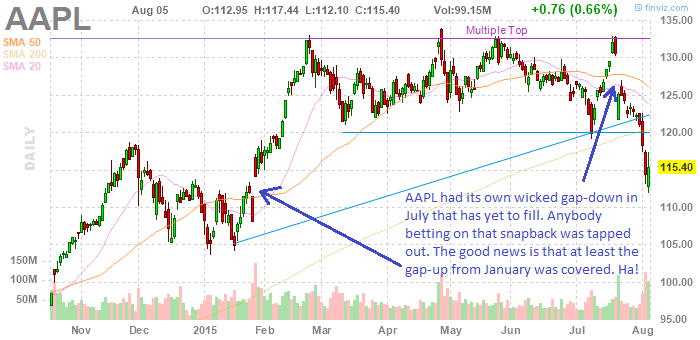
A gambler may want to consider playing the snapback with an aggressive option strategy as asset managers potentially step in to buy Disney shares in what could be perceived as an overreaction by Mr. Market. However, breadth has been severely deteriorating underneath the market. Additionally, AAPL may have set an example for what may occur. Observe the chart below.

clip_image002

Despite the current VIX reading, there is a lot of fear in the market. Sentiment readings have made it palpable. Now you have two mega-sized conglomerates showing incredibly weak market action. Is the price action of AAPL and DIS a precursor to something larger? Something of the summer of 2011 variety? Hell, I don’t know. Who does? If you want some actionable advice, I’d say do what the pros do and wait for confirmation. Trying to trade in front of a trend change has depleted the bank roll of many a trader. If you want to trade the potential of a snapback without waiting then I’d suggest keeping a tight stop on whatever medium you use. For longer term allocation, if you liked DIS at $120 but were waiting for a better entry, well then I’d say a quick 10% haircut is a better entry. Remember, DIS is richly valued right now and rightfully so in light of their IP and cash flows.

There are plenty of ways to gamble long or short on the current price action in Disney, hopefully making traders dreams come true.

Geological Assays, Biological Assays, Speculating Like an Ass, Hay! – Part 1

Two sectors of the equity markets that always attracts free-wheeling speculative capital like a moth to a light is early-stage biotech and junior precious metals companies. This will be a two-part posting; the first for biotech and the second for precious metals. Like I did for the “Sample ETF Portfolios”, I’ll keep separate running portfolios for the sectors against benchmark ETFs, leveraged ETFs, and stocks.

As I’ve stated in a previous post, I think biotech could end up in a huge, mega blow-off due to the M&A activity that will continue to get larger and more irrational as the equities bull market ages. Another reason M&A activity will spike is because the players who have access to easy credit to fund a debt driven shopping spree will want to get their hands on as much capital as possible before conditions tighten. Double-digit returns are obviously a whole lot easier on purchases with WACCs that are sub-4 or 5%.

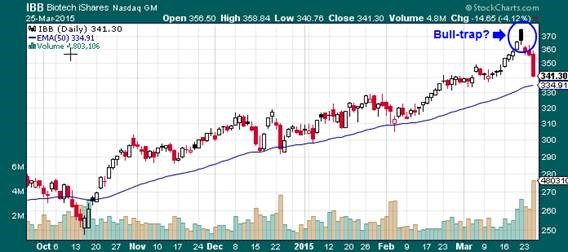
I thought that biotech may be leading a potential larger market sell-off but the sector continues to show resilience. Right now IBB is consolidating and has bounced off the 50 and 100-day EMAs with ease during its ascent in 2015.

clip_image001

As I said before, the conservative play is to simply buy and hold onto this bull and ride it for what it’s worth, bucking and all…but conservative isn’t fun. Yeah, yeah, I know that prudent capital allocation is not supposed to be fun. It’s about responsibly stewarding capital into intelligent investments to outperform the markets over the long term. Fine, but there isn’t a speculator, investor, or market player alive today that doesn’t get a thrill out of watching their holdings outperform the market. With that in mind let’s look at how we’ll construct a speculative portfolio of biotech stocks.

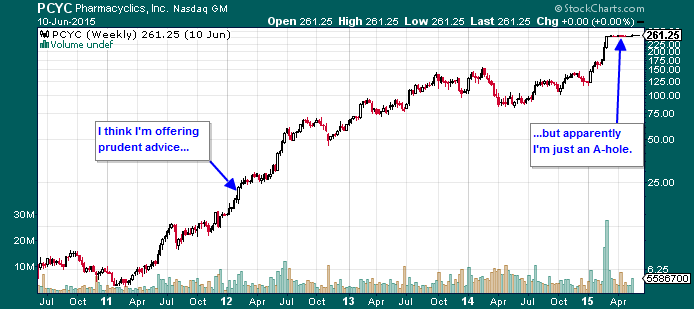
Now I’m not a biotech expert by any means. I gave up trying to cash in on the next big thing in medicine last decade in and around the time every American became an expert in real estate. For the most part, that’s been the right move but there’s always opportunity costs. In February of 2012, a friend asked for my opinion on PCYC when it was trading for a little under $20. He had shared with me some quality insight into the potential value of the company but my bias caused me to advise on passing on it. This was even after the deal with J&J. My name is Mud.

clip_image002

This was a ten-bagger mistake by allowing my previous experiences to misguide. Speculating in biotech is a slippery slope, though. One can get a taste of easy, probably lucky profits and think the process can be replicated, only to have hopes and trading account balances dashed.

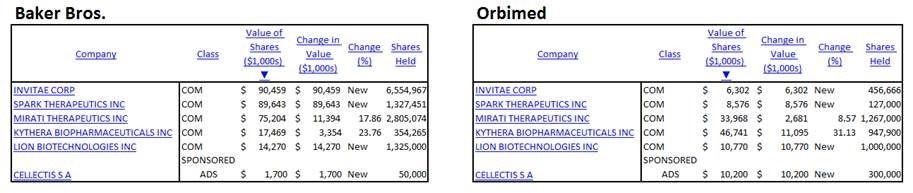
Which is why we’ll simply piggy-back the experts. Baker Brothers and Orbimed are two of the premier investment operations that specialize in biotech. Orbimed possesses approximately $15B in assets under management. Baker Brothers manages slightly less but has a higher profile with the public, especially after their huge billion-dollar gains in Synageva and Pharmacyclics in 2015.

It’s the old 13-F strategy made a little simpler. Instead of combing through their 13-F’s at the SEC site, I just hit the NASDAQ instead. There you’ll find the institutional portfolios, free of charge, of both Baker Bros. and Orbimed. They are updated as of Q1 2015. My logic is to simply cross-reference Q1 additions for each fund of the same companies, whether they’re a new position or an increase to an existing holding. The thesis being that if it’s good enough for both these guys then it’s good enough for me.

Bear in mind this is generally not a sound way to invest by any means. Sure there are dozens of sites dedicated to cloning professional portfolios by using 13-F filings, but blindly following a pro is just unsound. It always pays to conduct thorough due diligence. Gleaning ideas to further research is very different from blindly following a respected professional into a position. The thing about 13-Fs is that you never know how the pro is actually playing the position. How are they hedging? Are options involved? You just never know. With that being said…

The following are the stocks we’ve come up with from cross-referencing the Q1 additions.

clip_image004

This will not be a real-money portfolio for me, however, I reserve the right to position as I see fit should I be so inclined. If you want to take a flyer, without putting in any work, at higher biotech returns as M&A finally supercharges the sector then this little portfolio is as good a gamble as any. We’ll run this portfolio against five other investment options for biotech exposure.

The first option will be IBB, the all-weather biotech ETF with the most assets under management that has extensive coverage and great liquidity. IBB will be the benchmark. The next option will be LABU, which is the Direxion Daily 3x leveraged ETF of the S&P Biotech Select sub-index. This is our leveraged play without the margin. It’s very new; less than a month old. Trendy ETF creations that hop aboard trains which have already left the station have had a fairly consistent tendency to signal that the destination may soon be reached. As noted countless times though, “soon” is a relative term.

The third and fourth biotech investment options are the BioShares ETF offerings from LifeSci Index Partners. Paul Yook is the co-founder and portfolio manager for LifeSci. He came from Galleon as a portfolio manager and analyst. Despite the downfall of Galleon’s founder, it was still one of the more powerful hedge funds during its prime. You can garner some additional knowledge via this May ETF Reference interview with Yook. The thing that is nice about these two particular ETFs is that LifeSci offers two levels of risk. They offer BBC which takes positions in biotechs at the clinical trials level and has the potential for higher reward. Then there is BBP which only “invests in biotechnology companies with lead drugs already having received FDA approval.” In theory, BBP should reduce some of the risk and volatility compared to BBC.

The final investment option will be Ligand (LGND). They are basically the only publicly traded royalty play in biotech. They’re essentially modeled after the natural resources royalty players. Think Franco Nevada or BP Prudhoe Royalty Trust but with a wide-ranging portfolio of medicinal therapies at varying levels of clinical stages. LGND possesses a portfolio of over 120 partnered programs with biotech players ranging from the highly speculative to the most established in pharma. A position in Ligand is a bet on management’s competence to expose investors to some of the best profit generating opportunities in biotech while de-risking the investment, so to speak.

Be warned though, LGND has seen its share of volatility. Yes, it has treated shareholders exceptionally well for those who have been able to buy and hold over the last 5 years, but it hasn’t exactly been a one-way ticket to Profitsville. There’s been a few stops to Correctionville along the way including a recent 45% haircut through most of 2014.

clip_image005

None the less, as the only royalty option in the biotech sector I still want to track it against our speculative portfolio, volatility-warts and all.

I’ll post portfolio updates once a month. You’ll see a new link on the Marginrich.com home page around the beginning of next month. The tracking page will maintain nominal dollar gains and percentage gains as well. They’ll look exactly like I what used before with the Sample ETFs.

So there you have it; multiple ways in which to capitalize on what could be an explosive rise in biotech as M&A potentially rages out of control. If you’ve missed this several hundred percent move off the 2009 lows, then here is a perfect opportunity to get positioned for the final blow-off which should come just as it always does for every biotech boom. I don’t think this blow-off is imminent so please don’t misunderstand what has been written. I just feel very strongly that biotech M&A will catapult returns in the sector based on what we’ve seen in every other boom over the last 15 years. The timetable, as with all speculation, is the real question. This portfolio will be tracked indefinitely until we see signs of a legitimate trend-ending correction. Come back often to track the results.

One final note before signing off. For the truly conservative investors out there who visit this site, I just wanted to offer a quick update on one of the funds that I highlighted in my post regarding the emergency fund. It would appear that now may be an opportune time to position into the muni-bond closed-end funds. My preference happens to be NEA but there are a multitude available. Most of them happen to be at their 52-week lows in regards to their respective discounts to NAV. The 10-year Treasury yield is bumping up into what appears to be stiff resistance while at the same time hitting a 61.8% retracement off the Dec. 2013 highs to the Jan. 2015 lows. Additionally, NEA has retraced 38.2% off of its Dec. 2013 lows to Jan. 2015 highs while currently trading in a price range where it has tended to bounce off of. Three out of the last 5 times we saw the price action dip like this to the $12ish range we saw a relatively quick bounce back up into the $14ish area. The two times NEA went lower than $12 and took longer than normal to bounce back up over $14 were aberrant situations like the GFC of 2008 and the huge muni-selloff of 2013. It looks like a good time to take advantage of some great tax equivalent yield with the potential for some decent share price gains.

Spinoffs – A Review of Energizer

Spinoffs have long been a hedge fund favorite for arbitrage opportunities. That was of course before the days of derivative structures that allow asset managers to take on and hedge risk in countless ways, and not necessarily in the most intelligent fashion. A spinoff is still a good opportunity and there are more than a few academic studies, mostly from the 80’s and 90’s, that provide evidence behind the strategy of investing in spinoff opportunities.

Reading academic reports, even when one is engaged in the content, can at times be like watching paint dry whilst watching Empire by Andy Warhol in the background. However, Joel Greenblatt, one of the most successful hedge fund managers of all time, dedicated an entire chapter to spinoff opportunities in his classic book on speculation, You Can Be A Stock Market Genius. He takes a light-hearted approach to sharing his successful experience with spinoffs. You get the first-hand account of a true professional who has made money strategically utilizing spinoff situations as opposed to the dull but factual report of some PhD who’s never worked a day in the private sector.

Had to dust off my old copy to share some of his stuff but in chapter 3, Chips Off the Old Stock, Greenblatt covers the basics of speculating in spinoff situations while covering several working examples with Marriott, Home Shopping Network, Sears and a few others. He also goes over rights offerings with a Liberty example as anyone familiar with John Malone knows he loves to complicate things with a rights offering. Want an abridged version of how Malone made so much damn money transitioning to Liberty? Have a read of the end of chapter 3 in Greenblatt’s book.

Greenblatt sites a 25-year 1988 Penn State study to support the efficacy of investing in spinoff situations. In summary, the study found that spinoff companies outperformed the S&P 500 by approximately 10% per year in the first 3 years as a solo company. Additionally, the remaining parent companies also outperformed their respective sectors by 6% annually in that 3-year window when the spinoff occurred. That’s high outperformance by any measure. Greenblatt succinctly and eloquently states that:

If you accept the assumption that over long periods of time the market averages a return of approximately 10 percent per year, then, theoretically, outperforming the market by 10 percent could have you earning 20-percent annual returns. If the past experience of these studies holds true in the future, spectacular results could be achieved merely by buying a portfolio of recently spun-companies. Translation: 20-percent annual returns — no special talents or utensils required.

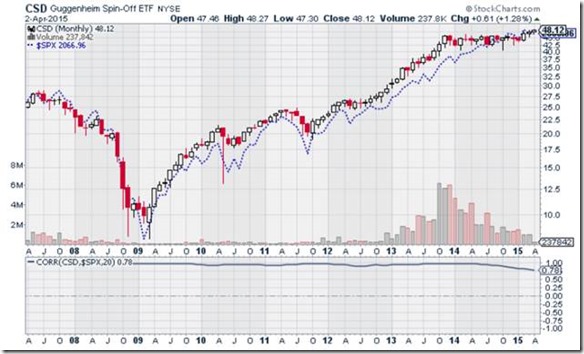
For the ETF-everything crowd, there’s even an offering for you which will allow you to outsource your intellectual efforts in case you’re not so keen on sifting through any Form 10s. Guggenheim offers the Beacon Spin-off Index (CSD), with approximately half a billion in AUM. If you’re already familiar with the offering then you know that results have been less than exciting compared to the picture Greenblatt painted, but such is the case when using an ETF instead of digging in and conducting your own due diligence. Below is a chart of performance since inception. It is easy to see the tight correlation of CSD’s (candlesticks) performance to the S&P 500 (blue dash), however since The Great Recession, it has consistently outperformed the S&P 500 by a couple of percentage points. Not exactly the stuff that makes up 20% annual.
clip_image002

You Can Be A Stock Market Genius is 18 years old. Many of the academic studies regarding spinoffs are equally as old or older. This means the data and situations covered came long before massive quantitative easing, ZIRP, high-frequency trading, and after Gramm-Leach-Bliley; four of the biggest reasons there is wide-scale questioning of true price discovery in most markets. Despite one’s perceptions of a skewed marketplace, the markets are still functioning and there is money to potentially be made, which brings us to Energizer.

A year ago, Energizer Holdings (ENR) announced they would be splitting the company in two. The company believes it has reached critical mass for its two operating segments and that each unit would benefit as a stand-alone operation. Everyone knows that Energizer makes batteries, including the Eveready brand, as well as various lighting devices as part of their Household segment. What is less well known is their Personal Care segment which manufactures razors, sun block, feminine products, and various baby care products. Both segments produce quality operating margins but Personal Care has become the revenue leader for the company due to some bolt-on acquisitions in conjunction with overall declining demand in the alkaline battery space. Have a look at Personal Care’s competitive positioning in its respective product categories, courtesy of their February CAGNY presentation:

clip_image004

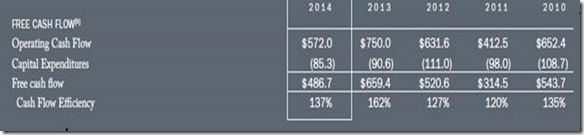
Even though Gillette’s grip on the razor space is massive, Schick’s entrenched position at number 2 in the world allows for some impressive cash flows. Additionally, holding the number 1,2, or 3 brands in the rest of the product categories has Personal Care, which will be renamed to Edgewell subsequent to new Energizer’s spinoff, well positioned to continue generating solid free cash flows. One of the current Energizer Holdings stated focus areas for management is free cash flow. In fact, a handy chart is provided right on the 2nd page of the most recent 10-K that shows the last 5 years’ worth of the company’s free cash flows (FCF).
clip_image006

With long-term debt of around $1.8 billion, we’re only talking about three and a half years for total payoff at current debt levels with this sort of consistent FCF generation. Additionally, in the shareholder letter on page 3, the CEO refers to the importance of maximizing free cash flow for any business while discussing the FCF results under the company’s working capital initiative. Earlier in the decade, ENR began to focus on reducing working capital to help maximize FCF. For initiative purposes, the company adopted a proprietary metric, “Adjusted NWC”, in which they strive to lower net working capital. Typically, for working capital, investors utilize the current ratio to help ensure efficient allocation of resources. Specifically, Energizer is focused on the reduction of receivables minus accrued liabilities, and inventories minus accounts payable. Accounting details aside, intentions are to generate higher free cash flows to increase shareholder value and you really can’t ask for much more from a corporation’s management. Here’s a slide, also from the February CAGNY presentation, illustrating the point:

clip_image008

We now know we have company management publicly aligned on shareholder-friendly initiatives, so let’s go over some of the particulars of the spinoff. Edgewell’s ticker will be EPC while the Household brands will maintain the Energizer name and continue to trade as ENR. For convenience and clarity, I will simply refer to each new company as their ticker symbol and if needed will refer back to the current combined company as Energizer Holdings.

The spinoff will be a 1 for 1 share distribution in a very straight-forward, tax-free separation without a convoluted package of rights offerings or tax strategies. The Form 10 is the document where anyone can review the details of the spinoff. For some, combing through the Form 10 can be the most cumbersome part of analyzing a spinoff transaction, however, so much of the content is simply boilerplate legalese that it doesn’t take as long as one might think to go over the entire document. Energizer Holdings filed an amended Form 10 on March 25th of this year and it runs 212 pages, but again, don’t let that length inhibit you if you really want to scrutinize the potential of the deal.

Energizer Holding’s listed reasons for separating the companies are just more basic boilerplate corporate speak: “focus on distinct commercial opportunities, allocation of financial resources, management focus and separate capital structure, targeted investment opportunity, creation of independent equity currencies.”

Great, but let’s take a look under the hood of the SpinCo., which is new Energizer (ENR). Edgewell (EPC) will technically remain as the “parent” company. In the Form 10, SpinCo. prepared financial results for a year-end as of September 30th, 2014 as if the company already split as of October 31st, 2014. Let’s first examine ENR’s top line over the last 3 years.

clip_image010

So if this is your first time seeing ENR’s sales results, you’re probably thinking “Whoa!” Where’s the growth? Decreased net sales for the last 3 years with a total failure to generate any organic growth, which is an unaudited metric that corporate managements usually take extra care to positively affect. But wait, it gets worse.

clip_image012

You can see that the trend in the top line was already flattening from 2010 to 2011 precipitating the decline that really kicked in in 2013. This slowing can be interpreted in two ways. One is that the business is stodgy and its main product line, alkaline batteries, lacks innovations to carry it forward into the evolving universe of devices. Or, the lack of sales growth is only temporary as management allocates greater resources to R&D to spark innovation across the product lines. Additionally, growth could be purchased through intelligent bolt-on acquisitions that work to enhance the culture of free cash flow growth. ENR’s free cash flows in conjunction with access to low-cost capital will provide management with flexibility to explore this option down the road.

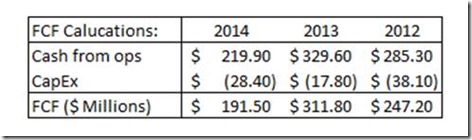
The production of FCF by ENR has been a bit choppy the past few years but the average has still been about $200M a year.
clip_image014

None the less, ENR is producing declines in revenues and profits across all geographic segments around the world. Additionally, SG&A continues to be higher than what I would like from a focused management with this particular expense category coming in at $391M as of September 30th, 2014. Making SG&A approximately 21% of net sales, which in my opinion is bit high but I understand separation costs and the working capital initiative have bitten into this area. We’ll partially chalk it up to a cost of building capital efficiencies.

One of the areas that has a tendency to get closely examined in a spinoff is executive compensation. How will pay be aligned with operational goals? Will those same goals be necessarily shareholder friendly? These are important questions to ask. More so I think with companies that utilize an excessive amount of share-based compensation and really dilute existing shareholders while the company may still be struggling to even generate a profit.

Happily that is not the case with Energizer Holdings and current executive compensation policies will roll out to new Energizer and Edgewell. Salaries for the CEO, COO, and CFO for new Energizer are reasonable with base salaries in the $400’s annually for the CEO and COO while the CFO is in the $300’s. Stock awards and short-term non-equity incentives i.e. cash bonuses will take the three of them up into the $1M to $2.5M range for total annual compensation. In a company of approximately 5500 employees and a stated goal of quality capital stewardship, I’m ok with the top 3 employees earning around $5M total for now. Again, the focus is on free cash flow while creating shareholder value and the retention of quality talent requires fair compensation in light of general employment market conditions.

Have a look at the Short-Term Incentive (STI) and Long-Term Incentive (LTI) plans for new Energizer executives, courtesy of the Form 10:

Executive STI:

Annual Cash Bonus Program – Annual cash bonuses to our named executive officers are based on a percentage of the executive’s annual salary, and adjusted based on performance on metrics determined by ParentCo’s NECC. The 2014 annual bonus program was designed to measure performance against four metrics:

• Adjusted EPS (30% of the named executive officer’s bonus target)
• Adjusted Operating Profit (30% of the named executive officer’s bonus target)
• Company-wide Three-Year Global Cost Savings (20% of the named executive officer’s bonus target)
• Adjusted NWC (20% of the named executive officer’s bonus target);

Executive LTI:

Continued enhancements to the long-term incentive program – Beginning in fiscal 2013, ParentCo’s NECC adopted three metrics for the long-term incentive program, replacing the Adjusted EPS metric used in past years. At the start of fiscal year 2014, ParentCo’s NECC reviewed the compensation elements and determined that the compensation elements adopted in fiscal 2013 continued to be consistent with ParentCo’s compensation philosophy and approved the same metrics for fiscal year 2014:

• adjusted return on invested capital (ROIC), to support ParentCo’s focus on cash flow, including improved working capital performance, and to emphasize the importance of capital allocation decisions;
• cumulative adjusted earnings before interest, taxes, depreciation and amortization (EBITDA), to emphasize growth in core operating earnings; and
• relative total shareholder return to further ensure that realized results are aligned with, and shareholder value creation results from ROIC and EBITDA can be further impacted by relative total shareholder return.

Margin Rich here again, for the cash bonuses the payouts aren’t simply based on earnings or profits. It’s earnings, operating profit aka cash from operations, company ability to reduce expenses, and working capital efficiency to help drive free cash flows. The stock awards are based on ROIC, EBITDA, and total shareholder return. These incentives seem quite shareholder friendly in light of the cronyism, greed, and career risk that runs rampant through the corporate world these days.

Ok, so I realize I’ve presented a little bit of a conflicting opinion here by pointing out the declines of the battery business but sharing appreciation for management’s focus on free cash flow and reasonable compensation packages for executives. The reason is because from a speculative standpoint, this spinoff can be approached in multiple ways. As a long-term investor, or at least 3-years according to the study, going long EPC and ENR provides what could be a solid opportunity to generate a market beating effort. Consider the pros: shareholder friendly management, great free cash flows, reasonable debt levels, and the tail-wind of the average performance of spinoffs according to several different academic studies. The cons: ENR’s declining revenues and profits, lack of innovation at ENR, and the negative perception that comes with the first two cons.

Notice I didn’t include Edgewell in the cons list as I think it may represent the better of the two opportunities. I suspect we may see the money management crowd attempt to short ENR while going long EPC, a classic arbitrage. Consider where the current combined company has seen its growth in the past 12 years. It’s in the personal care division through smart acquisitions. Observe:

clip_image016

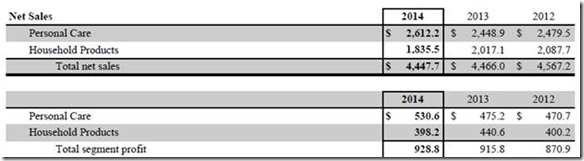
Have a look at how Personal Care and Household have stacked up against each other in sales and profits for the last few years, via the most recent 10-K.
clip_image018

It’s plain to see where the growth and the slump has occurred within Energizer Holdings. This is why I think the short-term trade is to go long EPC and short ENR. The battery business may get sold off as investors vote with their feet behind the company’s declining earnings. Obviously, nobody has a clue as to how the market is going to react to the post-spun shares. Both could sell off indiscriminately or be bought in a frenzy. These are the obvious risks of speculating, but they’re worth reiterating time and again. Another risk to consider is the ticker-risk with EPC. ENR is the current ticker of Energizer Holdings and the spinoff of the battery business will maintain that ticker. As EPC will be the new ticker that shows up in the accounts of current shareholders of Energizer Holdings, EPC may get sold off indiscriminately despite its higher growth profile in sales and earnings.

There’s plenty to consider here if attempting to capitalize on the Energizer spinoff. This is just a light dusting of research that should be undertaken for an intelligent investment. There’s still cash flows to model. The patent portfolios are fairly significant and would require a detailed look, if possible, to gauge value. Additionally, the capital structure has still not been finalized for new Energizer. Always conduct a thorough analysis but you can see that a spinoff presents a fun opportunity to test your skills as an analyst and speculator. Bear in mind, the professional set has picked this opportunity apart and modeled it a dozen different ways so if any readers attempt to allocate capital on this play; don’t try to be too cute.

There are a multitude of sites that allow anyone interested to stay on top of spinoff opportunities. One of my favorites is SpinoffMonitor.com. You can also check out StockSpinoffs.com or StockSpinoffResearch.com. Energizer Holdings is widely followed, and again, it’ll be analyzed six ways from Sunday by every analyst and money management firm out there. For a fresh research opportunity, consider W.R. Grace, which will be splitting itself into two companies. Grace is a well-capitalized, diversified chemical manufacturer. Each new Grace company will be an upper-tier participant in its respective industry. Have fun and good luck.
Short-term Equity Risks Arising

Despite Wednesday’s(3/25/2015) market weakness on virtually nothing but fear, there is plenty of technical action showing that markets appear fine. The question is how reliable is the action. Breadth indicators across multiple indices are positive. Small caps are leading large caps. Consumer discretionary to staples are favorable. Rate sensitive ETFs(TLT & XLU) have been conducting basic retracements which is perfectly natural coming off their hard sell-offs, but I think their selling will resume which will continue to indicate higher risk appetites once stocks take a little breather of their own. If the equity markets do what I think they’re going to do, which is correct a little harder here in the near-term, then I suspect TLT and XLU will chop for a bit while stocks let off of a little steam.

clip_image002

Everybody has their own methodologies for reviewing the markets to get a feel for the probability of directional plays. I really like to use inter-market analysis to help me potentially sense where the greater market may be headed. I have been watching biotech very closely as it has been the hottest sector and a market leader for some time. Real weakness in biotech may be a precursor to overall market weakness. That action last week in IBB had me suspicious. To me it appeared to be a blow-off. Call it what you want, a throw-over or a bull-trap. Either way the price action raised my hackles and officially put IBB on my radar as a temporary short. Current price action in IBB and the S&P 500 may be proving that out.

clip_image004

Now clearly, biotech is in a raging bull market and has been for several years now. You don’t want to fight that trend. It’s better just to ride it upwards for continued profit, because it’s going to take a lot more M&A in that sector before we see a top in biotech. However, there was a bit of froth in biotech M&A during the first quarter of 2015. Observe the following chart courtesy of Reuters and just look at Q1’s performance amongst pharmaceutical companies compared to the last 5 years.

clip_image006

We haven’t seen that kind of aggression since coming off the lows of 2009. There’s been approximately $60B of M&A activity in pharmaceuticals to start 2015, which accounted for 10% of overall M&A activity in the quarter. Twenty-one billion alone of that $60B was done in the Pharmacyclics purchase by AbbVie. That also signaled to me a potential short-term top for biotech as J&J and AbbVie slugged it out for rights to the cancer-fighting company.

So the real question then is how is this information actionable? Well that depends on your appetite for risk and how you’re looking to allocate capital in the short-term or long-term. If you’ve been visiting this blog for a while then you’re well aware I’m always ready to roll the dice based on my ability to interpret market action. I think shorting biotech via IBB or XBI is a good opportunity. I could have positioned earlier, but I was waiting for the price action to confirm so as to hopefully avoid being whipsawed.

If any readers are inclined to risk come capital, I think that IBB’s price action has stated to market players that it looks good for a short-term short. A small bounce at this price point is likely; especially in light of that 4% down day. I suspect the bounce could move the share price back up into the $355 to $365 range giving weak hands sufficient room to liquidate. That liquidation could then kick off the next leg down in biotech. There is a very strong floor at $290 as that is where the current 50-month EMA rests, so any option players will want to factor accordingly. I’m not stating that I think IBB will definitely hit $290, just that it’s a strong price point of support.

If IBB’s share price creates un-compelling options price points for smaller traders, then the XLV is a solid alternative. It has higher relative strength due to the size and various types of non-biotech holdings, but XLV possesses sufficient exposure to biotech that it will correct as well and it’s options may allow for a wider range of speculators to employ strategies.

As for the larger market i.e. the S&P 500, I wouldn’t expect anything deeper than a 10% correction if even that deep. There’s strong support at its 50-month EMA, as well, which is currently at $1,987. A 10% correction would take us down to approximately $1,900, which is also a round-number “power line” that I see providing strong support. I also suspect that any sell-off would result in yet another V-shaped recovery so be prepared to remove any short bias as a new leg higher ensues for the S&P 500 and biotech. Remember, these are interpretations based on my inter-market analysis. There are plenty of breadth indicators putting a more positive spin on things.

The markets are tricky, rigged, and no place for the ignorant. Manage your risks accordingly and utilize any potential correction to get long. There is continued quantitative easing on a massive scale across the world and the Fed is still reluctant to raise rates just yet. Current liquidity levels and yield curves continue to put a wind in the sails of higher risk assets. As Q1 draws to a close, take a moment to review your portfolio and see where you stand in 2015.

American Assets Discounting European Politics

Last summer, I shared some thoughts on the stock markets’ abilities as a discounting mechanism for future events. The gist was that stocks may provide a murky read some times when it comes to prophesying.

Reading the current macro signals is a tough endeavor for any speculator, and with today’s volatility, all the more dangerous when making bets based on those signals.

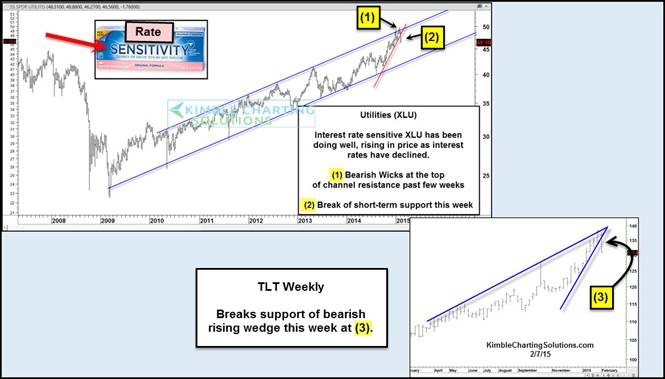
That being said, I get the feeling that last week’s action in some of the rate-sensitive sectors in combination with general stock market consolidation is portending a positive outcome in the Greece/Europe situation. Bear in mind these thoughts are pure suppositions based on nothing more than a hunch. I’ve been wrong before. I’ll be wrong again. As the old Soros saw goes, “It’s not whether you’re right or wrong that’s important, but how much money you make when you’re right and how much you lose when you’re wrong.”

Kimble recently provided a long-term view of two key sectors.

clip_image002

We’ll revisit the impact of the breakdowns in those sectors, but the whole world of finance is focused on the potential resolution of Greece’s debt-financing problems. We have Goliath, the Troika(ECB, IMF, and European Commission “EC”), attempting to dictate the how, what, and when to David aka Greece. Right now a political game of poker is being played with the potential for worldwide ramifications. Greece’s new management is playing the hand it’s been dealt in what appears to be a very transparent fashion. Basically, they’re happy to stay in the euro as long as fair terms are met in a reworking of current debts to the Troika.

The Troika, god I hate saying that word but it does beat out typing the three entities, is really trying to play hardball with Greece but they have no leverage. None. Ok, maybe the smallest amount; just to play chicken. In my estimation, 98% of the leveraging power belongs to Greece. Dijsselbloem, EC head finmin, and Schauble, German Minister of Finance, have both been bellowing the fiery rhetoric from the tops of their lungs, “Greece better pay or else!” Or else what? They’re going to let Greece depart the euro? Ok. Yeah, sure.

Greece isn’t going back to the drachma in an exit from the euro, at least not this year, because the markets would be roiled. There are simply too many things that could go wrong to upend the European status quo for a Grexit to happen. Let’s just logically play out a generic sequence of events. Europe can’t let Greece totally default. For the owners of Greek debt and of course credit default swaps on the debt, credit events would be triggered across a multitude of financial institutions which could in turn then trigger counterparty liquidity risks which would instantly panic the financial universe. This instant panic would hit all the developed stock markets but with a focus on the European stock markets, which would negate the positive effects of the trillion-euro QE plan before it even had a chance. Too me, that’s enough to know that even if the deadline for a Greek debt resolution is pushed out, it’s still going to end with Europe caving but in a manner which saves as much face as possible.

Germany’s account surplus is so ridiculously large that I don’t really think they are going to tell Greece to go souvlaki itself. German total employment is high and exports continue to be robust. Pushing Greece to exit the euro would create an environment of fear where recession could rear its ugly head at a time when German companies are rolling. While Greece has all the appearances of being the linchpin holding the euro together, they’re really just a very, very important lugnut. Italy is the real linchpin. Their debt has the potential to topple the world. Which is why Europe doesn’t want to easily concede to Greece and open the door for Italy to dictate revised terms of its sovereign debts. Aside from Italy, there is obviously still Spain, Portugal, and Ireland; but Italy is the megaton nuke that can change everything.

Aside from the financial obstacles for Europe, there are the more important political complexities that must be addressed in pushing Greece too far, too hard. Russia has already extended an olive branch for Greek funding and Greece officials are reporting that China has now offered a helping hand. The world knows that China possesses the funds to help provide a financial backstop for Greece. I suspect the world may doubt how much funding Russia can lend in light of its own domestic problems concerning the ruble’s decline alongside oil’s rout. I contend that doubt would be misplaced. Does anyone really believe that Europe would simply push Greece into Russia’s waiting and open arms, where after, Greece will be free to negotiate any number of fear-inducing considerations like the usage of Greek ports for the Russian navy. Or how about land or sea allowances for petroleum energy pipelines. Maybe missile battery emplacements “for protection” on the northern Greek borders.

These are extreme examples as Greece is still a NATO participant, but it is unknowable with which the speed of certain actions could be taken should political alliances be shifted over this money. Consider how fast Russia appropriated the Crimean peninsula. All the angles have to be considered and with Merkel’s established relationship with Putin, I don’t see the Troika being allowed to precipitate negative financial and geopolitical outcomes.

What is difficult to reason, for me at least, is how the US will come to bear its influence in this whole game of thrones. America will have its say on bailing out Greece, but how and where and with what level of impact is a challenging thought experiment.

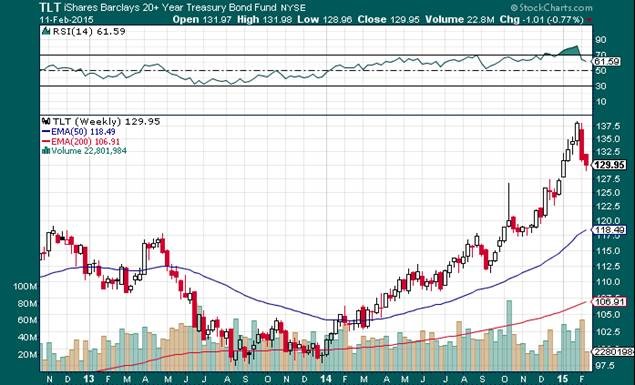
Coming back to American assets and their ability to discount the European outcomes, I think the speed with which the rate-sensitive sectors dropped last week are the tell-tell signs. Examine the two following weekly charts of TLT and XLU.

clip_image004

After a stellar run in 2014, that was a precipitous drop last week. The overall trend remains up, but the situation is very fluid as we have to consider the interrelationships between markets, especially the dollar and implied volatility across Treasury yields.

clip_image006

A familiar market adage is that Utilities tends to be a precursor for the greater stock markets. Any correlation is possible at any given time in the markets, however, we live in an age with remarkable volatility across asset classes. Thus, old interrelationships that once used to prove semi-reliable, may just not be so consistent. I think the Utilities, Treasuries, and yields are telling us that the general market environment is about to go risk-on with another leg-up in the greater stock markets.

There has been no shortage of writing on the significant perils in the market. I have read many a sound analysis that a major dislocation is “near.” But that’s the problem with using a word like “near” or any of its synonyms. Near is a relative term. It’s a word that gets used in a sentence and can mean anything from 1 day to 3 months to 2 years or whatever. Most analysts, bloggers, and general market commentators aren’t willing to stick their necks out and provide a more precise timeframe based on their opinions. They just point to a lot of evidence that says it’s “near.”

I agree that the next major leg down in the markets that began with the Great Recession in 2008 is near. I’ve long-stated that I thought 2015 – 2016 were going to be the years that major catalysts presented themselves for an epic sell-off, but I don’t think that time is upon us. I’m convinced that the markets will draw in a lot more participants first. I want to get that 1999 and 2007 feeling first. You know the feeling I’m talking about; that feeling that the markets will never go down and speculating in the stock market is a can’t lose venture.

The danger of deflationary forces is reasonably priced into the markets. Japan is still easing while the Fed is continuing to roll assets and now we have the ECB embarking on a trillion dollar extravaganza. I have read analysis that the efficacy of the ECB’s easing is highly questionable due to negative rates around the continent. I say nonsense. Animal spirits only care about a liquidity buffer to fill voids. Besides in a risk-on environment, yields will rise as higher levels of capital will flow into equities in a sector-rotational chase for alpha.

Risk-on is not mutually exclusive of risk management, no matter what. Countless interviews with billionaires around the world back up the fact that risk management is the number one key to successful speculation and investing. That being said, look for the general stock markets to pick up a little speed in advance of a potential workout between Europe and Greece. In just the last few days we’ve had two US hedge fund billionaires share their opinions on a Grexit. Dan Loeb, of Third Point, thinks there’s a lot of risk associated with these markets and has lowered net exposures across his funds so far this year. David Tepper, of Appaloosa, thinks there is nothing to worry about if Greece exits the euro. He basically stated that there’s a handful of percentage points of loss to worry about, but that the markets are strong enough to overcome a negative outcome. Loeb is prudent. Tepper believes in his analysis. I think the GermansEuropeans will reach an accord with Greece sometime soon(another relative term) and the stock markets will eat it up.

There is still that little matter of the dollar, euro, and their extreme levels in sentiment. Carry trades continue to be wonky in light of the dollar strength. Maintain a close eye on these currencies as they will enhance a risk-on move. Whether you believe the markets are discounting future events or not, there is a persistence of extreme movements. A European resolution with Greece and a shift in dollar sentiment may just provide a profitable environment for stock market participants.