Whipsaw, Whipsaw

MAN ALIVE! That action on Monday is enough to make a trader fold up operations and go back to counting beans or selling un-needed crap to folks. That was seriously some hair-raising action. Did you get your stops ran? Did any of you traders get whipsawed by Monday’s action? Rest assured, you probably weren’t alone.

If you’re attempting to go short here across any of the indices and had your stops ran on Monday then kudos to you for maintaining discipline. However, you just may be missing out on more of the fun of a potential downmove. Hard to say because my crystal ball is in the shop and for some unforeseen reason I’m not omniscient. It really makes me mad that I can’t call the exact turns of the market. Oh well. I still think a downward short-term bias is in effect and eventually the perceived risk indexes(Russell 2000 & NASDAQ) will finally pull down the “Great Proxy”, the S&P 500.

So far, so good for the S&P 500 as it set new highs this week…and has promptly come off those highs. Is that strong price momentum? Have a look at the daily action in the VIX. It gapped down to start the week and within 3 days that gap has filled, but still yet, the VIX is still down around all-time lows.

clip_image002

The MACD has been a pretty simple and fair indicator to clue traders in when the volatility is going to start spiking. Observe at the green lines that every time the MACD turned upwards, the VIX was usually in the early stage of an up-move. Are we at another up-move right now? It feels like it. If things get dicey, a quick move up to 20 on the VIX could easily occur.

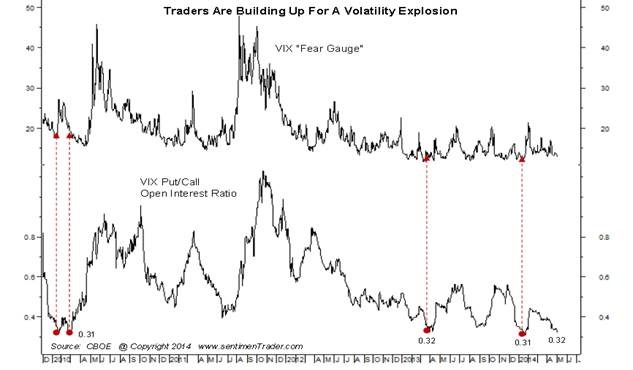
A couple of weeks ago, SentimentTrader shared a chart depicting the VIX Put/Call Open Interest Ratio. It puts on full display what the current option action on the VIX is saying about volatility. Judge for yourself:
clip_image004

There are plenty of messages being communicated very loudly and clearly by the markets. These aren’t esoteric signals that only the true professionals can divine. Anybody with the ability to read and some dial-up internet internet service can see these messages…more power to you if don’t have to result to a screeching connection via Juno or NetZero or whoever the hell provides dial-up these days. Also, to any readers who currently utilize dial-up to access this blog, please excuse my insensitivity.

Things are happening in the markets such as defensive rotation. Utilities have performed fantastically so far the past few months while the rotation to staples vs discretionary appears to have begun. Less and less issues are hitting 52-week highs despite the DOW and S&P 500 sitting near their own highs. Treasury rates continue to drop. Wal-Mart missed fairly big on YoY Q1 income. High-flying tech and small caps have already come off pretty hard and these are where the risk is allocated. Social media sites trading at P/E’s in the multi-hundreds. Biotech stories being sold on a wing and prayer for ridiculous valuations.

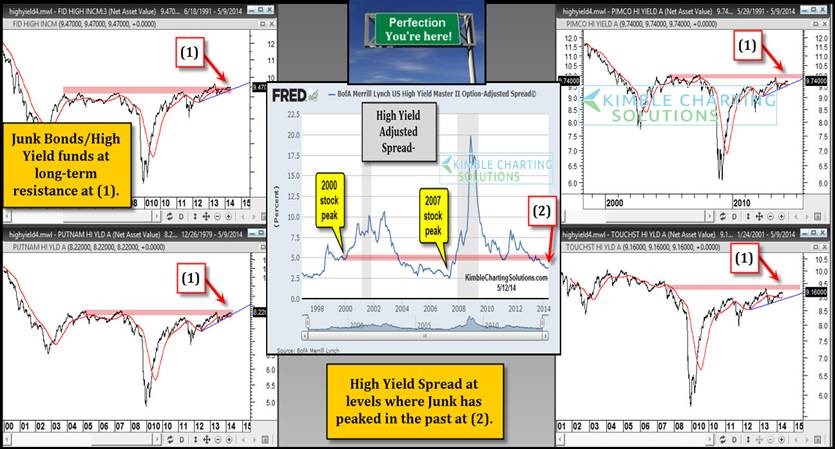
High-flying tech and small caps are part of what I call the 3-legged risk stool that are sort of propping up the animal spirits of the entire, current stock market. Two of those legs have been kicked out, so to speak, and yet still the S&P 500 hasn’t really shaken out the bulls. The third leg of the shaky risk stool and thus potentially the ultimate catalyst for a correction in the broader markets is junk bonds, I suspect.

If junk bonds correct here within the next 14 to 60 days, with remaining weakness in the NDX and RUT, then things can get real hairy, real fast for people who are poorly positioned for the move. Have a look at what Kimble shared over at his site a few days ago,
clip_image006

So then what could be a catalyst besides stiff resistance? Oh I don’t know. Maybe the humongousest junk bond issuance in financial history. Anybody remember seeing this near the end of April?

clip_image008

The markets have a funny tendency to act a little wonky after the largest-ever of anything occurs.

The action this week has that sort of a backdraft feeling to it. In case you never saw the movie, a backdraft(as defined by the Collins English Dictionary) is “an explosion that occurs when air reaches a fire that has used up all the available oxygen, often occurring when a door is opened to the room containing the fire.” Buyers potentially get a final pull into risk assets before an explosion outwards for a fast and hard move down after the right catalysts make their presence known.

Despite the already well covered move down in the Russell 2000, it appears as if there is plenty of room for a continuation downward. If you’re trading IWM, then keep your stops at an appropriate level. Biotech’s IBB essentially bounced off it’s 38.2% retracement using the week of August 8th, 2011 as your starting point for a quick Fibonacci analysis. A cautious short in IBB with the potential for further selling down to between $200 and $205, may yield a nice return during this summer. In a previous post, I had stated that I thought coffee was setting up for a short but my favorite indicators were not providing a green light just yet. Well those indicators finally gave their green light. If you’re feeling brave you can follow me on a short of JO with approximate targets of $35 and $30, if the selling momentum really gets going.

The list of investing icons who are advising caution continues to build. We’ve had mutual fund heroes like Romick of FPA and Yactkman share their thoughts months ago on building cash levels. Klarman, Marks, and Grantham have given the thumbs down. Now we had David Tepper, Mr. Highest Paid 2013 Hedgie, providing his valued insight on these precarious markets. It may not pay to listen to or heed a blogger like myself. That’s for you to decide; but you can’t dispute that it pays to heed what these most esteemed gentlemen have to share.

The Potential Depth of the Corrective Action

Markets’ darling leaders sell off? Check. Defensive sectors rotate up? Check. Seasonality coming into play(if you believe such stuff)? Check. S&P 500 VIX spiking? Not check. We have yet to see the S&P 500 really start to come down off its highs for the year just yet. Although, the market action has probably felt terrible for those heavily weighted to the NASDAQ, we have yet to see some heart-wrenching downside action in the S&P 500.

SentimentTrader just shared a note about the lack of volatility in the VIX and the downside potential in the S&P 500, “There have only been two other times in the past 20 years that the Nasdaq Composite had dropped more than -8% from its 52-week high, but the VIX “fear gauge” was still below 17.5, a scenario we have now. It shows relative complacency in the face of a sell-off in higher-beta stocks. Those two occurrences were March 28, 2002 and May 15, 2008. The S&P 500 sold off more than -15% over the next three months both times.

As usual, the statistics suffer from a small sample size within a relatively short period.

However, the facts are the facts.

Add in that earnings season has been off to a fairly weak start and you have that much more evidence to make you pause and consider before allocating more long capital right now. For any readers who are EPS hounds and swear that stocks always follow earnings, here’s a snapshot courtesy of Thompson Reuters’s Alpha Now that also supports a pause in the action through the spring and potentially summer.

S&P 500: EARNINGS AND REVENUE GROWTH TREND

clip_image002

And to keep my confirmation bias fully intact, here’s a snippet from Louise Yamada courtesy of CNBC. I can’t believe I’m quoting material from the hack-shop CNBC, but Louise truly is a legend in the institutional research side of technical analysis. Anyways, she states, “I don’t think the pullback is already over. I think that it’s an interim pullback, and we’ve certainly seen what we’ve expected, in the Internet and biotechs coming off. And I think that although they may bounce, there’s probably still a little bit more to go on the downside…If we break that level(1,750 on the S&P 500), that will be the first lower low that we would have seen all the way back to 2011, really…Below 1,750, support lies at 1,650.

If we hit that 1,650ish area, then that’s approximately 10% to 12% off the highs for the year. But who’s to say we have to have a minimum 10% correction? I’ve been calling for that level of correction to clear things out a bit in the market. Many other commentaries have also focused on the need for at least a 10% correction in the S&P 500 to work off overbought levels.

Richard Dickson, Chief Market Analyst at Lowry Research, recently gave an interview at FinancialSense.com providing his outlook on the “need” for a correction of at least 10% in the S&P. If you’re unfamiliar with Lowry Research, they are one of the true OG’s in the game of institutional level technical analysis and the oldest firm in the US to provide such services. Dickson stated that:

We’ve already had two corrections well over 10% from 2010 to 2011 in this bull market and, historically, if you go back and look at the various bull markets and use the Dow Jones on a closing basis, we’ve never had more than one 10% correction in a bull market… Since 1940, we’ve never had more than one, so this has been a little unprecedented in the fact that we’ve already had two. So, to say “well, we need another one”…my response to that is we’ve already had two, how many do you want?… As things stand right now, any pullback, whether it’s 5% or 10%, in our opinion, would simply be a buying opportunity.

So there you have it. Buy the dip according to Dickson.

Still though, want some basic ideas on how to play some downside action? Buy VXX or leverage it up and buy some Calls on VXX. You can buy some Puts on the SPY or eliminate the risk of purchasing the optimal option and purchase the 3x leveraged SPXU from ProShares. It may be a little late, but utilities ETF’s such as XLU have been the home of the defensive minded for several weeks now. The typical disclaimer applies regarding your own trades.

I intended to share some thoughts and charts on the serious distortions to the financial landscape, as stated at the end of my last post. My apologies but you’ll just have to wait till the next post again, where I will definitely talk distortions. I promise. Bis spater.

Correction Starting or Continued New Highs

Nowadays, you can’t go a single day without reading a financial opinion about how a major dislocation is imminent or that the economy is on the mend and this generational bull is still intact. The fact that the US stock markets have been so choppy to start the year has confused not only some columnists and bloggers(myself included), but some professional money managers as well. As I stated a couple of posts ago, there are plenty of short-term signals showing that now may be time to show caution. On the other hand, long-term price action does continue to show strength and the bull fundamentals do not appear impaired as the path of least resistance for the markets continues to be upward.

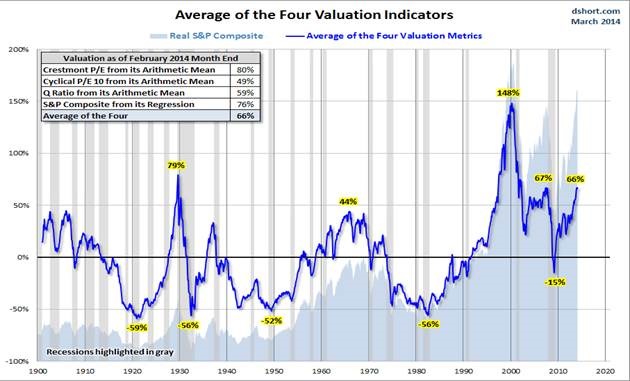
Depending on what measures you favor, valuations can appear a bit stretched currently; especially in the biotech and social media sectors. Doug Short, over at Advisor Perspectives, provides a monthly update of the chart below. Chris Kimble, of Kimble Charting Solutions, likes to add his own flair to it every now and then as well. The chart takes an average of four popular means of determining valuation for the S&P 500:

clip_image002

So based on this chart, we’re rapidly approaching 1929 levels of overvaluation of 79%, already passed the late 60’s peak of 44%, and are right back to 2007 levels at 66%. Do I think a soul crushing dislocation is imminent? Not at all. The chart also shows that things can get a lot more frothy ala 2000 and its 148% overvaluation level for all things dot.com and tech. Jeremy Grantham, via a recent Barron’s article, agrees that the market is 65% overvalued currently but that it would need to rise another 30% before he would consider it true bubble territory. For the arithmetically challenged, that puts the S&P 500 over 2,300. So according to J-Grizzle, there’s a lot of dancing left to do while the beat keeps bumping.

The S&P 500 hasn’t seen a correction of any real significance in about 2 years. When you throw in the fact that this bull recently turned 5 years old, nervous traders start to think that we just gotta see something to the downside soon. Maybe. Maybe not. Maybe f@$# yourself. My theory on the market is that it’s like a little kid. Feed it a bunch of sugar and watch it run like crazy. Thank you, Marky Mark. Despite the tapering, the Fed is still plugging a ton of sugar monthly into treasuries and MBS to keep these markets liquefied and rising.

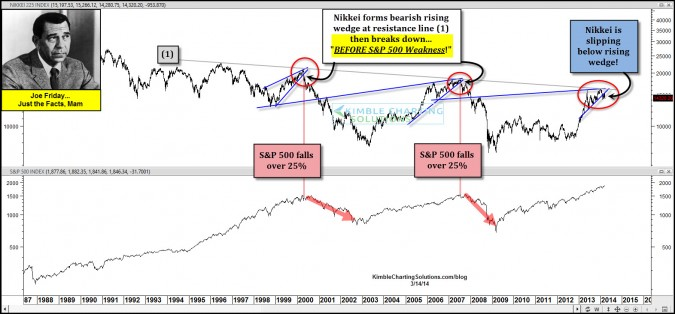
I already went on the record stating that I thought we could see downside action all the way to the 1,650ish area, which is approximately 12% off the highs. Kimble provided a chart last Friday showing the long-term action correlation between the Nikkei and S&P 500 since 2000. Observe:

clip_image003

So if the action is to be believed, then watch out. BUT WAIT! The S&P 500 is breaching all-time highs. Aside from risk management, buying into strength is a common message you’ll read in any and almost all of the great trading books. Well Goepfert at SentimentTrader shared some thoughts on the current price action too, “On Thursday, the S&P 500 rallied more than 0.5% to close within 0.5% of a 52-week high, yet more stocks declined than rose on the NYSE. That shows a lack of broad participation, despite a couple of important sectors (semis, financials) doing extremely well and breaking out to new highs. This has occurred 24 other times since 1940, and the S&P has struggled in the weeks following.”

Add to that biotech, a sector leader and market darling, is starting to show some real weakness. I think biotech is an easy short here using BIS or buying some Puts on a market leader such Amgen or Gilead. On a different note, there are some commodities now showing weakness as well. Coffee has been ripping in 2014, but this week has seen that momentum stopped in its tracks. It may just be a breather before it continues higher or it may see further downside action to eat up a nice chunk of those “easy”, early returns. The coffee ETF, JO, is an adequate proxy for those looking to trade the action without dabbling in futures. Either way and despite the current price action, my favorite indicators say that it’s not quite time to go short coffee yet. If they do give a signal, then it’s possible to see gap-filling action(on a weekly chart) all the way down to $28 or possibly $25 depending on the momentum.

Whether you lean optimistic or pessimistic is irrelevant. If you’re trading, then mind your stops. Managing your risks is all important.

Cycles, cycles everywhere…

Sadly, I don’t have any original content with which to dazzle your investment senses with for this post. I just want to share some noteworthy work on cycles.

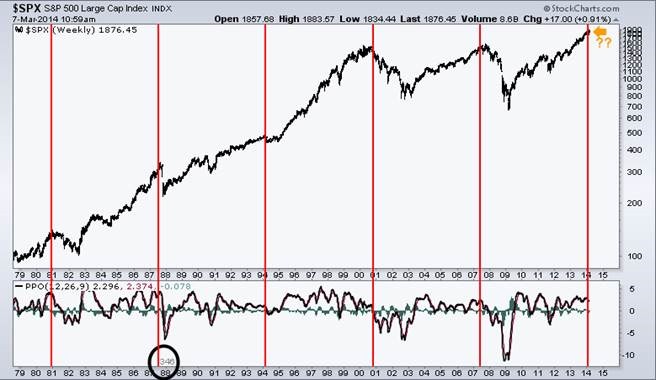
I was reviewing a couple of interesting charts this weekend, posted by Greg Schnell – The Canadian Technician. The two charts depict some consistent highs and lows across multi-week cycles. Chart number 1 breaks down the last 15 years of the S&P 500 within 66 week increments.

clip_image002

Here’s Mr. Schnell’s comments regarding the chart:

What has made the recent market cycles (last 15 years) so interesting, has been the difference in time spans. From the 2000 high to the 2002 low was a period of two 66 week time spans. From the 2007 top to the 2009 lows was 1 time span of roughly 66 weeks. Why 66 weeks? Well, it is only through the manipulation and experimentation of the cycle tool in Stockcharts that I was able to find a time span that worked for all the market turns. While multiples of 66 weeks like 132,198 and 264 work well, they all missed one of the turns. It was only the lowest common denominator that worked. This is trial and error, best fitting with the historical models.

You can see it worked pretty well on most cycle lines. It missed in 2001 at the blue arrow. What is most important, is the right edge of the chart. It is telling us that we are near one of those potential reversal points that George Lindsay talked about. Only the history books will tell us how it works out, but it is worth noting in a timely manner.

Upon publishing that chart, Schnell received a chart from a reader of his blog. This chart goes back even farther and utilizes a 346 week cycle, as denoted by the orange lines. Chart number 2 was sent into The Canadian Technician by Richard Rhodes of Rhodes Capital Management. The chart is equally compelling due to the uncanny ability to mark major highs.

clip_image004

Keep in mind, as Schnell admitted, these charts are “best-fitted” so to speak. So like every other chart you may look at to gauge potential direction, you have to take the information with a large grain of salt.

Can’t post on cycles without touching on The Election Cycle. Chris Puplava, at FinancialSense, shared a couple of interesting charts. The first one he posted, courtesy of Ned Davis Research, is based on the geometric mean from 1929 through 2009. We’re roughly at the blue arrow in the mid-term year.

clip_image006

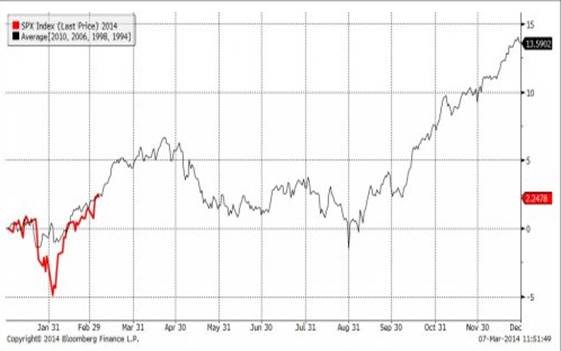
If the Election Cycle holds to pattern then we could potentially top out in the early spring, bottom out in the late summer, and begin the vaunted run-up of the pre-election year in the Election Cycle. That potential run is demarcated by the black box. Puplava put together a chart over the last 5 mid-term election years that correlates nicely with the previous chart, stating that, “The chart below is an average of the last 5 mid-term election years, excluding 2002 (I’m not anticipating a bear market this year), overlaid by the S&P 500 so far this year. The pattern suggests a rally of 6.5% into an April peak before giving back all of its gains, followed by a bottom in late August, to finish up with a strong year-end rally.”

clip_image008

Why would I share two charts that seem to conflict with each other? Because I want to continue to communicate that one must be very careful how they interpret the squiggles. It’s doubtful we’re at a major top, but those first two charts make you stop and think for just a moment. On the other hand, the Election Cycle is real, well known, and has been expounded on by countless hordes of technicians. If a gun were put to my head to decide how to invest going forward just based on these sets of charts, I would definitely follow the Election Cycle.

The ongoing point across a great deal of my posts is that these are not normal times to be speculating. Thus, an extra measure of care has to be taken before running off and allocating capital based off of some macro-themed charts. For readers who don’t think that these are unique times to be an investor, then have a read of some excerpts from Seth Klarman’s latest letter to Baupost Group investors. It comes courtesy of ZeroHedge, and in it, Klarman shares his own thoughts that probably mirror many of your own regarding this Twilight Zone environment.

I’ve shared Seth’s credentials a million times already but if this is your first time here and you are unfamiliar with Mr. Klarman, then he’s the founder of the Baupost Group hedge fund. He manages approximately $22 billion. He’s a notorious value investor whose skills are in a class with the best. Last year alone, he returned $4 billion to investors because he didn’t find enough compelling investment opportunities and the fund’s size may have been getting a touch unwieldy. He’s a legend, so the commentary shared in his letters is worth heeding.

The volatility that has returned to the markets this year has been a thing of beauty. I know the traders of the world have enjoyed it. Well keep calm and carry on the fight to enhance your own personal wealth effect.

A Read of the Tea Leaves and an Update to the ETF Portfolios

Well how about that correction in the S&P 500? Everyone suffered the 6% downward move and now we can all resume earning wealth…or can we? Is there some negative energy left in these markets? The tea leaves tell me that the corrective move is not over. As a reminder, just reading the tea leaves is about as antiquated as can get for a method of analysis. Looking at some squiggles on a chart and then making wholesale investment decisions is dangerous, but still, I think it’s one of the practical components on the speculator’s tool belt.

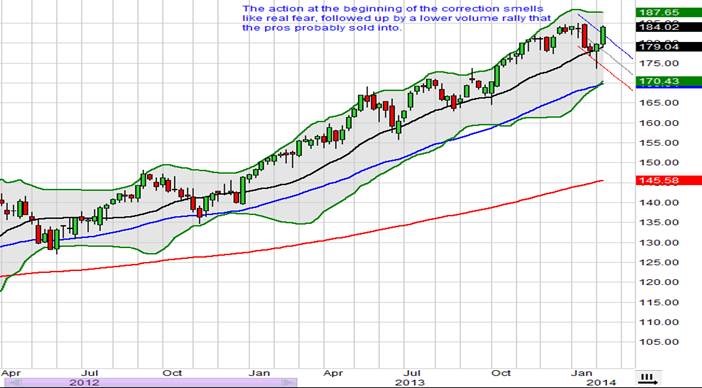
Let’s start by taking a look at the S&P 500, using SPY(weekly) as our proxy, and then we’ll move into some complimentary areas that may help shape the analysis. Bear in mind with Plunge Protection out there and HFT pace-setting through momentum ignition, all analysis is completely nullified should new highs be strongly set and the uptrend is fully resumed. Now prepare to be over-charted.

clip_image002

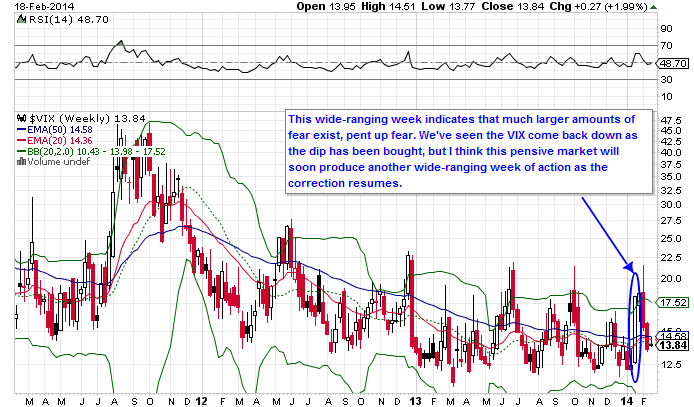
I think when this correction resumes, we’re looking at an endpoint underneath the 50-Day EMA(blue line). I think it’ll kiss that into the 165ish area before bottoming out. I just don’t believe that a 6% move down is the end of it. In 2013, all the corrective moves capitulated at the Bollinger mid-point. From the wide ranging fear that I observed, that just doesn’t feel appropriate for the correction here to start 2014.

Take a look at the VIX for moment. Yeah, yeah, I know the VIX is played out but it still provides clues as just one chart of many in attempting to get a better feel for market action.

clip_image003

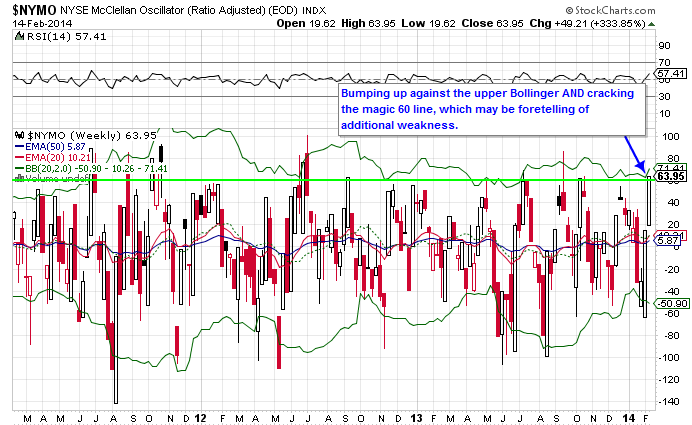
The markets haven’t seen fear like that since 2011. Another one of my favorite indicators, the NYMO, is indicating some further weakness. I’ve previously commented on the NYMO’s ability to help traders get positioned for market action. It’s hitting not one, but two indicators providing a signal for a resumption to the downside. Observe:

clip_image004

I have no worries that the major uptrend will resume after the corrective washout. These markets have been in need of a steam release for some time, but the obvious path of least resistance is upward. Those little exhalations near the end of 2013 essentially counted as non-moves, so a little fear and loathing is healthy for the uptrend to renew with some vigor going into the 2nd quarter. There are a couple of additional asset classes that may potentially shed a little light as to further direction subsequent to the completion of the corrective move. First, there is the yield on the 10-year Treasuries:

clip_image005

Okay, all kidding aside on my make-believe and totally fake “Rhombus of Hades” pattern, a downside move in yields in combination with ZIRP will continue to push market players into equities; especially if that yield pushes much lower to potentially 2.4% or even as low as 2%. I’m not saying that yields aren’t going to go higher in the long-term, just that the near-term outlook is presenting a potentially downward path in yields.

The Nikkei has maintained a fairly solid correlation with the S&P 500 and its action looks constructive as it may be basing for a resumption of its own uptrend. The two indicators below are the MACD and Full Stokes.

clip_image007

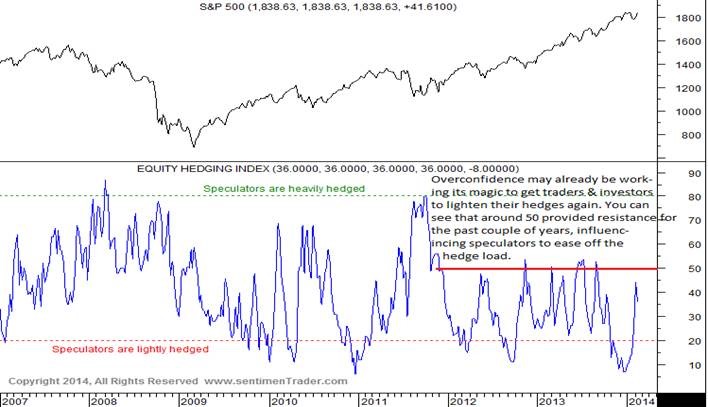
One last set of charts I’d like to share is the Equity Hedging Index(“EHI”). The EHI is one of the many proprietary models that can be found at SentimentTrader.com. It’s a contrary indicator, meaning lower extremes in the chart should produce a rally in the markets and vice versa. The EHI aggregates several inputs such as cash raising, Put purchases, and various other factors in order to construct a usable indicator. For more details, visit the site and take a free trial to see if the service is right for you. As I’ve stated on numerous occasions, I do not receive any compensation from them and I’m quite confident they don’t even know the MarginRich blog exists. Fortunately for my readers, Jason Goepfert, proprietor of SentimentTrader, is cool enough to allow people to republish his work as long as it’s not excessive and the work is credited.

Here’s a current read of the EHI.

clip_image009

And in case you need a visual on how well the EHI has performed in assisting traders see where some of the bigger turns have been occurring, observe the following chart from January 14th, 2014.

clip_image011

It’s not perfect, but then again, no single indicator is. If using technical analysis, it’s best to observe a wide variety of charts and cumulatively interpret them, so that one may obtain a more productive assessment. But this is all rubbish really because bias inherently sways emotions and thought process, and thus the analytical outcome must be considered questionable. If this sort of analysis is all you rely on, such as what I do here for the blog, then more power to you. For the record, before committing my own capital I analyze a broad swath of data; not just squiggles. Occasionally, squiggles may be all it takes to ascertain that a function-able trade has presented itself, but I like to mix fundamental analysis in combination with micro or macro economic reads.

It is decidedly better to test quantifiable inputs to statistically determine, so to speak, probable outcomes when attempting to make valid trading decisions. Have a read of this Price Action Lab blog entry. Based on his analysis, Mr. Harris states that the market is in mean-reverting mode. Long story short, he basically states that the market is fragile and so any suitable catalyst could cause a correction.

My conclusion is that I wouldn’t pick now to be throwing all my chips into the middle of the table as if everything is all clear. There are enough signals out there stating that one should trade with caution, especially if attempting to position long. It may be best to wait in cash, but if you gots the stones and the know-how, then it appears a nice set-up is forming for shorting or Put option strategies.

Before I bid you adieu, just want to let readers know that I’ve created a new link up top called Portfolio Updates. That’s where I’ll be placing the ETF portfolio updates from the January post titled, A Few Sample ETF Portfolios to Watch. I would describe the results thus far as interesting, but not all that compelling just yet. If you haven’t read the article then click the link and have a read, then check the updates to see how they are stacking up.