A Green Island in a Sea of Red

Like many a speculator, I’ve dabbled in the juniors. Specifically, I’m referring to junior gold and silver explorers and miners. Before 2011 it was a successful endeavor, post 2011, not so much. One of the things I did before altogether stopping the placement of new capital in any juniors was to compile a list of what I deemed to be some of the top opportunities for when precious metals finally make their turn back to positive. For the record, I don’t know when that’s going to be. The gold price languished for 20 years in the 80’s and 90’s. Do I think we’re in that type of 20-year-bear? No, but I don’t have a clue as to when the ship will right itself.

I simply believe in the long-term thesis for holding gold, but more importantly, I believe in the cyclicality of the commodity markets and historical precedence. There are any number of arguments in favor of allocating capital into precious metals, but for most speculators, the current price action in gold and silver pretty much tells the entire story. A declining market is not exactly the best moment to deploy new capital into the most riskiest ventures of a loss-leading sector. Thusly, it’s been at least 2 years since I speculated with any capital in a junior.

Which brings me to the list. One of the companies I had kept a passive eye on was Duluth Minerals. If you’re unfamiliar with their story, they’re the proud majority-owners of some prime property through a joint venture in the Twin Metals complex in Minnesota. Their land package and joint venture partner was what first attracted me to them. Duluth possesses one of the most promising platinum group metals (“PGM”) resources outside of Africa or Russia. In fact in North America, there’s really only two primary PGM producers of consequence, and they are Stillwater Mining and North American Palladium. So access to a nice PGM resource in a jurisdiction like North America is coveted.

However, PGM’s won’t even be the primary metals mined at Twin Metals. It’s primarily a copper and nickel mine. The PGM’s are a just a very nice by-product. Hence Antofagasta’s interest and investment in Duluth. Just a little background on Antofagasta (“Anto”), they are one of the largest, pure copper players in the world. Based in Chile with 4 operating mines, 90% of the company’s revenues are derived from mining operations. In 2013, they generated approximately $6 billion in revenue which is in line with large US copper player Southern Copper (SCCO) but far below the diversified mining giants such as Vale (VALE), Rio Tinto (RIO), or Freeport-McMoRan (FCX).

Before getting to the point of this post, some additional background is in order. So we have a major copper player with concentrated interests in Chile attempting to diversify their portfolio with the Twin Metals joint venture. In 2010, Antofagasta partnered with Duluth and over the next few years provided approximately $220 million in funds in order for Duluth to develop the properties. Duluth completed a ton of drilling to really prove out the potential of Twin Metals. They contracted with Bechtel, one of the largest and most powerful privately owned corporations in the US, to assist with the planning for the build-out of a mine.

But by 2014, Duluth had not done enough to build investor sentiment behind their company and access to capital was drying up in light of overall commodity underperformance, let alone precious metals performance. The stock price was badly languishing. Duluth’s cash reserves were drying up fast, and in July, Anto neglected to capitalize on an additional financing round that would have increased their ownership stake in the mine and provide much needed capital for Duluth. Clearly, Anto saw the writing on the wall and knew a better opportunity would avail itself very shortly.

One month later in August of this year, Duluth released a highly detailed presser of its Pre-feasibility Study (“PFS”) for the Twin Metals. The PFS was essentially a disaster as expectations were way too large. The stock price, trading at $0.40 a share the day before the PFS release, dropped 25% down to $0.30 a share on the day of the release. I think too many speculators in Duluth thought an outlandish estimate of PGM production was going to be reported, and that was obviously foolish. I sincerely believe that speculators really thought Twin Metals could annually pump out 300k or 400k ounces of PGM’s along with a couple million ounces total of combined silver/gold output.

The numbers were very solid, though. Specifically, the report estimated a 30 year mine life with total estimated production of 5.8 billion pounds of copper, 1.2 billion pounds of nickel, 1.5 million ounces of platinum, 4.0 million ounces of palladium, 1.0 million ounces of gold, and 25.2 million ounces of silver. Annually, that breaks down to approximately 88,000 tonnes of copper, 18,000 tonnes of nickel, 50,000 ounces of platinum, 133,000 ounces of palladium, 33,000 ounces of gold, and 840,000 ounces of silver. At spot prices for each of these commodities as of August 20th, that would’ve resulted in approximately $612M in copper revenues, $340M in nickel revenues, $187M in total PGM revenues, and $59M in gold & silver revenues. All product sales would theoretically total about $1.2 billion at those prices if the August 20th spot prices were the average for an operating year.

Now I don’t know about you, but for the right price, that’s definitely a resource I’d like to have my hands on. And that’s exactly why Anto did not participate in the July scheduled financing. They figured why bother. They’d already funded over $200M in project development. Duluth management was floundering while swirling the drain of bad finance options. Why not strike at the opportune moment and simply own the entire asset versus partnering in a JV. Just 9 days ago, that’s precisely what happened. This chart, courtesy of Inka Kola News, tells the story via price action.
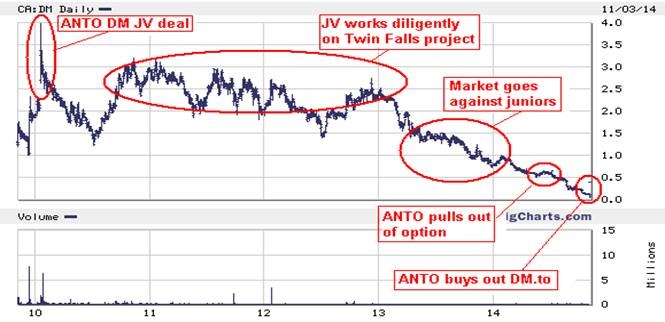
clip_image002

The PFS calculated a net present value of the Twin Metals project at $1.4 billion USD using an 8% discount rate. Anto already owned approximately 10% of Duluth. So Anto already invested approximately $220M into Twin Metals and only has to come up with roughly another $85M(including convertible debt and additional operating funds) to own the asset outright. That’s an absolute steal and congratulations to Anto’s management for deftly structuring the deal in obtaining the buy-in of Duluth’s board and of Wallbridge as well.

Now the reason this little sale is a green island in a sea of red is because I was able to perfectly time this trade. I watched the stock languish all year and when I saw that move two Friday’s ago, where Duluth dropped from 12 cents a share to 7 cents a share, I decided it was time to pull the trigger. I maintain a portfolio for my children’s future. It’s reserved for only the best businesses with the best long-term outlook that possess the best brands and continue to raise dividends decade after decade; names like Hershey and McDonalds. However, I thought why not buy a several-thousand block of shares as a little lottery ticket. At $0.07 a share, I simply thought the risk-reward was well justified for my wee ones in light of the quality of the underlying asset.

The wager paid off a lot faster than I expected. Waking up the following Monday morning and reading various headlines from various sites I frequent, I read that Duluth was selling itself to Anto. I immediately jumped over to Yahoo Finance to see this:

clip_image004

Well, hot damn! From a percentage gain standpoint, this is by far the most I’ve ever earned in a single trade for only holding a single trading day. I won’t annualize it as I’m sure I’ll probably never get this lucky again. Of course, the net income off the trade is minimal in light of the total amount of capital risked, but still it’s a nice little boost for the year to my children’s future. I haven’t actually realized the gain yet as I’m holding for a little currency translation to work in my favor first. Mistake? I don’t think so, as I think Canada will approve the sale of Duluth so I have the $0.38 locked in at today’s Loonie rates. The dollar looks set for a little breather and I suspect that just may translate into the higher liquidation price I’m reaching for.

Coming back to Anto and what the future holds for Twin Metals. They’ve admitted they have a long way to go, with their own projections putting production out to 2020 at the earliest and possibly even farther. The next step from the PFS is the Bankable Feasibility Report (“BFS”). It’s this report which will allow Anto to secure financing for the construction of the mine. Actually, they probably won’t even bother. Consider that the pre-fease reported mine construction expenses at $2.8 billion. We know that’s aggressive, so I think it’s safe to arbitrarily add another $400 million onto that total. Conservatively, building the mine is going to cost approximately $3.2 billion. But even with a staggering expense number like that, Anto should have no issues securing financing.

This is especially so if the cost of capital continues to stay cheap for players with access to the liquidity. Looking at free cash flow (“FCF”) for Anto, they’ve averaged $1.9 billion USD in FCF for the last 4 years. With that kind of cash generation, I don’t think they’re going to have a hard time obtaining financing at favorable rates. The money is not the issue. What’s more worrisome is of course receiving all the requisite permits to construct and operate the mine. The project is located in a state that calls itself “the land of a 1,000 lakes.” That’s a lot of water ways that can be affected. There will be a tremendous amount of pushback from environmentalists who will attempt to deter Anto. Just look at Pebble and the fight in Alaska. However, with a safe and environmentally friendly construction plan along with a superabundance of funds allocated to remediation of the lands, I feel confident Anto will pull it off. Just not without a fight. Although they do have this going for them:

clip_image006

When you have a day named after you in a state, I think it’s pretty safe to assume that the state is going to be very cooperative in light of the economic benefits to be garnered.

Just remember, you had a chance to own a fractional share in a billion dollar mine for a little over a nickel a share. The junior space is beginning to heat up as quality assets are beginning to be circled. The sharks are starting to get restless as a vast majority of the juniors simply will not be able to obtain sustainable financing in light of their current share prices. We’re talking about companies that simply throw cash down a hole with zero immediate economic return and too much G&A digging into value creation. New Gold snatched up Bayfield to round out its Rainy River package. Nord Gold is positioning on Columbus. Romarco just received all of its final permitting and negotiated a $200M dollar debt package that will allow them to begin construction immediately on their Haile mine. How long before a bidding war starts on their potential 150k ounce per year mine?

There’s value to be had and money to be made in the junior space, but it’s highly dangerous and not worth the capital risk for the average investor. I’ve been fortunate on a few junior trades in this terrible gold market with Romarco, Lake Shore, and now Duluth. I could easily replace the word fortunate with lucky, however, I did my homework on those companies. I’ve also screwed the pooch in names like Aurcana, Kaminak, and McEwen Mining with poorly timed purchases. All companies that have very good potential if or when the precious metals resume a bull market.

Despite my luck in the Duluth trade, I am a strong proponent of buying the right stocks for long-term holdings. As I stated before, that means companies with mega-brands who produce enormous amounts of free cash flow and consistently raise their dividends. Buying these kinds of companies when they go on sale is essentially a sure-fire bet to building wealth, but a little flyer every now and then is worth the risk.

A Few Sample ETF Portfolios to Watch

Well 2014 has arrived with a tepid start and already the correction bells are ringing around the financial web. I’m as guilty as the next blogger of trying to front-run corrective moves in the greater markets, but in my experience, it’s rare to see a pack of pundits predicting market direction with collective accuracy. Sure, equities look a touch expensive here depending on which valuation-gauges you’re utilizing, but financial writers around the web(myself included) have been calling for corrections since the last one of note in June. Additionally, I’ve read plenty of analysts who state there’s still value at these stock prices.

Let’s consult the tea leaves and see what they communicate:

clip_image002

As the squiggle shows, if this weak start to the year is the genuine beginning to a sizeable(but perfectly healthy) correction of at least 8%, then there will be plenty of time to get properly positioned to take advantage going in and coming out. Notice at the blue circles above, how long the market takes to actually set-up the real dip that shakes things up.

Last year was the Year of the Passive ETF. The year 2013 caught the hedge fund industry with its pants down and the rich, whose funds were locked into 2&20, drastically under-performed the plain old, vanilla ETF of SPY. The S&P 500 tracker returned 29% last year, beating it’s very long term CAGR by a very healthy premium. In a mad trading world of short-term thinking and instant gratification, the long-term view of the Bogleheads destroyed churning traders on an absolute basis. Will 2014 be more of the same? I wouldn’t bet on it, but the consensus view out there seems to be that 2014 will be another good year…just not as good as 2013. Some more consensus thinking has been, “We’ll probably finish the year with the stock markets up about 14% to 16% compared to the prior year’s 30%’s for some indices.”

So in the spirit of following what worked last year while trying to include a touch of the contrarian and a dash of new trends, I’ve put together an ETF portfolio that I’d like to track in 2014. Because chasing always works! As always, this is not an investment recommendation. Since buy & hold was an elite strategy for 2013, and really since 2009 apparently, let’s see if 2014 continues to favor buy & hold with good fortune.

We’ll title the portfolio, Look Back and Ahead. Here’s a snapshot of its construction using ETFreplay.com:

clip_image003

Let it be acknowledged that this portfolio is only partially constructed using a rear-view mirror, and that investing with one’s view on the rear-view mirror is generally not going to lead to short-term success. The Look Back & Ahead (“LB&A”) portfolio was constructed for short-term results in 2014 only and is looking to utilize prevailing trends and combine them with some of the strategies that had a rough 2013. Eight of the chosen ETF’s follow trends established in 2013. These are Japan(DXJ), Junk Bonds(HYG), Biotech(IBB), Russell 2000(IWM), Tech(QQQ), Share buy-backs and dividends in earnings growth(SYLD), Consumer Discretionary(VCR), and Health Care(VHT).

The remaining 4 ETF’s of LB&A are the contrarian plays that could bounce back in 2014. Some of the possible reasons behind any potential bounce-backs are: extended negative sentiment ready for a turn, value at these prices, or hot money moves in together creating a new trend. The 4 trends waiting for a potential 2014 rally off some lows are: Emerging Markets(DEM), Europe(FEZ), Gold(GLD), and Muni-bonds(TFI).

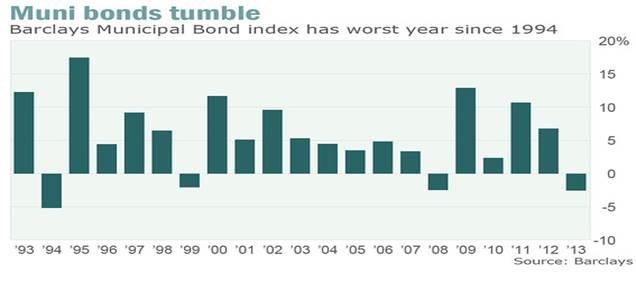
You might be thinking muni’s and saying to yourself, “Really?” They’ve had a tough year for sure. Certainly one of the worst performing years in the sector over the last 20. Barclays produced a chart of performance for the past couple of decades. It shows that after a down year, the sector tends to rally quite nicely. Will this time be different?

clip_image005

Since the S&P 500 index performed so well, we’ll track LB&A against the SPY for the year. But wait, there’s more. If I think that LB&A may be able to outperform the market by riding some established sector trends and a handful of potential counter trends, then why not leverage up. Well I have a portfolio for that too, that allows for a 2 or 3 times leveraged move in each of the sectors of LB&A without taking on margin risk into your investment account. Observe:

clip_image006

Unfortunately, ETFreplay subscriptions do not provide access to the entire universe of ETF’s. As they state on their website, “As of 2010, less than 500 ETFs have provided >98% of the trading ETF/ETN volume in the U.S. market.” Which means that due to a lack of liquidity and volume, six of the levered plays are not in the ETFreplay database. As such, I am unable to easily save and track the portfolio with their site’s tools. I’ll just save it on another site’s portfolio tools and drum up some charts in Excel for performance tracking purposes. And in the continued spirit of simple benchmarking against the S&P 500, we’ll use SSO(2x levered S&P ETF) as our comparison benchmark.

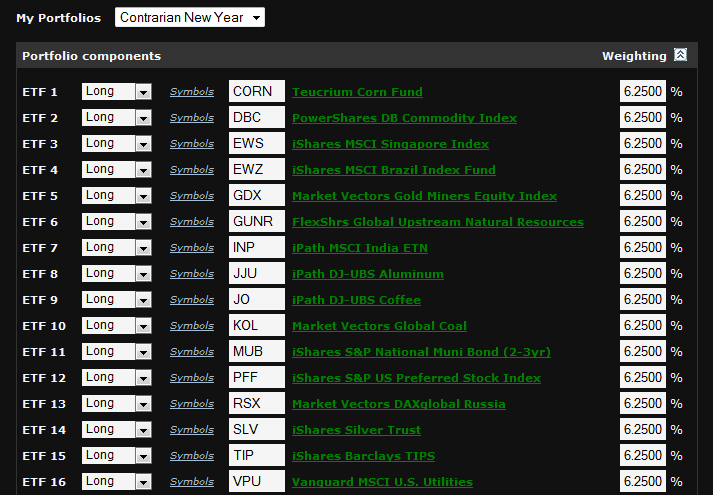
Just for ha-ha’s, we’ll track another portfolio in 2014 of purely contrarian plays. Construction of this portfolio should be obvious to most, but have a look at its make-up. It’s titled Contrarian New Year.

clip_image007

Obviously, the BRI of BRIC had a tough year so we’re allocating there for total country exposure. I also included Singapore but left out Turkey. With the ongoing corruption scandal in Erdogan’s government, there’s obviously a whole lot more than sentiment going on there. We’ll just see how that situation plays out and how it affects investor sentiment towards the Turkey ETF later in the year. Commodities were utterly atrocious, so I included DBC and GUNR but also wanted to concentrate performance for some mean reversion specifically in coffee, corn, aluminum, coal, and silver. Gold miners were…well you know the story by now. Utilities was one of the worst performing sectors in the US along with TIPS, as nobody expects inflation and everybody wants to buy growth. We’ll see if inflation starts to tick upward and relative value attracts some players back into the utility space in 2014.

Just like muni bonds up above, you may be thinking that the gold miners prove I’m a glutton for punishment. That may very well be, but risk can always be managed, and if the underlying product has a bounce-back year then the producers may see a little pop in performance. Especially if the metal can catch a bid sufficiently past most of the producers’ all-in-sustaining costs. Observe the following chart of the XAU’s performance over the last 30 years, courtesy of US Global investors via Bloomberg. It says to me that miners have a potential low risk/high reward set-up. Believe me, any time the word gold comes out of my mouth, I want to shoot myself in the face.

clip_image009

Remember, that these sample ETF portfolios are not investment recommendations and I reserve the right to allocate my own funds as I see fit into or out of any of the fore mentioned investment products. If you’re interested in some of the more professional portfolio metrics and want backtest results, Sharpe ratios, alpha and beta, correlations, etc., then too bad. Go look it up yourself. The name of the game in 2013 was absolute performance and so that is what we are measuring in 2014 with these ETF experiments.

And that ladies and gentlemen, is about all there is to basic asset management. Here’s the basic formula: Follow some prevailing trends to cover career risk + buy some contrarian plays based on quantitative models to cover career risk = hopefully benchmark beating results…and winning the grand prize of more AUM, which inevitably leads to diminishing performance. Obviously, I’m highly generalizing here. Asset management in any shape or form is usually performed by very well educated individuals or groups utilizing highly sophisticated quantitative or fundamental models drawn from a wealth of experience and knowledge. I don’t mean to belittle that nor do I begrudge anybody able to obtain a position managing assets. At the higher levels it is a very, very lucrative career that can build high-quality, long-lasting relationships.

For now, I’ll continue to trade my accounts, spend time with my family, post to my blog, and pursue interests. Am I going to be nominated for fund manager of the year for my efforts? Certainly not; but I just may have a shot at Dad’o the Year.

Now this wouldn’t be a real MarginRich.com article, if I didn’t over-chart the reader. So with that, I’ll bid you adieu with a few charts to provide entertainment and food for thought. Charts are courtesy of some of the financial blogosphere’s most respected, TRB, Jesse, and Kimble.

The January Effect:clip_image010

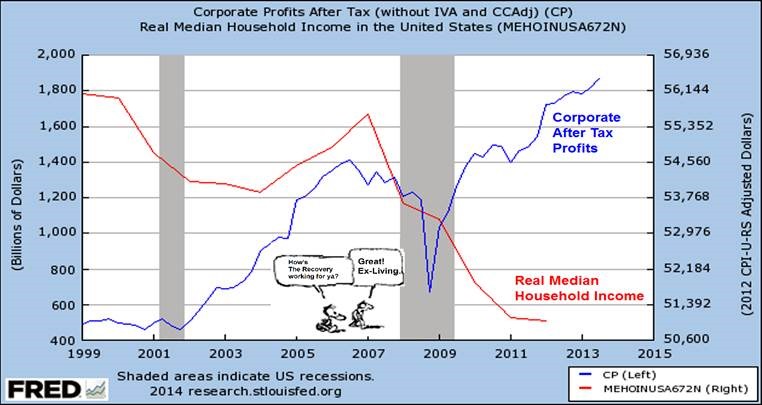
The Recovery:clip_image012

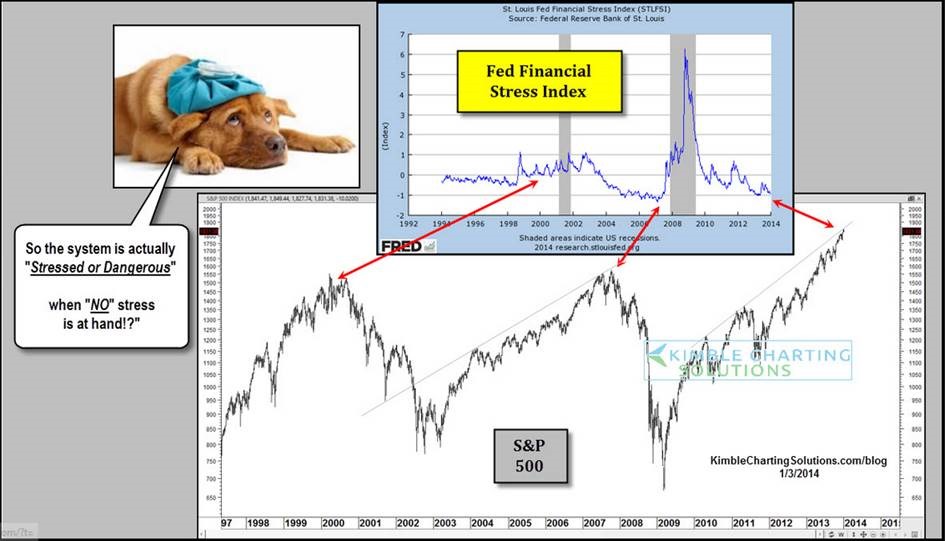
Is the financial system stressed?:clip_image014

Below is the final “Portfolio Update” posted on 1/4/2015:

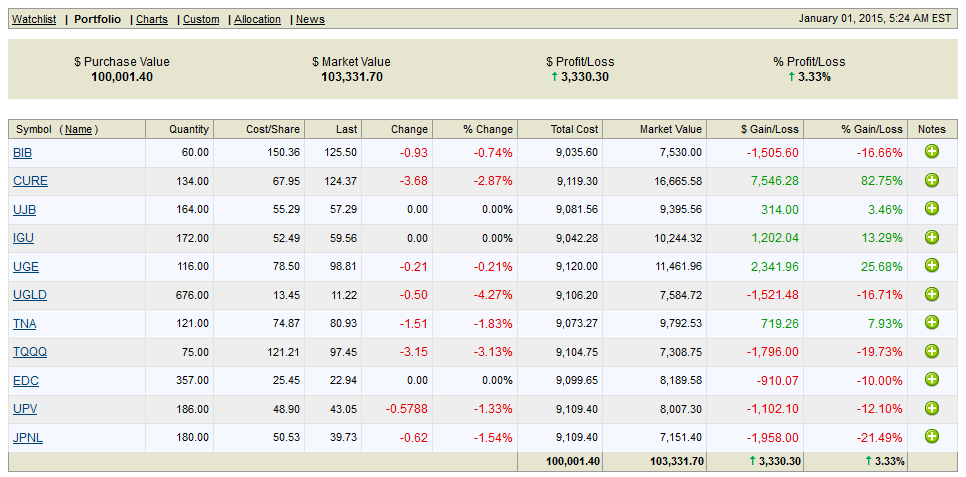
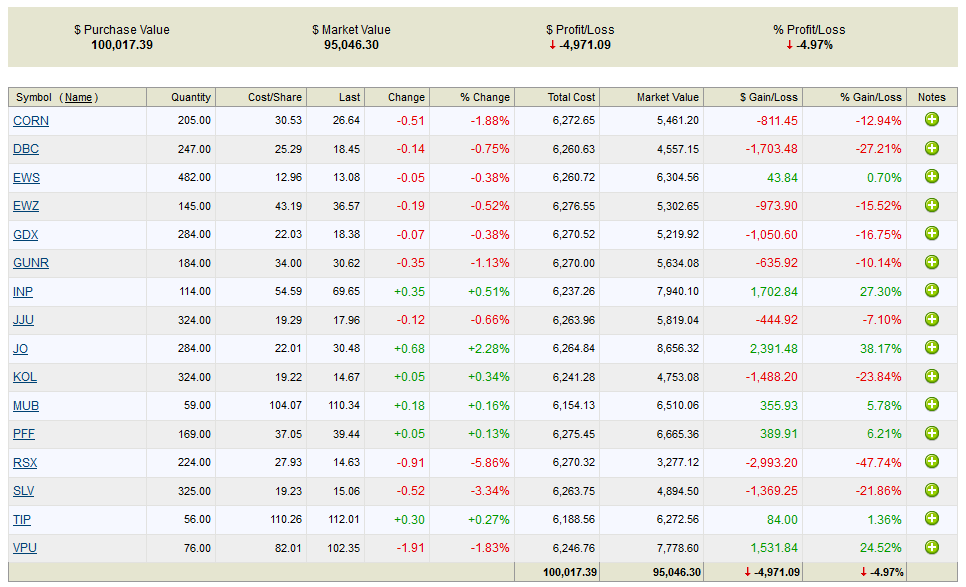
Here’s where I’ll maintain the updates to the ETF portfolios that I outlined in the January 2014 post titled, A Few Sample ETF Portfolios to Watch. If you haven’t read it and are curious as to the rhyme and reason behind these experimental portfolios, then please read the post for a full explanation. The portfolios all started with a “play-money” value of $100K. We’ll see how “buy & hold” closes out 2014. CLICK ON EACH TO ENLARGE.

Update 1/4/2015:  Say goodbye to 2014, the year of nothing specifically working except holding everything. Obviously, the adroit speculator was able to generate income in various and specific asset classes. However, the casual investor trying to pick stocks or even the majority of hedge fund managers were both trounced again by a levered ETF of the S&P 500. So much for trying to follow the trend while also also trying to be contrarian. That little thought experiment crashed and burned. I have a strong suspicion that indexing ain’t gonna be as easy as it’s been the last 2 years but who knows. I’ll leave these results up for the rest of the month and then bid adieu to this specific page regarding the 2014 experimental portfolios. Maybe I’ll come up with something else to add to the site, but at the rate I’ve been posting, don’t get your hopes up. Good luck in 2015, muppets!

1. Look Back & Ahead as of 12/31/2014:Look Back & Ahead (2014 Year End)

2. S&P 500 as of 11/18/2014:
S&P 500 (2014 Year End)

3. Levered Look Back & Ahead as of 12/31/2014:Levered Look Back & Ahead (2014 Year End)

4. S&P 500 2x Levered as of 12/31/2014:Ultra S&P 500 (2014 Year End)

5. Contrarian New Year as of 12/31/2014:

Contrarian New Year (2014 Year End)

Being Early is the Same as Being Wrong?

How many times have you heard that saying from the post title in the world of speculation? A bazillion to be sure and it’s true, but the beautiful thing about that saying is that it only applies to timing. It does not necessarily always apply to analysis. Traders lose all the time. It’s just a way of trading life. That’s why the discipline to cut and run is all important. Just because your analysis may have led you to be early on a move, doesn’t mean you cut and run from the analysis. There could be profit left to squeeze out of it and if you let your emotions get the best of you, then you might leave money on the table…and we all know that’s a trading sin.

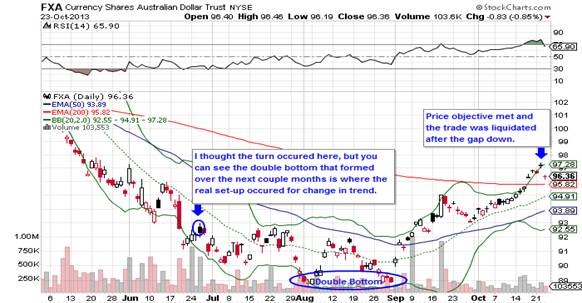
Observe the following 2 charts from a June post for a perfect example of this notion in action with the Aussie Dollar Currency Shares.

clip_image002clip_image004

Now I lost money on that first trade as the short energy simply had not dissipated yet. I thought the up-turn had occurred, but we had yet to even see a bottom in FXA. Serves me right for playing Mr. Pseudo-currency trader. My wheel-house is equities, but you read enough charts and conduct enough analysis and you just feel like you can trade anything. I kept my eye on the action in the Aussie dollar while also following the RBA decisions, amongst other indicators. As some real heavy hitters were reported to be short the Aussie dollar, it seemed as if the move had reached total extremis and a short covering rally was a distinct possibility. Additionally, the political hijinks of America were going to produce a counter-trend rally for some well-regarded international currencies, and the Aussie was as ripe as any. Observe the current action.

clip_image006

If I had given up on this trade and just moved on to another asset class, then the profit would have totally been squandered along with the opportunity to reclaim the loss from being originally stopped out. You have to have conviction in your beliefs if you know your analysis is sound. Obviously, it doesn’t pay to fight the market but that doesn’t mean that the market will keep fighting you. Markets capitulate at extremes, providing fantastic opportunities for the diligent. And just for laughs, an ancient chart pattern, The Double Bottom, actually proved its efficacy in this particular instance in portending the trend change. Score one for classic technical analysis against the hyper-algo houses, however, don’t get used to it though. You’ll just lose money with that kind of thinking, that classical patterns will definitely play out in your favor. Have a look at Peter Brandt’s note on the H&S in GOOG back on October 9th. Granted, he did do the full disclosure thing stating that all patterns are subject to failure. Brandt is a true OG in the trading game, but everyone gets it wrong sometimes. Now I may miss out on some more upside in FXA, but I’m cool with recouping previous trade losses and harvesting new profits under my original analysis.

It can’t be reiterated enough how important it is to mind your stops with absolute discipline. You never want to enter your stops into the market because our algo-driven world has the ability to sniff these out and run them. Of course it takes position size for that to occur and an aggregation of sloppy retail holders may provide that size. Although if you simply cannot be disciplined enough to close out the trade when warranted, then do what you have to do by entering the stop. Again, I’m not abdicating for the usage of actually entering your stops into the broker. That’s amateur hour even for amateurs, but it takes time to learn how to cut and run. The primary thought process of the average amateur speculator goes something like this, “Well it’s moved so far below my purchase price that I might as well wait for it to come back and then at least I can break even.” Or if it’s an option, they foolishly allow it to expire with a total loss. Discipline is key and the trailing stop is one of the trader’s best friends.

It’s difficult to touch on this subject and not comment on the gold market. For the gold bugs, faithfully holding onto the precious metal and the precious shares it’s been a nightmare of a dislocation. For the “finanical-assets-are-the-only-place-to-be-and-a-gold-allocation-is-stupid” crowd, then this dislocation is providing the music for them to tap-dance on the hearts of the “sit-tight-and-be-right” hopeful holders of precious metals related assets. But are those tap-dancers early themselves? Are the people who have gathered precious metals related assets going to have the last laugh? Nobody can say or predict with any true credibility. There are credible sources on both sides of the argument for the gold price direction. The short-term extrapolation by the pro-financial-asset side is so glaringly and willfully ignorant of the many historical facts and the current trends that are racking up in favor of precious metals. But on the opposite side of the coin, the assumed guarantee of certain actions in the economy and thus the precious metals by the Hayek/Mises followers can also be labeled as glaringly and willfully ignorant of modern market & monetary dynamics.

Full disclosure: I do lean toward the Austrian line of thinking, but I’m not a blind fool. Let’s be real. You have to be allocated across multiple asset classes. If you have the means, it makes sense to take advantage of real estate values and advantageous financing…even after 1 year run-up’s in values and mortgage rates. The long-term statistics behind holding dividend growing, cash gushing mega brand companies speaks for itself. And nowhere has that been more recently evident than after the 2008 downturn. Fixed income is not dead. There are some sectors within that asset class that are struggling for breath, but fixed income will always be a sound allocation within a well balanced portfolio. Commodities are volatile and to over-allocate based on some historical precedents is unsound money management. As I stated though, maybe the goldbugs end up having the last laugh in that sort of The Big Short kind of way. To ignore the following chart, courtesy of Tom Fitzpatrick at CitiFX, is to think this time is different and mean reversion doesn’t work.

clip_image008

Can you find a better, more consistent, and tighter correlation to gold than the US Debt Limit? If yes, then please feel free to comment below or e-mail. I’d like to hear other opinions, biased or unbiased. I’ve observed plenty of indicators over the years and this continues to be one of the strongest. Actually, there may just be one that is stronger. For some more ha-ha’s, I’ll include the following gold charts by the consistently insightful Tom McClellan. The gold price runs quite nicely with a certain 13 & 1/2 month cycle.

clip_image010

You may be thinking that the timeline is so short that this correlation is statistically worthless. Well he provided a longer chart for that, too.

clip_image012

So if you didn’t read the original note back in August, then you’re wondering what the heck is this fairly tight sine wave correlation to the gold price. The answer as presented by Mr. McClellan:

I mentioned that I don’t know why gold exhibits this very regular 13-1/2 month cycle.  But I do know that there is a very real and important anchor which seems to control its regularity.  You may have noticed that these charts show a rather funny looking representation of a sine wave cycle, with bars instead of a wiggly line.  Those bars have an important meaning: They represent the distance between the earth and moon on the day of the full moon.  So the 13-1/2 month cycle which is evident in gold prices just happens to match up really well with the lunar apogee-perigee cycle.  Or at least it has for a couple of decades, which ought to be long enough to establish it as a real phenomenon.

Seriously! The damn distance between the earth and moon during a lunar cycle. Hard to ignore it whether you think it is laughable or not. Gold has been showing some constructive action since going sub-$1,200 in June. It’s doing the classic higher lows walk right now and everybody can see the hardcore resistance at the $1,430’s and $1,530’s. Those most obvious resistance areas that literally everybody in the world can see makes me suspect that the paper price of gold will be sold off hard at those levels, by whatever entity or entities you want to believe conducts those sorts of operations. What we’ll really want to look for is the buying action off those potential sell-offs that will provide insight into how constructive the ongoing move really is coming out of June.

I don’t usually provide precious metals shares trading recommendations as the action in the shares is predicated solely on the underlying asset. With the volatility swinging so wildly with what appears to be no fundamental reasoning, it can be highly dangerous to speculate in gold or silver miners. Consider yourself duly warned and take another gander at the disclaimer as I’m not an investment professional and readers bear all the risk of trading or investing in these markets off of anything read here. Now that that’s off my chest, observe the following weekly charts of two quality miners. The first is Yamana (AUY) and the second is New Gold (NGD).

clip_image014clip_image016

The reason you’ll want to follow these two miners is that you get a top flight major producer (AUY), albeit very small compared to the big dogs, and a high level mid-tier producer (NGD). Both trade at penny stock prices. AUY and NGD share some operational qualities that distinguish them as quality picks in the mining space. They both possess top shelf management. They both possess some of the best all-in sustaining cost numbers for producers their size compared to their peers. They both possess readily available access to funds for project development. A majority of their mining and exploring operations are in respected, safe jurisdictions; especially New Gold. Most importantly they have huge growth already built into their production schedules over the next several years, which if precious metals resume their bull advance, then earnings growth has the potential to be very significant.

As far as a short-term trade to potentially leverage a move in gold over the next several months, I prefer AUY. And look…you can see that classic chart pattern again, The Double Bottom, rearing its head to possibly portend a trend change. There are a multitude of ways to execute a trade on these two. Simply buy the shares and go long. Buy some calls a handful of months out and subsidize part of the purchase with a put sell. Buy some LEAPs by themselves; hedge with some puts on the GLD. The last two times I played LEAPs in AUY, before the beginning of the Precious Dislocation, I was able to liquidate each trade with a 200% gain. The first in just a few weeks; the second in just a few months. Remember to conduct your own due diligence and structure a trade in which you are comfortable and allows you to sleep. Also, a concerted move below October lows will negate any analysis for a positive move upward

As far as a major move in gold pushing the price multiples higher in the years to come, well I’m in the camp that believes it’s probably going to happen. Am I a blind follower who prays to the Precious Metal gods daily and reads passages from the King Lebron James version of the Great Book of Precious Metals? All while rotating my alternating gold and silver rosary beads in my hand to add heft to my precious metals prayers? Decidedly not. In attempting to evaluate all the historical information at hand and objectively assess the current data, my noggin tells me to be positioned for a potential continued advance through this decade. At this point there is still plenty of time to open positions and begin accumulating the actual metals or quality shares, but to absolutely refuse an allocation based on pure ignorance or ego is a shameful act of poor money management. There are a plethora of wealth managers and bloggers whom have bought into their published stances with such conviction and unparalleled vanity, that they can’t truly admit to utilizing an objective or agnostic approach and perhaps are surrounded by one too many sycophants. It all sort of reminds me of the South Park episode where some of the parents start purchasing Toyota Priuses(Priusci, Priusae, Prius’s, or Priussessez) and then loving the smell of their own farts. Thankfully I reside in a country where everyone is entitled to their opinion, but the anti-PM crowd just may be early in their celebrations and wrong in their analysis.

Fear of Patience or Haste? Some Light Reading May Be Just What You Need

One of the notions I come across in conversations regarding the game of investing is the fear of making mistakes due to missing out(lack of action) or not waiting long enough(lack of patience). Bear in mind, we’re not talking about seasoned investment professionals(including myself). Oftentimes, this person is like many other hard-working individuals just trying to build something for the future. For the most part, that fear is completely unfounded as it generally stems from a person’s desire to invest or speculate outside of their competence levels. Why do people do that? Greed? Idiocy? Hubris? Ignorance? Naiveté? Who knows, but it definitely occurs on a daily basis with the retail set.

Two qualities that help to destroy the fear are knowledge and experience. With a healthy foundation of knowledge laid comes confidence. When combined with practical experience, one gets that level of seasoning that can lead to consistent investment success whether one is a pro or amateur. You may be thinking to yourself, “But I don’t have an MBA in finance from Wharton.” So what. Neither do a lot of successful professional investors. You going to work on Wall St.? No? Then who cares. There’s an endless supply of readily available books on everything one needs to at least complete the knowledge-half of the equation to start gaining investment confidence. The experience-half of the equation simply comes with practice, which obviously comes with time and repetition. Do you care enough about your financial future to put in the requisite time?

It all starts with one book, and if you really catch the bug, then it’ll turn into dozens or hundreds as you endeavor to consume as much information as possible to round out your self-education. Feel free to visit the MarginRich Books & Educational Content link at the top of the page(or click here if you suffer from acute wrist fatigue) to see some of the books that had the most positive influence on my own investing or speculating abilities. One can argue that there are better books or I should have read more economics or history or whatever. That’s true, but based on the population of books I have read so far, these had the most impact. When combined with regular perusal of relevant sites on the WWW, one can begin to reach that comfort level with taking appropriate action at the appropriate time based on a quality base of knowledge. Obviously, it’s my opinion that the list of links in Some Favorites off to the side or at the bottom on a mobile device, is a great place to start for web sources of relevant market information.

It is my experience that most people are simply too lazy to take the time to read or research. That’s why they listen to their Fidelity 401k advisor or their 2-bit Schwab financial advisor and wonder why they get average returns. It’s certainly true that just passively indexing in the recent past would have blown away many “complex” strategies, but any real downside protection is effectively eliminated in a down-move bust of the regular market cycle. Strategies really come down to timelines, so whether your horizon is way out or just ahead, it pays to be financially educated enough to truly take matters into your own hands. Building the foundation of knowledge and continuing to add to it will allow one to see value when it truly exists or determine extreme levels when potential outcomes are stretched; hence the tagline at the bottom of all the missives of “Read, Read, and Read some more.”

And let’s not forget the blue-blooded, Ivy League knuckleheads, allegedly the most educated financial professionals on the planet, that virtually blew up the whole system. I’ll never be convinced that it takes their magical, special sort of smarts to run a billion-dollar portfolio for an elite bank or large-scale insurance company and idiotically allow an excessive amount of funds to be gambled in the complex universe of the most esoteric derivatives all over the counter without any central clearing or oversight what so ever to potential worldwide ramifications. GTFOH with that! These fools almost blew it all up once, and you can be sure, the next time they’ll succeed…but life will go on and markets will continue to exist. Pick up a book you’ve been meaning to read and start perusing it. Whether it’s about investing or economics or history or anything, as long as it’s going to positively impact your overall investment skill set. Just…

Read, Read, and Read some more. Good luck out there.

Market Timing – Trades You Can Apply Yourself

Below I will outline what I feel are some high-probability set-ups for a handful of swing trades. At the very least, maybe you’ll find it fun or interesting if you’re not up for the risk. In the beginning of the year and for the next several months subsequent, my timing skills became out of whack. This is normal as nobody is right all the time. I rely on my ability to “read the tape.” That’s one of my edges…allegedly. Unfortunately, my “tape reading” ability cycles up and down. But every now and again I can get in a zone where I feel like I’m seeing market moves ahead of time, and consequently, make a series of successful trades in a row. Since the return of volatility to the markets back at the end of May, I have been able to capitalize in one of those zones. That volatility has put my technical analysis skills back in play. Keep in mind that I’m not really using traditional chart reading methods where I look for a “flag” in a “rising bear wedge” to determine an intermediate trend change but the overall bull trend remains intact as long as the “Hindenburg Omen” doesn’t offset the “Golden Cross” which is contingent upon the patterns occurring on 5-minute and 60-minute charts but not a daily or a weekly chart. As I’ve relayed before, that kind of stuff can provide value but pretty much gets nullified by skilled systematic traders and the sheer volume of high-frequency-traders in the markets. However, this volatility does allow for my simple use of technical analysis combined with pure “tape reading” to allow for some wins.

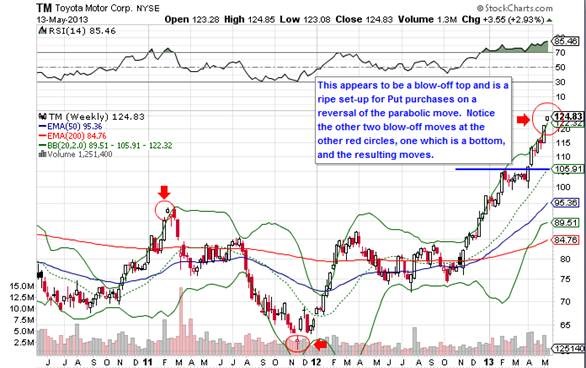
Recall the e-mail sent in May, “Step Right Up and Grab Your Short Opportunity,” and the Toyota recommendation. Observe the results in the original chart(5/13) and the follow-up chart(6/26):

clip_image001clip_image002

And by the way that trade is still open for profit potential on a farther-out timescale. The set-up looked like a mini-Eiffel Tower and I think $105 is still in play. I may re-open the trade as Toyota’s action has been weak in light of the little bounce back in the markets. Now you may be thinking so what. Nice luck, clown. Or even the sun shines on a dog’s rear end, but keep in mind I closed similar trades for profit nailing the turn in the XHB(housing), XLU(utilities), and INTC after it’s jump to $25. Plus, I have other Put option trades open. I also stated in the KSU presentation that a takedown would offer a better entry point for that particular equity when it was priced at $118 at the time I posted the presentation. It’s low since was $102, but I think there’s even more room to correct. But the fun doesn’t end there as there is a tremendous amount of fear still residing in the market. It’s almost palpable and it calls to traders. There has been commentary that the big one is here. This is the beginning of the huge takedown, like in 2000 or 2007, with enormous sell-offs in bonds and stock markets. I disagree. I see the current situation as a natural correction off the irrational 6-month exuberance that existed from the beginning of the year to June. I can’t really speak for the debt markets, but for the stock markets we could see a bounce back to new highs from here and then a stronger, scarier takedown somewhere in the late-July through mid-September range. It’s more probable that we chop along moving sideways through the Summer with some up and down bouncing and then finish out the year strong as animal spirits recover and taper talk dies down with renewed vigor behind the rhetoric of quantitative easing. Now just because I’m an equities guy doesn’t mean I don’t understand the debt markets. It’s just not my primary field of play for profit. What I do think though is that the BIG, GIANT crash in bonds is not on us yet. That period for bonds will shock the markets as the derivatives and debts of the world come together for the big one. No, what I think the correction in bond prices and spike in yields are doing is conveying the first message that judgment day is coming, so it’s time to start worrying but keep partying for now. As always, who friggin knows?

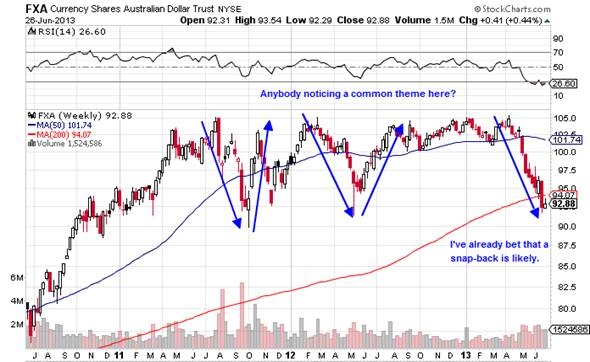
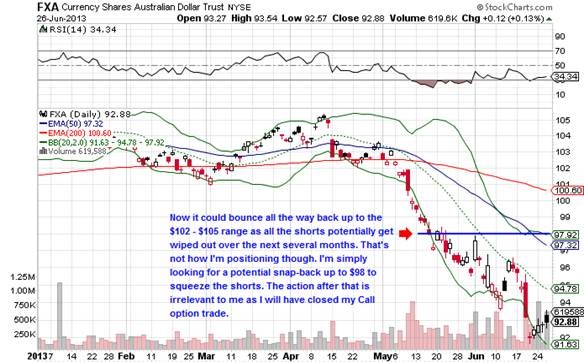
So getting back to the potential money makers I referred to earlier…the first one is on the Aussie dollar. The whole world is short the Aussie dollar. The basic macroeconomic rationale is that the Australian economy is centered solely on commodities and the sale of those commodities to China. With the whole commodity complex coming down, then the Australian currency is due for a dive. And dived it has due to speculators, bond vigilante’s, or the boogeyman. The fact of the matter is that the Australian economy, although possibly overheating, has not blown up yet nor has their housing market yet, either. The central bank of Australia has been raising rates as opposed to lowering, although I suspect that should change in the near future. And the bottom line is that when the whole world agrees on a trade, you simply have to go contrarian. Even if the macroeconomic rationale is correct, there’s still that little matter of timing. Recall gold and gold shares for proof of that. Anyways, observe the following weekly and daily charts of FXA, which as you should know from previous market notes, is an ETF proxy for the Aussie currency.

clip_image003clip_image004

The hedge funds, family offices, and wealth managers can borrow in a stronger or weaker currencies and short or go long another. That’s a carry trade done on margin. It can blow up spectacularly when done in things like borrowing Yen on margin to buy US safe, dividend paying stocks. It works till it doesn’t and then it can blow up fantastically, which is what we have seen this month. Obviously, I’m not operating on that level. Our trade is the September Calls at a $98 strike on the FXA. These options tend to trade with a little bit wider spreads of around $0.10 despite adequate liquidity, so as of 6/26 each Call was trading between $0.40 and $0.50. Do not put more than 2% of your trading capital at stake in the trade. I use a very wider stop-loss generally on option trades. Sometimes you gotta give a thesis time to marinate and that’s what going far enough out with a wide stop-loss allows. Not to get too remedial or insult your intelligence, but let’s do a quick example of what that looks like. Hypothetically you have $10K to trade and a 50% stop loss. That means you’re willing to risk $200, which means that you’d place $400 into the trade if you’re using the 50% stop loss. The resistance point of $98 is a pre-planned sell price, however feel free to liquidate earlier if you’re satisfied with the profits earned…after accounting for transaction fees of course. Full disclosure, I’ve already put the trade in play.

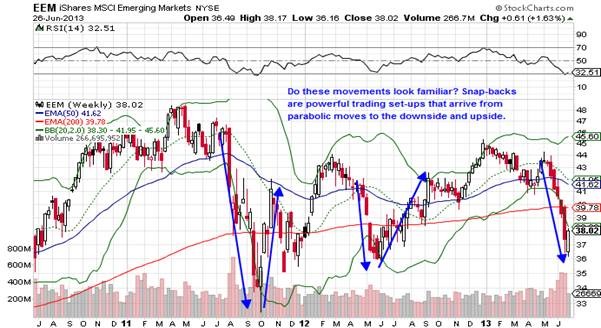
The second trade is in emerging markets. I spend hours every day scouring the web researching various markets and gathering usable intelligence that will allow for a potentially profitable trade set-up. One of the things of I’ve noticed over the last week or so is all the overwhelming negative sentiment on emerging markets. Once again, the whole world is short emerging markets. Literally, all I read are negatives on Brazil, China, India, and the rest of the developing countries and how the US is so strong, while the emerging market investment will destroy your portfolio. As I stated up above, when the whole world is in on a trade then you really do have to go contrarian. Look at the emerging market ETF, EEM. It has been destroyed in the last 4 weeks and with a serious gap-down just last week. In the daily chart we have two 2 beautiful set-ups that I love to see:  1. confirmation of the beginning of a snap-back, and  2. a gap-down that appears as if it will be covered as part of the snap-back. The weekly shows the snap-back consistency subsequent to a parabolic sell-off. Observe the following charts.

clip_image005clip_image006

I often comment on snap-backs when it comes to trading and that’s because I’m always looking for extremes. It’s one of the easiest things to look for in trading set-ups. Others call it mean reversion, although that’s not always the case as the reversion move may not necessarily move back all the way to the mathematical mean, but you get the point. Regardless, I generalize these set-ups as snap-backs and they’re far and away my favorite set-ups to consistently trade. They can be executed up or down. It doesn’t matter. The only real difference is that downside moves are much more explosive than upside moves, so Put option purchases are a touch more delicate than Call purchases. The trade here is the August Calls at a $39 strike for EEM. Each Call is trading at a fair $0.75 despite the resistance point only being a dollar away. Waiting for the mini-gap will present an even better price point. Liquidate at $39 to be safe or earlier if you’re already satisfied with the profit level. The sentiment against EEM is definitely extreme as the top holdings in the ETF are companies like:  1. OAO Gazprom – Russia’s largest natural gas producer and thus Europe’s largest supplier  2. China Mobil – China’s largest mobile carrier  3. Samsung – Largest company in S. Korea and one of the largest consumer electronics companies in the world  4. America Movil – Mexico’s largest telecommunications company, etc. These aren’t exactly the kinds of companies that are about to become insolvent. Full disclosure, I have not put the play in motion yet as I am waiting to allocate once that mini gap is filled.

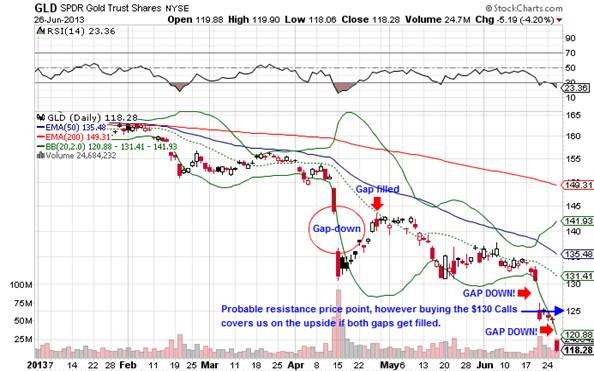
The third and final trade is a golden oldie. The sell-offs in the GLD on 6/20 and 6/26 also present my two favorite set-ups again. We have gap-downs and we have an extreme shift in the trend. By observing similar action in April, we can see the potential of the snap-back here in June. Understand I’m not calling for a secular trend change here in gold. I’m not saying go all-in gold because the correction is over. I’m just seeing a great set-up that deserves a short-term capital allocation. Observe the first chart, which is a daily chart of GLD. The second chart is of the COMEX paper gold. Using any technical analysis on gold is dangerous due to the gross manipulation, however trading is trading and greed is greed and extremes are extremes. These set-ups look compelling.

clip_image007clip_image008

I had shared with a colleague that I had purchased Calls for September, but was mistaken. The trade is for the August Calls at a $130 strike on GLD. These Calls got killed on 6/26 and could have been purchased for $0.85 as of the close, which is when I purchased my allotment. I suspect the trade will be ready for liquidation at $125, but if paper gold is running kind of hot off of the snap-back then there is the potential for $130, in which case the option should be liquidated. It is probable by that point that the takedown will resume in paper gold as $1,200 has not been hit yet and potentially slightly below $1,200, just to run all the stops set at $1,200 for easy profit.

There are some things to keep in mind when considering dipping your toes in. One is that it’s not as hard as it looks. Just be disciplined. Don’t over allocate and get out if the play moves against you. The second thing is that these moves aren’t for waiting on. The FXA and GLD options are for immediate purchase, so if you dilly dally and then decide you want to try, you’ll lose. The EEM is only a wait until the mini gap is covered which should happen the next day or two and then I’m going in. The third thing to consider is hedging. It’s not important to try to think outside of your realm of expertise and hedge each of these bets directly. For instance, you don’t need to short the dollar while buying Calls on GLD or buying E-mini Calls on the S&P 500 while you short the Aussie dollar. Hedge funds have expert analysts, with PhD’s, in combination with sophisticated software to determine correlations and anti-correlations between every asset class in the world and then calculate optimal statistical probabilities of a trade. We don’t have those resources. Like I stated in the previous note, think of your 401K’s and safely allocated retirement funds as your hedges to the risk you take on with options trades. It’s that simple.

I’m assuming that none of you will try these and I knew that before penned this note. I don’t care what the universities & the mutual fund marketers communicate about asset allocation and thinking of the long term. Markets ain’t efficient and short-term profit opportunities consistently present themselves. I enjoy deep-dive analysis on companies for long-term potential as much as the next value investor. That is also fun for me…and profitable. It’s just that swing trading is more fun and presents profits a lot more quickly, but of course the danger factor is amplified exponentially. At the very least, bookmark the charts from Stockcharts.com and the ticker profiles from Yahoo Finance for the next couple weeks to couple of months to see how these play out…just for laughs.

Lastly, remember these are simple option trade set-up’s of the purchase of a Put or Call. You can facilitate more complex option trades around the analysis, but that’s not what I share here. If you have the requisite skill set then you’re covered.

Read, Read, and Read some more. Good luck out there.