Whipsaw, Whipsaw

MAN ALIVE! That action on Monday is enough to make a trader fold up operations and go back to counting beans or selling un-needed crap to folks. That was seriously some hair-raising action. Did you get your stops ran? Did any of you traders get whipsawed by Monday’s action? Rest assured, you probably weren’t alone.

If you’re attempting to go short here across any of the indices and had your stops ran on Monday then kudos to you for maintaining discipline. However, you just may be missing out on more of the fun of a potential downmove. Hard to say because my crystal ball is in the shop and for some unforeseen reason I’m not omniscient. It really makes me mad that I can’t call the exact turns of the market. Oh well. I still think a downward short-term bias is in effect and eventually the perceived risk indexes(Russell 2000 & NASDAQ) will finally pull down the “Great Proxy”, the S&P 500.

So far, so good for the S&P 500 as it set new highs this week…and has promptly come off those highs. Is that strong price momentum? Have a look at the daily action in the VIX. It gapped down to start the week and within 3 days that gap has filled, but still yet, the VIX is still down around all-time lows.

clip_image002

The MACD has been a pretty simple and fair indicator to clue traders in when the volatility is going to start spiking. Observe at the green lines that every time the MACD turned upwards, the VIX was usually in the early stage of an up-move. Are we at another up-move right now? It feels like it. If things get dicey, a quick move up to 20 on the VIX could easily occur.

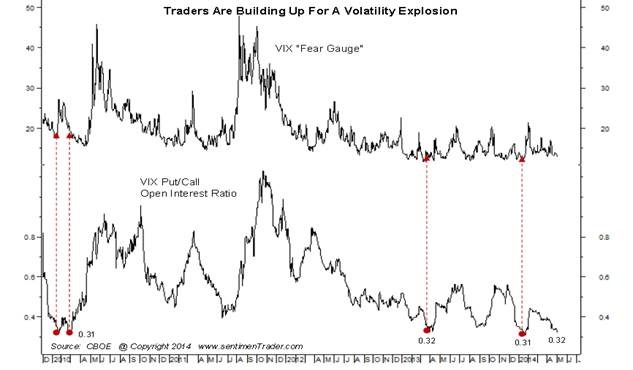
A couple of weeks ago, SentimentTrader shared a chart depicting the VIX Put/Call Open Interest Ratio. It puts on full display what the current option action on the VIX is saying about volatility. Judge for yourself:

clip_image004

There are plenty of messages being communicated very loudly and clearly by the markets. These aren’t esoteric signals that only the true professionals can divine. Anybody with the ability to read and some dial-up internet internet service can see these messages…more power to you if don’t have to result to a screeching connection via Juno or NetZero or whoever the hell provides dial-up these days. Also, to any readers who currently utilize dial-up to access this blog, please excuse my insensitivity.

Things are happening in the markets such as defensive rotation. Utilities have performed fantastically so far the past few months while the rotation to staples vs discretionary appears to have begun. Less and less issues are hitting 52-week highs despite the DOW and S&P 500 sitting near their own highs. Treasury rates continue to drop. Wal-Mart missed fairly big on YoY Q1 income. High-flying tech and small caps have already come off pretty hard and these are where the risk is allocated. Social media sites trading at P/E’s in the multi-hundreds. Biotech stories being sold on a wing and prayer for ridiculous valuations.

High-flying tech and small caps are part of what I call the 3-legged risk stool that are sort of propping up the animal spirits of the entire, current stock market. Two of those legs have been kicked out, so to speak, and yet still the S&P 500 hasn’t really shaken out the bulls. The third leg of the shaky risk stool and thus potentially the ultimate catalyst for a correction in the broader markets is junk bonds, I suspect.

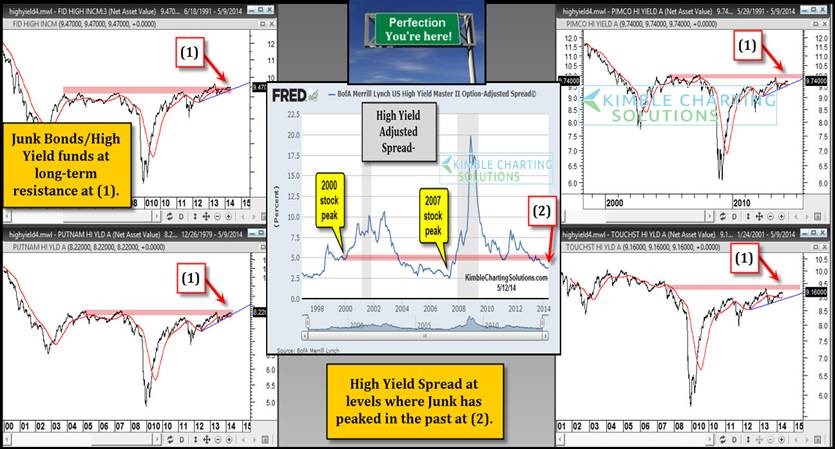
If junk bonds correct here within the next 14 to 60 days, with remaining weakness in the NDX and RUT, then things can get real hairy, real fast for people who are poorly positioned for the move. Have a look at what Kimble shared over at his site a few days ago,

clip_image006

So then what could be a catalyst besides stiff resistance? Oh I don’t know. Maybe the humongousest junk bond issuance in financial history. Anybody remember seeing this near the end of April?

clip_image008

The markets have a funny tendency to act a little wonky after the largest-ever of anything occurs.

The action this week has that sort of a backdraft feeling to it. In case you never saw the movie, a backdraft(as defined by the Collins English Dictionary) is “an explosion that occurs when air reaches a fire that has used up all the available oxygen, often occurring when a door is opened to the room containing the fire.” Buyers potentially get a final pull into risk assets before an explosion outwards for a fast and hard move down after the right catalysts make their presence known.

Despite the already well covered move down in the Russell 2000, it appears as if there is plenty of room for a continuation downward. If you’re trading IWM, then keep your stops at an appropriate level. Biotech’s IBB essentially bounced off it’s 38.2% retracement using the week of August 8th, 2011 as your starting point for a quick Fibonacci analysis. A cautious short in IBB with the potential for further selling down to between $200 and $205, may yield a nice return during this summer. In a previous post, I had stated that I thought coffee was setting up for a short but my favorite indicators were not providing a green light just yet. Well those indicators finally gave their green light. If you’re feeling brave you can follow me on a short of JO with approximate targets of $35 and $30, if the selling momentum really gets going.

The list of investing icons who are advising caution continues to build. We’ve had mutual fund heroes like Romick of FPA and Yactkman share their thoughts months ago on building cash levels. Klarman, Marks, and Grantham have given the thumbs down. Now we had David Tepper, Mr. Highest Paid 2013 Hedgie, providing his valued insight on these precarious markets. It may not pay to listen to or heed a blogger like myself. That’s for you to decide; but you can’t dispute that it pays to heed what these most esteemed gentlemen have to share.

Economic Distortions

Here at MarginRich.com, I mention Jeremy Grantham and his firm GMO quite a bit. That is for two very big reasons. Number 1, he and his firm manage in excess of $100 billion for the biggest institutional investors across the land. And number 2, he’s publicly nailed multiple bubble calls. Does he nail them to the day? Well no, but he’s been close enough and has effectively ensured his clients were positioned accordingly to mitigate the damage of the last two major stock market bubbles.

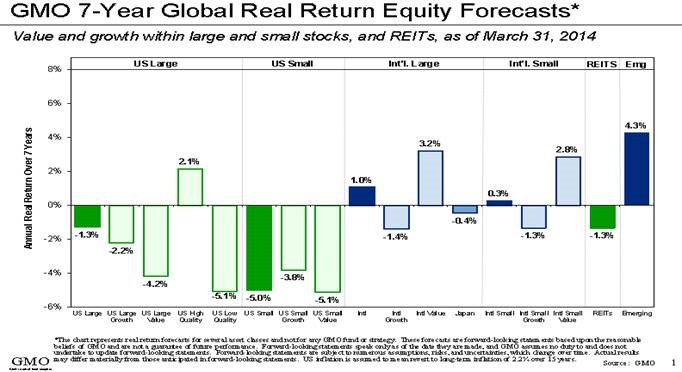
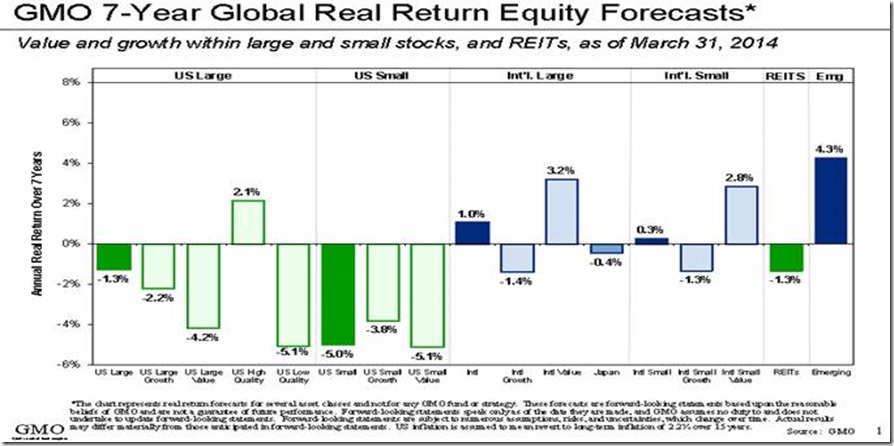
GMO came out with its most recent 7-year forecast for various asset classes and equities. It ain’t a pretty picture. These guys have consistently nailed their forecasts, especially for equities. They’re predicting negative returns essentially across the board of various sectors with pockets of relative strength in Int’l value, US high quality, and emerging markets. Observe the drilldown:
clip_image002

Why do you think this forecast is so negative? It may be valuations, but I think it’s because they see a major dislocation occurring within the next 7 years. This dislocation will cause most sectors to lose money over the specified time period. And of course depending how one is positioned, losses can and will be a lot worse than what is depicted in the chart. GMO will never reveal the secret sauce, so to speak, behind their methodology in determining their 7-year forecast. It’s probably safe to assume they use an amalgamation of various data inputs involving valuation, macroeconomic outlooks, interest rates, monetary trends, geopolitical trends, and so forth.

You don’t need to be able to reproduce the forecast in order to trust it. Knowing that this is how GMO perceives equity market returns going forward, one really needs to be conscious with their long-money portfolios. This is a message I have been consistently sharing over the past few articles, so let’s visit a few severe distortions that may have a major effect on equity markets within the next 7 years.

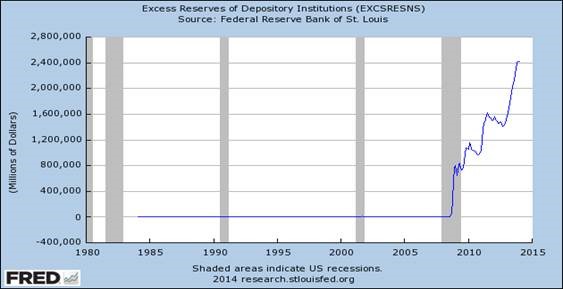
The first distortion is excess reserves maintained at the Federal Reserve. This first chart is to show how ridiculously large this number has grown to, which is now in excess of $2.4 trillion. That’s the cumulative and collected excess reserves of the banks who collude conduct business with the Federal Reserve.

clip_image004

Notice how before 2007, the amount was virtually zero. I realize this chart only goes back to the early 1980’s, so here’s a “Discontinued Series” chart that the Fed previously utilized to report the excess reserves. It goes back to the 1950’s and shows the same virtual zero in excess reserves as the normal course of business. That’s right, up until the Great Recession the amount of excess reserves held at the Fed was in the single digit billions. That’s basically zero. Since 2007, it has been a different story entirely.

clip_image006

For the uninitiated regarding excess reserves, I want to provide a relatively brief explanation. For the reader with an already good grasp, I apologize for any redundancy. The excess reserves were at virtually zero for all those decades because the Fed never paid any interest on them. Then in response to the entire financial world sitting on the precipice of obliteration, a multi-part plan was instituted in order to maintain the status quo and keep the entire system intact. The federal funds rate was dropped to zero where it has stayed, interest began to be paid by the Fed on excess reserves, and the process of quantitative easing(“QE”) was illustriously birthed.

The federal funds rate was dropped to zero so as to stimulate the economy in the face of certain deflationary doom. The book is still out on whether the US has seen true economic improvement due to ZIRP. What we do know is that savers are being heavily penalized by this policy and investors of all ilk are being forced up the risk ladder in increasingly desperate attempts for yield. The paying of interest by the Fed for excess reserves is one of the Fed’s tools for maintaining interest rates where they want them. It also just so happens to be able to provide a colossal liquidity buffer for the so called balance sheets of the participating banks i.e. Wall St.

Between the erroneously valued derivative books across the entire industry and jumbled collateral chains, the participating banks and the Fed think they’ve built an adequate buffer to potentially withstand additional impairment to balance sheets. And why shouldn’t they? They’ve got everything under control because now they can taper QE. Quantitative Easing was established to fight both fronts of the policy as a tool to reduce long-term interest rates while also stimulating the economy. Do you feel like the economy is stimulated? I know one thing for sure that has been stimulated and that’s asset prices. Take a moment to yourself and remember how this story has played out for the Weimar republic of Germany, recently in Zimbabwe, and even more recently in Venezuela.

Wondering why it matters so much that the banks keep their excess reserves at the Fed instead of productively using them within the economy? It’s because the money is essentially free. When the Fed monetizes its debt and buys assets such as MBS, it creates an asset on its own balance sheet and a corresponding liability. That liability is the excess reserves that belong to the TBTF banks who are the Fed’s main partners in facilitating QE. The banks keep those excess reserves with the Fed because why would you give away your gravy train and expose it to more unnecessary risk? The Fed pays 0.25% on excess reserves. May not seem like much, but 0.25% on $2.4 trillion equals $6 billion for the biggest banks to collect risk free in interest income.

If you were a bank CEO and knew you had derivative exposure that could single-handedly dismantle the system, would you kill the golden goose provided by the Fed? The proof is already in the pudding as the velocity of money is cratering but has had no material effect on our economy thus far. There’s no velocity of the money supply because banks aren’t lending out to businesses and households. Sure large corporations have been able to finance buy-backs and special dividends but capital expenditures have yet to reach a point of acceleration where we know some good economic tidings are bound to follow.

In the chart below, I’ve overlaid the rise of the excess reserves vs. the velocity of the M2 money supply.

clip_image008

If that’s not a chart yelling out for some mean-reversion, then I don’t know what is. So what are some triggers to increase velocity and why does it matter? An increase in velocity matters because that price inflation that everyone was so scared of during the beginning phases of TARP and QE, could finally begin to materialize. And this could hamstring any efforts to get the economy breathing on its own without the use of a respirator. As far as a trigger to generate velocity, it would take the Fed no longer paying interest(like they’ve almost always done) or even charging to hold excess reserves. The participating banks would immediately withdraw that $2.4 trillion in cash and put it to work. Where? Businesses and households. If those dollars hit the economy in a flood over the course of a year or two, we could see some scary jumps in asset prices that matter and not just fine art and collectible cars. Not to mention, there’s still all that cash that the mega-corporations keep parked internationally. If the US were to shift tax policy for this money and it were to be repatriated and spread around the economy, we could be talking about a doubly increase in money velocity.

The Fed knows this and you would think they wouldn’t be dumb enough to cut off their nose to spite their face but the Fed is backed into a corner. Additionally, the Fed has to answer to its political masters all while managing the world’s perception of America’s currency and economy. This is a dangerous game being played right now, as after 2008, Fed policy entered the realm of pure experimentation.

Would the Fed have maintained these policies this long, which are causing massive economic distortions, if the economy had really reached escape velocity or at least was well on its way? Let’s revisit interest rates, the second massive distortion. Gary Tanashian, with his Notes From the Rabbit Hole newsletter, provided an elegantly simple chart putting on full display the lack of efficacy of the Fed’s ZIRP policy to have any material effect on the economy. Below you’ll see the 3-month T-bill yield($IRX) overlaid against the S&P 500 index($SPX). You can see in the past 20 years that as the economy and markets picked up, the Fed would subsequently raise interest rates. That is completely normal policy and has been consistently used for decades.

clip_image010

But as you can see in the chart, where’s the rise in rates? The correlation of the two are generally fairly strong. Oh, so our economy is not genuinely approaching a growth level that warrants a raise in interest rates? These are the results of the great financial experiment, of which we are all a part of the double-blinded no placebo study that’s about to have a phase 3 letdown in the next year or two.

The Fed has been able to subvert a normal business cycle by reflating on demand through interest rate policy and monetary policy. That last doozie back in 2008 should have seen the destruction of several industry giants and the Fed wasn’t ready to allow that to happen in America. I get it. The pain and suffering would probably have been unspeakable and potentially worse than the Great Depression. When you combine the fact that the developed countries are so interconnected, the US didn’t want to single-handedly bring down the entire world’s economies. All that being said, the tricks to perpetrate the subversion of normal business cycle forces have been used up. You can’t drive interest rates any lower. You can’t print even more dollars and expect sufficient potency. Hence, the notion that the Fed is backed into a corner.

As far as impact to the market, I read a simple statement over at Economicnoise.com, that sums up the good fortune the Fed has had in driving up market prices in an attempt to drive the wealth effect while building animal spirits. Economicnoise.com stated, “Within the last fourteen years, there have been two major market corrections, both of which saw drops of 55% from their highs. That, or more, is the potential for what lies ahead…but next time the government is unlikely to be able to re-inflate the stock market bubble. To put into perspective how lucky (investors have been), it took 25 years for the Dow Jones to recover to its pre-crash highs after the Great Depression. Likewise, the Dow hit an intraday high of 1,000 in 1962 but never closed above 1,000 until about twenty years later.”

These distortions are what the doomsday types, Austrian economics practitioners, goldbugs, and similar minded types have been seeing and simply can’t seem to shake off. The team at GMO has never been labeled as any of those types; only true professionals’ professionals in the game of capital allocation. Below is the other chart in their 7-year forecast and it covers multiple asset classes as opposed to just equities.

clip_image012

The granddaddy winner for the next 7 years is timber, according to them. So forget about investing. Go cut some trees down. Chop’em up and store them in your house. Over the next 7 years that wood will have outperformed your 401k. Lame jokes aside, there are a few ways to easily make a play on timber. There are of course the biggest North American players such as Plum Creek (PCL), Weyerhaeuser (WY), Rayonier (RYN), and Potlatch (PCH). If you prefer ETF’s, there is iShares Global Timber & Forestry (WOOD) which focuses on North America and thus has significant positions in the largest players here. For more of an international flare to your timber exposure, Guggenheim offers its own Timber ETF (CUT). A cursory glance of CUT’s holdings will show that it focuses its holdings around the planet as opposed to N. America.

Since the average joe can’t simply invest in huge plots of timber like a hedge fund, endowment, or pension fund, then these are decent options to play the sector. PCL is the biggest of the N. American group and thus has a well established reputation on the street. However, friends and old colleagues will already be familiar with what is probably my favorite way to garner some timber exposure, and that is through Brookfield Asset Management. BAM! Remember though, at the end of the day these are still equities and have the potential to be pulled down with every other sector in the event of a sell-off or major dislocation.

Comparing Plum Creek to Brookfield Asset Management is not exactly an apples to apples comparison, as Brookfield is a massive asset manager focusing on real or hard assets with a portfolio approaching $200 billion. Plum Creek possesses the largest portfolio of timber acreage in N. America, so their market capitalization is justified. PCL carries a timber portfolio worth approximately $5 billion. Brookfield’s portfolio of timber acreage is significant in real terms but small compared to their entire portfolio. BAM carries approximately $4 billion worth of timber assets, and that is after selling approximately $2.5 billion worth of timber assets last year to Weyerhaeuser. BAM will monetize assets when appropriate. They don’t hold just to hold, however they’re considered some of the finest value investors in the world when it comes to real assets.

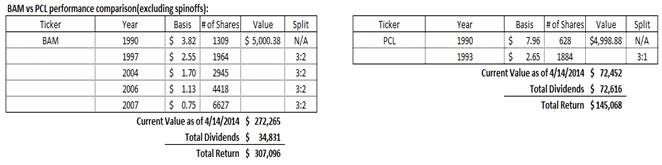
Let’s take a side by side look at long-term performance of each company since 1990. We’re using 1990 as PCL was founded in 1989, so I wanted to give it a year of operations under its belt for comparison purposes. The following chart compares the split adjusted values of each stock starting with an initial $5,000 and includes dividends but excludes the two spin-offs(BIP & BPY) from BAM.

clip_image014*Dividend data garnered from Dividata.com

You can see that BAM’s long-term performance speaks for itself. If you account for BIP & BPY, then to me it appears to be a no-brainer between the two for long-term exposure to timber. PCL’s dividend is vastly bigger, so if an investor needed that higher yield for whatever reason then it would make the decision of choosing between the two a little tougher. Overall though, if you want some timber exposure in combination with other world-class real assets then BAM is a heckuva way to play it.

Valuations matter. Momentum can be ridden, but in the end a stock’s price will revert to an appropriate valuation after momentum has made investors lose their collective minds. GMO’s forecast is not to be taken lightly. It’s just another recent indicator that should really make investors pause and think before allocating capital. I tend to concur with old Uncle Warren in that it’s not usually a safe bet to bet against America, so I promise that I’m not a total gloom & doomer here at MarginRich.com. These economic distortions, just a few of so many, are communicating a signal that America and really the world’s developed markets could find themselves in some pretty rough seas in the not too distant future. Invest accordingly.

The Potential Depth of the Corrective Action

Markets’ darling leaders sell off? Check. Defensive sectors rotate up? Check. Seasonality coming into play(if you believe such stuff)? Check. S&P 500 VIX spiking? Not check. We have yet to see the S&P 500 really start to come down off its highs for the year just yet. Although, the market action has probably felt terrible for those heavily weighted to the NASDAQ, we have yet to see some heart-wrenching downside action in the S&P 500.

SentimentTrader just shared a note about the lack of volatility in the VIX and the downside potential in the S&P 500, “There have only been two other times in the past 20 years that the Nasdaq Composite had dropped more than -8% from its 52-week high, but the VIX “fear gauge” was still below 17.5, a scenario we have now. It shows relative complacency in the face of a sell-off in higher-beta stocks. Those two occurrences were March 28, 2002 and May 15, 2008. The S&P 500 sold off more than -15% over the next three months both times.

As usual, the statistics suffer from a small sample size within a relatively short period.

However, the facts are the facts.

Add in that earnings season has been off to a fairly weak start and you have that much more evidence to make you pause and consider before allocating more long capital right now. For any readers who are EPS hounds and swear that stocks always follow earnings, here’s a snapshot courtesy of Thompson Reuters’s Alpha Now that also supports a pause in the action through the spring and potentially summer.

S&P 500: EARNINGS AND REVENUE GROWTH TREND

clip_image002

And to keep my confirmation bias fully intact, here’s a snippet from Louise Yamada courtesy of CNBC. I can’t believe I’m quoting material from the hack-shop CNBC, but Louise truly is a legend in the institutional research side of technical analysis. Anyways, she states, “I don’t think the pullback is already over. I think that it’s an interim pullback, and we’ve certainly seen what we’ve expected, in the Internet and biotechs coming off. And I think that although they may bounce, there’s probably still a little bit more to go on the downside…If we break that level(1,750 on the S&P 500), that will be the first lower low that we would have seen all the way back to 2011, really…Below 1,750, support lies at 1,650.

If we hit that 1,650ish area, then that’s approximately 10% to 12% off the highs for the year. But who’s to say we have to have a minimum 10% correction? I’ve been calling for that level of correction to clear things out a bit in the market. Many other commentaries have also focused on the need for at least a 10% correction in the S&P 500 to work off overbought levels.

Richard Dickson, Chief Market Analyst at Lowry Research, recently gave an interview at FinancialSense.com providing his outlook on the “need” for a correction of at least 10% in the S&P. If you’re unfamiliar with Lowry Research, they are one of the true OG’s in the game of institutional level technical analysis and the oldest firm in the US to provide such services. Dickson stated that:

We’ve already had two corrections well over 10% from 2010 to 2011 in this bull market and, historically, if you go back and look at the various bull markets and use the Dow Jones on a closing basis, we’ve never had more than one 10% correction in a bull market… Since 1940, we’ve never had more than one, so this has been a little unprecedented in the fact that we’ve already had two. So, to say “well, we need another one”…my response to that is we’ve already had two, how many do you want?… As things stand right now, any pullback, whether it’s 5% or 10%, in our opinion, would simply be a buying opportunity.

So there you have it. Buy the dip according to Dickson.

Still though, want some basic ideas on how to play some downside action? Buy VXX or leverage it up and buy some Calls on VXX. You can buy some Puts on the SPY or eliminate the risk of purchasing the optimal option and purchase the 3x leveraged SPXU from ProShares. It may be a little late, but utilities ETF’s such as XLU have been the home of the defensive minded for several weeks now. The typical disclaimer applies regarding your own trades.

I intended to share some thoughts and charts on the serious distortions to the financial landscape, as stated at the end of my last post. My apologies but you’ll just have to wait till the next post again, where I will definitely talk distortions. I promise. Bis spater.

Analogous Equities Markets – 1970’s & 20Teens

Secular bull? Or bear about to do its thing on “unsuspecting” market players? These are questions making serious rounds on the world wide interlinking-web. That’s because fear sells and nothing gets eyeballs and clicks for the user-ravenous financial sites like some market-topping bear talk.

If you were alive and investing in the 70’s, or like myself, have read up on the stock market action of the 70’s then one can see how similar the two time periods seem to be acting(at least in the S&P 500). Don’t worry, I’m not about to hit you with yet another comparison chart of some calamitous US financial event laid over current action. Instead, I’d like to share some work by Lance Roberts. For the record, I like those comparison charts but I also take them for what they are…entertainment. At best they’re another useful input and at worse they’re just noise.

If you’re unfamiliar with Mr. Roberts, he consistently writes compelling market pieces. I happen to think he’s one of the more under-appreciated financial commentators on the web right now. He’s the co-founder and general partner of STA Wealth Management. Earlier in the year, Mr. Roberts shared some graphs comparing current times to the secular bull formed in the 80’s and the fakeout in the 70’s. At STA they definitely have Austrian economic tendencies in their communications regarding the markets, and so obviously can lean toward a more bearish stance at times. Or as other Austrians call it, just being realistic in light of all the economic data readily ascertainable.

They have significant assets under management of approximately $500 million to $600 million, so these guys are the real deal. Specifically, they focus on the client who possesses low six-figures to approximately $5 million in capital, so they’re not exactly whale hunters. STA feels that market is an underserved niche of wealth management. I’m not trying to plug their services nor do I have any relationship with their firm. Like other commentators or service providers I include in my posts here at MarginRich.com, I’m fairly certain STA doesn’t even know this blog exists. I just want to share with my readers another financial blogger whose work I really enjoy. You can also find work by Lance Roberts at Advisor Perspectives, home of dshort.

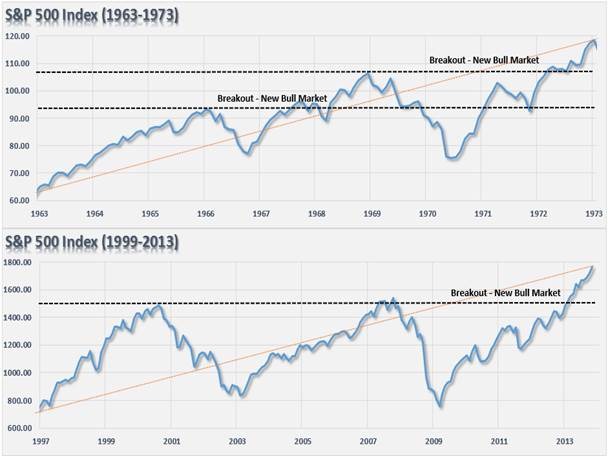
Now back to the charts Roberts shared in January. The first one shows a direct comparison of the current period to the false breakout of the late 60’s into what looked like a new bull going into 1973.

clip_image002

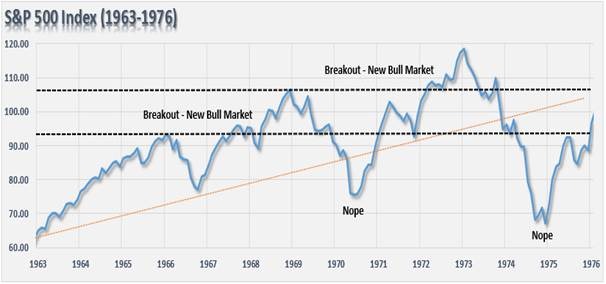
As we all know, The recession starting in 1973 was one of the worse times to be in the stock market in its history. The next chart shows the S&P’s performance and the realization of the false hopes for investors during those time periods.

clip_image004

Sorta looks like the decade of the Oh-Oh’s, except the action up to 1973 produced higher highs. As opposed to what we experienced in 2000 and 2007 in the S&P 500 with virtually equal tops. The reason for that was obviously all the capital was pouring into the NASDAQ in 2000.

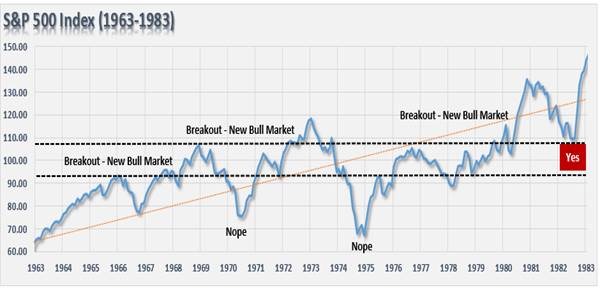
Moving on to the last chart. Roberts shows the total picture with the final washout in 1981 and the true beginning of the 18 year mega-secular bull market that helped to explode the growth of the mutual fund and retirement investing industries. Of course there were up’s and down’s during the real secular bull, but boomers blessed with the easiest time to make buy and hold gains during peak earning years helped to build the academic case of always investing in stocks for the long run. Not that I want to get into any philosophical debates on investment strategies or the level of difficulty of investing through the 80’s and 90’s. I use the term “easy” through the lenses of hindsight.

clip_image006

The point of sharing these charts is to increase awareness that this 5 year run that America has been on off of the 2009 lows, may not be the start of a real secular run like we saw from 1982 to 2000. In 1982, the conditions were more like a final “cleansing”, so to speak. The new CEO of America was instilling a lot of genuine hope and assuaging genuine fears with genuine actions, not lies or baseless rhetoric. Valuations were exceptionally low with single digit P/E’s and very enticing dividend yields across the market. Price inflation had been beaten back by the last semi-responsible Fed head.

Simply put, these are not conditions that exist today. In fact, the exact opposite of each of those conditions exist today. I understand that the music is playing but do you want to keep dancing? Conditions are decidedly different due to deep distortions across the financial landscape. But hey, I’m only one voice of many and if you’re one of plenty of people(including professionals) who think we’re in the midst of a secular bull market, then by all means keep putting new money to work. However, even if you’re dollar cost averaging and you don’t believe in “timing” the market, now may be a time to build your cash levels.

Don’t just take my word for it. In a previous post I cited some thoughts shared by Seth Klarman and Jeremy Grantham. They each communicated their fears of the frothiness of these markets but that the markets will continue to move higher before an inevitable bust. Now the inimitable Howard Marks has essentially shared the same sentiment in his latest Memo From Our Chairman. Collectively, these 3 gentlemen help oversee more than $200 billion in assets under management. In addition to their combined multiple decades of experience, their respective savvy has made each of them billionaires. Now if scions of the investment world such as these fellas are telling you to be cautious, do you really want to be the rebel without a cause out there allocating your capital based on the premise that trees DO grow to the sky?

Look I know the path of least resistance for the markets is up and I’ve reinforced that in previous posts. It’s just that based on the distortions, it really feels like a reckoning is coming. And just some basic cycle research yields a time table of approximately 12 to 24 months from now for some potentially tough times as an investor. I’m not talking about exiting the markets entirely. I’m talking about raising cash levels to be prepared when the real values potentially present themselves and minding your stops. Next time I’ll share some hopefully enlightening charts and thoughts on those aforementioned distortions.

Correction Starting or Continued New Highs

Nowadays, you can’t go a single day without reading a financial opinion about how a major dislocation is imminent or that the economy is on the mend and this generational bull is still intact. The fact that the US stock markets have been so choppy to start the year has confused not only some columnists and bloggers(myself included), but some professional money managers as well. As I stated a couple of posts ago, there are plenty of short-term signals showing that now may be time to show caution. On the other hand, long-term price action does continue to show strength and the bull fundamentals do not appear impaired as the path of least resistance for the markets continues to be upward.

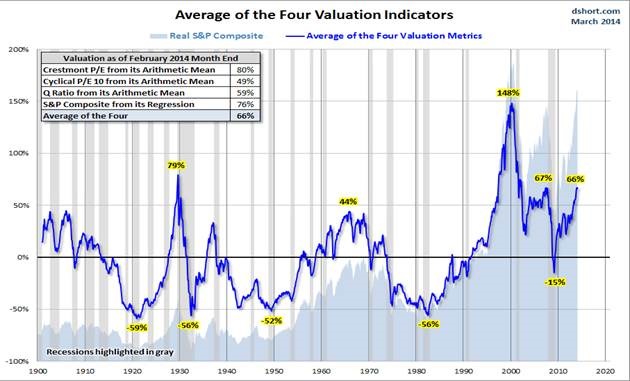
Depending on what measures you favor, valuations can appear a bit stretched currently; especially in the biotech and social media sectors. Doug Short, over at Advisor Perspectives, provides a monthly update of the chart below. Chris Kimble, of Kimble Charting Solutions, likes to add his own flair to it every now and then as well. The chart takes an average of four popular means of determining valuation for the S&P 500:

clip_image002

So based on this chart, we’re rapidly approaching 1929 levels of overvaluation of 79%, already passed the late 60’s peak of 44%, and are right back to 2007 levels at 66%. Do I think a soul crushing dislocation is imminent? Not at all. The chart also shows that things can get a lot more frothy ala 2000 and its 148% overvaluation level for all things dot.com and tech. Jeremy Grantham, via a recent Barron’s article, agrees that the market is 65% overvalued currently but that it would need to rise another 30% before he would consider it true bubble territory. For the arithmetically challenged, that puts the S&P 500 over 2,300. So according to J-Grizzle, there’s a lot of dancing left to do while the beat keeps bumping.

The S&P 500 hasn’t seen a correction of any real significance in about 2 years. When you throw in the fact that this bull recently turned 5 years old, nervous traders start to think that we just gotta see something to the downside soon. Maybe. Maybe not. Maybe f@$# yourself. My theory on the market is that it’s like a little kid. Feed it a bunch of sugar and watch it run like crazy. Thank you, Marky Mark. Despite the tapering, the Fed is still plugging a ton of sugar monthly into treasuries and MBS to keep these markets liquefied and rising.

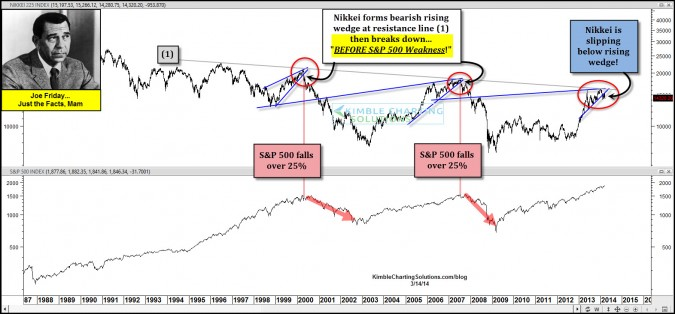
I already went on the record stating that I thought we could see downside action all the way to the 1,650ish area, which is approximately 12% off the highs. Kimble provided a chart last Friday showing the long-term action correlation between the Nikkei and S&P 500 since 2000. Observe:

clip_image003

So if the action is to be believed, then watch out. BUT WAIT! The S&P 500 is breaching all-time highs. Aside from risk management, buying into strength is a common message you’ll read in any and almost all of the great trading books. Well Goepfert at SentimentTrader shared some thoughts on the current price action too, “On Thursday, the S&P 500 rallied more than 0.5% to close within 0.5% of a 52-week high, yet more stocks declined than rose on the NYSE. That shows a lack of broad participation, despite a couple of important sectors (semis, financials) doing extremely well and breaking out to new highs. This has occurred 24 other times since 1940, and the S&P has struggled in the weeks following.”

Add to that biotech, a sector leader and market darling, is starting to show some real weakness. I think biotech is an easy short here using BIS or buying some Puts on a market leader such Amgen or Gilead. On a different note, there are some commodities now showing weakness as well. Coffee has been ripping in 2014, but this week has seen that momentum stopped in its tracks. It may just be a breather before it continues higher or it may see further downside action to eat up a nice chunk of those “easy”, early returns. The coffee ETF, JO, is an adequate proxy for those looking to trade the action without dabbling in futures. Either way and despite the current price action, my favorite indicators say that it’s not quite time to go short coffee yet. If they do give a signal, then it’s possible to see gap-filling action(on a weekly chart) all the way down to $28 or possibly $25 depending on the momentum.

Whether you lean optimistic or pessimistic is irrelevant. If you’re trading, then mind your stops. Managing your risks is all important.