Don’t Forget to Read Prem Watsa’s Shareholder Letter, Too

Like many other experienced investors, I appreciate the value of a high-quality insurance operation. Berkshire Hathaway is the gold standard in this industry from an investment standpoint and the recent 50th anniversary shareholder letter was widely commented on throughout the financial realm. It’s not as if the Berkshire family of insurers are the absolute greatest underwriters in the world. They simply have such grand size and scale in combination with enough discipline to continually underwrite at a profit which continues to provide Warren and Charlie with a ridiculous level of float to continue their intergalactic wheeling and dealing. Yeah, I said intergalactic, as in, Berkshire’s about to close a deal for part ownership of Ganymede, Jupiter’s largest moon. Rumors are swirling that Lemann and the boys at 3G will front most of the capital while Warren obtains the preferreds on the newly discovered salt-water bodies.

Much ballyhoo is paid to Buffett and deservedly so, however, Prem Watsa who is his much smaller counterpart up in Canada also provides a must-read annual shareholder letter. Watsa runs Fairfax Financial which has long been considered a “Baby-Berk” and you can scour the web to find countless articles on them. I’m not writing today to conduct a deep-dive on Fairfax. Feel free to dig into their old letters and annual reports for that. I just wanted to share a little content from Watsa’s most recent shareholder letter in light of all the press that W.B. and C.M. received for Berkshire’s. Watsa is a well-respected value investor who is often criticized for his asset allocations but he almost always has the last laugh.

Watsa’s letters are filled with quality analysis on current economic and market goings-on. Does he explain his whole playbook? Of course not, but he shares enough to make you consider your own stance and allocations. Many consider Watsa’s skills to be right up there with any asset manager alive. I thought I’d share what are a few important notions from his most recent letter, which was released at the beginning of March. Full disclosure, I’m a long-time and current shareholder in Fairfax Financial.

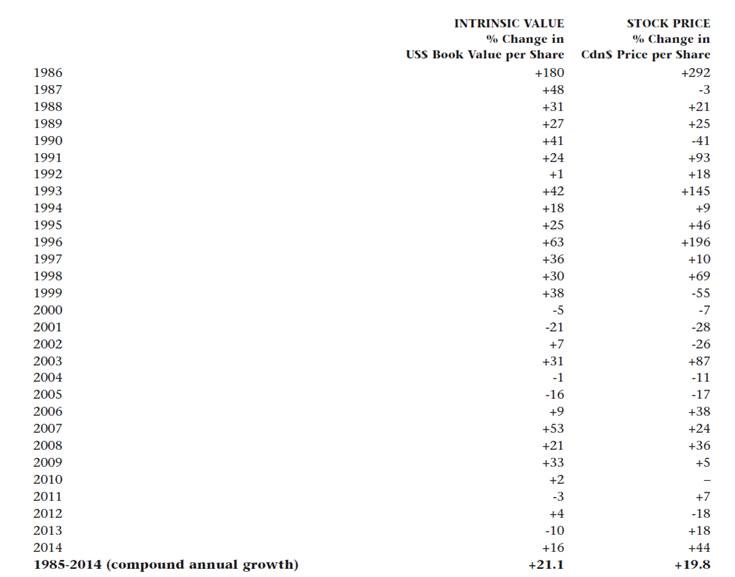
First, I’d like to display the Fairfax CAGR in Book Value as well as Share Price:
clip_image002

Holding a stock that had a 20% CAGR in the share price over the last twenty-nine years was an easy way to become wealthy for anybody who happened to have been smart enough to have purchased shares and held them. I, unfortunately, am not one of those smart persons. Aside from all the usual valuation metrics and models for the seasoned investors to analyze, at $545/share(USD) the investing novice can pick up some shares and let Prem work his magic for hopefully another 15 to 20 years. Watsa turns 65 at the end of the summer and he’s long said he does not want to work into his 80’s, but obviously we’ll have to wait to see what the future holds. It’s very difficult for a successful business person to just hand over the reins of their babies which they’ve built from nothing. I don’t see Watsa casually walking away from Fairfax just because of age. As long as his mental faculties allow him, I see him running Fairfax.

Watsa has done a brilliant job acquiring add-on insurance and reinsurance operations around the world to expand Fairfax’s international footprint. Additionally, he’s shuffled and empowered managers to tighten up underwriting standards across all lines. The result has been a significant increase in operating profits.

clip_image004

You can see that just a few years ago, Fairfax was underwriting coverage at a loss across multiple subsidiaries. Only the discipline at their largest revenues source, OdysseyRe, allowed them to maintain a combined ratio under 100% in 2012. For any readers who are not fully aware of how profit reporting works with insurance companies, if an insurer or reinsurer has a combined ratio of 100% or higher, then the company is underwriting policies at zero profit or a loss. It’s what’s called a lack of discipline and even if the CIO has tremendous investment results, consistent underwriting at a combined ratio over 100% is a sure-fire way to insolvency.

This trend in the combined ratio is a very positive development and I look forward to a consistent number in the low 90s or even 80s.

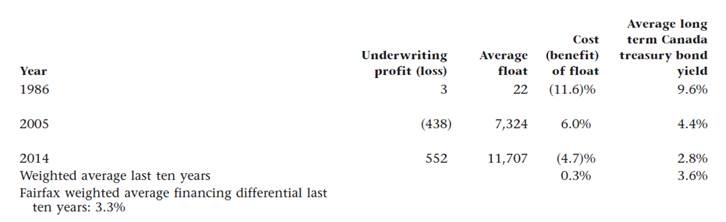
Arguably, the most important component of an insurance business to analyze is the float. Watsa has been very forthcoming about Fairfax’s float levels and how the float has positively affected the company’s “cost of capital” to invest. Disciplined underwriting allows Fairfax to essentially be paid to let one of the greatest investors in North America to invest it’s capital. Observe the following chart depicting some of Fairfax’s long-term float performance.
clip_image006

In Prem’s own words, “Our long term goal is to increase the float at no cost, by achieving combined ratios consistently at or below 100%. This, combined with our ability to invest the float well, is why we feel we can achieve our long term objective of compounding book value per share by 15% per annum. In the last ten years, our float cost us 0.3% per year – significantly less than the 3.6% that it cost the Government of Canada to borrow for ten years.” A negative number under “Cost (benefit) of float” means that Fairfax was paid to invest. That number is a return on float investment, which over the last 10 years, takes the average cost of investment capital to damn near zero.

For a deeper dive on the importance of the positive carry on float, have a read of Berkshire’s most recent shareholder letter if you haven’t already. Additionally, Porter Stansberry has produced a multitude of fine analyses on the value of quality P&Cs effectively managing float.

Like Berkshire Hathaway and even Markel, Fairfax has a bevy of non-insurance related public and private equity investments with the most well-known being Blackberry. You can read the entire letter or the annual report for the details on those businesses. The last part of the shareholder letter that I wanted to touch on is the equity hedges and Fairfax’s derivative book.

clip_image008

On the surface, it would appear as if Prem’s portfolio hedging decisions have been less than successful. These are mostly non-cash losses though as a majority of these are simple write-downs and not actually realized losses, but the cumulative impairments since 2010 are substantial. However, we saw the same thing leading up to 2007 – 2008. During 2003 – 2006 while credit was flowing out of every orifice on the earth’s surface, Fairfax suffered significant unrealized losses on their hedging program. Then 2007 and 2008 came along to make Prem look like a genius.

clip_image010

Look at those outsized gains. Watsa’s multibillion dollar winning bets paid off huge during a time when even the smartest investment players on the planet were sitting around slackjawed questioning the great existential philosophy of what it means to be an asset manager.

Although the losses are primarily unrealized, it also means that Watsa may have positioned too largely and too early. Not only does the hedging program require mark-to-market revaluation but there is also the cash outlay for the payments of premiums. It is clear Watsa feels he has been exercising prudence here despite possibly underestimating the impact of central banking on the investment world. I won’t begrudge him though, because what is more important, is that Fairfax is seeing a shift in the value of their hedging program. The trend is already beginning to move upward.

clip_image012

Notice how there was a slight improvement in 2013 and a doubling in value in 2014. This may be a precursor to broader market conditions as we saw the same thing leading up to the Great Recession. First, the valuation of the hedging program starts shifting positive and then the early bets pay off in spectacular fashion. It’s definitely something to keep in mind as you continue to invest in today’s markets. I would not discount the fact that Fairfax’s hedge book is beginning to increase in value.

Prem Watsa has earned the respect of everybody in the world of investing. He stomped out short-selling hedge funds via the legal system back in the 00’s. He’s grown Fairfax from virtually nothing into a highly successful international insurance conglomerate. His investment results, although admittedly choppy by Watsa, are legendary due to the big scores. Have a read of the recent 20 page shareholder letter. It’s fairly easy to digest and you get a very honest assessment of Prem’s current view on the investing climate. As Munger would indirectly say; read, read, and read some more.
American Assets Discounting European Politics

Last summer, I shared some thoughts on the stock markets’ abilities as a discounting mechanism for future events. The gist was that stocks may provide a murky read some times when it comes to prophesying.

Reading the current macro signals is a tough endeavor for any speculator, and with today’s volatility, all the more dangerous when making bets based on those signals.

That being said, I get the feeling that last week’s action in some of the rate-sensitive sectors in combination with general stock market consolidation is portending a positive outcome in the Greece/Europe situation. Bear in mind these thoughts are pure suppositions based on nothing more than a hunch. I’ve been wrong before. I’ll be wrong again. As the old Soros saw goes, “It’s not whether you’re right or wrong that’s important, but how much money you make when you’re right and how much you lose when you’re wrong.”

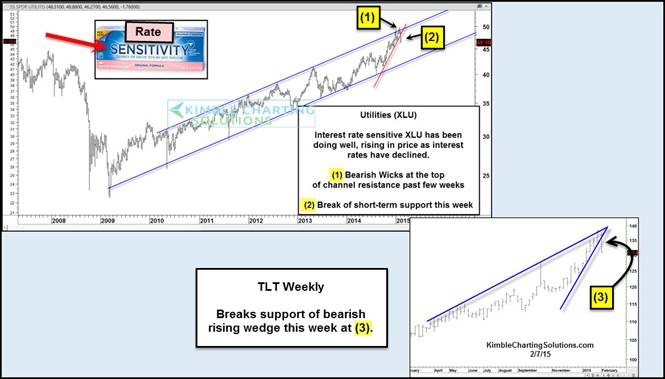
Kimble recently provided a long-term view of two key sectors.

clip_image002

We’ll revisit the impact of the breakdowns in those sectors, but the whole world of finance is focused on the potential resolution of Greece’s debt-financing problems. We have Goliath, the Troika(ECB, IMF, and European Commission “EC”), attempting to dictate the how, what, and when to David aka Greece. Right now a political game of poker is being played with the potential for worldwide ramifications. Greece’s new management is playing the hand it’s been dealt in what appears to be a very transparent fashion. Basically, they’re happy to stay in the euro as long as fair terms are met in a reworking of current debts to the Troika.

The Troika, god I hate saying that word but it does beat out typing the three entities, is really trying to play hardball with Greece but they have no leverage. None. Ok, maybe the smallest amount; just to play chicken. In my estimation, 98% of the leveraging power belongs to Greece. Dijsselbloem, EC head finmin, and Schauble, German Minister of Finance, have both been bellowing the fiery rhetoric from the tops of their lungs, “Greece better pay or else!” Or else what? They’re going to let Greece depart the euro? Ok. Yeah, sure.

Greece isn’t going back to the drachma in an exit from the euro, at least not this year, because the markets would be roiled. There are simply too many things that could go wrong to upend the European status quo for a Grexit to happen. Let’s just logically play out a generic sequence of events. Europe can’t let Greece totally default. For the owners of Greek debt and of course credit default swaps on the debt, credit events would be triggered across a multitude of financial institutions which could in turn then trigger counterparty liquidity risks which would instantly panic the financial universe. This instant panic would hit all the developed stock markets but with a focus on the European stock markets, which would negate the positive effects of the trillion-euro QE plan before it even had a chance. Too me, that’s enough to know that even if the deadline for a Greek debt resolution is pushed out, it’s still going to end with Europe caving but in a manner which saves as much face as possible.

Germany’s account surplus is so ridiculously large that I don’t really think they are going to tell Greece to go souvlaki itself. German total employment is high and exports continue to be robust. Pushing Greece to exit the euro would create an environment of fear where recession could rear its ugly head at a time when German companies are rolling. While Greece has all the appearances of being the linchpin holding the euro together, they’re really just a very, very important lugnut. Italy is the real linchpin. Their debt has the potential to topple the world. Which is why Europe doesn’t want to easily concede to Greece and open the door for Italy to dictate revised terms of its sovereign debts. Aside from Italy, there is obviously still Spain, Portugal, and Ireland; but Italy is the megaton nuke that can change everything.

Aside from the financial obstacles for Europe, there are the more important political complexities that must be addressed in pushing Greece too far, too hard. Russia has already extended an olive branch for Greek funding and Greece officials are reporting that China has now offered a helping hand. The world knows that China possesses the funds to help provide a financial backstop for Greece. I suspect the world may doubt how much funding Russia can lend in light of its own domestic problems concerning the ruble’s decline alongside oil’s rout. I contend that doubt would be misplaced. Does anyone really believe that Europe would simply push Greece into Russia’s waiting and open arms, where after, Greece will be free to negotiate any number of fear-inducing considerations like the usage of Greek ports for the Russian navy. Or how about land or sea allowances for petroleum energy pipelines. Maybe missile battery emplacements “for protection” on the northern Greek borders.

These are extreme examples as Greece is still a NATO participant, but it is unknowable with which the speed of certain actions could be taken should political alliances be shifted over this money. Consider how fast Russia appropriated the Crimean peninsula. All the angles have to be considered and with Merkel’s established relationship with Putin, I don’t see the Troika being allowed to precipitate negative financial and geopolitical outcomes.

What is difficult to reason, for me at least, is how the US will come to bear its influence in this whole game of thrones. America will have its say on bailing out Greece, but how and where and with what level of impact is a challenging thought experiment.

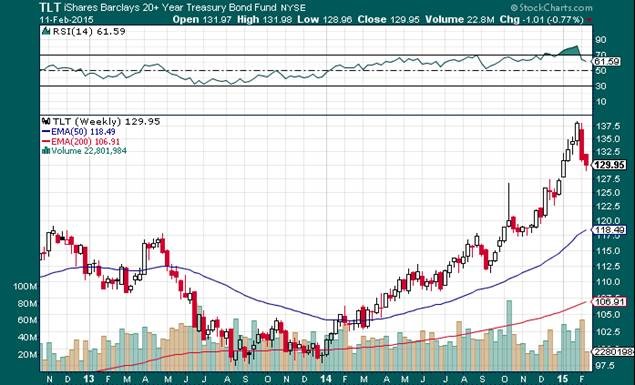
Coming back to American assets and their ability to discount the European outcomes, I think the speed with which the rate-sensitive sectors dropped last week are the tell-tell signs. Examine the two following weekly charts of TLT and XLU.

clip_image004

After a stellar run in 2014, that was a precipitous drop last week. The overall trend remains up, but the situation is very fluid as we have to consider the interrelationships between markets, especially the dollar and implied volatility across Treasury yields.

clip_image006

A familiar market adage is that Utilities tends to be a precursor for the greater stock markets. Any correlation is possible at any given time in the markets, however, we live in an age with remarkable volatility across asset classes. Thus, old interrelationships that once used to prove semi-reliable, may just not be so consistent. I think the Utilities, Treasuries, and yields are telling us that the general market environment is about to go risk-on with another leg-up in the greater stock markets.

There has been no shortage of writing on the significant perils in the market. I have read many a sound analysis that a major dislocation is “near.” But that’s the problem with using a word like “near” or any of its synonyms. Near is a relative term. It’s a word that gets used in a sentence and can mean anything from 1 day to 3 months to 2 years or whatever. Most analysts, bloggers, and general market commentators aren’t willing to stick their necks out and provide a more precise timeframe based on their opinions. They just point to a lot of evidence that says it’s “near.”

I agree that the next major leg down in the markets that began with the Great Recession in 2008 is near. I’ve long-stated that I thought 2015 – 2016 were going to be the years that major catalysts presented themselves for an epic sell-off, but I don’t think that time is upon us. I’m convinced that the markets will draw in a lot more participants first. I want to get that 1999 and 2007 feeling first. You know the feeling I’m talking about; that feeling that the markets will never go down and speculating in the stock market is a can’t lose venture.

The danger of deflationary forces is reasonably priced into the markets. Japan is still easing while the Fed is continuing to roll assets and now we have the ECB embarking on a trillion dollar extravaganza. I have read analysis that the efficacy of the ECB’s easing is highly questionable due to negative rates around the continent. I say nonsense. Animal spirits only care about a liquidity buffer to fill voids. Besides in a risk-on environment, yields will rise as higher levels of capital will flow into equities in a sector-rotational chase for alpha.

Risk-on is not mutually exclusive of risk management, no matter what. Countless interviews with billionaires around the world back up the fact that risk management is the number one key to successful speculation and investing. That being said, look for the general stock markets to pick up a little speed in advance of a potential workout between Europe and Greece. In just the last few days we’ve had two US hedge fund billionaires share their opinions on a Grexit. Dan Loeb, of Third Point, thinks there’s a lot of risk associated with these markets and has lowered net exposures across his funds so far this year. David Tepper, of Appaloosa, thinks there is nothing to worry about if Greece exits the euro. He basically stated that there’s a handful of percentage points of loss to worry about, but that the markets are strong enough to overcome a negative outcome. Loeb is prudent. Tepper believes in his analysis. I think the GermansEuropeans will reach an accord with Greece sometime soon(another relative term) and the stock markets will eat it up.

There is still that little matter of the dollar, euro, and their extreme levels in sentiment. Carry trades continue to be wonky in light of the dollar strength. Maintain a close eye on these currencies as they will enhance a risk-on move. Whether you believe the markets are discounting future events or not, there is a persistence of extreme movements. A European resolution with Greece and a shift in dollar sentiment may just provide a profitable environment for stock market participants.

Much Ado About Snapdragon

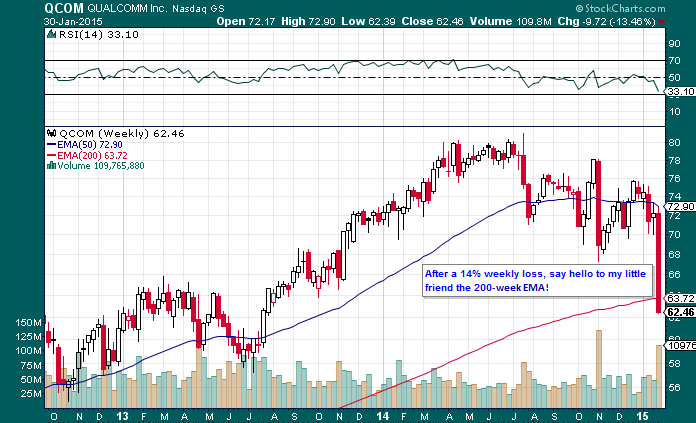
Since the start of the 2nd half of 2014, Qualcomm has had a rough go of it. After peaking at $81.05/share, it’s been all chop and drop. Just look at that massive 14% drop in the share price last week subsequent to beating earnings estimates but confirming that Samsung will drop Qualcomm’s Snapdragon chipset and go in-house with its own proprietary technology for the new Galaxy release.

clip_image001

The loss of that one particular Samsung line caused Qualcomm to lower guidance for 2015 revenues by $800 million. Stop the presses! You mean Qualcomm may, as in possibly but not certainly, have 3% less in revenues than what was projected for the entire year?! That’s definitely grounds for revaluing a business lower by 14% within days, because your valuation models weren’t skewed before and this new information means everything. You have to love the market. It consistently puts great businesses on sale during a year. You just have to have a list, understand the fundamental values, and be patient.

It’s not just the loss of Snapdragon in the new Galaxy and lower guidance. It’s also the uncertainty of the antitrust probes that have been reopened by China, Europe, and the US. Qualcomm’s market-share in mobile technology is so vast that the issue may never be fully put to rest. Countries can and will continue to reopen cases regarding Qualcomm’s trade practices as long as they continue to maintain such a strong hold of the market with their wide-ranging patent portfolio that gives them such a huge cut of the telecommunications action. Reminds me of the scene in Goodfellas, where Ray Liotta’s character explains what it’s like to go into business with the mob. Slow sales? FU, pay me! R&D too high? FU, pay me! Having trouble innovating? FU, pay me! I don’t want to mischaracterize Qualcomm as I truly appreciate their business model, but you get the point.

Qualcomm is the emperor of all that is 3G technology. Their patent portfolio is so immense that there is a never-ending line of vendors waiting to kiss the ring and pass along envelopes filled with cash. That’s one of the many reasons Qualcomm is so great. Their lordship over CDMA is simply a money mint and all of their competitors around the globe can’t stand it. It appears as if the China anti-trust issue will soon be put to rest with minimal damage, from a relative standpoint. With any luck, they’ll pay their fine of around $1 billion or less and lose some concessions but still be in the game in the ever-important Chinese market. No government is going to kill a golden goose like Qualcomm and all the tax revenues that they represent. I suspect the EU and the US may even just end their own probes with very little in the way of remediation, but that is pure conjecture.

These fears surrounding Qualcomm are not completely unfounded as a worldwide attack on the company’s ability to extract royalties is a clear and present danger. However, as I noted before, Qualcomm is a cash cow and in light of the cronyism that runs rampant through the developed world do we really think this is the company where regulators stand up and decide to fight for something? Really, I suspect a great deal of the matter depends on the strength of the relationships of Qualcomm’s competitors with government bodies to possibly influence the regulatory inquiries.

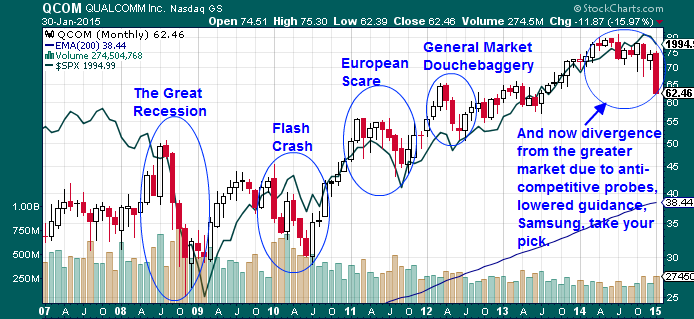
Over the last 8 years, Qualcomm’s corrections have essentially kept time with the greater market. Observe the price action on the following chart. More recently, the stock price has corrected approximately 23% while the market has continued its ascent. I am not inferring anything here, we’re simply reviewing the relationship between the greater market and Qualcomm while noting the current divergence in light of the company’s own gravity-inducing catalysts.

clip_image002

Qualcomm has faced pressures from sovereign entities as recently as 2009 with South Korea and 2007 with the European Commission. The effects to the company’s ability to generate free cash flow have been utterly negligible. Let’s take a look at the last 3 years’ worth of free cash flow results.

2014 – $7.7 billion (OH NO! That’s the same as 2013! Please.)

2013 – $7.7 billion

2012 – $4.7 billion

All that cash and no long-term debt equals the ability to deploy capital in a shareholder friendly manner. The current dividend yield is now approaching 3%, which would imply a price per share of $55 if it reaches that point. These colossal free cash flows are a product of a royalty portfolio that accounts for 30% of the company’s revenues but over 85% of earnings before taxes.

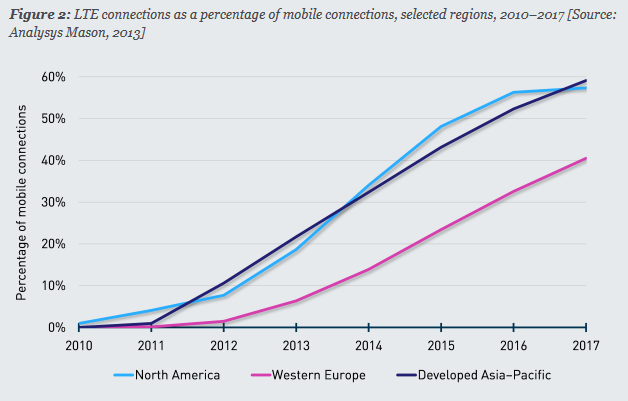
One of the most persistent questions about Qualcomm’s future profit generating ability is what happens as the wireless telecommunications space evolves(spectrum and equipment). That’s a reasonable concern in light of LTE’s advance. However, LTE is nowhere near to reaching maximum penetration around the world yet. Additionally, 3G compatibility within LTE devices will keep the royalty portfolio pumping cash for years to come. This is due to the fact that voice is still primarily handled via 3G while LTE is focused on data. Furthermore, the adoption of LTE has been very slow in Europe which leaves a very rich opportunity for continued penetration of Qualcomm chipsets in higher income per capita regions. Observe the potential in this chart from Analysys Mason, one of the leading international consultancies to the telecommunications industry.

clip_image003

For a long-term portfolio option, these prices at the 52-week low appear to be quite reasonable to begin establishing a position. There are plenty of risks to assess before allocating capital, but the moat they have created around their business model in conjunction with the consistent eruption of free cash flow creates a very enticing opportunity. At this current share price their EV/EBITDA is at a reasonable 9 and they are approaching an EV/FCF of 10. Despite all the negativity surrounding their fiscal Q1 results, revenues and net income were still up YoY by 3% and 26%, respectively.

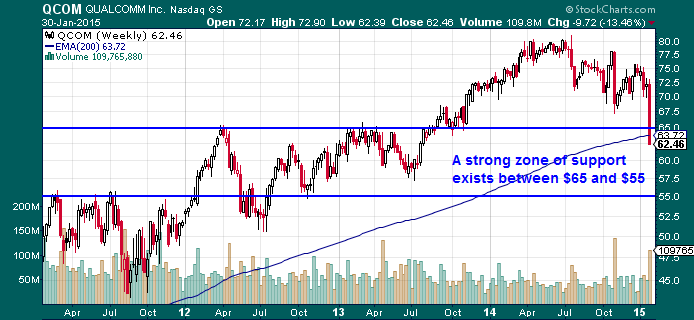
Valuation depends on the variables in your model and what factors you prefer to place the most influence. As a potential long-term addition to portfolios, these share prices warrant a look. Let’s take one last look at the technicals. Qualcomm has dipped its toes into what appears to be a very strong support zone. As always, anything is possible in these highly volatile markets, so tread carefully.

clip_image004

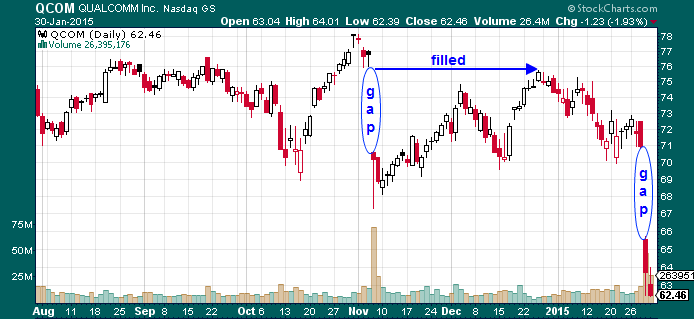
For true fiends out for any action, have a look at QCOM’s daily chart. It’s presenting the potential for a gap fill and long-time readers know how much I love the action of the snap-back. No further comment is necessary. The chart says it all.

clip_image005

If you feel the need to trade last week’s gap then bear in mind the gap fills at approximately $71. Simple strategy, simple stop, but delivering profit may be a touch more complex.

In summary, Qualcomm has the moat, prodigious free cash flows, and share price action that lends itself to constructively researching a potential investment. Last week’s ado may in fact just be about nothing. Allow the price action to inform you.

A Green Island in a Sea of Red

Like many a speculator, I’ve dabbled in the juniors. Specifically, I’m referring to junior gold and silver explorers and miners. Before 2011 it was a successful endeavor, post 2011, not so much. One of the things I did before altogether stopping the placement of new capital in any juniors was to compile a list of what I deemed to be some of the top opportunities for when precious metals finally make their turn back to positive. For the record, I don’t know when that’s going to be. The gold price languished for 20 years in the 80’s and 90’s. Do I think we’re in that type of 20-year-bear? No, but I don’t have a clue as to when the ship will right itself.

I simply believe in the long-term thesis for holding gold, but more importantly, I believe in the cyclicality of the commodity markets and historical precedence. There are any number of arguments in favor of allocating capital into precious metals, but for most speculators, the current price action in gold and silver pretty much tells the entire story. A declining market is not exactly the best moment to deploy new capital into the most riskiest ventures of a loss-leading sector. Thusly, it’s been at least 2 years since I speculated with any capital in a junior.

Which brings me to the list. One of the companies I had kept a passive eye on was Duluth Minerals. If you’re unfamiliar with their story, they’re the proud majority-owners of some prime property through a joint venture in the Twin Metals complex in Minnesota. Their land package and joint venture partner was what first attracted me to them. Duluth possesses one of the most promising platinum group metals (“PGM”) resources outside of Africa or Russia. In fact in North America, there’s really only two primary PGM producers of consequence, and they are Stillwater Mining and North American Palladium. So access to a nice PGM resource in a jurisdiction like North America is coveted.

However, PGM’s won’t even be the primary metals mined at Twin Metals. It’s primarily a copper and nickel mine. The PGM’s are a just a very nice by-product. Hence Antofagasta’s interest and investment in Duluth. Just a little background on Antofagasta (“Anto”), they are one of the largest, pure copper players in the world. Based in Chile with 4 operating mines, 90% of the company’s revenues are derived from mining operations. In 2013, they generated approximately $6 billion in revenue which is in line with large US copper player Southern Copper (SCCO) but far below the diversified mining giants such as Vale (VALE), Rio Tinto (RIO), or Freeport-McMoRan (FCX).

Before getting to the point of this post, some additional background is in order. So we have a major copper player with concentrated interests in Chile attempting to diversify their portfolio with the Twin Metals joint venture. In 2010, Antofagasta partnered with Duluth and over the next few years provided approximately $220 million in funds in order for Duluth to develop the properties. Duluth completed a ton of drilling to really prove out the potential of Twin Metals. They contracted with Bechtel, one of the largest and most powerful privately owned corporations in the US, to assist with the planning for the build-out of a mine.

But by 2014, Duluth had not done enough to build investor sentiment behind their company and access to capital was drying up in light of overall commodity underperformance, let alone precious metals performance. The stock price was badly languishing. Duluth’s cash reserves were drying up fast, and in July, Anto neglected to capitalize on an additional financing round that would have increased their ownership stake in the mine and provide much needed capital for Duluth. Clearly, Anto saw the writing on the wall and knew a better opportunity would avail itself very shortly.

One month later in August of this year, Duluth released a highly detailed presser of its Pre-feasibility Study (“PFS”) for the Twin Metals. The PFS was essentially a disaster as expectations were way too large. The stock price, trading at $0.40 a share the day before the PFS release, dropped 25% down to $0.30 a share on the day of the release. I think too many speculators in Duluth thought an outlandish estimate of PGM production was going to be reported, and that was obviously foolish. I sincerely believe that speculators really thought Twin Metals could annually pump out 300k or 400k ounces of PGM’s along with a couple million ounces total of combined silver/gold output.

The numbers were very solid, though. Specifically, the report estimated a 30 year mine life with total estimated production of 5.8 billion pounds of copper, 1.2 billion pounds of nickel, 1.5 million ounces of platinum, 4.0 million ounces of palladium, 1.0 million ounces of gold, and 25.2 million ounces of silver. Annually, that breaks down to approximately 88,000 tonnes of copper, 18,000 tonnes of nickel, 50,000 ounces of platinum, 133,000 ounces of palladium, 33,000 ounces of gold, and 840,000 ounces of silver. At spot prices for each of these commodities as of August 20th, that would’ve resulted in approximately $612M in copper revenues, $340M in nickel revenues, $187M in total PGM revenues, and $59M in gold & silver revenues. All product sales would theoretically total about $1.2 billion at those prices if the August 20th spot prices were the average for an operating year.

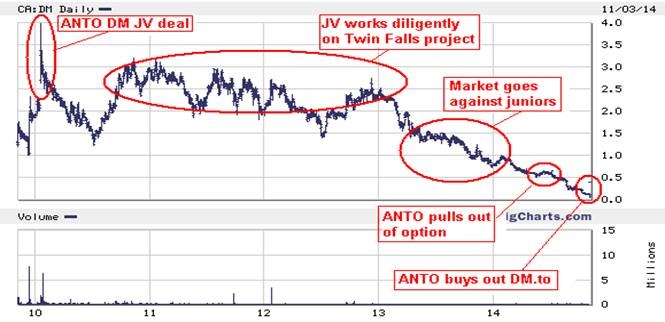
Now I don’t know about you, but for the right price, that’s definitely a resource I’d like to have my hands on. And that’s exactly why Anto did not participate in the July scheduled financing. They figured why bother. They’d already funded over $200M in project development. Duluth management was floundering while swirling the drain of bad finance options. Why not strike at the opportune moment and simply own the entire asset versus partnering in a JV. Just 9 days ago, that’s precisely what happened. This chart, courtesy of Inka Kola News, tells the story via price action.

clip_image002

The PFS calculated a net present value of the Twin Metals project at $1.4 billion USD using an 8% discount rate. Anto already owned approximately 10% of Duluth. So Anto already invested approximately $220M into Twin Metals and only has to come up with roughly another $85M(including convertible debt and additional operating funds) to own the asset outright. That’s an absolute steal and congratulations to Anto’s management for deftly structuring the deal in obtaining the buy-in of Duluth’s board and of Wallbridge as well.

Now the reason this little sale is a green island in a sea of red is because I was able to perfectly time this trade. I watched the stock languish all year and when I saw that move two Friday’s ago, where Duluth dropped from 12 cents a share to 7 cents a share, I decided it was time to pull the trigger. I maintain a portfolio for my children’s future. It’s reserved for only the best businesses with the best long-term outlook that possess the best brands and continue to raise dividends decade after decade; names like Hershey and McDonalds. However, I thought why not buy a several-thousand block of shares as a little lottery ticket. At $0.07 a share, I simply thought the risk-reward was well justified for my wee ones in light of the quality of the underlying asset.

The wager paid off a lot faster than I expected. Waking up the following Monday morning and reading various headlines from various sites I frequent, I read that Duluth was selling itself to Anto. I immediately jumped over to Yahoo Finance to see this:

clip_image004

Well, hot damn! From a percentage gain standpoint, this is by far the most I’ve ever earned in a single trade for only holding a single trading day. I won’t annualize it as I’m sure I’ll probably never get this lucky again. Of course, the net income off the trade is minimal in light of the total amount of capital risked, but still it’s a nice little boost for the year to my children’s future. I haven’t actually realized the gain yet as I’m holding for a little currency translation to work in my favor first. Mistake? I don’t think so, as I think Canada will approve the sale of Duluth so I have the $0.38 locked in at today’s Loonie rates. The dollar looks set for a little breather and I suspect that just may translate into the higher liquidation price I’m reaching for.

Coming back to Anto and what the future holds for Twin Metals. They’ve admitted they have a long way to go, with their own projections putting production out to 2020 at the earliest and possibly even farther. The next step from the PFS is the Bankable Feasibility Report (“BFS”). It’s this report which will allow Anto to secure financing for the construction of the mine. Actually, they probably won’t even bother. Consider that the pre-fease reported mine construction expenses at $2.8 billion. We know that’s aggressive, so I think it’s safe to arbitrarily add another $400 million onto that total. Conservatively, building the mine is going to cost approximately $3.2 billion. But even with a staggering expense number like that, Anto should have no issues securing financing.

This is especially so if the cost of capital continues to stay cheap for players with access to the liquidity. Looking at free cash flow (“FCF”) for Anto, they’ve averaged $1.9 billion USD in FCF for the last 4 years. With that kind of cash generation, I don’t think they’re going to have a hard time obtaining financing at favorable rates. The money is not the issue. What’s more worrisome is of course receiving all the requisite permits to construct and operate the mine. The project is located in a state that calls itself “the land of a 1,000 lakes.” That’s a lot of water ways that can be affected. There will be a tremendous amount of pushback from environmentalists who will attempt to deter Anto. Just look at Pebble and the fight in Alaska. However, with a safe and environmentally friendly construction plan along with a superabundance of funds allocated to remediation of the lands, I feel confident Anto will pull it off. Just not without a fight. Although they do have this going for them:

clip_image006

When you have a day named after you in a state, I think it’s pretty safe to assume that the state is going to be very cooperative in light of the economic benefits to be garnered.

Just remember, you had a chance to own a fractional share in a billion dollar mine for a little over a nickel a share. The junior space is beginning to heat up as quality assets are beginning to be circled. The sharks are starting to get restless as a vast majority of the juniors simply will not be able to obtain sustainable financing in light of their current share prices. We’re talking about companies that simply throw cash down a hole with zero immediate economic return and too much G&A digging into value creation. New Gold snatched up Bayfield to round out its Rainy River package. Nord Gold is positioning on Columbus. Romarco just received all of its final permitting and negotiated a $200M dollar debt package that will allow them to begin construction immediately on their Haile mine. How long before a bidding war starts on their potential 150k ounce per year mine?

There’s value to be had and money to be made in the junior space, but it’s highly dangerous and not worth the capital risk for the average investor. I’ve been fortunate on a few junior trades in this terrible gold market with Romarco, Lake Shore, and now Duluth. I could easily replace the word fortunate with lucky, however, I did my homework on those companies. I’ve also screwed the pooch in names like Aurcana, Kaminak, and McEwen Mining with poorly timed purchases. All companies that have very good potential if or when the precious metals resume a bull market.

Despite my luck in the Duluth trade, I am a strong proponent of buying the right stocks for long-term holdings. As I stated before, that means companies with mega-brands who produce enormous amounts of free cash flow and consistently raise their dividends. Buying these kinds of companies when they go on sale is essentially a sure-fire bet to building wealth, but a little flyer every now and then is worth the risk.

Some Musings About Q3

Musing 1. Why do new home sales data releases by HUD possess any significance?

Maybe so that the HFT houses have a headline for an algorithm to pump millions of unfilled bids into a market. It’s baffling. For me, the most important part of a release by HUD regarding new residential sales is the Explanatory Notes. In this section they tell you how wrong their data could be and they lay out all the statistical errors that could be occurring due to things such as “bias, variance from response, nonreporting, and undercoverage.” Reported numbers are consistently displayed with standard deviations of plus or minus percentages in the teens or twenties. For example, September’s results show a 0.2% (+/- 15.7%) above revised August new home sales.

That means the actual number may have been as low as -15.5% or as high at 15.9%. The dispersion is so wide as to render the results effectively meaningless, which is why there are always revisions. But why would revisions possess any more statistical relevance when weighed against the potential of HUD’s self-reported surveying errors? Observe the median sales price from August to September. It went from $275,600 at the end of the summer to $259,000 in the beginning of the fall. While the average price of a new home sale dropped from $348K to $313K. Drops of that magnitude have to make you question the credibility of the August new home sales pricing data. Did prices for a new residence actually drop that much in a single month or was it that the data was massaged to begin with? Not even the Census Bureau will provide a quality answer. I know the confidence level of the statistics is at least 90% but c’mon. Honestly.

Can you imagine if other industries were allowed to utilize such wide standard deviations in their statistical reporting. Take biotech. “Each participant that takes the pill in the study has approximately a 50% chance of increasing their lifespan by 12 more years…plus or minus 40%.” Or how about plane engine manufacturers. “We believe this critical engine component will operate in extreme conditions with a failure rate of 0.03% (+/-72.7%)” These are extreme, outlandish examples to be sure, but you hopefully get the point. Admittedly, my statistical skillset is decidedly above the average dolt off the street, but assuredly below regular practitioners such as finance & economics professionals or academics. The book is still open on whether or not to reject the null hypothesis that MarginRich is actually just one of the said dolts off the street.

Musing 2. What’s the big deal about oil reserves vs. oil resources?

This musing stems from an article I read at Bloomberg that was titled, We’re Sitting on 10 Billion Barrel of Oil! Ok, Two. The theme was expanded on at Zero Hedge that potentially the whole petroleum renaissance is nothing more than smoke and mirrors. Now I enjoy Zero Hedge as much as the next bloke, but I wouldn’t expect them to so quickly jump on the extremist bandwagon when it comes to E&P’s sharing their opinions on resources.

The basic gist of the Bloomberg piece was that oil and gas companies are grossly irresponsible in reporting resource potential in their corporate presentations versus the actual reserves they are filing with the SEC. However, before they get into the meat and potatoes of the article they share a giant caveat about investors and the differences between reserves versus resources. The authors quote Scott Sheffield, CEO of Pioneer Resources, one of the largest players in Texas with significant rig counts in the Permian and Eagle Ford. Sheffield states that experienced investors know the difference between the two numbers. Specifically, “Shareholders understand. We’re owned 95 percent by institutions. Now the American public is going into the mutual funds (or ETFs), so they’re trusting what those institutions are doing in their homework.”

Precisely. Experienced and sophisticated investors know that resource potential is not the same as current, existing barrels of oil in ground. That doesn’t mean that through innovative techniques that a high percentage of those resources cannot be converted into reserves. Patience and demand are the keys to the development of refined exploration techniques that can continue to expand the US energy base. The article implies that the shale boom is potentially a large scandal waiting to blow-up with Enron-like repercussions. That is an epically gross exaggeration. E&P companies have time and again improved or grew reserves at rates consistent with estimates. Additionally, we’ve seen the oil and gas players consistently beat reserve estimates established by the EIA for various geographic areas.

Bloomberg provided a snapshot of companies to graphically show the disparity between the two numbers:

clip_image002[6]

Any speculator in hard assets, knows what the steak and the sizzle are in natural resources. The reserves are the steak. The resources are the sizzle. It would help if more of the E&P players would utilize the P’s more in their presentations for the retail players who want to get in on the action. The P’s stand for proven, probable, and possible. Proven or 1P reserves have a high probability of being produced and you can count on the number. Then there is proven and probable, which is 2P; and then proven, probable, and possible is 3P. The higher the number of P, the less likely the company can produce the reserve. However, that doesn’t eliminate the current or future viability and economic potential of the resource. These P-designations, standard nomenclature in the industry, are easy to understand and not nearly utilized enough in company presentations. Oil and gas are no different than gold, silver, platinum, copper, or any other natural resource. All natural resource companies report reserves and resources and it’s up to the speculators to conduct their own due diligence.

Musing 3. There’s some serious Kool-Aid drinking at First Trust

First Trust is an investment advisory firm founded back in 1991. They’re fairly sizeable in that through their assortment of ETFs, mutual funds, and other various products; they’ve been able to garner $32 billion in assets under management. A hefty sum by any measure, but very small compared to the biggest players in the game.

The Monday Morning Outlook is a weekly little opinion piece that First Trust puts out that also includes a schedule of important economic releases for the week. Content is hit or miss with this shop, however, there was one piece from last month that struck me as an egregiously, cowardly article. You can have a read for yourself to see if I’m out of bounds in my assessment. I admit that based on my own opinions shared at this site, that I could be labeled a doom & gloomer, but I simply refuse to un-acknowledge the current and future distortions that have and will occur in asset markets around the world thanks to central bank interference.

The piece titled Why Do Stocks Keep Rising?, from September 8th, pumps First Trust’s fist in the air behind a sis-boom-bah of how the markets have continued their upward ascent despite the steady flow of negative-impact events over the last 5 years. They don’t understand how pessimism can remain so ingrained for certain pockets of investors under such conditions. I know it’s a quick 1-page offering that they throw up every Monday, but you can’t just break out the pom-poms and then stick your head in the sand without truly acknowledging the reasoning of the very parties you are criticizing. Amateur hour!

They don’t touch on how central banks have kept the cost of capital at virtually zero for longer than any period in history despite an “improving” economy and “improving” employment. They extol the virtues of the rising profits across industries but share nothing on top-lines and how that will affect profits going forward. Or how slashing SG&A and CapEx in combination with share repurchases has significantly affected stated earnings to the positive. Nor do they expound on how these behaviors are unsustainable. They fail to acknowledge that the current situation of central bank involvement in the developed nations has absolutely no precedent, and thus, no back-testable strategy for when the house of cards begins to wobble.

As an investment adviser it behooves them to cheerlead so as to grow assets under management higher and higher. That’s fine and they have a right to share a one-sided puff piece. They should just try not to be so damn cowardly the next time they want to cheerlead investing in a rising market right before a 7%(which I stated will not be the low) haircut commences.

Before signing off, I wanted to touch on the current action in the S&P 500. In my last article, I had stated that if the price action is simply a bounce within a larger correction that I thought the 1,950 area to be a solid resistance point before turning down again. Today’s close at 1,964 is still around 1,950, so we’re not quite out of the woods just yet. If we move onto sustained new highs then I will offer a mea-culpa, but I continue to think that caution is warranted. I’ll leave you with a chart shared by Lance Roberts at STA Wealth that displays the price action in the S&P 500 during the last two corrections that reached a depth of 10% or more.

clip_image003[6]