The Potential Depth of the Corrective Action

Markets’ darling leaders sell off? Check. Defensive sectors rotate up? Check. Seasonality coming into play(if you believe such stuff)? Check. S&P 500 VIX spiking? Not check. We have yet to see the S&P 500 really start to come down off its highs for the year just yet. Although, the market action has probably felt terrible for those heavily weighted to the NASDAQ, we have yet to see some heart-wrenching downside action in the S&P 500.

SentimentTrader just shared a note about the lack of volatility in the VIX and the downside potential in the S&P 500, “There have only been two other times in the past 20 years that the Nasdaq Composite had dropped more than -8% from its 52-week high, but the VIX “fear gauge” was still below 17.5, a scenario we have now. It shows relative complacency in the face of a sell-off in higher-beta stocks. Those two occurrences were March 28, 2002 and May 15, 2008. The S&P 500 sold off more than -15% over the next three months both times.

As usual, the statistics suffer from a small sample size within a relatively short period.

However, the facts are the facts.

Add in that earnings season has been off to a fairly weak start and you have that much more evidence to make you pause and consider before allocating more long capital right now. For any readers who are EPS hounds and swear that stocks always follow earnings, here’s a snapshot courtesy of Thompson Reuters’s Alpha Now that also supports a pause in the action through the spring and potentially summer.

S&P 500: EARNINGS AND REVENUE GROWTH TREND

clip_image002

And to keep my confirmation bias fully intact, here’s a snippet from Louise Yamada courtesy of CNBC. I can’t believe I’m quoting material from the hack-shop CNBC, but Louise truly is a legend in the institutional research side of technical analysis. Anyways, she states, “I don’t think the pullback is already over. I think that it’s an interim pullback, and we’ve certainly seen what we’ve expected, in the Internet and biotechs coming off. And I think that although they may bounce, there’s probably still a little bit more to go on the downside…If we break that level(1,750 on the S&P 500), that will be the first lower low that we would have seen all the way back to 2011, really…Below 1,750, support lies at 1,650.

If we hit that 1,650ish area, then that’s approximately 10% to 12% off the highs for the year. But who’s to say we have to have a minimum 10% correction? I’ve been calling for that level of correction to clear things out a bit in the market. Many other commentaries have also focused on the need for at least a 10% correction in the S&P 500 to work off overbought levels.

Richard Dickson, Chief Market Analyst at Lowry Research, recently gave an interview at FinancialSense.com providing his outlook on the “need” for a correction of at least 10% in the S&P. If you’re unfamiliar with Lowry Research, they are one of the true OG’s in the game of institutional level technical analysis and the oldest firm in the US to provide such services. Dickson stated that:

We’ve already had two corrections well over 10% from 2010 to 2011 in this bull market and, historically, if you go back and look at the various bull markets and use the Dow Jones on a closing basis, we’ve never had more than one 10% correction in a bull market… Since 1940, we’ve never had more than one, so this has been a little unprecedented in the fact that we’ve already had two. So, to say “well, we need another one”…my response to that is we’ve already had two, how many do you want?… As things stand right now, any pullback, whether it’s 5% or 10%, in our opinion, would simply be a buying opportunity.

So there you have it. Buy the dip according to Dickson.

Still though, want some basic ideas on how to play some downside action? Buy VXX or leverage it up and buy some Calls on VXX. You can buy some Puts on the SPY or eliminate the risk of purchasing the optimal option and purchase the 3x leveraged SPXU from ProShares. It may be a little late, but utilities ETF’s such as XLU have been the home of the defensive minded for several weeks now. The typical disclaimer applies regarding your own trades.

I intended to share some thoughts and charts on the serious distortions to the financial landscape, as stated at the end of my last post. My apologies but you’ll just have to wait till the next post again, where I will definitely talk distortions. I promise. Bis spater.

Correction Starting or Continued New Highs

Nowadays, you can’t go a single day without reading a financial opinion about how a major dislocation is imminent or that the economy is on the mend and this generational bull is still intact. The fact that the US stock markets have been so choppy to start the year has confused not only some columnists and bloggers(myself included), but some professional money managers as well. As I stated a couple of posts ago, there are plenty of short-term signals showing that now may be time to show caution. On the other hand, long-term price action does continue to show strength and the bull fundamentals do not appear impaired as the path of least resistance for the markets continues to be upward.

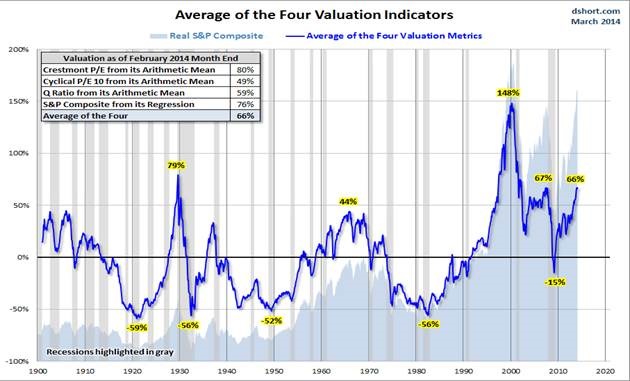
Depending on what measures you favor, valuations can appear a bit stretched currently; especially in the biotech and social media sectors. Doug Short, over at Advisor Perspectives, provides a monthly update of the chart below. Chris Kimble, of Kimble Charting Solutions, likes to add his own flair to it every now and then as well. The chart takes an average of four popular means of determining valuation for the S&P 500:

clip_image002

So based on this chart, we’re rapidly approaching 1929 levels of overvaluation of 79%, already passed the late 60’s peak of 44%, and are right back to 2007 levels at 66%. Do I think a soul crushing dislocation is imminent? Not at all. The chart also shows that things can get a lot more frothy ala 2000 and its 148% overvaluation level for all things dot.com and tech. Jeremy Grantham, via a recent Barron’s article, agrees that the market is 65% overvalued currently but that it would need to rise another 30% before he would consider it true bubble territory. For the arithmetically challenged, that puts the S&P 500 over 2,300. So according to J-Grizzle, there’s a lot of dancing left to do while the beat keeps bumping.

The S&P 500 hasn’t seen a correction of any real significance in about 2 years. When you throw in the fact that this bull recently turned 5 years old, nervous traders start to think that we just gotta see something to the downside soon. Maybe. Maybe not. Maybe f@$# yourself. My theory on the market is that it’s like a little kid. Feed it a bunch of sugar and watch it run like crazy. Thank you, Marky Mark. Despite the tapering, the Fed is still plugging a ton of sugar monthly into treasuries and MBS to keep these markets liquefied and rising.

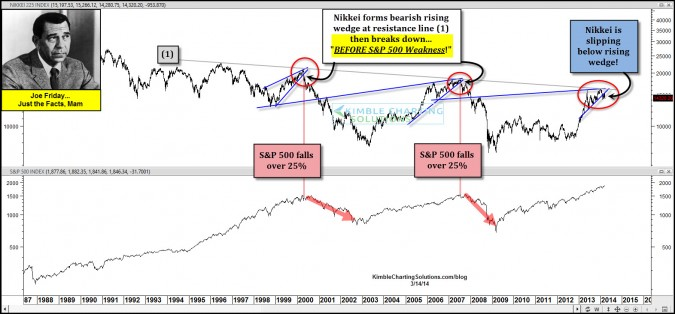
I already went on the record stating that I thought we could see downside action all the way to the 1,650ish area, which is approximately 12% off the highs. Kimble provided a chart last Friday showing the long-term action correlation between the Nikkei and S&P 500 since 2000. Observe:

clip_image003

So if the action is to be believed, then watch out. BUT WAIT! The S&P 500 is breaching all-time highs. Aside from risk management, buying into strength is a common message you’ll read in any and almost all of the great trading books. Well Goepfert at SentimentTrader shared some thoughts on the current price action too, “On Thursday, the S&P 500 rallied more than 0.5% to close within 0.5% of a 52-week high, yet more stocks declined than rose on the NYSE. That shows a lack of broad participation, despite a couple of important sectors (semis, financials) doing extremely well and breaking out to new highs. This has occurred 24 other times since 1940, and the S&P has struggled in the weeks following.”

Add to that biotech, a sector leader and market darling, is starting to show some real weakness. I think biotech is an easy short here using BIS or buying some Puts on a market leader such Amgen or Gilead. On a different note, there are some commodities now showing weakness as well. Coffee has been ripping in 2014, but this week has seen that momentum stopped in its tracks. It may just be a breather before it continues higher or it may see further downside action to eat up a nice chunk of those “easy”, early returns. The coffee ETF, JO, is an adequate proxy for those looking to trade the action without dabbling in futures. Either way and despite the current price action, my favorite indicators say that it’s not quite time to go short coffee yet. If they do give a signal, then it’s possible to see gap-filling action(on a weekly chart) all the way down to $28 or possibly $25 depending on the momentum.

Whether you lean optimistic or pessimistic is irrelevant. If you’re trading, then mind your stops. Managing your risks is all important.

A Read of the Tea Leaves and an Update to the ETF Portfolios

Well how about that correction in the S&P 500? Everyone suffered the 6% downward move and now we can all resume earning wealth…or can we? Is there some negative energy left in these markets? The tea leaves tell me that the corrective move is not over. As a reminder, just reading the tea leaves is about as antiquated as can get for a method of analysis. Looking at some squiggles on a chart and then making wholesale investment decisions is dangerous, but still, I think it’s one of the practical components on the speculator’s tool belt.

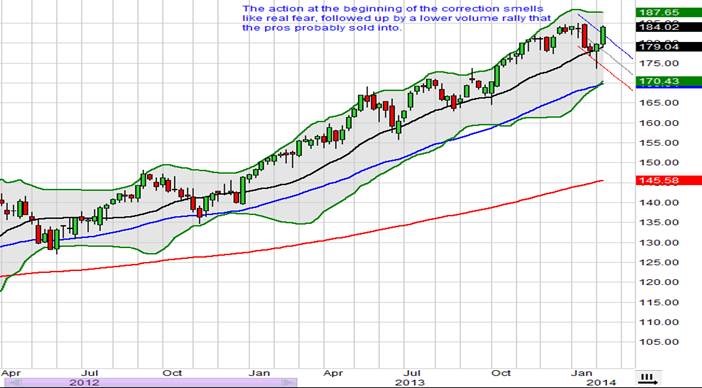
Let’s start by taking a look at the S&P 500, using SPY(weekly) as our proxy, and then we’ll move into some complimentary areas that may help shape the analysis. Bear in mind with Plunge Protection out there and HFT pace-setting through momentum ignition, all analysis is completely nullified should new highs be strongly set and the uptrend is fully resumed. Now prepare to be over-charted.

clip_image002

I think when this correction resumes, we’re looking at an endpoint underneath the 50-Day EMA(blue line). I think it’ll kiss that into the 165ish area before bottoming out. I just don’t believe that a 6% move down is the end of it. In 2013, all the corrective moves capitulated at the Bollinger mid-point. From the wide ranging fear that I observed, that just doesn’t feel appropriate for the correction here to start 2014.

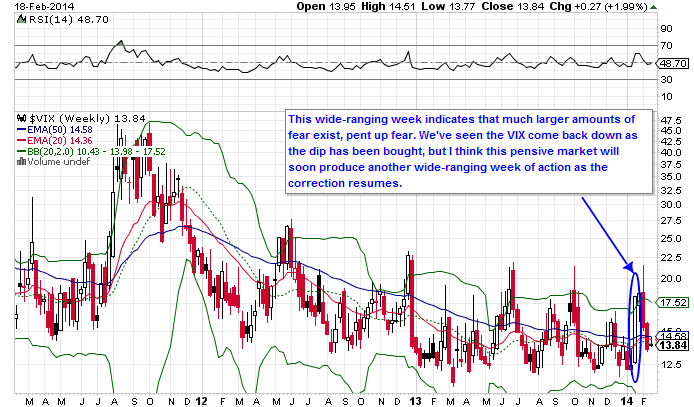
Take a look at the VIX for moment. Yeah, yeah, I know the VIX is played out but it still provides clues as just one chart of many in attempting to get a better feel for market action.

clip_image003

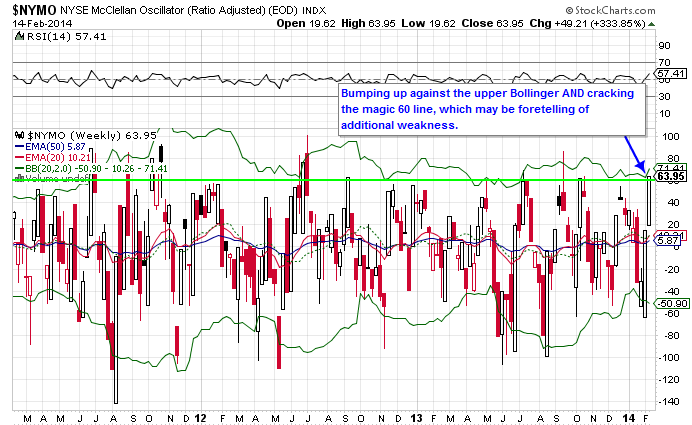
The markets haven’t seen fear like that since 2011. Another one of my favorite indicators, the NYMO, is indicating some further weakness. I’ve previously commented on the NYMO’s ability to help traders get positioned for market action. It’s hitting not one, but two indicators providing a signal for a resumption to the downside. Observe:

clip_image004

I have no worries that the major uptrend will resume after the corrective washout. These markets have been in need of a steam release for some time, but the obvious path of least resistance is upward. Those little exhalations near the end of 2013 essentially counted as non-moves, so a little fear and loathing is healthy for the uptrend to renew with some vigor going into the 2nd quarter. There are a couple of additional asset classes that may potentially shed a little light as to further direction subsequent to the completion of the corrective move. First, there is the yield on the 10-year Treasuries:

clip_image005

Okay, all kidding aside on my make-believe and totally fake “Rhombus of Hades” pattern, a downside move in yields in combination with ZIRP will continue to push market players into equities; especially if that yield pushes much lower to potentially 2.4% or even as low as 2%. I’m not saying that yields aren’t going to go higher in the long-term, just that the near-term outlook is presenting a potentially downward path in yields.

The Nikkei has maintained a fairly solid correlation with the S&P 500 and its action looks constructive as it may be basing for a resumption of its own uptrend. The two indicators below are the MACD and Full Stokes.

clip_image007

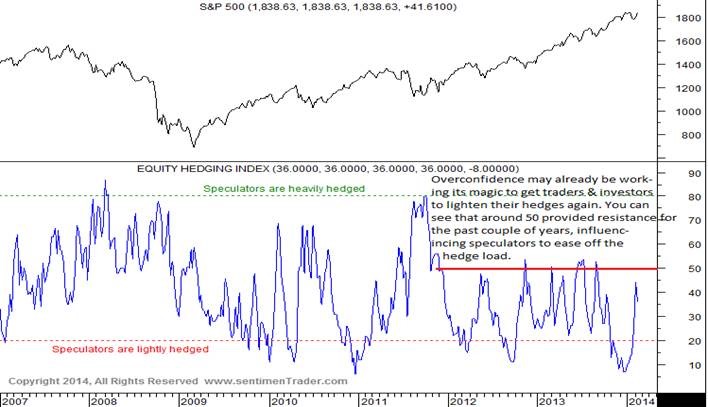
One last set of charts I’d like to share is the Equity Hedging Index(“EHI”). The EHI is one of the many proprietary models that can be found at SentimentTrader.com. It’s a contrary indicator, meaning lower extremes in the chart should produce a rally in the markets and vice versa. The EHI aggregates several inputs such as cash raising, Put purchases, and various other factors in order to construct a usable indicator. For more details, visit the site and take a free trial to see if the service is right for you. As I’ve stated on numerous occasions, I do not receive any compensation from them and I’m quite confident they don’t even know the MarginRich blog exists. Fortunately for my readers, Jason Goepfert, proprietor of SentimentTrader, is cool enough to allow people to republish his work as long as it’s not excessive and the work is credited.

Here’s a current read of the EHI.

clip_image009

And in case you need a visual on how well the EHI has performed in assisting traders see where some of the bigger turns have been occurring, observe the following chart from January 14th, 2014.

clip_image011

It’s not perfect, but then again, no single indicator is. If using technical analysis, it’s best to observe a wide variety of charts and cumulatively interpret them, so that one may obtain a more productive assessment. But this is all rubbish really because bias inherently sways emotions and thought process, and thus the analytical outcome must be considered questionable. If this sort of analysis is all you rely on, such as what I do here for the blog, then more power to you. For the record, before committing my own capital I analyze a broad swath of data; not just squiggles. Occasionally, squiggles may be all it takes to ascertain that a function-able trade has presented itself, but I like to mix fundamental analysis in combination with micro or macro economic reads.

It is decidedly better to test quantifiable inputs to statistically determine, so to speak, probable outcomes when attempting to make valid trading decisions. Have a read of this Price Action Lab blog entry. Based on his analysis, Mr. Harris states that the market is in mean-reverting mode. Long story short, he basically states that the market is fragile and so any suitable catalyst could cause a correction.

My conclusion is that I wouldn’t pick now to be throwing all my chips into the middle of the table as if everything is all clear. There are enough signals out there stating that one should trade with caution, especially if attempting to position long. It may be best to wait in cash, but if you gots the stones and the know-how, then it appears a nice set-up is forming for shorting or Put option strategies.

Before I bid you adieu, just want to let readers know that I’ve created a new link up top called Portfolio Updates. That’s where I’ll be placing the ETF portfolio updates from the January post titled, A Few Sample ETF Portfolios to Watch. I would describe the results thus far as interesting, but not all that compelling just yet. If you haven’t read the article then click the link and have a read, then check the updates to see how they are stacking up.

To invest the emergency fund, or not, that is the question

I wanted to veer away from the normal subject matter and touch a little bit on personal finance. We’re going to visit the concept of the emergency fund(“e-fund”). It’s a subject that’s made some heavy rounds in the financial news sites and blogosphere to start 2014, but the subject of e-funds gets expounded on annually in countless articles.

Marketwatch ran an article on how to retire early. The piece was focused on Mr. Money Moustache and his methods of living well with less. One of the personal policies he espouses was that there’s not really a need to maintain an e-fund. It’s not that he doesn’t believe in them, just that an e-fund is probably best for a specific demographic. Here’s what he stated in the article:

Yeah, I’ve always questioned the idea of an emergency fund. It’s a great tool for the financial beginner who lives from paycheck to paycheck, and for whom a broken water heater would make the difference between making ends meet and borrowing via a credit card. But once you get off the ground, your credit card is a monthly buffer and your investment accounts are the emergency fund.

So I have no savings account at all, and keep just a few thousand dollars in the checking account. If a huge unexpected expense ever came up that was greater than my income, I would put it on the credit card along with all other monthly spending. Then just sell some shares of an index fund and transfer that back to the bank before the credit-card automatic payment happened at the end of the month. And I’ve still never had to run a credit-card balance in my life.

The great part is that if your spending is much lower than your income, these emergencies become very rare, because there is always a surplus, which you have to sweep away into investments each month. So if the water heater dies, you buy a new one and just invest a little bit less that month.

Maintaining access to adequate amounts of liquidity when a true need arises is simply a matter of prudence. The rich may not call it their “emergency fund” per se, but they tend to keep enough cash on hand or maintain easy access when they need it. The middle class are generally fastidious about maintaining an e-fund despite the level of job security or adequate assets already accumulated. The less fortunate, and those just starting out in the game of asset accumulation, are simply looking to scrape together what they can so they have something squirreled away for a genuine unexpected need.

Everyone has to assess their own total financial situation and determine what is the best mix for their e-fund. Is it all cash? Is it all investments and play the statistical odds game against Murphy’ Law that the markets won’t be in the middle of a serious dislocation at the exact time you need to liquidate? Is an e-fund even needed?

Suze Orman and Dave Ramsey, the personal finance gurus for the Great Unwashed, have two decidedly different takes on the e-fund but both believe in the concept. Orman believes that 8 months of expenses should be covered with the emergency fund, and that one should forsake making more than minimum payments on any credit card debt in order to build up that surplus. Ramsey believes in building up $1,000 ASAP for emergency purposes and then paying off all non-mortgage debt i.e. revolving credit, auto loans, and student loans by utilizing the debt-snowball method. Then once those debts are paid, begin building an e-fund to cover 3 to 6 months’ worth of expenses.

The one glaring consistency across Orman, Ramsey, and the countless other commentators is the total lack of imagination in how to allocate the e-fund. Here’s the same list of financial instruments shared ad nauseum across the web: online savings account, CD’s, laddered CD’s, money market, T-bonds, or I-bonds. If one truly wants a “risk free” tool for safe interest accrual then these are of course adequate options, but you still have penalty risk with the CD’s and bonds. The problem is that these instruments yield virtually nothing. Thank you ZIRP.

I’m a proponent of part cash/part investing. If you’re going to maintain a sizeable e-fund, which is of course a relative term, then there are several tools available that offer vastly superior yield without the pure risk of stocks. I didn’t say zero risk; just not pure stock market risk. I’m talking about closed-end funds(“CEF’s”) in the income sectors. Specifically, I’m talking about investing in CEF’s that hold preferred securities, muni-bonds, and energy-related MLP’s.

CEF’s can be a good addition to an e-fund because they easily provide yields over 5% and can often sell at a discount to net asset value(“NAV”). Meaning, the total market capitalization of the closed end fund will trade for less than the total market capitalization of the investments the fund holds. It is not unusual to be able to enter a position into a CEF for $0.90 on the dollar. Stated another way, if Make-Believe fund’s NAV is $10 a share, then the market may place a value on the share at $9. This discount may occur for any number of reasons. Circumstances are different for each fund. The most obvious reason is sentiment in the primary asset class of a CEF’s holdings.

My current 3 favorite CEF’s for partial e-funding are tickers: JPS, NEA, and KYE. I’ll get to some details on each in a moment. I want to share a site first.

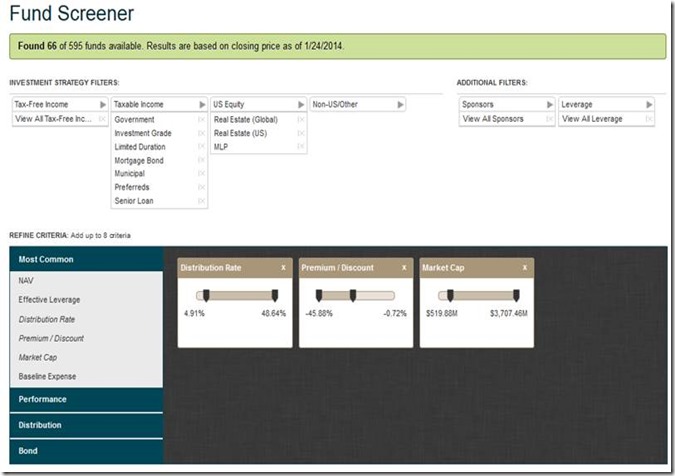
If you’re one of my readers who is un-initiated in the world of closed end funds, then stop by CEFConnect.com. There you can find most everything you need to explore the world of CEF’s and link to the sites of each asset manager to obtain even more detail about a fund you may be interested in. It’s a comprehensive site that provides news, education, interviews, a screener and more. In fact, here’s a snapshot of the screening page I used to pare down my own list of CEF’s.
clip_image002

The screener is easily customizable to winnow down the list of hundreds of CEF’s. From the pic above, you can see that my screen utilized a 5% minimum distribution rate, which is the CEF equivalent to yield for you stock dividend and bond coupon junkies. I also screened by discount to NAV and Market Cap to ensure that only funds that traded at a discount and with adequate liquidity would be filtered. The list was narrowed down to 66 closed end funds. I knew what sectors I wanted to choose from, so then it was a matter of assessing discounts to NAV, yields, and market caps to make final selections.

The Nuveen name is well known in the CEF space and has a long, rich history operating as a financial institution since 1898. Nuveen possesses total assets under management of $215 billion. Visit Nuveen for additional details about the company and its selection of CEF’s.

I like preferred stocks because they’re highly liquid, trade like common stocks, and in a lot of situations can yield income as steady as a bond. Preferred stocks provide no voting rights to shareholders but they are farther up the food chain in the event of a bankruptcy. Preferred stocks generally trade at a par price of $25 and tend not to get too far above or below that except in times of serious economic strain. Municipal bonds are tax free and appear to have a great deal of the fear in the sector already baked into the price. Lastly, the energy-related MLP’s allow for the upside potential of energy production increases across the world by investing in the companies that provide energy transport via pipelines and ship containers. These companies are the “toll booth” operators of energy transport and their consistently assured business allows outstanding cash flows from these master limited partnerships. Additionally, these three are not the most strongly correlated assets across the income space which provides a small margin of safety.

JPS is a Nuveen offering that specializes in preferred securities. Why bother with the hassle of researching which credit worthy securities to allocate your funds in when you can have the experts at Nuveen take care of you. JPS offers a juicy 8% yield paid in monthly distributions of 5.5 cents each, and the current discount to the NAV is 11%. So you’d be paying $0.89 for $1.00 worth of assets.

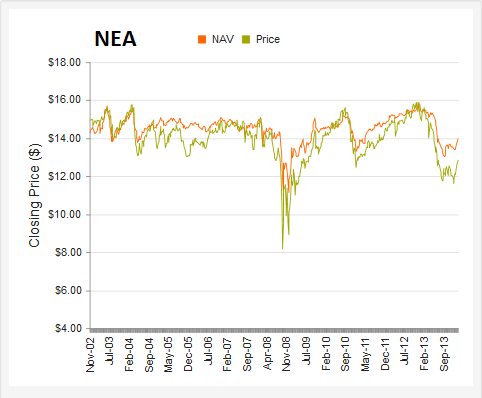
NEA is another Nuveen offering, but it specializes in municipal bonds. Municipal bonds are tax free instruments so they’re probably best utilized in a taxable account, but I’m no CPA or tax attorney so please consult an expert for advice on your specific situation. And remember, the securities described in this post are not a specific recommendation to the reader. They are simply an offering of my preference in how to semi-allocate an emergency fund. Muni-bonds were oversold in 2013 and some fear of muni-bonds may be well founded. Cities in California were going bankrupt. Detroit is Detroit. Puerto Rico is freaking out fixed income investors, but all these fears have now been discounted into the sector. Hopefully, fully discounted. If you recall in my last post, in the last 20 years muni’s have always bounced back to gain at least 10% after a down year.

Plus, NEA trades at a 8% discount to its NAV. The best part of this instrument is that while it yields a lovely 6.4% at last close as of this writing, the yield is tax free. So if you’re in the highest tax bracket of 39.6%, that’s a taxable equivalent yield of 10.6%. A double digit yield is not easy to come by these days and here you have a tool that allows you to earn that yield at a discount. Your taxable equivalent yield is calculated by taking the fund’s current distribution yield and dividing it by 1 minus your tax rate.

Example: 6.38/(1 – .25) = 8.5%

The last fund is KYE, which technically invests across a broad range of energy related assets and not just MLP’s, but I just generalize it as an energy-MLP specialist. KYE offers a yield of over 7% and trades at a discount of 9% to the NAV. So again, you’re only paying $0.91 for a $1.00 worth of assets. The fund has positions in companies such as Kinder Morgan, Williams, ONEOK, Plains All American, and Teekay; which are all heavyweights in their respective fields. If you believe in the growth of America’s energy production and potential for energy export while also believing in the potential growth of worldwide demand for energy, then KYE appears to be a conservative bet on that growth while also being paid to watch if the thesis is correct. Kayne Anderson is not a typical mass market asset manager. I guess you could consider them a little more boutique in their operations, but $25 billion in total AUM is certainly nothing to sneeze at. They’ve been around for 30 years now and have a focus on energy, muni’s, private equity, and mezzanine level credit opportunities. Learn more at KayneCapital.com.

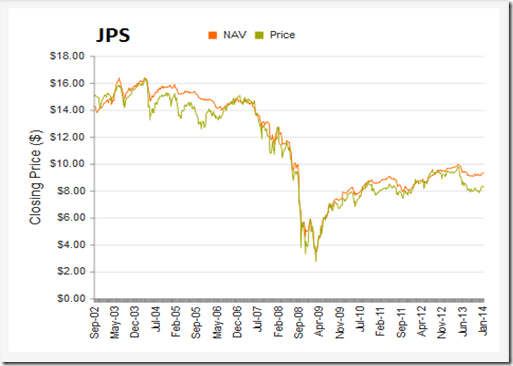
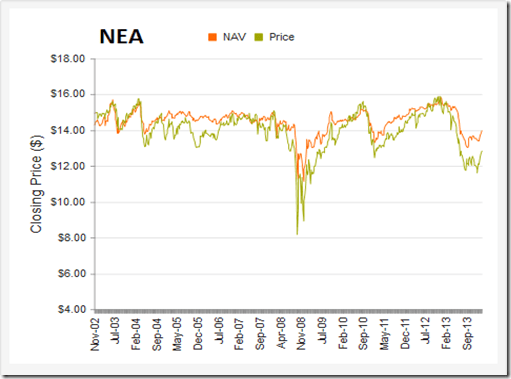
So here’s the point in the article where you think to yourself, “Yeah thanks for the recommendations but how did these investments stack up during the financial crises?” Like I said, no risk can be eliminated; only mitigated. That’s why it’s called investing aka speculating. In 2008 – 2009, every asset on the planet lost value. These 3 offerings recovered surprisingly well, especially NEA and KYE. They fell hard but bounced back fairly quickly into their pre-crisis trading ranges. JPS fared worse as it has yet to even touch its inception per share price of $15. However it has risen 150% off of the lows, all while yielding over 7% like clockwork. Observe the following trio of charts courtesy of CEFConnect.

Preferreds
clip_image003

Although again, it has not recovered its pre-crash pricing, JPS bounced up to over $8 a share in fairly short order and has maintained a fairly tight range between $8 and $10 a share. With the NAV discount, this looks like a good window for allocation.

Muni’s
clip_image004

NEA recovered to new all-time highs in 2012, but then a couple of California cities, a Motor City, and a certain salsa dancing island later has brought the fund back down to 2009 levels. The baked in fear and NAV discount present a compelling opportunity for appreciation and yield.

Energy Transport
clip_image005

KYE has performed the most consistently before and after the last financial crisis, trading in a tight range between $25 and $30 a share. Pre-crisis, the fund primarily traded at a discount. Post-crisis, it has traded primarily at a premium. Now, despite all the energy being discovered, drilled, and pumped in America in addition to the ZIRP environment, KYE again trades at a discount towards the lower end of the price range.

These charts show that there are obvious risks in making an investment. One can’t just allocate some cash to these securities and then forget them like they’re a savings account. These are uncertain times to be investing and you have to be vigilant in constantly assessing the risks of an allocation. The largest risk associated with these funds is interest rate risk. In a Zero-Interest-Rate-Policy environment, these funds can be affected if rates begin to rise. KYE would be less affected than JPS which would be less affected than NEA, which is partly why I have chosen the three holdings, but a rising rate environment would have a negative effect.

Fortunately, the widely-known fact that the Federal Reserve wants to maintain ZIRP through 2015 provides at least a 2 year window to take advantage with these 3 closed-end funds. But facts and circumstances can change, and so accordingly, decisions about how funds are allocated must adapt. A couple of ways to help mitigate some of the risks is to use trailing stops as well as look at how far a potential premium builds. If the premium builds too far, say 5% to 10% over NAV, then taking profits may be a good idea. Even accounting for frictional costs, it may be worth earning the capital gain. The resultant cash can then be placed in a different fund, maybe in the same family, that is a reasonable facsimile from a holdings and performance standpoint. Or, you can park the cash in savings again and simply wait for the premium to abate, which by reviewing the charts up above, happens quite often.

Lastly, we’ll visit the fee structure. Professional expertise along with the provided infrastructure has to be paid for and these CEF’s are no different than any other mutual fund or ETF. At first glance, the fees and expenses appear outrageous but only to an ETF-addict who doesn’t understand what they’re getting for their money. The table below summarizes the management fees and expenses for the 3 funds:

Fund Family Ticker Management Fee Other Expenses Interest Expense Total
Nuveen JPS 1.17% 0.07% 0.47% 1.71%
Nuveen NEA 0.90% 0.09% 0.83% 1.82%
Kayne Anderson KYE 1.83% 0.91% 1.64% 4.38%

Now don’t get scared away by those numbers just yet and go running for cover under the low-fee Vanguard umbrella. Keep in mind these fees and expenses are taken from operational profits of the funds. After the fund accounts for these 3 operational expenses, then available cash flows are distributed to shareholders. So despite those fees and expenses, shareholders earn a yield of over 7% in JPS and KYE while NEA provides a taxable equivalent yield of between 8% to 10%. Last time I checked the Vanguard ETF’s, even with their incredible fee structure, there are zero ETF’s that yield over 5%. The universe for financial products is wide and vast; presenting workable solutions for everybody.

Assess your own situation. Determine the best course of action for you or your family and make a decision regarding an emergency fund. But now instead of simply reading about the same old non-yielding(but relatively safe) bank tools everyone has at their disposal, you have some high-yielding options that provide a small margin of safety. Remember, if you’re unsure, seek the advice of a professional and always be sure to conduct your own due diligence.

A Few Sample ETF Portfolios to Watch

Well 2014 has arrived with a tepid start and already the correction bells are ringing around the financial web. I’m as guilty as the next blogger of trying to front-run corrective moves in the greater markets, but in my experience, it’s rare to see a pack of pundits predicting market direction with collective accuracy. Sure, equities look a touch expensive here depending on which valuation-gauges you’re utilizing, but financial writers around the web(myself included) have been calling for corrections since the last one of note in June. Additionally, I’ve read plenty of analysts who state there’s still value at these stock prices.

Let’s consult the tea leaves and see what they communicate:

clip_image002

As the squiggle shows, if this weak start to the year is the genuine beginning to a sizeable(but perfectly healthy) correction of at least 8%, then there will be plenty of time to get properly positioned to take advantage going in and coming out. Notice at the blue circles above, how long the market takes to actually set-up the real dip that shakes things up.

Last year was the Year of the Passive ETF. The year 2013 caught the hedge fund industry with its pants down and the rich, whose funds were locked into 2&20, drastically under-performed the plain old, vanilla ETF of SPY. The S&P 500 tracker returned 29% last year, beating it’s very long term CAGR by a very healthy premium. In a mad trading world of short-term thinking and instant gratification, the long-term view of the Bogleheads destroyed churning traders on an absolute basis. Will 2014 be more of the same? I wouldn’t bet on it, but the consensus view out there seems to be that 2014 will be another good year…just not as good as 2013. Some more consensus thinking has been, “We’ll probably finish the year with the stock markets up about 14% to 16% compared to the prior year’s 30%’s for some indices.”

So in the spirit of following what worked last year while trying to include a touch of the contrarian and a dash of new trends, I’ve put together an ETF portfolio that I’d like to track in 2014. Because chasing always works! As always, this is not an investment recommendation. Since buy & hold was an elite strategy for 2013, and really since 2009 apparently, let’s see if 2014 continues to favor buy & hold with good fortune.

We’ll title the portfolio, Look Back and Ahead. Here’s a snapshot of its construction using ETFreplay.com:

clip_image003

Let it be acknowledged that this portfolio is only partially constructed using a rear-view mirror, and that investing with one’s view on the rear-view mirror is generally not going to lead to short-term success. The Look Back & Ahead (“LB&A”) portfolio was constructed for short-term results in 2014 only and is looking to utilize prevailing trends and combine them with some of the strategies that had a rough 2013. Eight of the chosen ETF’s follow trends established in 2013. These are Japan(DXJ), Junk Bonds(HYG), Biotech(IBB), Russell 2000(IWM), Tech(QQQ), Share buy-backs and dividends in earnings growth(SYLD), Consumer Discretionary(VCR), and Health Care(VHT).

The remaining 4 ETF’s of LB&A are the contrarian plays that could bounce back in 2014. Some of the possible reasons behind any potential bounce-backs are: extended negative sentiment ready for a turn, value at these prices, or hot money moves in together creating a new trend. The 4 trends waiting for a potential 2014 rally off some lows are: Emerging Markets(DEM), Europe(FEZ), Gold(GLD), and Muni-bonds(TFI).

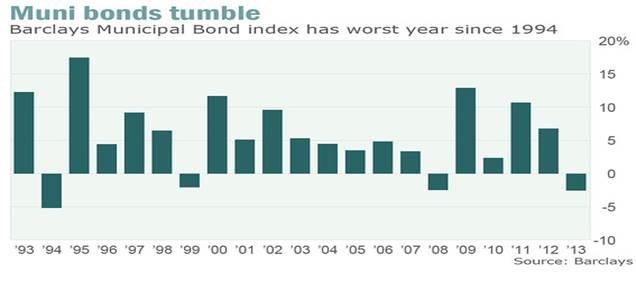
You might be thinking muni’s and saying to yourself, “Really?” They’ve had a tough year for sure. Certainly one of the worst performing years in the sector over the last 20. Barclays produced a chart of performance for the past couple of decades. It shows that after a down year, the sector tends to rally quite nicely. Will this time be different?

clip_image005

Since the S&P 500 index performed so well, we’ll track LB&A against the SPY for the year. But wait, there’s more. If I think that LB&A may be able to outperform the market by riding some established sector trends and a handful of potential counter trends, then why not leverage up. Well I have a portfolio for that too, that allows for a 2 or 3 times leveraged move in each of the sectors of LB&A without taking on margin risk into your investment account. Observe:

clip_image006

Unfortunately, ETFreplay subscriptions do not provide access to the entire universe of ETF’s. As they state on their website, “As of 2010, less than 500 ETFs have provided >98% of the trading ETF/ETN volume in the U.S. market.” Which means that due to a lack of liquidity and volume, six of the levered plays are not in the ETFreplay database. As such, I am unable to easily save and track the portfolio with their site’s tools. I’ll just save it on another site’s portfolio tools and drum up some charts in Excel for performance tracking purposes. And in the continued spirit of simple benchmarking against the S&P 500, we’ll use SSO(2x levered S&P ETF) as our comparison benchmark.

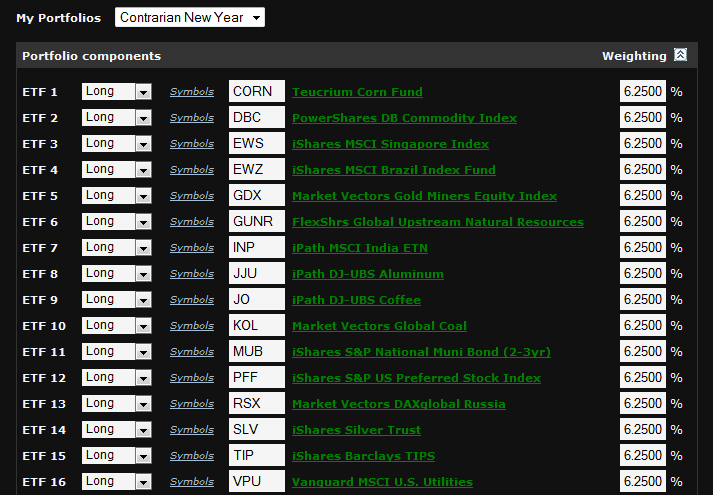
Just for ha-ha’s, we’ll track another portfolio in 2014 of purely contrarian plays. Construction of this portfolio should be obvious to most, but have a look at its make-up. It’s titled Contrarian New Year.

clip_image007

Obviously, the BRI of BRIC had a tough year so we’re allocating there for total country exposure. I also included Singapore but left out Turkey. With the ongoing corruption scandal in Erdogan’s government, there’s obviously a whole lot more than sentiment going on there. We’ll just see how that situation plays out and how it affects investor sentiment towards the Turkey ETF later in the year. Commodities were utterly atrocious, so I included DBC and GUNR but also wanted to concentrate performance for some mean reversion specifically in coffee, corn, aluminum, coal, and silver. Gold miners were…well you know the story by now. Utilities was one of the worst performing sectors in the US along with TIPS, as nobody expects inflation and everybody wants to buy growth. We’ll see if inflation starts to tick upward and relative value attracts some players back into the utility space in 2014.

Just like muni bonds up above, you may be thinking that the gold miners prove I’m a glutton for punishment. That may very well be, but risk can always be managed, and if the underlying product has a bounce-back year then the producers may see a little pop in performance. Especially if the metal can catch a bid sufficiently past most of the producers’ all-in-sustaining costs. Observe the following chart of the XAU’s performance over the last 30 years, courtesy of US Global investors via Bloomberg. It says to me that miners have a potential low risk/high reward set-up. Believe me, any time the word gold comes out of my mouth, I want to shoot myself in the face.

clip_image009

Remember, that these sample ETF portfolios are not investment recommendations and I reserve the right to allocate my own funds as I see fit into or out of any of the fore mentioned investment products. If you’re interested in some of the more professional portfolio metrics and want backtest results, Sharpe ratios, alpha and beta, correlations, etc., then too bad. Go look it up yourself. The name of the game in 2013 was absolute performance and so that is what we are measuring in 2014 with these ETF experiments.

And that ladies and gentlemen, is about all there is to basic asset management. Here’s the basic formula: Follow some prevailing trends to cover career risk + buy some contrarian plays based on quantitative models to cover career risk = hopefully benchmark beating results…and winning the grand prize of more AUM, which inevitably leads to diminishing performance. Obviously, I’m highly generalizing here. Asset management in any shape or form is usually performed by very well educated individuals or groups utilizing highly sophisticated quantitative or fundamental models drawn from a wealth of experience and knowledge. I don’t mean to belittle that nor do I begrudge anybody able to obtain a position managing assets. At the higher levels it is a very, very lucrative career that can build high-quality, long-lasting relationships.

For now, I’ll continue to trade my accounts, spend time with my family, post to my blog, and pursue interests. Am I going to be nominated for fund manager of the year for my efforts? Certainly not; but I just may have a shot at Dad’o the Year.

Now this wouldn’t be a real MarginRich.com article, if I didn’t over-chart the reader. So with that, I’ll bid you adieu with a few charts to provide entertainment and food for thought. Charts are courtesy of some of the financial blogosphere’s most respected, TRB, Jesse, and Kimble.

The January Effect:clip_image010

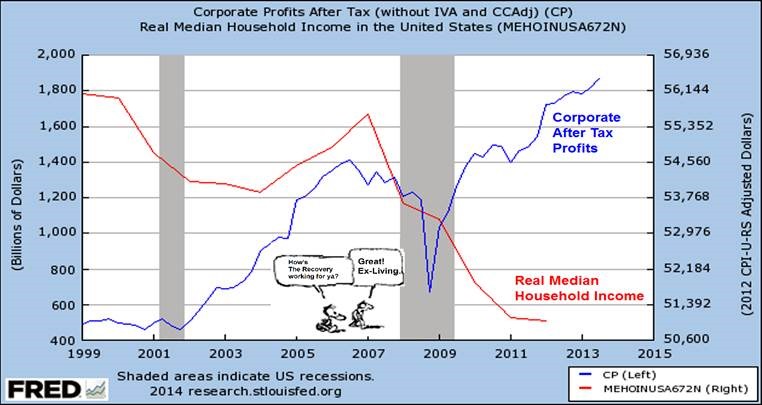
The Recovery:clip_image012

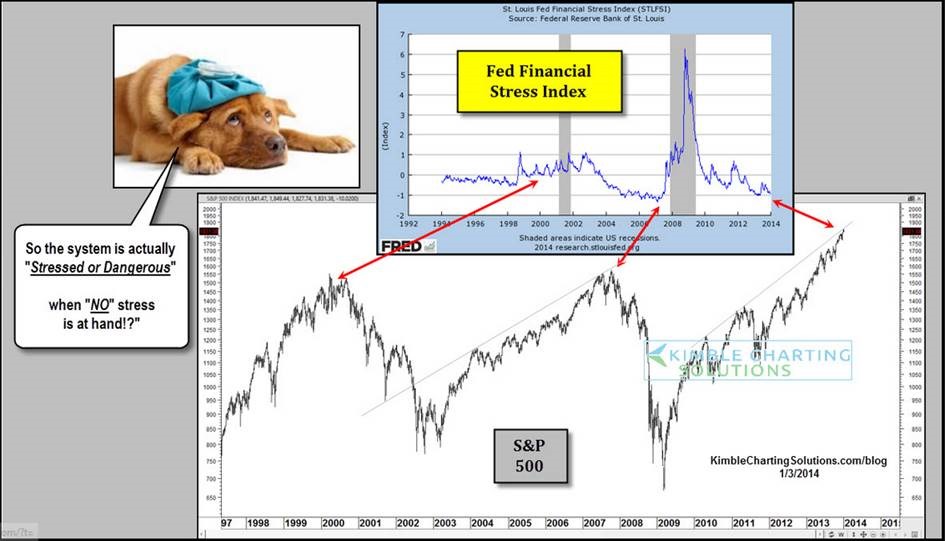
Is the financial system stressed?:clip_image014

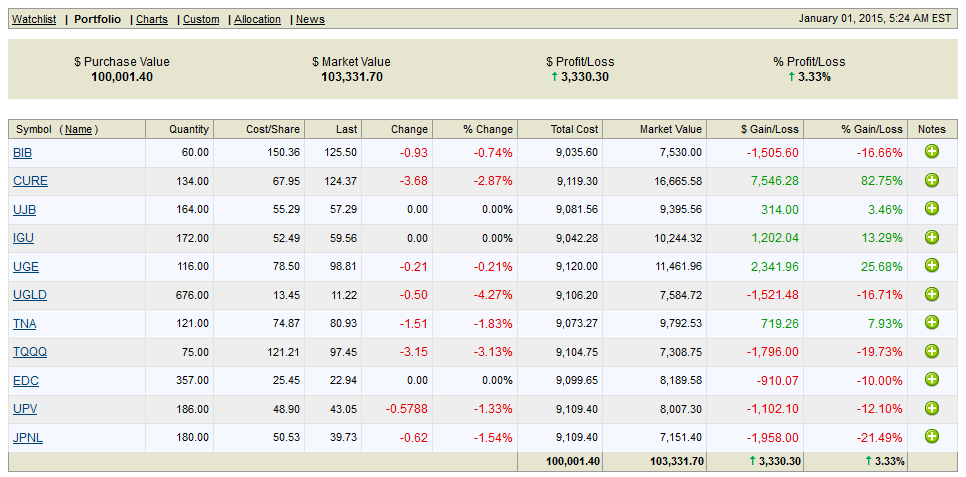
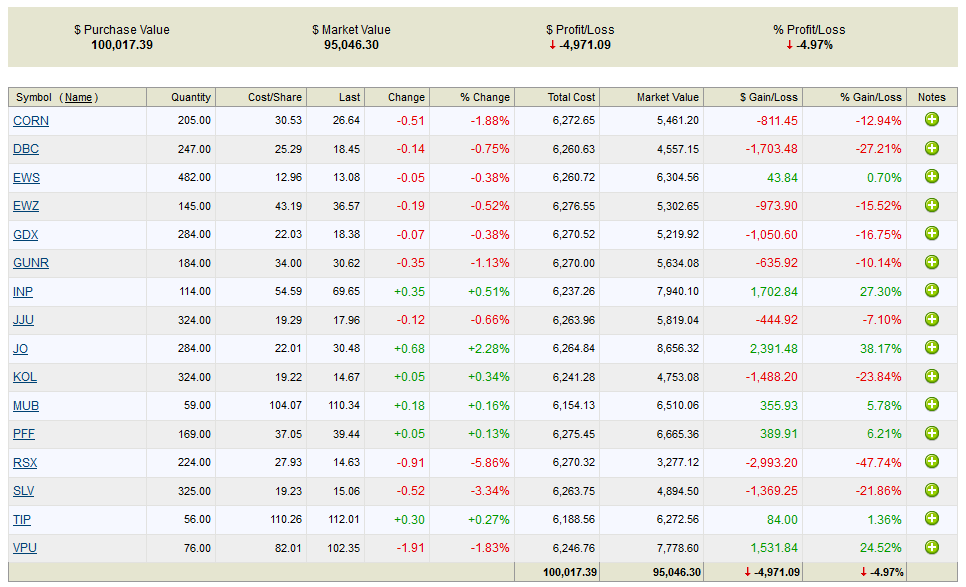
Below is the final “Portfolio Update” posted on 1/4/2015:

Here’s where I’ll maintain the updates to the ETF portfolios that I outlined in the January 2014 post titled, A Few Sample ETF Portfolios to Watch. If you haven’t read it and are curious as to the rhyme and reason behind these experimental portfolios, then please read the post for a full explanation. The portfolios all started with a “play-money” value of $100K. We’ll see how “buy & hold” closes out 2014. CLICK ON EACH TO ENLARGE.

Update 1/4/2015:  Say goodbye to 2014, the year of nothing specifically working except holding everything. Obviously, the adroit speculator was able to generate income in various and specific asset classes. However, the casual investor trying to pick stocks or even the majority of hedge fund managers were both trounced again by a levered ETF of the S&P 500. So much for trying to follow the trend while also also trying to be contrarian. That little thought experiment crashed and burned. I have a strong suspicion that indexing ain’t gonna be as easy as it’s been the last 2 years but who knows. I’ll leave these results up for the rest of the month and then bid adieu to this specific page regarding the 2014 experimental portfolios. Maybe I’ll come up with something else to add to the site, but at the rate I’ve been posting, don’t get your hopes up. Good luck in 2015, muppets!

1. Look Back & Ahead as of 12/31/2014:Look Back & Ahead (2014 Year End)

2. S&P 500 as of 11/18/2014:
S&P 500 (2014 Year End)

3. Levered Look Back & Ahead as of 12/31/2014:Levered Look Back & Ahead (2014 Year End)

4. S&P 500 2x Levered as of 12/31/2014:Ultra S&P 500 (2014 Year End)

5. Contrarian New Year as of 12/31/2014:

Contrarian New Year (2014 Year End)