Geological Assays, Biological Assays, Speculating Like an Ass, Hay! – Part 1

Two sectors of the equity markets that always attracts free-wheeling speculative capital like a moth to a light is early-stage biotech and junior precious metals companies. This will be a two-part posting; the first for biotech and the second for precious metals. Like I did for the “Sample ETF Portfolios”, I’ll keep separate running portfolios for the sectors against benchmark ETFs, leveraged ETFs, and stocks.

As I’ve stated in a previous post, I think biotech could end up in a huge, mega blow-off due to the M&A activity that will continue to get larger and more irrational as the equities bull market ages. Another reason M&A activity will spike is because the players who have access to easy credit to fund a debt driven shopping spree will want to get their hands on as much capital as possible before conditions tighten. Double-digit returns are obviously a whole lot easier on purchases with WACCs that are sub-4 or 5%.

I thought that biotech may be leading a potential larger market sell-off but the sector continues to show resilience. Right now IBB is consolidating and has bounced off the 50 and 100-day EMAs with ease during its ascent in 2015.

clip_image001

As I said before, the conservative play is to simply buy and hold onto this bull and ride it for what it’s worth, bucking and all…but conservative isn’t fun. Yeah, yeah, I know that prudent capital allocation is not supposed to be fun. It’s about responsibly stewarding capital into intelligent investments to outperform the markets over the long term. Fine, but there isn’t a speculator, investor, or market player alive today that doesn’t get a thrill out of watching their holdings outperform the market. With that in mind let’s look at how we’ll construct a speculative portfolio of biotech stocks.

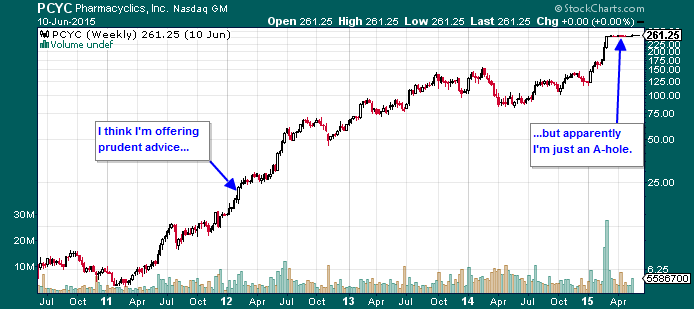
Now I’m not a biotech expert by any means. I gave up trying to cash in on the next big thing in medicine last decade in and around the time every American became an expert in real estate. For the most part, that’s been the right move but there’s always opportunity costs. In February of 2012, a friend asked for my opinion on PCYC when it was trading for a little under $20. He had shared with me some quality insight into the potential value of the company but my bias caused me to advise on passing on it. This was even after the deal with J&J. My name is Mud.
clip_image002

This was a ten-bagger mistake by allowing my previous experiences to misguide. Speculating in biotech is a slippery slope, though. One can get a taste of easy, probably lucky profits and think the process can be replicated, only to have hopes and trading account balances dashed.

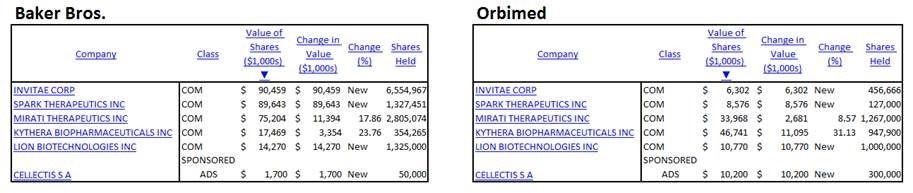
Which is why we’ll simply piggy-back the experts. Baker Brothers and Orbimed are two of the premier investment operations that specialize in biotech. Orbimed possesses approximately $15B in assets under management. Baker Brothers manages slightly less but has a higher profile with the public, especially after their huge billion-dollar gains in Synageva and Pharmacyclics in 2015.

It’s the old 13-F strategy made a little simpler. Instead of combing through their 13-F’s at the SEC site, I just hit the NASDAQ instead. There you’ll find the institutional portfolios, free of charge, of both Baker Bros. and Orbimed. They are updated as of Q1 2015. My logic is to simply cross-reference Q1 additions for each fund of the same companies, whether they’re a new position or an increase to an existing holding. The thesis being that if it’s good enough for both these guys then it’s good enough for me.

Bear in mind this is generally not a sound way to invest by any means. Sure there are dozens of sites dedicated to cloning professional portfolios by using 13-F filings, but blindly following a pro is just unsound. It always pays to conduct thorough due diligence. Gleaning ideas to further research is very different from blindly following a respected professional into a position. The thing about 13-Fs is that you never know how the pro is actually playing the position. How are they hedging? Are options involved? You just never know. With that being said…

The following are the stocks we’ve come up with from cross-referencing the Q1 additions.
clip_image004

This will not be a real-money portfolio for me, however, I reserve the right to position as I see fit should I be so inclined. If you want to take a flyer, without putting in any work, at higher biotech returns as M&A finally supercharges the sector then this little portfolio is as good a gamble as any. We’ll run this portfolio against five other investment options for biotech exposure.

The first option will be IBB, the all-weather biotech ETF with the most assets under management that has extensive coverage and great liquidity. IBB will be the benchmark. The next option will be LABU, which is the Direxion Daily 3x leveraged ETF of the S&P Biotech Select sub-index. This is our leveraged play without the margin. It’s very new; less than a month old. Trendy ETF creations that hop aboard trains which have already left the station have had a fairly consistent tendency to signal that the destination may soon be reached. As noted countless times though, “soon” is a relative term.

The third and fourth biotech investment options are the BioShares ETF offerings from LifeSci Index Partners. Paul Yook is the co-founder and portfolio manager for LifeSci. He came from Galleon as a portfolio manager and analyst. Despite the downfall of Galleon’s founder, it was still one of the more powerful hedge funds during its prime. You can garner some additional knowledge via this May ETF Reference interview with Yook. The thing that is nice about these two particular ETFs is that LifeSci offers two levels of risk. They offer BBC which takes positions in biotechs at the clinical trials level and has the potential for higher reward. Then there is BBP which only “invests in biotechnology companies with lead drugs already having received FDA approval.” In theory, BBP should reduce some of the risk and volatility compared to BBC.

The final investment option will be Ligand (LGND). They are basically the only publicly traded royalty play in biotech. They’re essentially modeled after the natural resources royalty players. Think Franco Nevada or BP Prudhoe Royalty Trust but with a wide-ranging portfolio of medicinal therapies at varying levels of clinical stages. LGND possesses a portfolio of over 120 partnered programs with biotech players ranging from the highly speculative to the most established in pharma. A position in Ligand is a bet on management’s competence to expose investors to some of the best profit generating opportunities in biotech while de-risking the investment, so to speak.

Be warned though, LGND has seen its share of volatility. Yes, it has treated shareholders exceptionally well for those who have been able to buy and hold over the last 5 years, but it hasn’t exactly been a one-way ticket to Profitsville. There’s been a few stops to Correctionville along the way including a recent 45% haircut through most of 2014.

clip_image005

None the less, as the only royalty option in the biotech sector I still want to track it against our speculative portfolio, volatility-warts and all.

I’ll post portfolio updates once a month. You’ll see a new link on the Marginrich.com home page around the beginning of next month. The tracking page will maintain nominal dollar gains and percentage gains as well. They’ll look exactly like I what used before with the Sample ETFs.

So there you have it; multiple ways in which to capitalize on what could be an explosive rise in biotech as M&A potentially rages out of control. If you’ve missed this several hundred percent move off the 2009 lows, then here is a perfect opportunity to get positioned for the final blow-off which should come just as it always does for every biotech boom. I don’t think this blow-off is imminent so please don’t misunderstand what has been written. I just feel very strongly that biotech M&A will catapult returns in the sector based on what we’ve seen in every other boom over the last 15 years. The timetable, as with all speculation, is the real question. This portfolio will be tracked indefinitely until we see signs of a legitimate trend-ending correction. Come back often to track the results.

One final note before signing off. For the truly conservative investors out there who visit this site, I just wanted to offer a quick update on one of the funds that I highlighted in my post regarding the emergency fund. It would appear that now may be an opportune time to position into the muni-bond closed-end funds. My preference happens to be NEA but there are a multitude available. Most of them happen to be at their 52-week lows in regards to their respective discounts to NAV. The 10-year Treasury yield is bumping up into what appears to be stiff resistance while at the same time hitting a 61.8% retracement off the Dec. 2013 highs to the Jan. 2015 lows. Additionally, NEA has retraced 38.2% off of its Dec. 2013 lows to Jan. 2015 highs while currently trading in a price range where it has tended to bounce off of. Three out of the last 5 times we saw the price action dip like this to the $12ish range we saw a relatively quick bounce back up into the $14ish area. The two times NEA went lower than $12 and took longer than normal to bounce back up over $14 were aberrant situations like the GFC of 2008 and the huge muni-selloff of 2013. It looks like a good time to take advantage of some great tax equivalent yield with the potential for some decent share price gains.

Short-term Equity Risks Arising

Despite Wednesday’s(3/25/2015) market weakness on virtually nothing but fear, there is plenty of technical action showing that markets appear fine. The question is how reliable is the action. Breadth indicators across multiple indices are positive. Small caps are leading large caps. Consumer discretionary to staples are favorable. Rate sensitive ETFs(TLT & XLU) have been conducting basic retracements which is perfectly natural coming off their hard sell-offs, but I think their selling will resume which will continue to indicate higher risk appetites once stocks take a little breather of their own. If the equity markets do what I think they’re going to do, which is correct a little harder here in the near-term, then I suspect TLT and XLU will chop for a bit while stocks let off of a little steam.

clip_image002

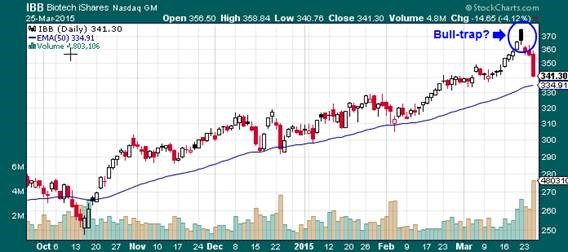
Everybody has their own methodologies for reviewing the markets to get a feel for the probability of directional plays. I really like to use inter-market analysis to help me potentially sense where the greater market may be headed. I have been watching biotech very closely as it has been the hottest sector and a market leader for some time. Real weakness in biotech may be a precursor to overall market weakness. That action last week in IBB had me suspicious. To me it appeared to be a blow-off. Call it what you want, a throw-over or a bull-trap. Either way the price action raised my hackles and officially put IBB on my radar as a temporary short. Current price action in IBB and the S&P 500 may be proving that out.

clip_image004

Now clearly, biotech is in a raging bull market and has been for several years now. You don’t want to fight that trend. It’s better just to ride it upwards for continued profit, because it’s going to take a lot more M&A in that sector before we see a top in biotech. However, there was a bit of froth in biotech M&A during the first quarter of 2015. Observe the following chart courtesy of Reuters and just look at Q1’s performance amongst pharmaceutical companies compared to the last 5 years.

clip_image006

We haven’t seen that kind of aggression since coming off the lows of 2009. There’s been approximately $60B of M&A activity in pharmaceuticals to start 2015, which accounted for 10% of overall M&A activity in the quarter. Twenty-one billion alone of that $60B was done in the Pharmacyclics purchase by AbbVie. That also signaled to me a potential short-term top for biotech as J&J and AbbVie slugged it out for rights to the cancer-fighting company.

So the real question then is how is this information actionable? Well that depends on your appetite for risk and how you’re looking to allocate capital in the short-term or long-term. If you’ve been visiting this blog for a while then you’re well aware I’m always ready to roll the dice based on my ability to interpret market action. I think shorting biotech via IBB or XBI is a good opportunity. I could have positioned earlier, but I was waiting for the price action to confirm so as to hopefully avoid being whipsawed.

If any readers are inclined to risk come capital, I think that IBB’s price action has stated to market players that it looks good for a short-term short. A small bounce at this price point is likely; especially in light of that 4% down day. I suspect the bounce could move the share price back up into the $355 to $365 range giving weak hands sufficient room to liquidate. That liquidation could then kick off the next leg down in biotech. There is a very strong floor at $290 as that is where the current 50-month EMA rests, so any option players will want to factor accordingly. I’m not stating that I think IBB will definitely hit $290, just that it’s a strong price point of support.

If IBB’s share price creates un-compelling options price points for smaller traders, then the XLV is a solid alternative. It has higher relative strength due to the size and various types of non-biotech holdings, but XLV possesses sufficient exposure to biotech that it will correct as well and it’s options may allow for a wider range of speculators to employ strategies.

As for the larger market i.e. the S&P 500, I wouldn’t expect anything deeper than a 10% correction if even that deep. There’s strong support at its 50-month EMA, as well, which is currently at $1,987. A 10% correction would take us down to approximately $1,900, which is also a round-number “power line” that I see providing strong support. I also suspect that any sell-off would result in yet another V-shaped recovery so be prepared to remove any short bias as a new leg higher ensues for the S&P 500 and biotech. Remember, these are interpretations based on my inter-market analysis. There are plenty of breadth indicators putting a more positive spin on things.

The markets are tricky, rigged, and no place for the ignorant. Manage your risks accordingly and utilize any potential correction to get long. There is continued quantitative easing on a massive scale across the world and the Fed is still reluctant to raise rates just yet. Current liquidity levels and yield curves continue to put a wind in the sails of higher risk assets. As Q1 draws to a close, take a moment to review your portfolio and see where you stand in 2015.

American Assets Discounting European Politics

Last summer, I shared some thoughts on the stock markets’ abilities as a discounting mechanism for future events. The gist was that stocks may provide a murky read some times when it comes to prophesying.

Reading the current macro signals is a tough endeavor for any speculator, and with today’s volatility, all the more dangerous when making bets based on those signals.

That being said, I get the feeling that last week’s action in some of the rate-sensitive sectors in combination with general stock market consolidation is portending a positive outcome in the Greece/Europe situation. Bear in mind these thoughts are pure suppositions based on nothing more than a hunch. I’ve been wrong before. I’ll be wrong again. As the old Soros saw goes, “It’s not whether you’re right or wrong that’s important, but how much money you make when you’re right and how much you lose when you’re wrong.”

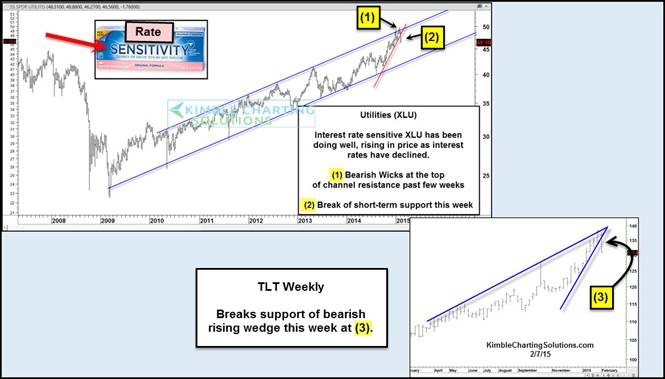
Kimble recently provided a long-term view of two key sectors.

clip_image002

We’ll revisit the impact of the breakdowns in those sectors, but the whole world of finance is focused on the potential resolution of Greece’s debt-financing problems. We have Goliath, the Troika(ECB, IMF, and European Commission “EC”), attempting to dictate the how, what, and when to David aka Greece. Right now a political game of poker is being played with the potential for worldwide ramifications. Greece’s new management is playing the hand it’s been dealt in what appears to be a very transparent fashion. Basically, they’re happy to stay in the euro as long as fair terms are met in a reworking of current debts to the Troika.

The Troika, god I hate saying that word but it does beat out typing the three entities, is really trying to play hardball with Greece but they have no leverage. None. Ok, maybe the smallest amount; just to play chicken. In my estimation, 98% of the leveraging power belongs to Greece. Dijsselbloem, EC head finmin, and Schauble, German Minister of Finance, have both been bellowing the fiery rhetoric from the tops of their lungs, “Greece better pay or else!” Or else what? They’re going to let Greece depart the euro? Ok. Yeah, sure.

Greece isn’t going back to the drachma in an exit from the euro, at least not this year, because the markets would be roiled. There are simply too many things that could go wrong to upend the European status quo for a Grexit to happen. Let’s just logically play out a generic sequence of events. Europe can’t let Greece totally default. For the owners of Greek debt and of course credit default swaps on the debt, credit events would be triggered across a multitude of financial institutions which could in turn then trigger counterparty liquidity risks which would instantly panic the financial universe. This instant panic would hit all the developed stock markets but with a focus on the European stock markets, which would negate the positive effects of the trillion-euro QE plan before it even had a chance. Too me, that’s enough to know that even if the deadline for a Greek debt resolution is pushed out, it’s still going to end with Europe caving but in a manner which saves as much face as possible.

Germany’s account surplus is so ridiculously large that I don’t really think they are going to tell Greece to go souvlaki itself. German total employment is high and exports continue to be robust. Pushing Greece to exit the euro would create an environment of fear where recession could rear its ugly head at a time when German companies are rolling. While Greece has all the appearances of being the linchpin holding the euro together, they’re really just a very, very important lugnut. Italy is the real linchpin. Their debt has the potential to topple the world. Which is why Europe doesn’t want to easily concede to Greece and open the door for Italy to dictate revised terms of its sovereign debts. Aside from Italy, there is obviously still Spain, Portugal, and Ireland; but Italy is the megaton nuke that can change everything.

Aside from the financial obstacles for Europe, there are the more important political complexities that must be addressed in pushing Greece too far, too hard. Russia has already extended an olive branch for Greek funding and Greece officials are reporting that China has now offered a helping hand. The world knows that China possesses the funds to help provide a financial backstop for Greece. I suspect the world may doubt how much funding Russia can lend in light of its own domestic problems concerning the ruble’s decline alongside oil’s rout. I contend that doubt would be misplaced. Does anyone really believe that Europe would simply push Greece into Russia’s waiting and open arms, where after, Greece will be free to negotiate any number of fear-inducing considerations like the usage of Greek ports for the Russian navy. Or how about land or sea allowances for petroleum energy pipelines. Maybe missile battery emplacements “for protection” on the northern Greek borders.

These are extreme examples as Greece is still a NATO participant, but it is unknowable with which the speed of certain actions could be taken should political alliances be shifted over this money. Consider how fast Russia appropriated the Crimean peninsula. All the angles have to be considered and with Merkel’s established relationship with Putin, I don’t see the Troika being allowed to precipitate negative financial and geopolitical outcomes.

What is difficult to reason, for me at least, is how the US will come to bear its influence in this whole game of thrones. America will have its say on bailing out Greece, but how and where and with what level of impact is a challenging thought experiment.

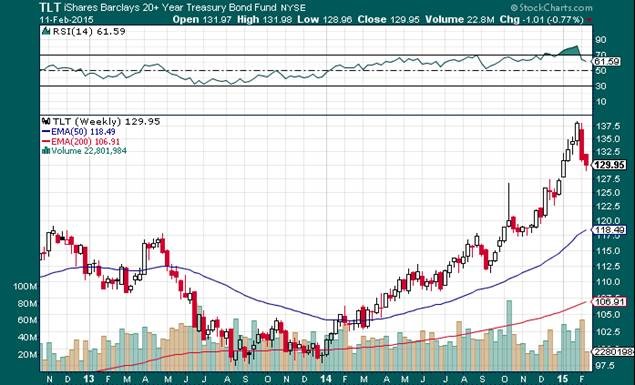
Coming back to American assets and their ability to discount the European outcomes, I think the speed with which the rate-sensitive sectors dropped last week are the tell-tell signs. Examine the two following weekly charts of TLT and XLU.

clip_image004

After a stellar run in 2014, that was a precipitous drop last week. The overall trend remains up, but the situation is very fluid as we have to consider the interrelationships between markets, especially the dollar and implied volatility across Treasury yields.

clip_image006

A familiar market adage is that Utilities tends to be a precursor for the greater stock markets. Any correlation is possible at any given time in the markets, however, we live in an age with remarkable volatility across asset classes. Thus, old interrelationships that once used to prove semi-reliable, may just not be so consistent. I think the Utilities, Treasuries, and yields are telling us that the general market environment is about to go risk-on with another leg-up in the greater stock markets.

There has been no shortage of writing on the significant perils in the market. I have read many a sound analysis that a major dislocation is “near.” But that’s the problem with using a word like “near” or any of its synonyms. Near is a relative term. It’s a word that gets used in a sentence and can mean anything from 1 day to 3 months to 2 years or whatever. Most analysts, bloggers, and general market commentators aren’t willing to stick their necks out and provide a more precise timeframe based on their opinions. They just point to a lot of evidence that says it’s “near.”

I agree that the next major leg down in the markets that began with the Great Recession in 2008 is near. I’ve long-stated that I thought 2015 – 2016 were going to be the years that major catalysts presented themselves for an epic sell-off, but I don’t think that time is upon us. I’m convinced that the markets will draw in a lot more participants first. I want to get that 1999 and 2007 feeling first. You know the feeling I’m talking about; that feeling that the markets will never go down and speculating in the stock market is a can’t lose venture.

The danger of deflationary forces is reasonably priced into the markets. Japan is still easing while the Fed is continuing to roll assets and now we have the ECB embarking on a trillion dollar extravaganza. I have read analysis that the efficacy of the ECB’s easing is highly questionable due to negative rates around the continent. I say nonsense. Animal spirits only care about a liquidity buffer to fill voids. Besides in a risk-on environment, yields will rise as higher levels of capital will flow into equities in a sector-rotational chase for alpha.

Risk-on is not mutually exclusive of risk management, no matter what. Countless interviews with billionaires around the world back up the fact that risk management is the number one key to successful speculation and investing. That being said, look for the general stock markets to pick up a little speed in advance of a potential workout between Europe and Greece. In just the last few days we’ve had two US hedge fund billionaires share their opinions on a Grexit. Dan Loeb, of Third Point, thinks there’s a lot of risk associated with these markets and has lowered net exposures across his funds so far this year. David Tepper, of Appaloosa, thinks there is nothing to worry about if Greece exits the euro. He basically stated that there’s a handful of percentage points of loss to worry about, but that the markets are strong enough to overcome a negative outcome. Loeb is prudent. Tepper believes in his analysis. I think the GermansEuropeans will reach an accord with Greece sometime soon(another relative term) and the stock markets will eat it up.

There is still that little matter of the dollar, euro, and their extreme levels in sentiment. Carry trades continue to be wonky in light of the dollar strength. Maintain a close eye on these currencies as they will enhance a risk-on move. Whether you believe the markets are discounting future events or not, there is a persistence of extreme movements. A European resolution with Greece and a shift in dollar sentiment may just provide a profitable environment for stock market participants.

JJG Still Ain’t Ready

In my last post, I stated that I’d be sharing some thoughts on college football and I will later today with another post or no later than tomorrow. That’s a promise for any sports gambling addict readers who’ve been waiting with bated breath to read my words. I just wanted to share a couple of quick thoughts. One on JJG, which I wrote about a couple of months ago. Additionally, I wanted to share a note from the Price Action Lab blog as well. I regularly follow Mr. Harris’s work, but his note on Friday the 19th was the best work I’ve seen out of him.

For any readers who deign to label themselves technical analysts it’s a must-read. Really it’s a must read for any trader. In the very short but sweet article he covers these BTFD, V-shaped recoveries that started in 2012, agreeing with the timeline I also posited when squiggly-reading began losing its efficacy. Harris hypothesizes that this is due to central bank intervention. Have a look at the chart for yourself and consider back to the hard balance sheet expansion of the world’s central banks.

clip_image002

Harris goes on to opine that indexing’s time in the sun may have an abrupt shift into darkness. As for the last 5 years, he also basically states that what has been won’t always be. Take it for whatever it’s worth, but I recommend taking a few minutes to ingest the article.

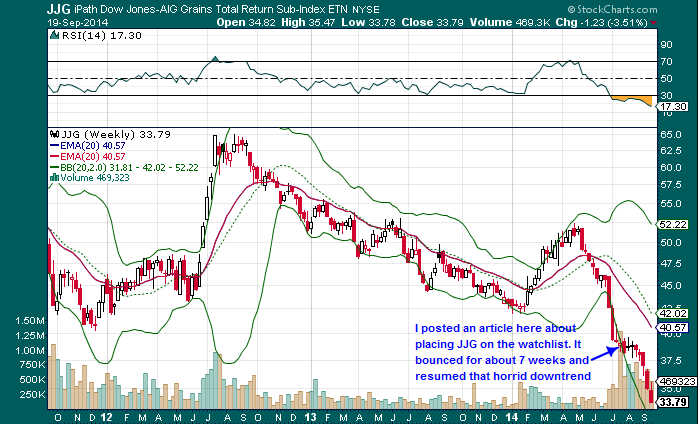
Regarding JJG, don’t feel bad if you tried to bottom-tick that one too early. Them’s the breaks. I had stated that the trade looked ripe but that my indicators weren’t giving me a go. I also stated that I would send out an update if the indicators give the green light. Now this ain’t the update for the green light, it’s just to let any readers know that we’re still keeping an eye on the ETF. Soybeans, corn, and wheat are getting destroyed. It’s serious destruction and the greater commodity index (CRB) just took a dip past support, so it’s not looking good for a trade anytime in the immediate future.

However, one of my indicators has flattened out and the other appears to be following. Even if they do shift, that may simply lead to some bottom bouncing consolidation for several months as opposed to a V-shaped rocket ride upward. I wouldn’t expect a coffee style abrupt turnaround, but anything’s possible. Have a look at the weekly JJG chart in case you haven’t in a while.

clip_image003

Once the indicators have turned in favor of an uptrend, then the HFT shops may just juice this thing for nice little return. I hope to have you along for the ride on the timing of that one. We’ll have to wait and see. For reference sake, let’s take a look back at coffee’s beautiful halt to its downtrend and abrupt rocket ride upwards for the lucky schleps(or skilled) who rode that trend to the bank.

clip_image004

Alright, so read that article from the Price Action Lab blog. Keep a wary eye on soybeans, corn, and wheat. And enjoy Saturday. College football is back, so go pay your bookie a visit and dare to be great.

PS: Marginrich.com does not condone nor endorse any illegal activity regarding unsanctioned and unlicensed sports wagering. If you are compelled beyond your will to place wagers on the outcome of any sporting event maybe it’s time to seek counseling and admit the problem is real. Read those two sentences really fast like the MicroMachines commercial guy with the moustache from the 80’s and it’ll sound real official. And for anyone who thinks I’m insensitive to the genuine sickness that is a gambling addiction and reads articles here, get real, I write about speculation regularly.

Whipsaw, Whipsaw

MAN ALIVE! That action on Monday is enough to make a trader fold up operations and go back to counting beans or selling un-needed crap to folks. That was seriously some hair-raising action. Did you get your stops ran? Did any of you traders get whipsawed by Monday’s action? Rest assured, you probably weren’t alone.

If you’re attempting to go short here across any of the indices and had your stops ran on Monday then kudos to you for maintaining discipline. However, you just may be missing out on more of the fun of a potential downmove. Hard to say because my crystal ball is in the shop and for some unforeseen reason I’m not omniscient. It really makes me mad that I can’t call the exact turns of the market. Oh well. I still think a downward short-term bias is in effect and eventually the perceived risk indexes(Russell 2000 & NASDAQ) will finally pull down the “Great Proxy”, the S&P 500.

So far, so good for the S&P 500 as it set new highs this week…and has promptly come off those highs. Is that strong price momentum? Have a look at the daily action in the VIX. It gapped down to start the week and within 3 days that gap has filled, but still yet, the VIX is still down around all-time lows.

clip_image002

The MACD has been a pretty simple and fair indicator to clue traders in when the volatility is going to start spiking. Observe at the green lines that every time the MACD turned upwards, the VIX was usually in the early stage of an up-move. Are we at another up-move right now? It feels like it. If things get dicey, a quick move up to 20 on the VIX could easily occur.

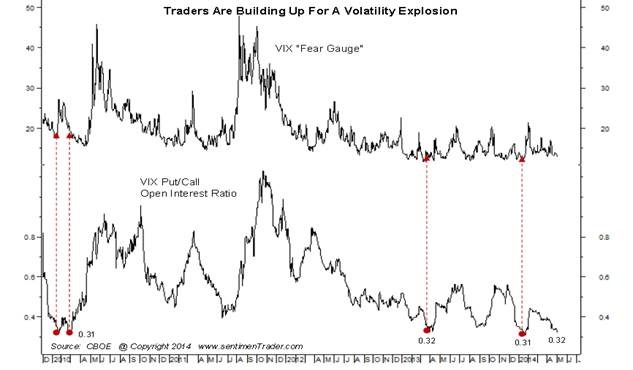
A couple of weeks ago, SentimentTrader shared a chart depicting the VIX Put/Call Open Interest Ratio. It puts on full display what the current option action on the VIX is saying about volatility. Judge for yourself:

clip_image004

There are plenty of messages being communicated very loudly and clearly by the markets. These aren’t esoteric signals that only the true professionals can divine. Anybody with the ability to read and some dial-up internet internet service can see these messages…more power to you if don’t have to result to a screeching connection via Juno or NetZero or whoever the hell provides dial-up these days. Also, to any readers who currently utilize dial-up to access this blog, please excuse my insensitivity.

Things are happening in the markets such as defensive rotation. Utilities have performed fantastically so far the past few months while the rotation to staples vs discretionary appears to have begun. Less and less issues are hitting 52-week highs despite the DOW and S&P 500 sitting near their own highs. Treasury rates continue to drop. Wal-Mart missed fairly big on YoY Q1 income. High-flying tech and small caps have already come off pretty hard and these are where the risk is allocated. Social media sites trading at P/E’s in the multi-hundreds. Biotech stories being sold on a wing and prayer for ridiculous valuations.

High-flying tech and small caps are part of what I call the 3-legged risk stool that are sort of propping up the animal spirits of the entire, current stock market. Two of those legs have been kicked out, so to speak, and yet still the S&P 500 hasn’t really shaken out the bulls. The third leg of the shaky risk stool and thus potentially the ultimate catalyst for a correction in the broader markets is junk bonds, I suspect.

If junk bonds correct here within the next 14 to 60 days, with remaining weakness in the NDX and RUT, then things can get real hairy, real fast for people who are poorly positioned for the move. Have a look at what Kimble shared over at his site a few days ago,

clip_image006

So then what could be a catalyst besides stiff resistance? Oh I don’t know. Maybe the humongousest junk bond issuance in financial history. Anybody remember seeing this near the end of April?

clip_image008

The markets have a funny tendency to act a little wonky after the largest-ever of anything occurs.

The action this week has that sort of a backdraft feeling to it. In case you never saw the movie, a backdraft(as defined by the Collins English Dictionary) is “an explosion that occurs when air reaches a fire that has used up all the available oxygen, often occurring when a door is opened to the room containing the fire.” Buyers potentially get a final pull into risk assets before an explosion outwards for a fast and hard move down after the right catalysts make their presence known.

Despite the already well covered move down in the Russell 2000, it appears as if there is plenty of room for a continuation downward. If you’re trading IWM, then keep your stops at an appropriate level. Biotech’s IBB essentially bounced off it’s 38.2% retracement using the week of August 8th, 2011 as your starting point for a quick Fibonacci analysis. A cautious short in IBB with the potential for further selling down to between $200 and $205, may yield a nice return during this summer. In a previous post, I had stated that I thought coffee was setting up for a short but my favorite indicators were not providing a green light just yet. Well those indicators finally gave their green light. If you’re feeling brave you can follow me on a short of JO with approximate targets of $35 and $30, if the selling momentum really gets going.

The list of investing icons who are advising caution continues to build. We’ve had mutual fund heroes like Romick of FPA and Yactkman share their thoughts months ago on building cash levels. Klarman, Marks, and Grantham have given the thumbs down. Now we had David Tepper, Mr. Highest Paid 2013 Hedgie, providing his valued insight on these precarious markets. It may not pay to listen to or heed a blogger like myself. That’s for you to decide; but you can’t dispute that it pays to heed what these most esteemed gentlemen have to share.