Oil & Economics – All Q, No A

Almost nobody saw the crash in oil coming. A handful of savvy investors and analysts shared this thesis but were largely ignored. For all intents and purposes, “nobody” foresaw the action in oil which is the essence of the dumb crowd missing it again. Not inferring that I am not an occasional member of that dumb crowd, just commenting on the oil industry.

When oil prices dropped, the instant message that was and continues to be bellowed across the financial landscape is that the drop would provide a pseudo-tax cut for the great unwashed in the form of lower gasoline prices. Along this line of thought is that the commoners will spread this saved gas money throughout the economy in various outlets. This should in turn support GDP levels, which is of course fallacious. Through Q3 of 2014, the US is annualizing 5% GDP growth. WHOOOOO! Gonna get some cold cuts based on that level of growth!

The problem with the thesis that lower gasoline prices should support or maybe even boost GDP levels discounts two very important factors to the economy. Number one, nobody can predict the level of the money saved from lower gasoline prices that will go into personal savings. Number two and more importantly, the importance of the oil industry to national employment and economic growth has been totally discounted by far too many educated parties. Just look at how important the oil industry has been to America’s employment recovery.

clip_image001
(chart courtesy of Prof. Mark Perry)

Now add in North Dakota and it’s growth in employment thanks to the Bakken. Last month the Joint Economic Committee provided an update courtesy of the BLS. Since February of 2010, the national low point in private sector employment, North Dakota added 102,500 private sector jobs. A vast majority of those went to petroleum related companies, making the “US Employment Minus Texas” numbers look even worse. Maybe you’re one of those thinking in your head with a Patrick the starfish voice, “Yeah, but a percentage of that job growth for Texas and N. Dakota is dedicated to non-oil like teaching, retailing, food services, etc.” Sure there’s growth in those areas too but an overwhelming majority of the growth has come in industries like mining, logging, transportation, utilities, and construction; where the pay has been significantly higher on average than in the non-oil industries. An argument could even be made that a high percentage of the growth in non-petroleum based jobs was simply derivative growth from the petroleum industry.

Well what’s the point? There are a couple of points, actually. Talking to one’s self consistently is a strong precursor to madness, so at least I’ve got that going for me…which is nice. Seriously though, one of my points is where does the job growth come from in America now that the oil patch growth and development has fallen off of a cliff? Amazon DC part-timers? Wal-Mart part-timers? McDonald’s part-timers? Maybe I’m failing to notice a forest through some trees here but I’m having a hard time seeing the downward trend in unemployment continue its happy descent into “full employment.” And for the 1 plus 1 crowd, if there’s less people employed then there’s less people to buy things. Maybe there will be enough growth across all the other non-oil and gas industries, but that chart up above sure says a lot about placing too much faith in that thesis.

The second point, which may be even more relevant, is where will the growth in US corporate capital expenditures now occur? It’s very late in this business cycle coming out of the Great Recession and capex output is still relatively weak compared to previous cycle recoveries at the same stage. Capex has been essentially carried by energy. Let’s look at some facts regarding US capex and the oil industry. Energy(primarily oil and gas) accounts for approximately a third of all capex in the S&P 500. That means it’s virtually irreplaceable. Need a visual? No problem.

clip_image002
(chart courtesy of Zero Hedge via Deutsche Bank and the Bureau of Economic Analysis)

So if I’m understanding the basic tenets of the TV economists’ argument, US GDP will be just fine despite the oil industry tightening their belts because American consumers will use all that money they saved at the gas pumps at their favorite retailer, service provider, or online. BOOM! Problem solved.

I just can’t reconcile that thesis with the facts as they are presented via the press releases of major oil companies. ConocoPhillips has already announced it’s slashing its capex budget by 20% for 2015, which means $3 billion less than 2014. Suncor, Canada’s largest company by revenue, is slashing it’s capex budget by $1 billion dollars for 2015 while also cutting operating expenses by up to $800 million in addition to a 1,000 person reduction in the workforce. Conoco did not announce layoffs in their presser regarding capex but you can be sure there will be layoffs there and across the board. We have yet to hear from the two giant US elephants of petroleum energy, Exxon and Chevron. Analysts are essentially expecting an average decrease of 25% in investment spending by energy companies.

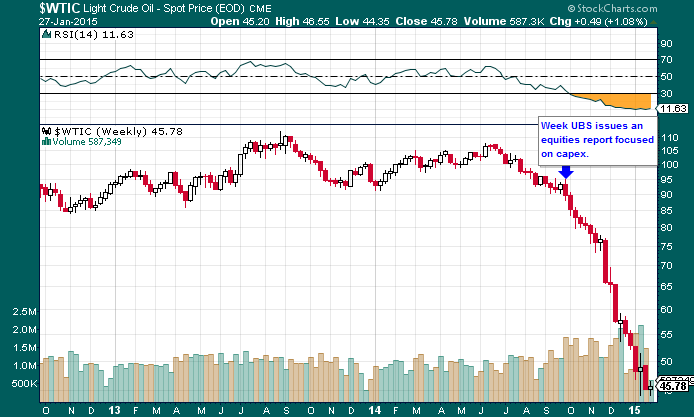
This subject has been covered extensively at Zero Hedge. You can obtain additional details and their always-optimistic opinion right here and here. There are some blog and finance news snobs out there who look down their nose at Zero Hedge, but the fact of the matter is they do a good job credibly covering a wide swath of financial, economic, and geopolitical news; and literally everybody reads it. None the less, for you financy snobs that need a Wall St. bank’s take on capex, here’s a September 26th, 2014 report courtesy of UBS with impeccably timed commentary on capex. Here’s a couple of gems from their Equity Strategy team: 1. “Capex rising thesis still intact”, and 2. “…business fixed investment is forecasted by UBS economists to rise by 6.2% in 2014 and 7.8% in 2015.”

Let’s just see how the timing of that report’s issue coincides with the fall in the price of West Texas Intermediate Crude.
clip_image003

Does 7.8% growth in 2015 capex sound credible now? Well done UBS Wealth Management. Positive guidance on capex right before capex is about to be gutted via a 50% slide in the oil price. Let’s do some basic, rough arithmetic based on the Deutsche Bank chart up above. Thirty-two percent of $685 billion is $220 billion. Twenty-five percent of $220 billion is $55 billion. So approximately $55 billion of what was to be potentially spent in 2015 is going to be eliminated and yet employment or GDP should be unaffected as the economy is recovering in the US. That’ll be what gets sold by the main stream media.

Oil and gas notwithstanding, the capital expenditure reports coming out of the Federal Reserve branches were laughable. It’s all IT spending. Go read the December 3rd, 2014 Beige Book to see for yourself. Here’s an exercise for those who refuse to read the sleep-inducing report. Click that Beige Book link and search(hit ctrl-F) the document for “capital expenditure” and simply read the surrounding text. It’s mostly IT. I’m pretty sure that network upgrades and addressing cyber security concerns aren’t going to carry the US economy in conjunction with consumer spending, but we’ll have to wait for 2015 to play out.

The bottom line is that 2015 is going to be a most interesting year for the US economy and the rest of the world for that matter, too. Just look at the volatility we’ve already seen across currencies, central banking behaviors, geopolitics, etc. I’m still seeing plenty of rosy projections for the US economy, coming off that 5% read, and maybe I just need somebody to crack me in the head to help me see the data in a better light.

Sa-wing Batta!

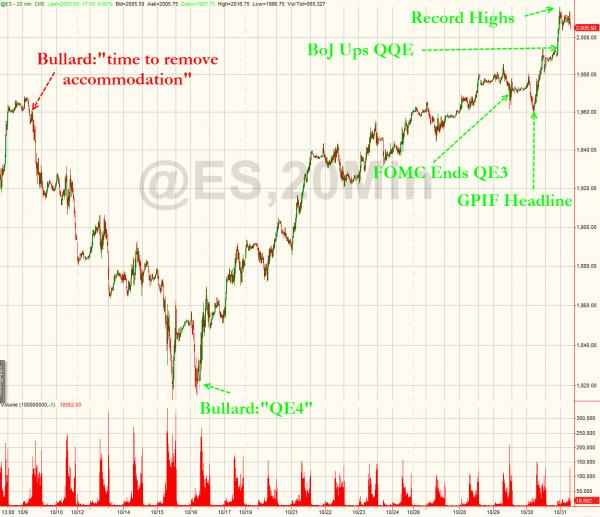
If you played, coached, or spectated little league baseball or watched Ferris Bueller’s Day Off, then you’re familiar with the age-old, friendly taunt of “Hey batta batta batta batta, sa-wing battaaaa.” During early morning Halloween hours, the Bank of Japan(BOJ) provided the treat of all Halloween-day treats for speculators around the world. They announced additional quantitative easing that set the stock markets around the world on FIYA! BOJ Governor Kuroda went and grabbed the 50oz special big-boy bat and took a monster swing at deflationary forces.

clip_image001(photo courtesy of Reuters)

What a miraculously well timed announcement on the heels of the Federal Reserve reiterating the completion of its own QE program. Of course, the Fed’s not really wrapping up just yet as it will continue to roll as opposed to liquidate the assets it has purchased over the last 5 years. The Nikkei’s intraday move was over 4%. Most of the major indexes around the world gained over a percent today thanks to the “good” news.

Japan’s central bank will be upping its bond asset purchases to $60B(all numbers in this post are in USD) a month or $730B annually. The US dollar amount will fluctuate as the Yen weakens against it, however the BOJ will keep steady at about $6.7 trillion yen a month. They claim that the move is temporary until inflation targets have been sufficiently met. Yeah, about that temporary thing? Along with the bond purchase announcement, the BOJ also stated that they’ll be buying up Japanese ETFs and REITs to the tune of almost $7 billion and $1 billion a year, respectively. That’s a lot of dough to be tossing around and my guess is that it’ll drive enough positive sentiment that from a political standpoint, nobody’s going to want to sign off on terminating the purchases. Imagine the negative perception along with a move down in animal spirits. As they say in Jersey, dey don’t want nuttin ta’doo wit dat.

Additionally, the BOJ coordinated the announcement with the Government Pension and Investment Fund of Japan (GPIF), the largest pension entity in the world, which 1 day earlier stated they would be upping their own stock purchase program. Specifically, the GPIF announced it was paring back its Japanese debt holdings from 60% of its portfolio to only 35%. An unheard of allocation choice for a pension entity considering the lack of conservatism. They might as well have said “we’re all in on stocks.” They’ll be doubling their equity exposure to 50% of the portfolio.

Rational economic thought behind these massive moves is how will the unintended consequences manifest themselves down the road? Kuroda, like all central bankers, assures the public that they can control the inflationary forces that they so desperately desire. Maybe for a little bit. Maybe forever. Recall Kyle Bass’s thesis as the BOJ is walking a fine line. At this point in the game, it’s hard not to believe that central bankers really do have everything under control. This is despite the fact that monetary and economic policies in the advanced economies have no parallels in history, and in the short-term, things seem to be working out brilliantly on a statistical basis. It is difficult not to observe all the activity while thinking that the unintended, and most probably, uncontrollable consequences will be the ultimate arbiters of the societal value behind these unprecedented steps taken by the central banks of the westernized nations.

In the meantime, enjoy the ride and the implacable rise in financial asset prices. Actually, in a November 2013 report, McKinsey stated the impact of ZIRP on asset prices is inconclusive. Specifically, they state, “…we find little evidence that ultra-low interest rate policies have boosted equity prices in the long term. In the United States, the evidence on whether action by the Federal Reserve has lifted the housing market is also unclear, because it is difficult to disaggregate the impact of these measures from other forces at work in the market.” That’s curious.

One would think logically that there would be a direct correlation between record low mortgage rates and new home purchases. Combine that with a ridiculously low WACC for the biggest financial players and Americans said hello to their new landlords, yield-starved institutional investors and astute corporate vultures. It would also be logical to assume that when an entity can borrow at 1% and buy back its own stock yielding 2.5%, that there would be positive arbitrage opportunities. The fact that those opportunities lead to reduced share counts, increase earnings, and thus drive up stock prices has no correlation to ultra-low interest rates.

D-short presents a perfect illustration of the “low-correlation” effects of ZIRP and QE on the stock market.

clip_image003

As I was saying, enjoy the ride. Buy every damn dip. Just buy and hold. Buy, buy, buy! In reality, I continue to think that raising cash levels due to a true lack of value across multiple sectors is prudent portfolio management. That doesn’t mean liquidate your portfolio. It just means that raising cash levels for potential bargains that avail themselves may prove more profitable than simply sitting in holdings that have already accumulated a very nice gain over the last few years. Look at the E&P’s off of oil’s slide. Myself, I don’t think we’re going to see an avalanche down to $30’s like we saw after the fall from the $150’s. Toe-dipping into the really well managed opportunities that possess prime shale or offshore acreage appears to be presenting quality value. Observe the P&C insurance players as well. They held up remarkably well in the most recent sell-off and continue to report tremendous profitability, however, in the face of a softening price cycle.

Just be careful. If you think momentum ignition and government intervention(jawbone or real) are fictional notions that don’t affect volatility, then have a look at this ZH chart.

clip_image004

Coming back to our little baseball reference, America was the 3rd and most valuable batter in this game of QE. Japan is hitting clean-up and protecting America’s own aggressive batting strategy. At some point, the 5th man in the lineup needs to show his power capabilities as well and drive in some runs. That 5th batter is Europe and Draghi is wielding the bat. If the game of central banks is to continue unimpeded, then he needs to put down the 36oz timber and go get his own corked 50oz bat to stave off deflationary forces in Europe. That damn German 3rd base coach keeps getting in the way though and giving the signal to sacrifice bunt.

Lastly, if you have kids, then take them to the wealthy neighborhoods to fill their bags full of candy. If you’re at home and not trick or treating, then give out the giant sized candy bars. You’ll be loved by the neighborhood children. If you’re in your 20’s and single, then go party it up with all the Halloween hotties(female or male) dressed to impress tonight…and be safe. Happy Halloween readers!

Some Musings About Q3

Musing 1. Why do new home sales data releases by HUD possess any significance?

Maybe so that the HFT houses have a headline for an algorithm to pump millions of unfilled bids into a market. It’s baffling. For me, the most important part of a release by HUD regarding new residential sales is the Explanatory Notes. In this section they tell you how wrong their data could be and they lay out all the statistical errors that could be occurring due to things such as “bias, variance from response, nonreporting, and undercoverage.” Reported numbers are consistently displayed with standard deviations of plus or minus percentages in the teens or twenties. For example, September’s results show a 0.2% (+/- 15.7%) above revised August new home sales.

That means the actual number may have been as low as -15.5% or as high at 15.9%. The dispersion is so wide as to render the results effectively meaningless, which is why there are always revisions. But why would revisions possess any more statistical relevance when weighed against the potential of HUD’s self-reported surveying errors? Observe the median sales price from August to September. It went from $275,600 at the end of the summer to $259,000 in the beginning of the fall. While the average price of a new home sale dropped from $348K to $313K. Drops of that magnitude have to make you question the credibility of the August new home sales pricing data. Did prices for a new residence actually drop that much in a single month or was it that the data was massaged to begin with? Not even the Census Bureau will provide a quality answer. I know the confidence level of the statistics is at least 90% but c’mon. Honestly.

Can you imagine if other industries were allowed to utilize such wide standard deviations in their statistical reporting. Take biotech. “Each participant that takes the pill in the study has approximately a 50% chance of increasing their lifespan by 12 more years…plus or minus 40%.” Or how about plane engine manufacturers. “We believe this critical engine component will operate in extreme conditions with a failure rate of 0.03% (+/-72.7%)” These are extreme, outlandish examples to be sure, but you hopefully get the point. Admittedly, my statistical skillset is decidedly above the average dolt off the street, but assuredly below regular practitioners such as finance & economics professionals or academics. The book is still open on whether or not to reject the null hypothesis that MarginRich is actually just one of the said dolts off the street.

Musing 2. What’s the big deal about oil reserves vs. oil resources?

This musing stems from an article I read at Bloomberg that was titled, We’re Sitting on 10 Billion Barrel of Oil! Ok, Two. The theme was expanded on at Zero Hedge that potentially the whole petroleum renaissance is nothing more than smoke and mirrors. Now I enjoy Zero Hedge as much as the next bloke, but I wouldn’t expect them to so quickly jump on the extremist bandwagon when it comes to E&P’s sharing their opinions on resources.

The basic gist of the Bloomberg piece was that oil and gas companies are grossly irresponsible in reporting resource potential in their corporate presentations versus the actual reserves they are filing with the SEC. However, before they get into the meat and potatoes of the article they share a giant caveat about investors and the differences between reserves versus resources. The authors quote Scott Sheffield, CEO of Pioneer Resources, one of the largest players in Texas with significant rig counts in the Permian and Eagle Ford. Sheffield states that experienced investors know the difference between the two numbers. Specifically, “Shareholders understand. We’re owned 95 percent by institutions. Now the American public is going into the mutual funds (or ETFs), so they’re trusting what those institutions are doing in their homework.”

Precisely. Experienced and sophisticated investors know that resource potential is not the same as current, existing barrels of oil in ground. That doesn’t mean that through innovative techniques that a high percentage of those resources cannot be converted into reserves. Patience and demand are the keys to the development of refined exploration techniques that can continue to expand the US energy base. The article implies that the shale boom is potentially a large scandal waiting to blow-up with Enron-like repercussions. That is an epically gross exaggeration. E&P companies have time and again improved or grew reserves at rates consistent with estimates. Additionally, we’ve seen the oil and gas players consistently beat reserve estimates established by the EIA for various geographic areas.

Bloomberg provided a snapshot of companies to graphically show the disparity between the two numbers:

clip_image002[6]

Any speculator in hard assets, knows what the steak and the sizzle are in natural resources. The reserves are the steak. The resources are the sizzle. It would help if more of the E&P players would utilize the P’s more in their presentations for the retail players who want to get in on the action. The P’s stand for proven, probable, and possible. Proven or 1P reserves have a high probability of being produced and you can count on the number. Then there is proven and probable, which is 2P; and then proven, probable, and possible is 3P. The higher the number of P, the less likely the company can produce the reserve. However, that doesn’t eliminate the current or future viability and economic potential of the resource. These P-designations, standard nomenclature in the industry, are easy to understand and not nearly utilized enough in company presentations. Oil and gas are no different than gold, silver, platinum, copper, or any other natural resource. All natural resource companies report reserves and resources and it’s up to the speculators to conduct their own due diligence.

Musing 3. There’s some serious Kool-Aid drinking at First Trust

First Trust is an investment advisory firm founded back in 1991. They’re fairly sizeable in that through their assortment of ETFs, mutual funds, and other various products; they’ve been able to garner $32 billion in assets under management. A hefty sum by any measure, but very small compared to the biggest players in the game.

The Monday Morning Outlook is a weekly little opinion piece that First Trust puts out that also includes a schedule of important economic releases for the week. Content is hit or miss with this shop, however, there was one piece from last month that struck me as an egregiously, cowardly article. You can have a read for yourself to see if I’m out of bounds in my assessment. I admit that based on my own opinions shared at this site, that I could be labeled a doom & gloomer, but I simply refuse to un-acknowledge the current and future distortions that have and will occur in asset markets around the world thanks to central bank interference.

The piece titled Why Do Stocks Keep Rising?, from September 8th, pumps First Trust’s fist in the air behind a sis-boom-bah of how the markets have continued their upward ascent despite the steady flow of negative-impact events over the last 5 years. They don’t understand how pessimism can remain so ingrained for certain pockets of investors under such conditions. I know it’s a quick 1-page offering that they throw up every Monday, but you can’t just break out the pom-poms and then stick your head in the sand without truly acknowledging the reasoning of the very parties you are criticizing. Amateur hour!

They don’t touch on how central banks have kept the cost of capital at virtually zero for longer than any period in history despite an “improving” economy and “improving” employment. They extol the virtues of the rising profits across industries but share nothing on top-lines and how that will affect profits going forward. Or how slashing SG&A and CapEx in combination with share repurchases has significantly affected stated earnings to the positive. Nor do they expound on how these behaviors are unsustainable. They fail to acknowledge that the current situation of central bank involvement in the developed nations has absolutely no precedent, and thus, no back-testable strategy for when the house of cards begins to wobble.

As an investment adviser it behooves them to cheerlead so as to grow assets under management higher and higher. That’s fine and they have a right to share a one-sided puff piece. They should just try not to be so damn cowardly the next time they want to cheerlead investing in a rising market right before a 7%(which I stated will not be the low) haircut commences.

Before signing off, I wanted to touch on the current action in the S&P 500. In my last article, I had stated that if the price action is simply a bounce within a larger correction that I thought the 1,950 area to be a solid resistance point before turning down again. Today’s close at 1,964 is still around 1,950, so we’re not quite out of the woods just yet. If we move onto sustained new highs then I will offer a mea-culpa, but I continue to think that caution is warranted. I’ll leave you with a chart shared by Lance Roberts at STA Wealth that displays the price action in the S&P 500 during the last two corrections that reached a depth of 10% or more.

clip_image003[6]

Fun With Employment Charts

Before we get to the employment chartporn, I want to share a quick note regarding my two previous posts and handicapping football games. I SUCK AT HANDICAPPING NCAA FOOTBALL THIS YEAR! College is usually my bread and butter but for some reason my radar for college handicapping has been turned off and my normally mediocre NFL radar has been fine-tuned into a well-oiled machine. Go figure. Either way, if any readers out there placed college football bets based on my picks, I hope you learned your lesson. As for the show of hubris behind my so-called college football handicapping ability, well you can be sure I learned my own lesson.

The BLS provided it’s September NFP update last Friday and the markets loved all of it. Not loving it so much now, but the overreaction was stunning last week. Unemployment fell below 6% which means America is fully employed! Hooray! Breakout the champagne because everyone that needs a job has a job in America. Hitting the 5% mark makes it true. Remember, when unemployment in the 5% range meant full employment? I think Lady Yellen’s memory is little bit fuzzy. According to a recent report at Bloomberg, “The labor market has yet to fully recover,” Fed Chair Janet Yellen said at a press conference after the FOMC meeting. “There are still too many people who want jobs but can’t find them.”

So everything is awesome, but not? Damn, and here I thought we were in full recovery mode. CPI inflation is tamed FOREVER! Monetary inflation is make-believe. And unemployment reached its magical number, so let the jacking up of rates begin already. Let’s taper the asset purchases by the Fed down to zero and feel some tightening; our economy’s ready!

Alright enough with the snark, if you haven’t already been charted out by the financial blogosphere and other various news sources then I’ll give you your fill. We’ll try to look at the perception and the reality. Bear in mind as you read these charts snipped from various other sites, that they’re all generated off of BLS data. You can go right to the BLS site yourself for verification. There you’ll find all the data tables needed to plug into Excel and create your own graphs. I readily admit that I’m way too lazy for that so enjoy your reblogged content.

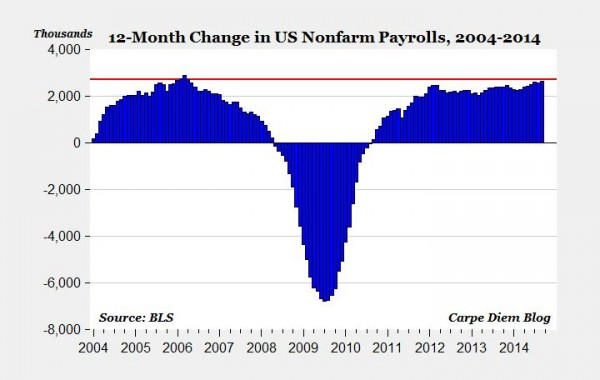
The first chart, courtesy of Carpe Diem, shows the 12-month change in NFP over the last decade. Basically, it shows that annual job growth is at a new high since the last peak in 2006.

clip_image001

Of course, this bit of great news coincides with an all-time high in temp hirings. Because nothing says full employment like setting a new record for temporary hires who will soon be unemployed again. Chart is also courtesy of Carpe Diem via FRED.

clip_image002

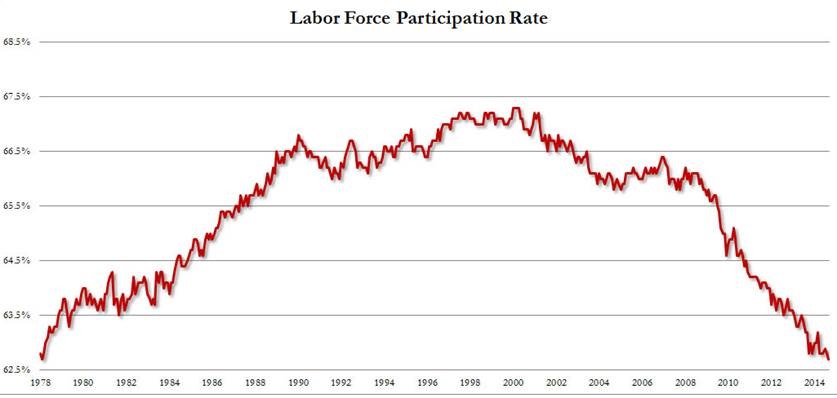
So this chart obviously speaks to the quality of the jobs being created out there, but you can’t review a new post-recession low in unemployment without reviewing the labor participation rate and its new lows. The next several charts regarding labor participation are all courtesy of the financial conspiracy theorists’ home site, Zero Hedge.

clip_image004

Allow me a quick indulgence here to rant on Josh Brown, The Reformed Broker, as he so unaptly stated in his own post last Friday regarding the NFP, “Losers will crawl out of their coffins and crypts to whine about the labor force participation rate, but no one cares. Think tank economists want things to get worse so they have some firepower for Fox News and MSNBC tonight. The reality is, the economy is growing as expected – slowly but surely – and there’s nothing “wrong” with today’s release. ” What a load of sellout, dickbag nonsense.

I remember when this guy used to offer fairly witty insights into the markets despite his own less than savory pathway into the field of finance. Now he’s so impressed with himself that he has to avoid reality, Krugman-style. I get that he’s now an established best-selling author, Yahoo Finance contributing personality, sometimes TV commentator, and CEO of a wealth management firm, so he’s had to sacrifice some of his original personality for some wealth and fame. No begrudgements here. Many famous and wealthy can be labeled a “sellout” but usually the only people who use that title, do so out of envy and/or disgust at their own lack of success. I assure you that’s not the case here. I’m just appalled at the sack this guy has in calling fellow reporters, bloggers, and media commentators, a “loser” for referring to the facts regarding America’s employment situation. This clown fish has been officially un-favorited at the MarginRich blogroll, because all 8 of my followers are really going to care. Okay, enough about Josh Brown. Wait, one more burn, what’s with the Something About Mary hairstyle?

clip_image006     clip_image008

Anyways, the percentage of working age Americans in the workforce has reached a 36 year low…but America’s fully employed at 5.9%. Right. A fair percentage of the decline in US unemployment numbers are directly attributed to the decline in the labor participation rate. There are a record 93 million working-age Americans that are not in the labor force. These facts have been reported on ad nauseam, but let’s drill down on the participation rate to the year the Great Recession started.

clip_image009

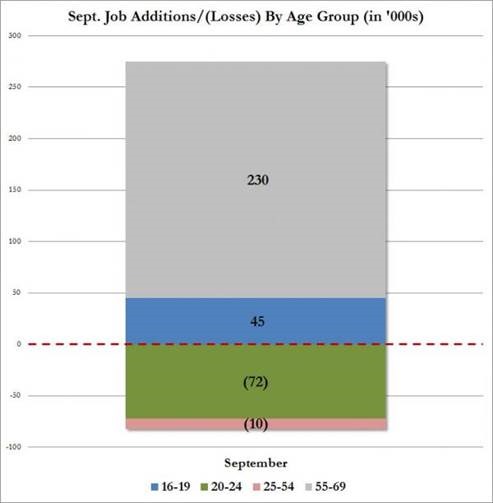
Many of Josh Brown’s ilk as disregarders of the labor participation rate will simply attribute the declining rate entirely to retiring employees. As I shared almost a year ago, the Philly Fed already tried to officially go down that route but the information just doesn’t conveniently jive. Lo and behold, look what demographic group was the largest gainer of job additions in September.

clip_image011

What do you know? It was the boomers and people in retirement age. Are we to believe that the demographic group of 55 and older is the backbone of America’s economic and employment recovery? Lest one think that this is an aberration or a one-off event for the month of September, there’s a chart for that, too. This trend has really picked up speed since the Great Recession.

clip_image012

Sorry millennials. You’re $80-Gs in debt for an education that got you a temp job where you report to a manager, aged 55 – 69, who has just been newly hired. Life’s tough. The youngest boomers and gen x don’t exactly have it a whole lot easier, but at least they’re entrenched in their jobs held from the Great Recession, where they’re just forced to complete double the work for the promise of a raise that hasn’t materialized in 6 years.

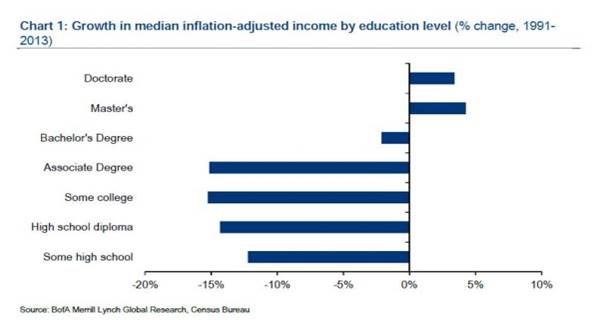
Since America is fully employed now, there should be much more income available for consumption to really begin to juice the economy. Especially since the tapering is near completion and we’re on the doorstep of the ever-so-important holiday shopping season. Unfortunately, we’ve hit a little roadblock in that department too as wages have been stagnating for some time now. Have a look at whose wages are actually growing, courtesy of BofA.

clip_image014

Unfortunately, only the most educated are consistently seeing growth in income generation. However, this statistic rides shotgun with the fact that a college degree is continuing to lose its edge as a value-adding tool for a new entrant into the workforce. Additionally, most of the middle-class, the back bone of the consuming public, fall into the educational categories below Master’s degree. Thus, negative comps at Wal-Mart, McDonalds, etc.

Demand is declining as exhibited by declining top-line revenues. We’re seeing more and more negative YoY comparable sales numbers across multiple industries. Earnings growth going forward probably won’t be driven by consumption so much as by share repurchases. I don’t want to be the constant doom and gloomer in the corner of the room brooding by myself, but if everything is so damn rosy why doesn’t it feel that way to the average American? You can’t just read the beige books, NFP reports, ISM reports, PCE and CPI price indexes, and all the other governmental reports while continuing to turn a blind eye to the genuine outlook here in the US.

Couple all this information with current stock market behavior and there’s reason to maintain a cautious stance. Last month I reported on the divergences occurring within the equity markets, offering that it was a time to take caution and build cash levels. I hope readers listened. Oil is tanking and it will generate a lot of financial buzz as it allows investors a much better entry point for previously missed opportunities. It will also provide a pseudo-subsidy to the American consumer. However, as some very important countries in the world rely on a higher price of oil, I can see where geopolitical conflict intensifies with Middle-Eastern concerns as well as Russia.

The currency markets are creating set-ups to coincide with the previously described events and that may lead to additional downside action in equity markets but possibly upside action in the commodity markets(except oil), specifically the precious metals. Please observe the following chart, courtesy of Kimble.

clip_image016

The currencies are important to keep watch on as they can be leading indicators for other asset classes. I hope you’ve built some cash levels to take advantage of the opportunities being created in several asset categories, because if you think this current sell-off is THE BIG ONE, you’re mistaken. We may get a very scary drawdown, however markets of all shape and size will see new highs going into next year and investors will want to be positioned to take advantage of the major momentum in asset prices that builds up to a legitimate bear-change in trend.

Oil and gas have sold off indiscriminately. If you felt like you were left behind in those areas, then be keeping a close eye. I wouldn’t be in a rush to start grabbing shares though, as the oil price may ride lower and for a longer time period than you’d think likely. Additionally, rig counts will take time to level off so drillers could remain depressed as well. We’ll see a bounce in driller names, but we’ll probably also see a resumption of their downtrend. Cash, a watchlist, and patience are the best friends of the prudent investor shopping for value. In the meantime, if you’re looking for a job then stop reading this damn article and go hit the Manpower agency to get a temp job you can call your own.

Economic Distortions

Here at MarginRich.com, I mention Jeremy Grantham and his firm GMO quite a bit. That is for two very big reasons. Number 1, he and his firm manage in excess of $100 billion for the biggest institutional investors across the land. And number 2, he’s publicly nailed multiple bubble calls. Does he nail them to the day? Well no, but he’s been close enough and has effectively ensured his clients were positioned accordingly to mitigate the damage of the last two major stock market bubbles.

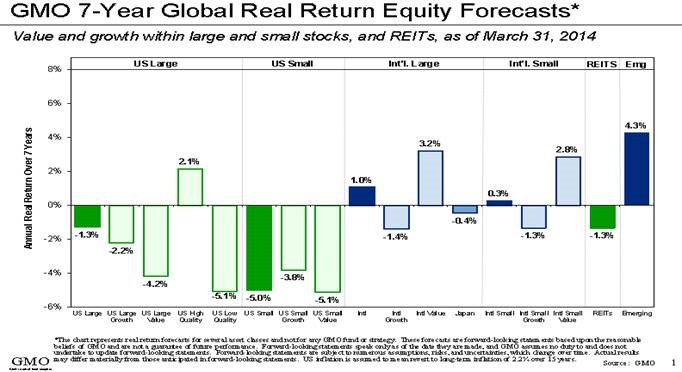
GMO came out with its most recent 7-year forecast for various asset classes and equities. It ain’t a pretty picture. These guys have consistently nailed their forecasts, especially for equities. They’re predicting negative returns essentially across the board of various sectors with pockets of relative strength in Int’l value, US high quality, and emerging markets. Observe the drilldown:

clip_image002

Why do you think this forecast is so negative? It may be valuations, but I think it’s because they see a major dislocation occurring within the next 7 years. This dislocation will cause most sectors to lose money over the specified time period. And of course depending how one is positioned, losses can and will be a lot worse than what is depicted in the chart. GMO will never reveal the secret sauce, so to speak, behind their methodology in determining their 7-year forecast. It’s probably safe to assume they use an amalgamation of various data inputs involving valuation, macroeconomic outlooks, interest rates, monetary trends, geopolitical trends, and so forth.

You don’t need to be able to reproduce the forecast in order to trust it. Knowing that this is how GMO perceives equity market returns going forward, one really needs to be conscious with their long-money portfolios. This is a message I have been consistently sharing over the past few articles, so let’s visit a few severe distortions that may have a major effect on equity markets within the next 7 years.

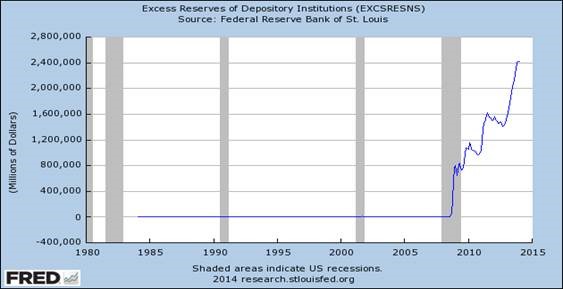
The first distortion is excess reserves maintained at the Federal Reserve. This first chart is to show how ridiculously large this number has grown to, which is now in excess of $2.4 trillion. That’s the cumulative and collected excess reserves of the banks who collude conduct business with the Federal Reserve.

clip_image004

Notice how before 2007, the amount was virtually zero. I realize this chart only goes back to the early 1980’s, so here’s a “Discontinued Series” chart that the Fed previously utilized to report the excess reserves. It goes back to the 1950’s and shows the same virtual zero in excess reserves as the normal course of business. That’s right, up until the Great Recession the amount of excess reserves held at the Fed was in the single digit billions. That’s basically zero. Since 2007, it has been a different story entirely.

clip_image006

For the uninitiated regarding excess reserves, I want to provide a relatively brief explanation. For the reader with an already good grasp, I apologize for any redundancy. The excess reserves were at virtually zero for all those decades because the Fed never paid any interest on them. Then in response to the entire financial world sitting on the precipice of obliteration, a multi-part plan was instituted in order to maintain the status quo and keep the entire system intact. The federal funds rate was dropped to zero where it has stayed, interest began to be paid by the Fed on excess reserves, and the process of quantitative easing(“QE”) was illustriously birthed.

The federal funds rate was dropped to zero so as to stimulate the economy in the face of certain deflationary doom. The book is still out on whether the US has seen true economic improvement due to ZIRP. What we do know is that savers are being heavily penalized by this policy and investors of all ilk are being forced up the risk ladder in increasingly desperate attempts for yield. The paying of interest by the Fed for excess reserves is one of the Fed’s tools for maintaining interest rates where they want them. It also just so happens to be able to provide a colossal liquidity buffer for the so called balance sheets of the participating banks i.e. Wall St.

Between the erroneously valued derivative books across the entire industry and jumbled collateral chains, the participating banks and the Fed think they’ve built an adequate buffer to potentially withstand additional impairment to balance sheets. And why shouldn’t they? They’ve got everything under control because now they can taper QE. Quantitative Easing was established to fight both fronts of the policy as a tool to reduce long-term interest rates while also stimulating the economy. Do you feel like the economy is stimulated? I know one thing for sure that has been stimulated and that’s asset prices. Take a moment to yourself and remember how this story has played out for the Weimar republic of Germany, recently in Zimbabwe, and even more recently in Venezuela.

Wondering why it matters so much that the banks keep their excess reserves at the Fed instead of productively using them within the economy? It’s because the money is essentially free. When the Fed monetizes its debt and buys assets such as MBS, it creates an asset on its own balance sheet and a corresponding liability. That liability is the excess reserves that belong to the TBTF banks who are the Fed’s main partners in facilitating QE. The banks keep those excess reserves with the Fed because why would you give away your gravy train and expose it to more unnecessary risk? The Fed pays 0.25% on excess reserves. May not seem like much, but 0.25% on $2.4 trillion equals $6 billion for the biggest banks to collect risk free in interest income.

If you were a bank CEO and knew you had derivative exposure that could single-handedly dismantle the system, would you kill the golden goose provided by the Fed? The proof is already in the pudding as the velocity of money is cratering but has had no material effect on our economy thus far. There’s no velocity of the money supply because banks aren’t lending out to businesses and households. Sure large corporations have been able to finance buy-backs and special dividends but capital expenditures have yet to reach a point of acceleration where we know some good economic tidings are bound to follow.

In the chart below, I’ve overlaid the rise of the excess reserves vs. the velocity of the M2 money supply.

clip_image008

If that’s not a chart yelling out for some mean-reversion, then I don’t know what is. So what are some triggers to increase velocity and why does it matter? An increase in velocity matters because that price inflation that everyone was so scared of during the beginning phases of TARP and QE, could finally begin to materialize. And this could hamstring any efforts to get the economy breathing on its own without the use of a respirator. As far as a trigger to generate velocity, it would take the Fed no longer paying interest(like they’ve almost always done) or even charging to hold excess reserves. The participating banks would immediately withdraw that $2.4 trillion in cash and put it to work. Where? Businesses and households. If those dollars hit the economy in a flood over the course of a year or two, we could see some scary jumps in asset prices that matter and not just fine art and collectible cars. Not to mention, there’s still all that cash that the mega-corporations keep parked internationally. If the US were to shift tax policy for this money and it were to be repatriated and spread around the economy, we could be talking about a doubly increase in money velocity.

The Fed knows this and you would think they wouldn’t be dumb enough to cut off their nose to spite their face but the Fed is backed into a corner. Additionally, the Fed has to answer to its political masters all while managing the world’s perception of America’s currency and economy. This is a dangerous game being played right now, as after 2008, Fed policy entered the realm of pure experimentation.

Would the Fed have maintained these policies this long, which are causing massive economic distortions, if the economy had really reached escape velocity or at least was well on its way? Let’s revisit interest rates, the second massive distortion. Gary Tanashian, with his Notes From the Rabbit Hole newsletter, provided an elegantly simple chart putting on full display the lack of efficacy of the Fed’s ZIRP policy to have any material effect on the economy. Below you’ll see the 3-month T-bill yield($IRX) overlaid against the S&P 500 index($SPX). You can see in the past 20 years that as the economy and markets picked up, the Fed would subsequently raise interest rates. That is completely normal policy and has been consistently used for decades.

clip_image010

But as you can see in the chart, where’s the rise in rates? The correlation of the two are generally fairly strong. Oh, so our economy is not genuinely approaching a growth level that warrants a raise in interest rates? These are the results of the great financial experiment, of which we are all a part of the double-blinded no placebo study that’s about to have a phase 3 letdown in the next year or two.

The Fed has been able to subvert a normal business cycle by reflating on demand through interest rate policy and monetary policy. That last doozie back in 2008 should have seen the destruction of several industry giants and the Fed wasn’t ready to allow that to happen in America. I get it. The pain and suffering would probably have been unspeakable and potentially worse than the Great Depression. When you combine the fact that the developed countries are so interconnected, the US didn’t want to single-handedly bring down the entire world’s economies. All that being said, the tricks to perpetrate the subversion of normal business cycle forces have been used up. You can’t drive interest rates any lower. You can’t print even more dollars and expect sufficient potency. Hence, the notion that the Fed is backed into a corner.

As far as impact to the market, I read a simple statement over at Economicnoise.com, that sums up the good fortune the Fed has had in driving up market prices in an attempt to drive the wealth effect while building animal spirits. Economicnoise.com stated, “Within the last fourteen years, there have been two major market corrections, both of which saw drops of 55% from their highs. That, or more, is the potential for what lies ahead…but next time the government is unlikely to be able to re-inflate the stock market bubble. To put into perspective how lucky (investors have been), it took 25 years for the Dow Jones to recover to its pre-crash highs after the Great Depression. Likewise, the Dow hit an intraday high of 1,000 in 1962 but never closed above 1,000 until about twenty years later.”

These distortions are what the doomsday types, Austrian economics practitioners, goldbugs, and similar minded types have been seeing and simply can’t seem to shake off. The team at GMO has never been labeled as any of those types; only true professionals’ professionals in the game of capital allocation. Below is the other chart in their 7-year forecast and it covers multiple asset classes as opposed to just equities.

clip_image012

The granddaddy winner for the next 7 years is timber, according to them. So forget about investing. Go cut some trees down. Chop’em up and store them in your house. Over the next 7 years that wood will have outperformed your 401k. Lame jokes aside, there are a few ways to easily make a play on timber. There are of course the biggest North American players such as Plum Creek (PCL), Weyerhaeuser (WY), Rayonier (RYN), and Potlatch (PCH). If you prefer ETF’s, there is iShares Global Timber & Forestry (WOOD) which focuses on North America and thus has significant positions in the largest players here. For more of an international flare to your timber exposure, Guggenheim offers its own Timber ETF (CUT). A cursory glance of CUT’s holdings will show that it focuses its holdings around the planet as opposed to N. America.

Since the average joe can’t simply invest in huge plots of timber like a hedge fund, endowment, or pension fund, then these are decent options to play the sector. PCL is the biggest of the N. American group and thus has a well established reputation on the street. However, friends and old colleagues will already be familiar with what is probably my favorite way to garner some timber exposure, and that is through Brookfield Asset Management. BAM! Remember though, at the end of the day these are still equities and have the potential to be pulled down with every other sector in the event of a sell-off or major dislocation.

Comparing Plum Creek to Brookfield Asset Management is not exactly an apples to apples comparison, as Brookfield is a massive asset manager focusing on real or hard assets with a portfolio approaching $200 billion. Plum Creek possesses the largest portfolio of timber acreage in N. America, so their market capitalization is justified. PCL carries a timber portfolio worth approximately $5 billion. Brookfield’s portfolio of timber acreage is significant in real terms but small compared to their entire portfolio. BAM carries approximately $4 billion worth of timber assets, and that is after selling approximately $2.5 billion worth of timber assets last year to Weyerhaeuser. BAM will monetize assets when appropriate. They don’t hold just to hold, however they’re considered some of the finest value investors in the world when it comes to real assets.

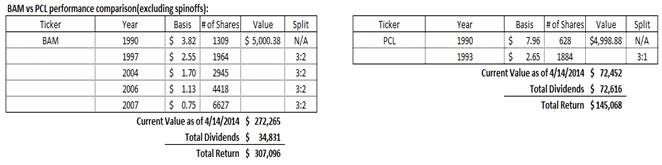
Let’s take a side by side look at long-term performance of each company since 1990. We’re using 1990 as PCL was founded in 1989, so I wanted to give it a year of operations under its belt for comparison purposes. The following chart compares the split adjusted values of each stock starting with an initial $5,000 and includes dividends but excludes the two spin-offs(BIP & BPY) from BAM.

clip_image014*Dividend data garnered from Dividata.com

You can see that BAM’s long-term performance speaks for itself. If you account for BIP & BPY, then to me it appears to be a no-brainer between the two for long-term exposure to timber. PCL’s dividend is vastly bigger, so if an investor needed that higher yield for whatever reason then it would make the decision of choosing between the two a little tougher. Overall though, if you want some timber exposure in combination with other world-class real assets then BAM is a heckuva way to play it.

Valuations matter. Momentum can be ridden, but in the end a stock’s price will revert to an appropriate valuation after momentum has made investors lose their collective minds. GMO’s forecast is not to be taken lightly. It’s just another recent indicator that should really make investors pause and think before allocating capital. I tend to concur with old Uncle Warren in that it’s not usually a safe bet to bet against America, so I promise that I’m not a total gloom & doomer here at MarginRich.com. These economic distortions, just a few of so many, are communicating a signal that America and really the world’s developed markets could find themselves in some pretty rough seas in the not too distant future. Invest accordingly.