American Assets Discounting European Politics

Last summer, I shared some thoughts on the stock markets’ abilities as a discounting mechanism for future events. The gist was that stocks may provide a murky read some times when it comes to prophesying.

Reading the current macro signals is a tough endeavor for any speculator, and with today’s volatility, all the more dangerous when making bets based on those signals.

That being said, I get the feeling that last week’s action in some of the rate-sensitive sectors in combination with general stock market consolidation is portending a positive outcome in the Greece/Europe situation. Bear in mind these thoughts are pure suppositions based on nothing more than a hunch. I’ve been wrong before. I’ll be wrong again. As the old Soros saw goes, “It’s not whether you’re right or wrong that’s important, but how much money you make when you’re right and how much you lose when you’re wrong.”

Kimble recently provided a long-term view of two key sectors.
clip_image002

We’ll revisit the impact of the breakdowns in those sectors, but the whole world of finance is focused on the potential resolution of Greece’s debt-financing problems. We have Goliath, the Troika(ECB, IMF, and European Commission “EC”), attempting to dictate the how, what, and when to David aka Greece. Right now a political game of poker is being played with the potential for worldwide ramifications. Greece’s new management is playing the hand it’s been dealt in what appears to be a very transparent fashion. Basically, they’re happy to stay in the euro as long as fair terms are met in a reworking of current debts to the Troika.

The Troika, god I hate saying that word but it does beat out typing the three entities, is really trying to play hardball with Greece but they have no leverage. None. Ok, maybe the smallest amount; just to play chicken. In my estimation, 98% of the leveraging power belongs to Greece. Dijsselbloem, EC head finmin, and Schauble, German Minister of Finance, have both been bellowing the fiery rhetoric from the tops of their lungs, “Greece better pay or else!” Or else what? They’re going to let Greece depart the euro? Ok. Yeah, sure.

Greece isn’t going back to the drachma in an exit from the euro, at least not this year, because the markets would be roiled. There are simply too many things that could go wrong to upend the European status quo for a Grexit to happen. Let’s just logically play out a generic sequence of events. Europe can’t let Greece totally default. For the owners of Greek debt and of course credit default swaps on the debt, credit events would be triggered across a multitude of financial institutions which could in turn then trigger counterparty liquidity risks which would instantly panic the financial universe. This instant panic would hit all the developed stock markets but with a focus on the European stock markets, which would negate the positive effects of the trillion-euro QE plan before it even had a chance. Too me, that’s enough to know that even if the deadline for a Greek debt resolution is pushed out, it’s still going to end with Europe caving but in a manner which saves as much face as possible.

Germany’s account surplus is so ridiculously large that I don’t really think they are going to tell Greece to go souvlaki itself. German total employment is high and exports continue to be robust. Pushing Greece to exit the euro would create an environment of fear where recession could rear its ugly head at a time when German companies are rolling. While Greece has all the appearances of being the linchpin holding the euro together, they’re really just a very, very important lugnut. Italy is the real linchpin. Their debt has the potential to topple the world. Which is why Europe doesn’t want to easily concede to Greece and open the door for Italy to dictate revised terms of its sovereign debts. Aside from Italy, there is obviously still Spain, Portugal, and Ireland; but Italy is the megaton nuke that can change everything.

Aside from the financial obstacles for Europe, there are the more important political complexities that must be addressed in pushing Greece too far, too hard. Russia has already extended an olive branch for Greek funding and Greece officials are reporting that China has now offered a helping hand. The world knows that China possesses the funds to help provide a financial backstop for Greece. I suspect the world may doubt how much funding Russia can lend in light of its own domestic problems concerning the ruble’s decline alongside oil’s rout. I contend that doubt would be misplaced. Does anyone really believe that Europe would simply push Greece into Russia’s waiting and open arms, where after, Greece will be free to negotiate any number of fear-inducing considerations like the usage of Greek ports for the Russian navy. Or how about land or sea allowances for petroleum energy pipelines. Maybe missile battery emplacements “for protection” on the northern Greek borders.

These are extreme examples as Greece is still a NATO participant, but it is unknowable with which the speed of certain actions could be taken should political alliances be shifted over this money. Consider how fast Russia appropriated the Crimean peninsula. All the angles have to be considered and with Merkel’s established relationship with Putin, I don’t see the Troika being allowed to precipitate negative financial and geopolitical outcomes.

What is difficult to reason, for me at least, is how the US will come to bear its influence in this whole game of thrones. America will have its say on bailing out Greece, but how and where and with what level of impact is a challenging thought experiment.

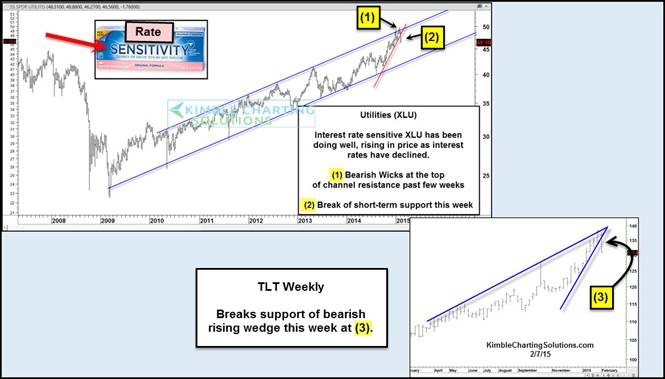
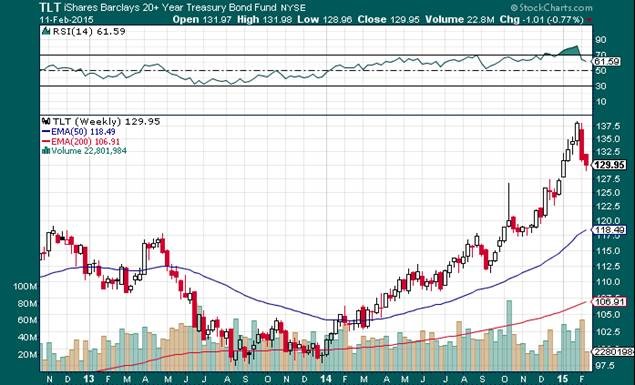
Coming back to American assets and their ability to discount the European outcomes, I think the speed with which the rate-sensitive sectors dropped last week are the tell-tell signs. Examine the two following weekly charts of TLT and XLU.
clip_image004

After a stellar run in 2014, that was a precipitous drop last week. The overall trend remains up, but the situation is very fluid as we have to consider the interrelationships between markets, especially the dollar and implied volatility across Treasury yields.

clip_image006

A familiar market adage is that Utilities tends to be a precursor for the greater stock markets. Any correlation is possible at any given time in the markets, however, we live in an age with remarkable volatility across asset classes. Thus, old interrelationships that once used to prove semi-reliable, may just not be so consistent. I think the Utilities, Treasuries, and yields are telling us that the general market environment is about to go risk-on with another leg-up in the greater stock markets.

There has been no shortage of writing on the significant perils in the market. I have read many a sound analysis that a major dislocation is “near.” But that’s the problem with using a word like “near” or any of its synonyms. Near is a relative term. It’s a word that gets used in a sentence and can mean anything from 1 day to 3 months to 2 years or whatever. Most analysts, bloggers, and general market commentators aren’t willing to stick their necks out and provide a more precise timeframe based on their opinions. They just point to a lot of evidence that says it’s “near.”

I agree that the next major leg down in the markets that began with the Great Recession in 2008 is near. I’ve long-stated that I thought 2015 – 2016 were going to be the years that major catalysts presented themselves for an epic sell-off, but I don’t think that time is upon us. I’m convinced that the markets will draw in a lot more participants first. I want to get that 1999 and 2007 feeling first. You know the feeling I’m talking about; that feeling that the markets will never go down and speculating in the stock market is a can’t lose venture.

The danger of deflationary forces is reasonably priced into the markets. Japan is still easing while the Fed is continuing to roll assets and now we have the ECB embarking on a trillion dollar extravaganza. I have read analysis that the efficacy of the ECB’s easing is highly questionable due to negative rates around the continent. I say nonsense. Animal spirits only care about a liquidity buffer to fill voids. Besides in a risk-on environment, yields will rise as higher levels of capital will flow into equities in a sector-rotational chase for alpha.

Risk-on is not mutually exclusive of risk management, no matter what. Countless interviews with billionaires around the world back up the fact that risk management is the number one key to successful speculation and investing. That being said, look for the general stock markets to pick up a little speed in advance of a potential workout between Europe and Greece. In just the last few days we’ve had two US hedge fund billionaires share their opinions on a Grexit. Dan Loeb, of Third Point, thinks there’s a lot of risk associated with these markets and has lowered net exposures across his funds so far this year. David Tepper, of Appaloosa, thinks there is nothing to worry about if Greece exits the euro. He basically stated that there’s a handful of percentage points of loss to worry about, but that the markets are strong enough to overcome a negative outcome. Loeb is prudent. Tepper believes in his analysis. I think the GermansEuropeans will reach an accord with Greece sometime soon(another relative term) and the stock markets will eat it up.

There is still that little matter of the dollar, euro, and their extreme levels in sentiment. Carry trades continue to be wonky in light of the dollar strength. Maintain a close eye on these currencies as they will enhance a risk-on move. Whether you believe the markets are discounting future events or not, there is a persistence of extreme movements. A European resolution with Greece and a shift in dollar sentiment may just provide a profitable environment for stock market participants.
It Ain’t a Trend Until it’s a Trend

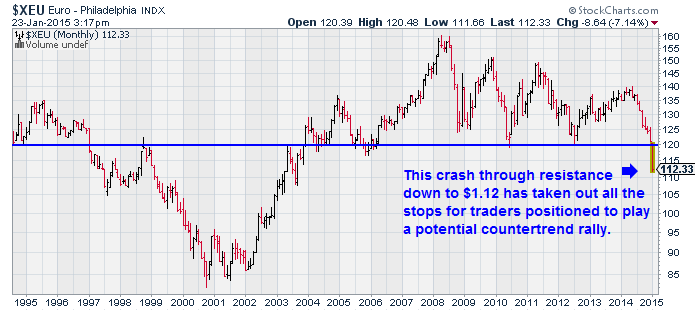
The euro and the dollar both looked ripe for countertrend rallies. Still do, actually. In my last post, I shared some charts that showed what I thought were very good set-ups for what at least could be some short-term trend reversals in the two currencies. This was of course well before the monetary nuke dropped by the Swiss National Bank that they would no longer be pegging the franc to the euro. Subsequent to this announcement, the franc took off like a rocket and the euro has dived well past support.

clip_image001

The rocket launch of the franc has seen plenty of banks, forex shops, hedge funds, and various financial institutions cumulatively lose billions of dollars; and the total damage has yet to be seen from all the short franc trades around the world. Those who may have positioned early on the euro or dollar reversals would almost assuredly have been stopped out. I was fortunate to not have taken a position in either currency. Specifically, I stated on January 5th, “I have not positioned in a trade yet as I haven’t observed a very usable signal just yet, but we are very close.”

Adhering to the discipline of waiting for confirmation from my go-to signals versus taking a chance on the price action based on trend lines saved me from a loss; even if the loss only would have been minimal due to stop-discipline. The same thing could be achieved by simply waiting for the price action to confirm the trend reversals. One notion that many of the best traders consistently follow is simply letting go of trying to time 100% of a move. There is enough profit made by catching 80% of a move by letting a trend establish itself. This concept is age-old and time-tested.

I prefer the indicators in conjunction with the price action, but if you’re going to be trading then you should have a methodology or technique that allows you to safely enter into a trade. You shouldn’t be throwing money around willy nilly simply off of squiggly lines and 100 year old patterns. The indicators I like to follow are very common and used by virtually everyone, however, I have specific chart timing I like to utilize. Additionally, I have a subtle difference of viewing the indicators for confirming signals. For the indicators I like to follow, most traders are still using crossovers but that simply doesn’t work anymore due to the mainframe warehouses being able to program out their market efficacy. This is my edge. It’s been backtested over several years and many trades. It’s not some guaranteed profit magic item I consult before each trade. I get stopped out and whipsawed too. It’s simply a go-to tool to help me mitigate risk. If you don’t have or know your edge, stop and rethink what you are doing and why you are doing it.

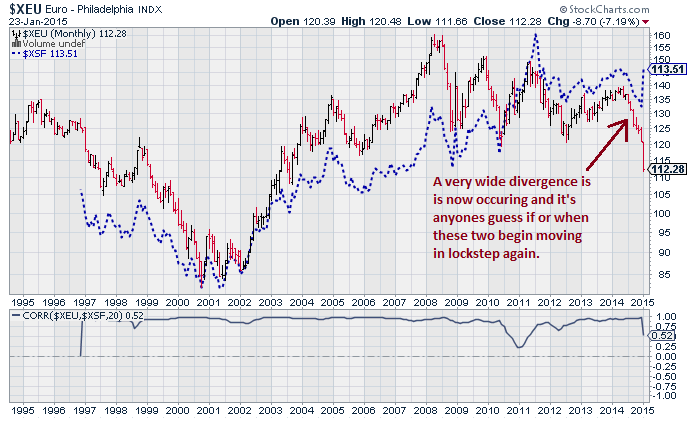
I will be keeping an eye on the euro and the dollar along with every other market player in the world. With the franc front running a very obvious move for QE by the ECB, the downtrend in the euro and the uptrend in the dollar may be entrenched for a while longer. A counter-trend catalyst could present itself at any point so keep your eyes peeled, as even shorts can be squeezed unbelievably faster than what was conventionally thought for a currency trade. There is a lot of uncertainty between the franc and the euro, which generally move quite closely with each other.

clip_image002

The franc’s shift in perception back to safe-haven status while the euro is weakened by the ECB’s proposed monetary inflation has helped to muddy the waters, so to speak, in how to effectively trade them in the current environment.

On another subject, Intel (INTC) is a stock that is often commented on as being a leading indicator of the S&P 500. The same can be said for many other economically sensitive stocks such as: Caterpillar (CAT), Wal-Mart (WMT), McDonalds (MCD), FedEx (FDX), and Amazon (AMZN). I could keep going, but you get the picture. These companies are fully integrated across the entire North American landscape so that the performance of these companies can be viewed as economic indicators and thus potential leading indicators for the S&P 500.

This theory has of course been backtested and the correlations examined extensively, so I leave it up to readers to indulge their curiosities by searching the web for additional information.

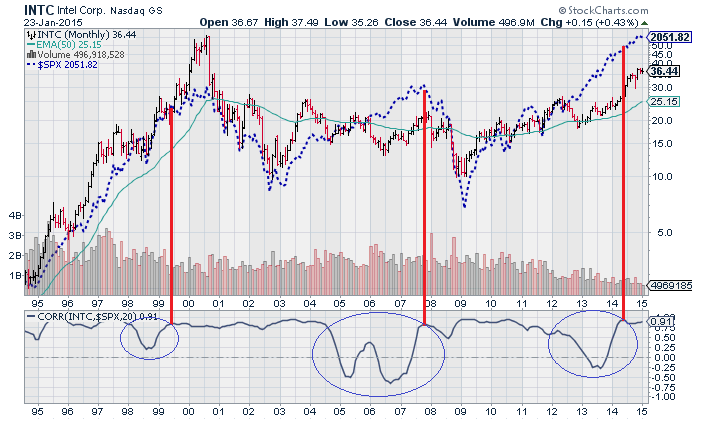
Anyways, coming back to INTC; in viewing a chart of its performance and correlation to the S&P 500 over the last 20 years I did notice something curious. As 20 years is probably statistically insignificant, I wouldn’t place too much importance on what I’m about to point out but it’s still curious. Have a look.

clip_image003

Using a 20-month correlation, it can be seen that a majority of the time the two are highly correlated between .80 and 1.0. However, before the start of each of the major crashes in 2000 and 2007, it can be seen that correlations between INTC and the S&P 500 took a dive towards zero and even negative correlations before recovering back up over .80. When this happened in 1999, the recovery in correlation preceded the actual correction in the larger index by about 15 months. That is only because most of the action of that period was in the NASDAQ and the recovery in correlation between INTC and the S&P 500 actually preceded the beginning of the NASDAQ’s downturn by 6 months. The NASDAQ began its implosion several months earlier than the rest of the indexes as it was the focus of the dot.com era.

For 2007’s crisis, it can be observed that the recovery in correlation back up over .80 between the two pretty much nailed the exact top in the S&P 500 to the month. And now we can see that between May and June of 2014, we saw another recovery to at least .80 in the correlation of INTC and the S&P 500 after a year-long dip. Again, I’m not implying that this is a usable signal to discern that we are near a major top in the equity markets. The last two crises had unique fundamental backgrounds and triggers, just like the next will have its own. In 2000 and 2001, we saw the bust of the tech boom exacerbated by 9/11 and the beginning of the never-ending war on terrorism. In the middle of the decade, we saw real estate financing and associated derivative leverage hasten a credit crisis that nearly took down the entire economic system. For the next one, it could very well be sovereign debt, central bank incompetence, and derivative leverage once again that initiates difficulties. I’m simply pointing out that the 20-month correlation of Intel and the S&P 500 provides an interesting signal.

Obviously, the correlation coefficient can be set to any number of months, weeks, days or minutes based on the period used for your charts. Twenty is the default parameter utilized by Stockcharts.com. Sixty is also prominently used and in the case of Intel and the S&P 500, when using 60 months, that leading pattern does not exist. So take the indicator for what it is; a simple signal of interest. Nothing more. Incidentally, if you gauge the correlation of each of the economically sensitive stocks I listed above, no early-warning signal exists between them and S&P 500. That pattern in the correlation for the potential of an early-warning of greater market direction only existed with INTC. Happy trading, speculating, investing, winning, and losing.

Dollar Strength and Euro Weakness – Trends Within Trends

You keep hearing the same message from source after source and then your trading spidey-senses start tingling with contrarian ambitions. That’s what has been going on for me with the Euro and the Dollar the last several weeks. Plenty of financial print has been dedicated to the strength of the dollar’s ascent and the weakness of the euro’s countertrend towards parity. Right now dollar strength is being bandied about due to it being a “safe haven” play for some reason(I don’t know against what current dangers) in conjunction with the cliché of America’s economy being the “cleanest dirty shirt.”

The current dollar and euro trends are glaringly obvious to all market players. Literally, every single trader and market player on the planet is watching these currencies. Which means we have a highly liquid trade opportunity availing itself and I have been waiting for some indicators to line up with my thesis to provide a lower-risk entry. There’s no sense positioning too early simply to have the mainframe warehouses wipe out the potential of the trade by running all the stops and igniting a sell-off. This could in turn create a short covering rally but utilizing multiple signals for entry points helps mitigate the whipsaws.

Make no mistake, in the long-term anything can happen with these two currencies but senseless extrapolation across multiple time frames can often create profit-delivering opportunities. Let’s observe a series of charts before the suggestion of some simple plays.

The first chart is a monthly chart of the euro going back the last 18 years. There are some simple markups on the chart. The first feature that should jump out at you is what we’ll call “The Power Line” at $1.20. This price acted as stiff resistance in the late 90’s and early 00’s (“Oh-Oh’s”), but for the last 10 years has acted as reliable support. The second feature is the potentially bearish descending triangle with “The Power Line” as the base of that triangle. Now for trading purposes, I’m betting the euro bounces here again towards that upper line of the triangle. However, one can see that as this triangle plays out and should it be broken to the downside in the future, the potential target would blow well past parity with the dollar to about $0.89. But that is another story for another day.

clip_image001

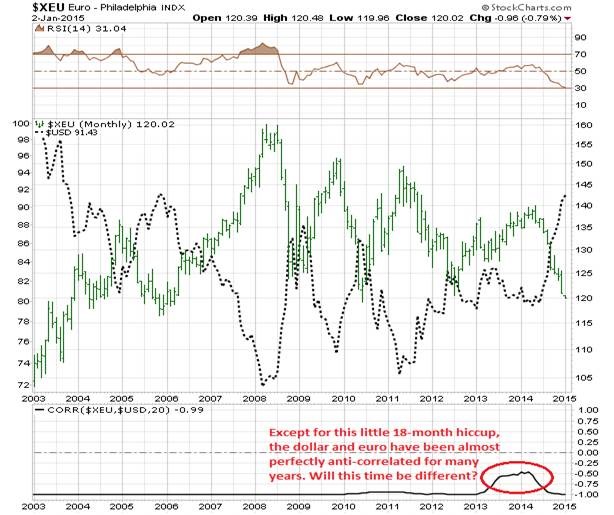
While the euro appears to be possibly setting up for a bounce off strong support, the dollar is running up against potentially strong resistance around 91 which also happens to have held for the last 10 years. This sets up a virtually perfect pair-trade between the euro and the dollar. Observe the dollar and euro’s nearly perfect negative correlation.

clip_image003

Aside from price action, sentiment indicators also look favorable. Observe the following Optix Indexes courtesy of SentimenTrader.com. The always savvy Jason Goepfert creates sentiment indexes based on an amalgamation of surveys and various sentiment indicators and applies them to a multitude of asset classes. Below are the Optix Indexes for the euro and the USD.

clip_image005

Over the last 5 years, when the euro Optix spent 4 to 6 months in the “Excessive pessimism” zone, then a countertrend usually presented itself in the short-term or intermediate term. The opposite pattern can be observed in the US dollar.

clip_image007

Can the dollar continue its vertical joyride? Possibly, but that would run counter to what have been some fairly reliable patterns that have held for several years now. Throw in the fact that the mainstream media continues to extol the virtues of the wondrously strong dollar and a small measure of mean reversion seems in order.

If one were inclined to attempt to profit on a pair trade, there are a few simple ways to go about it. There are of course the futures contracts which are generally the realm of the professionals. If you’re an armchair speculator, you can buy some of FXE and short some UUP. You can leverage that same play with some Calls on FXE and Puts on UUP. Perhaps you want to keep things simple with some ETFs going long the euro with ULE and short the dollar with UDN. If you’re inclined, play it anyway you feel comfortable. Be especially careful with ULE as average volumes are exceptionally light. I have not positioned in a trade yet as I haven’t observed a very usable signal just yet, but we are very close.

For you Fibonacci believers, here’s some potential retracements for the euro.

clip_image008

The 38.2% retracement, assuming $1.20ish is the low, is around $1.28 which was very strong support during 2013 so this makes for a good initial profit point. The trade has all the appearances of a money-laying-in-the-corner trade as sentiment has become extended, however, if it appears too obvious then it can’t be true. Right? Not necessarily. The pattern may be delayed as a final sell-off occurs to run all the stops between $1.20 and $1.17 over the next several weeks or possibly months, so the trade set-up may require some patience. That’s the discipline in swing or position trading.

If any readers choose to enter a position then good luck to you. There is a lot of doom and gloom about the euro due to the “Grexit” talk, Russian sanctions, and the ECB’s impotence amongst other things. I’m not saying to ignore any of these notions, but the charts above should hopefully spell out what the price action and sentiment are trying to communicate in light of all this bad news. I suspect the worst for the euro may already be priced into the currency, for the short-term at least.

As for 2014, I hope you ended the year in style without too many tax losses and may 2015 bring some additional prosperity to your life.

Sa-wing Batta!

If you played, coached, or spectated little league baseball or watched Ferris Bueller’s Day Off, then you’re familiar with the age-old, friendly taunt of “Hey batta batta batta batta, sa-wing battaaaa.” During early morning Halloween hours, the Bank of Japan(BOJ) provided the treat of all Halloween-day treats for speculators around the world. They announced additional quantitative easing that set the stock markets around the world on FIYA! BOJ Governor Kuroda went and grabbed the 50oz special big-boy bat and took a monster swing at deflationary forces.

clip_image001(photo courtesy of Reuters)

What a miraculously well timed announcement on the heels of the Federal Reserve reiterating the completion of its own QE program. Of course, the Fed’s not really wrapping up just yet as it will continue to roll as opposed to liquidate the assets it has purchased over the last 5 years. The Nikkei’s intraday move was over 4%. Most of the major indexes around the world gained over a percent today thanks to the “good” news.

Japan’s central bank will be upping its bond asset purchases to $60B(all numbers in this post are in USD) a month or $730B annually. The US dollar amount will fluctuate as the Yen weakens against it, however the BOJ will keep steady at about $6.7 trillion yen a month. They claim that the move is temporary until inflation targets have been sufficiently met. Yeah, about that temporary thing? Along with the bond purchase announcement, the BOJ also stated that they’ll be buying up Japanese ETFs and REITs to the tune of almost $7 billion and $1 billion a year, respectively. That’s a lot of dough to be tossing around and my guess is that it’ll drive enough positive sentiment that from a political standpoint, nobody’s going to want to sign off on terminating the purchases. Imagine the negative perception along with a move down in animal spirits. As they say in Jersey, dey don’t want nuttin ta’doo wit dat.

Additionally, the BOJ coordinated the announcement with the Government Pension and Investment Fund of Japan (GPIF), the largest pension entity in the world, which 1 day earlier stated they would be upping their own stock purchase program. Specifically, the GPIF announced it was paring back its Japanese debt holdings from 60% of its portfolio to only 35%. An unheard of allocation choice for a pension entity considering the lack of conservatism. They might as well have said “we’re all in on stocks.” They’ll be doubling their equity exposure to 50% of the portfolio.

Rational economic thought behind these massive moves is how will the unintended consequences manifest themselves down the road? Kuroda, like all central bankers, assures the public that they can control the inflationary forces that they so desperately desire. Maybe for a little bit. Maybe forever. Recall Kyle Bass’s thesis as the BOJ is walking a fine line. At this point in the game, it’s hard not to believe that central bankers really do have everything under control. This is despite the fact that monetary and economic policies in the advanced economies have no parallels in history, and in the short-term, things seem to be working out brilliantly on a statistical basis. It is difficult not to observe all the activity while thinking that the unintended, and most probably, uncontrollable consequences will be the ultimate arbiters of the societal value behind these unprecedented steps taken by the central banks of the westernized nations.

In the meantime, enjoy the ride and the implacable rise in financial asset prices. Actually, in a November 2013 report, McKinsey stated the impact of ZIRP on asset prices is inconclusive. Specifically, they state, “…we find little evidence that ultra-low interest rate policies have boosted equity prices in the long term. In the United States, the evidence on whether action by the Federal Reserve has lifted the housing market is also unclear, because it is difficult to disaggregate the impact of these measures from other forces at work in the market.” That’s curious.

One would think logically that there would be a direct correlation between record low mortgage rates and new home purchases. Combine that with a ridiculously low WACC for the biggest financial players and Americans said hello to their new landlords, yield-starved institutional investors and astute corporate vultures. It would also be logical to assume that when an entity can borrow at 1% and buy back its own stock yielding 2.5%, that there would be positive arbitrage opportunities. The fact that those opportunities lead to reduced share counts, increase earnings, and thus drive up stock prices has no correlation to ultra-low interest rates.

D-short presents a perfect illustration of the “low-correlation” effects of ZIRP and QE on the stock market.

clip_image003

As I was saying, enjoy the ride. Buy every damn dip. Just buy and hold. Buy, buy, buy! In reality, I continue to think that raising cash levels due to a true lack of value across multiple sectors is prudent portfolio management. That doesn’t mean liquidate your portfolio. It just means that raising cash levels for potential bargains that avail themselves may prove more profitable than simply sitting in holdings that have already accumulated a very nice gain over the last few years. Look at the E&P’s off of oil’s slide. Myself, I don’t think we’re going to see an avalanche down to $30’s like we saw after the fall from the $150’s. Toe-dipping into the really well managed opportunities that possess prime shale or offshore acreage appears to be presenting quality value. Observe the P&C insurance players as well. They held up remarkably well in the most recent sell-off and continue to report tremendous profitability, however, in the face of a softening price cycle.

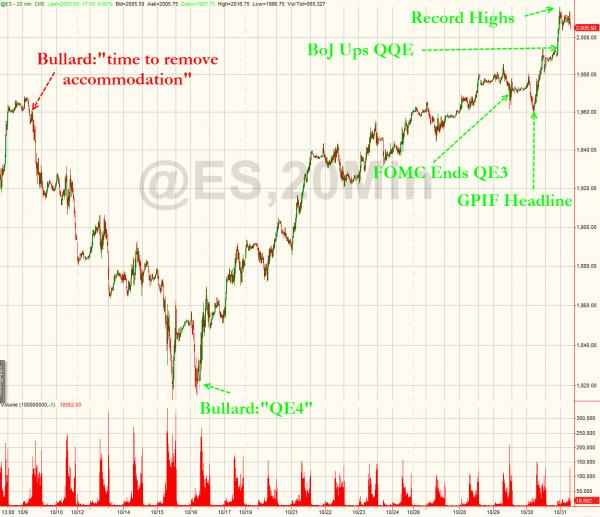
Just be careful. If you think momentum ignition and government intervention(jawbone or real) are fictional notions that don’t affect volatility, then have a look at this ZH chart.

clip_image004

Coming back to our little baseball reference, America was the 3rd and most valuable batter in this game of QE. Japan is hitting clean-up and protecting America’s own aggressive batting strategy. At some point, the 5th man in the lineup needs to show his power capabilities as well and drive in some runs. That 5th batter is Europe and Draghi is wielding the bat. If the game of central banks is to continue unimpeded, then he needs to put down the 36oz timber and go get his own corked 50oz bat to stave off deflationary forces in Europe. That damn German 3rd base coach keeps getting in the way though and giving the signal to sacrifice bunt.

Lastly, if you have kids, then take them to the wealthy neighborhoods to fill their bags full of candy. If you’re at home and not trick or treating, then give out the giant sized candy bars. You’ll be loved by the neighborhood children. If you’re in your 20’s and single, then go party it up with all the Halloween hotties(female or male) dressed to impress tonight…and be safe. Happy Halloween readers!

Fun With Employment Charts

Before we get to the employment chartporn, I want to share a quick note regarding my two previous posts and handicapping football games. I SUCK AT HANDICAPPING NCAA FOOTBALL THIS YEAR! College is usually my bread and butter but for some reason my radar for college handicapping has been turned off and my normally mediocre NFL radar has been fine-tuned into a well-oiled machine. Go figure. Either way, if any readers out there placed college football bets based on my picks, I hope you learned your lesson. As for the show of hubris behind my so-called college football handicapping ability, well you can be sure I learned my own lesson.

The BLS provided it’s September NFP update last Friday and the markets loved all of it. Not loving it so much now, but the overreaction was stunning last week. Unemployment fell below 6% which means America is fully employed! Hooray! Breakout the champagne because everyone that needs a job has a job in America. Hitting the 5% mark makes it true. Remember, when unemployment in the 5% range meant full employment? I think Lady Yellen’s memory is little bit fuzzy. According to a recent report at Bloomberg, “The labor market has yet to fully recover,” Fed Chair Janet Yellen said at a press conference after the FOMC meeting. “There are still too many people who want jobs but can’t find them.”

So everything is awesome, but not? Damn, and here I thought we were in full recovery mode. CPI inflation is tamed FOREVER! Monetary inflation is make-believe. And unemployment reached its magical number, so let the jacking up of rates begin already. Let’s taper the asset purchases by the Fed down to zero and feel some tightening; our economy’s ready!

Alright enough with the snark, if you haven’t already been charted out by the financial blogosphere and other various news sources then I’ll give you your fill. We’ll try to look at the perception and the reality. Bear in mind as you read these charts snipped from various other sites, that they’re all generated off of BLS data. You can go right to the BLS site yourself for verification. There you’ll find all the data tables needed to plug into Excel and create your own graphs. I readily admit that I’m way too lazy for that so enjoy your reblogged content.

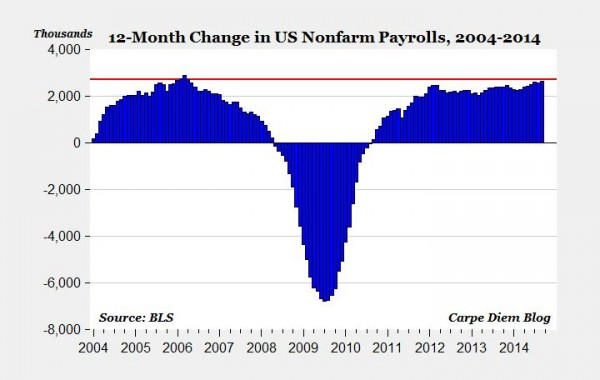
The first chart, courtesy of Carpe Diem, shows the 12-month change in NFP over the last decade. Basically, it shows that annual job growth is at a new high since the last peak in 2006.

clip_image001

Of course, this bit of great news coincides with an all-time high in temp hirings. Because nothing says full employment like setting a new record for temporary hires who will soon be unemployed again. Chart is also courtesy of Carpe Diem via FRED.

clip_image002

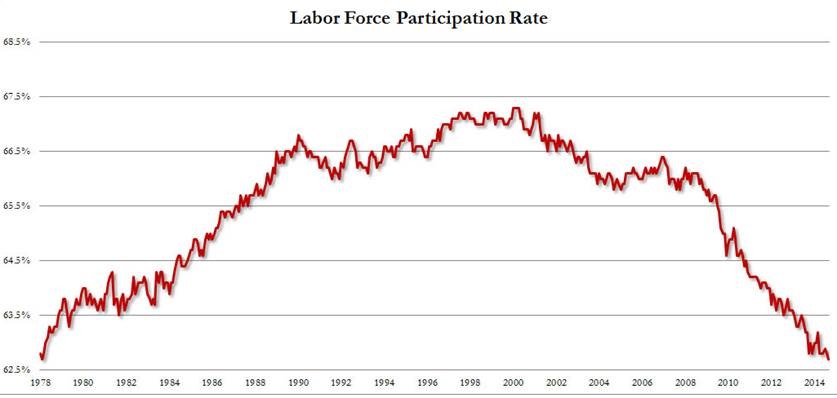
So this chart obviously speaks to the quality of the jobs being created out there, but you can’t review a new post-recession low in unemployment without reviewing the labor participation rate and its new lows. The next several charts regarding labor participation are all courtesy of the financial conspiracy theorists’ home site, Zero Hedge.

clip_image004

Allow me a quick indulgence here to rant on Josh Brown, The Reformed Broker, as he so unaptly stated in his own post last Friday regarding the NFP, “Losers will crawl out of their coffins and crypts to whine about the labor force participation rate, but no one cares. Think tank economists want things to get worse so they have some firepower for Fox News and MSNBC tonight. The reality is, the economy is growing as expected – slowly but surely – and there’s nothing “wrong” with today’s release. ” What a load of sellout, dickbag nonsense.

I remember when this guy used to offer fairly witty insights into the markets despite his own less than savory pathway into the field of finance. Now he’s so impressed with himself that he has to avoid reality, Krugman-style. I get that he’s now an established best-selling author, Yahoo Finance contributing personality, sometimes TV commentator, and CEO of a wealth management firm, so he’s had to sacrifice some of his original personality for some wealth and fame. No begrudgements here. Many famous and wealthy can be labeled a “sellout” but usually the only people who use that title, do so out of envy and/or disgust at their own lack of success. I assure you that’s not the case here. I’m just appalled at the sack this guy has in calling fellow reporters, bloggers, and media commentators, a “loser” for referring to the facts regarding America’s employment situation. This clown fish has been officially un-favorited at the MarginRich blogroll, because all 8 of my followers are really going to care. Okay, enough about Josh Brown. Wait, one more burn, what’s with the Something About Mary hairstyle?

clip_image006     clip_image008

Anyways, the percentage of working age Americans in the workforce has reached a 36 year low…but America’s fully employed at 5.9%. Right. A fair percentage of the decline in US unemployment numbers are directly attributed to the decline in the labor participation rate. There are a record 93 million working-age Americans that are not in the labor force. These facts have been reported on ad nauseam, but let’s drill down on the participation rate to the year the Great Recession started.

clip_image009

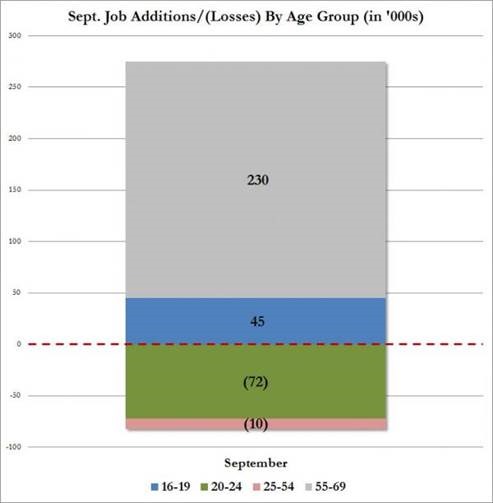
Many of Josh Brown’s ilk as disregarders of the labor participation rate will simply attribute the declining rate entirely to retiring employees. As I shared almost a year ago, the Philly Fed already tried to officially go down that route but the information just doesn’t conveniently jive. Lo and behold, look what demographic group was the largest gainer of job additions in September.

clip_image011

What do you know? It was the boomers and people in retirement age. Are we to believe that the demographic group of 55 and older is the backbone of America’s economic and employment recovery? Lest one think that this is an aberration or a one-off event for the month of September, there’s a chart for that, too. This trend has really picked up speed since the Great Recession.

clip_image012

Sorry millennials. You’re $80-Gs in debt for an education that got you a temp job where you report to a manager, aged 55 – 69, who has just been newly hired. Life’s tough. The youngest boomers and gen x don’t exactly have it a whole lot easier, but at least they’re entrenched in their jobs held from the Great Recession, where they’re just forced to complete double the work for the promise of a raise that hasn’t materialized in 6 years.

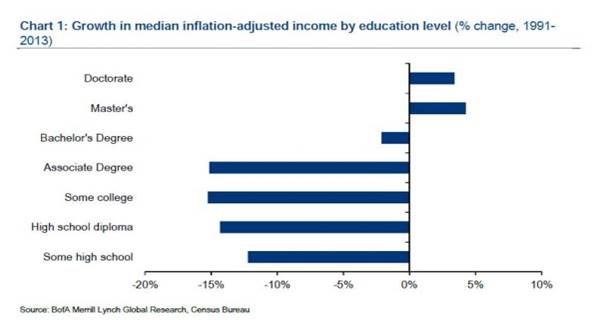
Since America is fully employed now, there should be much more income available for consumption to really begin to juice the economy. Especially since the tapering is near completion and we’re on the doorstep of the ever-so-important holiday shopping season. Unfortunately, we’ve hit a little roadblock in that department too as wages have been stagnating for some time now. Have a look at whose wages are actually growing, courtesy of BofA.

clip_image014

Unfortunately, only the most educated are consistently seeing growth in income generation. However, this statistic rides shotgun with the fact that a college degree is continuing to lose its edge as a value-adding tool for a new entrant into the workforce. Additionally, most of the middle-class, the back bone of the consuming public, fall into the educational categories below Master’s degree. Thus, negative comps at Wal-Mart, McDonalds, etc.

Demand is declining as exhibited by declining top-line revenues. We’re seeing more and more negative YoY comparable sales numbers across multiple industries. Earnings growth going forward probably won’t be driven by consumption so much as by share repurchases. I don’t want to be the constant doom and gloomer in the corner of the room brooding by myself, but if everything is so damn rosy why doesn’t it feel that way to the average American? You can’t just read the beige books, NFP reports, ISM reports, PCE and CPI price indexes, and all the other governmental reports while continuing to turn a blind eye to the genuine outlook here in the US.

Couple all this information with current stock market behavior and there’s reason to maintain a cautious stance. Last month I reported on the divergences occurring within the equity markets, offering that it was a time to take caution and build cash levels. I hope readers listened. Oil is tanking and it will generate a lot of financial buzz as it allows investors a much better entry point for previously missed opportunities. It will also provide a pseudo-subsidy to the American consumer. However, as some very important countries in the world rely on a higher price of oil, I can see where geopolitical conflict intensifies with Middle-Eastern concerns as well as Russia.

The currency markets are creating set-ups to coincide with the previously described events and that may lead to additional downside action in equity markets but possibly upside action in the commodity markets(except oil), specifically the precious metals. Please observe the following chart, courtesy of Kimble.

clip_image016

The currencies are important to keep watch on as they can be leading indicators for other asset classes. I hope you’ve built some cash levels to take advantage of the opportunities being created in several asset categories, because if you think this current sell-off is THE BIG ONE, you’re mistaken. We may get a very scary drawdown, however markets of all shape and size will see new highs going into next year and investors will want to be positioned to take advantage of the major momentum in asset prices that builds up to a legitimate bear-change in trend.

Oil and gas have sold off indiscriminately. If you felt like you were left behind in those areas, then be keeping a close eye. I wouldn’t be in a rush to start grabbing shares though, as the oil price may ride lower and for a longer time period than you’d think likely. Additionally, rig counts will take time to level off so drillers could remain depressed as well. We’ll see a bounce in driller names, but we’ll probably also see a resumption of their downtrend. Cash, a watchlist, and patience are the best friends of the prudent investor shopping for value. In the meantime, if you’re looking for a job then stop reading this damn article and go hit the Manpower agency to get a temp job you can call your own.