Analogous Equities Markets – 1970’s & 20Teens

Secular bull? Or bear about to do its thing on “unsuspecting” market players? These are questions making serious rounds on the world wide interlinking-web. That’s because fear sells and nothing gets eyeballs and clicks for the user-ravenous financial sites like some market-topping bear talk.

If you were alive and investing in the 70’s, or like myself, have read up on the stock market action of the 70’s then one can see how similar the two time periods seem to be acting(at least in the S&P 500). Don’t worry, I’m not about to hit you with yet another comparison chart of some calamitous US financial event laid over current action. Instead, I’d like to share some work by Lance Roberts. For the record, I like those comparison charts but I also take them for what they are…entertainment. At best they’re another useful input and at worse they’re just noise.

If you’re unfamiliar with Mr. Roberts, he consistently writes compelling market pieces. I happen to think he’s one of the more under-appreciated financial commentators on the web right now. He’s the co-founder and general partner of STA Wealth Management. Earlier in the year, Mr. Roberts shared some graphs comparing current times to the secular bull formed in the 80’s and the fakeout in the 70’s. At STA they definitely have Austrian economic tendencies in their communications regarding the markets, and so obviously can lean toward a more bearish stance at times. Or as other Austrians call it, just being realistic in light of all the economic data readily ascertainable.

They have significant assets under management of approximately $500 million to $600 million, so these guys are the real deal. Specifically, they focus on the client who possesses low six-figures to approximately $5 million in capital, so they’re not exactly whale hunters. STA feels that market is an underserved niche of wealth management. I’m not trying to plug their services nor do I have any relationship with their firm. Like other commentators or service providers I include in my posts here at MarginRich.com, I’m fairly certain STA doesn’t even know this blog exists. I just want to share with my readers another financial blogger whose work I really enjoy. You can also find work by Lance Roberts at Advisor Perspectives, home of dshort.

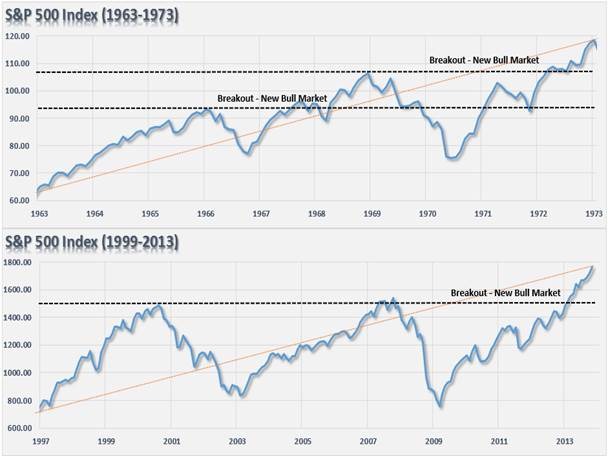
Now back to the charts Roberts shared in January. The first one shows a direct comparison of the current period to the false breakout of the late 60’s into what looked like a new bull going into 1973.
clip_image002

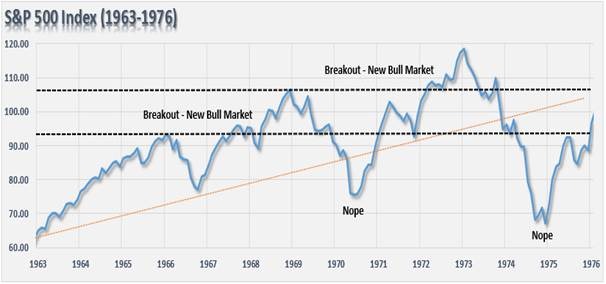
As we all know, The recession starting in 1973 was one of the worse times to be in the stock market in its history. The next chart shows the S&P’s performance and the realization of the false hopes for investors during those time periods.
clip_image004

Sorta looks like the decade of the Oh-Oh’s, except the action up to 1973 produced higher highs. As opposed to what we experienced in 2000 and 2007 in the S&P 500 with virtually equal tops. The reason for that was obviously all the capital was pouring into the NASDAQ in 2000.

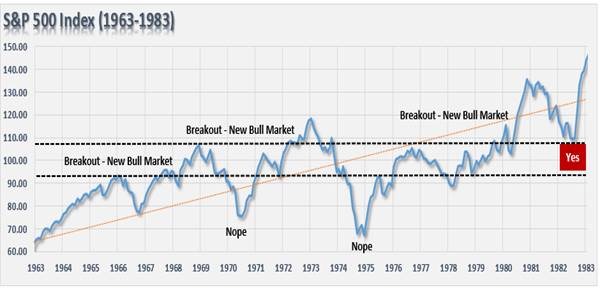
Moving on to the last chart. Roberts shows the total picture with the final washout in 1981 and the true beginning of the 18 year mega-secular bull market that helped to explode the growth of the mutual fund and retirement investing industries. Of course there were up’s and down’s during the real secular bull, but boomers blessed with the easiest time to make buy and hold gains during peak earning years helped to build the academic case of always investing in stocks for the long run. Not that I want to get into any philosophical debates on investment strategies or the level of difficulty of investing through the 80’s and 90’s. I use the term “easy” through the lenses of hindsight.
clip_image006

The point of sharing these charts is to increase awareness that this 5 year run that America has been on off of the 2009 lows, may not be the start of a real secular run like we saw from 1982 to 2000. In 1982, the conditions were more like a final “cleansing”, so to speak. The new CEO of America was instilling a lot of genuine hope and assuaging genuine fears with genuine actions, not lies or baseless rhetoric. Valuations were exceptionally low with single digit P/E’s and very enticing dividend yields across the market. Price inflation had been beaten back by the last semi-responsible Fed head.

Simply put, these are not conditions that exist today. In fact, the exact opposite of each of those conditions exist today. I understand that the music is playing but do you want to keep dancing? Conditions are decidedly different due to deep distortions across the financial landscape. But hey, I’m only one voice of many and if you’re one of plenty of people(including professionals) who think we’re in the midst of a secular bull market, then by all means keep putting new money to work. However, even if you’re dollar cost averaging and you don’t believe in “timing” the market, now may be a time to build your cash levels.

Don’t just take my word for it. In a previous post I cited some thoughts shared by Seth Klarman and Jeremy Grantham. They each communicated their fears of the frothiness of these markets but that the markets will continue to move higher before an inevitable bust. Now the inimitable Howard Marks has essentially shared the same sentiment in his latest Memo From Our Chairman. Collectively, these 3 gentlemen help oversee more than $200 billion in assets under management. In addition to their combined multiple decades of experience, their respective savvy has made each of them billionaires. Now if scions of the investment world such as these fellas are telling you to be cautious, do you really want to be the rebel without a cause out there allocating your capital based on the premise that trees DO grow to the sky?

Look I know the path of least resistance for the markets is up and I’ve reinforced that in previous posts. It’s just that based on the distortions, it really feels like a reckoning is coming. And just some basic cycle research yields a time table of approximately 12 to 24 months from now for some potentially tough times as an investor. I’m not talking about exiting the markets entirely. I’m talking about raising cash levels to be prepared when the real values potentially present themselves and minding your stops. Next time I’ll share some hopefully enlightening charts and thoughts on those aforementioned distortions.
Correction Starting or Continued New Highs

Nowadays, you can’t go a single day without reading a financial opinion about how a major dislocation is imminent or that the economy is on the mend and this generational bull is still intact. The fact that the US stock markets have been so choppy to start the year has confused not only some columnists and bloggers(myself included), but some professional money managers as well. As I stated a couple of posts ago, there are plenty of short-term signals showing that now may be time to show caution. On the other hand, long-term price action does continue to show strength and the bull fundamentals do not appear impaired as the path of least resistance for the markets continues to be upward.

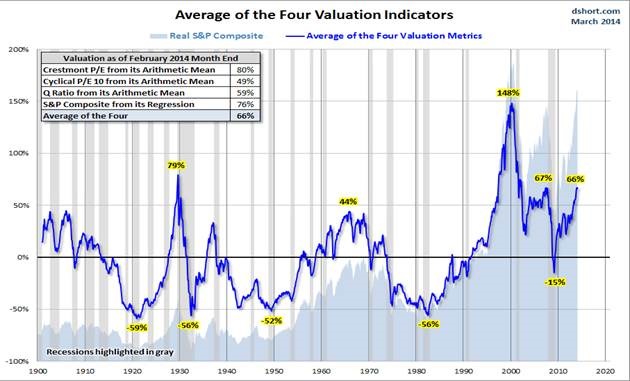
Depending on what measures you favor, valuations can appear a bit stretched currently; especially in the biotech and social media sectors. Doug Short, over at Advisor Perspectives, provides a monthly update of the chart below. Chris Kimble, of Kimble Charting Solutions, likes to add his own flair to it every now and then as well. The chart takes an average of four popular means of determining valuation for the S&P 500:

clip_image002

So based on this chart, we’re rapidly approaching 1929 levels of overvaluation of 79%, already passed the late 60’s peak of 44%, and are right back to 2007 levels at 66%. Do I think a soul crushing dislocation is imminent? Not at all. The chart also shows that things can get a lot more frothy ala 2000 and its 148% overvaluation level for all things dot.com and tech. Jeremy Grantham, via a recent Barron’s article, agrees that the market is 65% overvalued currently but that it would need to rise another 30% before he would consider it true bubble territory. For the arithmetically challenged, that puts the S&P 500 over 2,300. So according to J-Grizzle, there’s a lot of dancing left to do while the beat keeps bumping.

The S&P 500 hasn’t seen a correction of any real significance in about 2 years. When you throw in the fact that this bull recently turned 5 years old, nervous traders start to think that we just gotta see something to the downside soon. Maybe. Maybe not. Maybe f@$# yourself. My theory on the market is that it’s like a little kid. Feed it a bunch of sugar and watch it run like crazy. Thank you, Marky Mark. Despite the tapering, the Fed is still plugging a ton of sugar monthly into treasuries and MBS to keep these markets liquefied and rising.

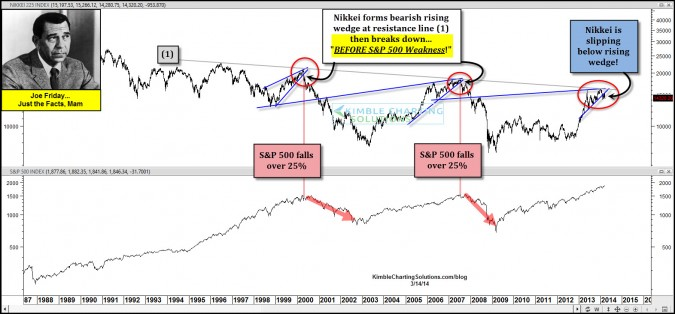
I already went on the record stating that I thought we could see downside action all the way to the 1,650ish area, which is approximately 12% off the highs. Kimble provided a chart last Friday showing the long-term action correlation between the Nikkei and S&P 500 since 2000. Observe:

clip_image003

So if the action is to be believed, then watch out. BUT WAIT! The S&P 500 is breaching all-time highs. Aside from risk management, buying into strength is a common message you’ll read in any and almost all of the great trading books. Well Goepfert at SentimentTrader shared some thoughts on the current price action too, “On Thursday, the S&P 500 rallied more than 0.5% to close within 0.5% of a 52-week high, yet more stocks declined than rose on the NYSE. That shows a lack of broad participation, despite a couple of important sectors (semis, financials) doing extremely well and breaking out to new highs. This has occurred 24 other times since 1940, and the S&P has struggled in the weeks following.”

Add to that biotech, a sector leader and market darling, is starting to show some real weakness. I think biotech is an easy short here using BIS or buying some Puts on a market leader such Amgen or Gilead. On a different note, there are some commodities now showing weakness as well. Coffee has been ripping in 2014, but this week has seen that momentum stopped in its tracks. It may just be a breather before it continues higher or it may see further downside action to eat up a nice chunk of those “easy”, early returns. The coffee ETF, JO, is an adequate proxy for those looking to trade the action without dabbling in futures. Either way and despite the current price action, my favorite indicators say that it’s not quite time to go short coffee yet. If they do give a signal, then it’s possible to see gap-filling action(on a weekly chart) all the way down to $28 or possibly $25 depending on the momentum.

Whether you lean optimistic or pessimistic is irrelevant. If you’re trading, then mind your stops. Managing your risks is all important.

Cycles, cycles everywhere…

Sadly, I don’t have any original content with which to dazzle your investment senses with for this post. I just want to share some noteworthy work on cycles.

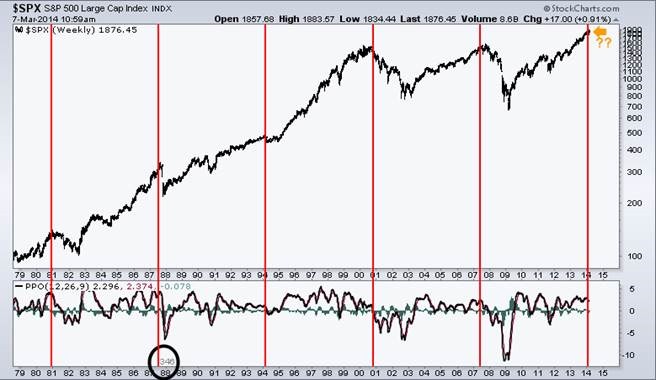
I was reviewing a couple of interesting charts this weekend, posted by Greg Schnell – The Canadian Technician. The two charts depict some consistent highs and lows across multi-week cycles. Chart number 1 breaks down the last 15 years of the S&P 500 within 66 week increments.

clip_image002

Here’s Mr. Schnell’s comments regarding the chart:

What has made the recent market cycles (last 15 years) so interesting, has been the difference in time spans. From the 2000 high to the 2002 low was a period of two 66 week time spans. From the 2007 top to the 2009 lows was 1 time span of roughly 66 weeks. Why 66 weeks? Well, it is only through the manipulation and experimentation of the cycle tool in Stockcharts that I was able to find a time span that worked for all the market turns. While multiples of 66 weeks like 132,198 and 264 work well, they all missed one of the turns. It was only the lowest common denominator that worked. This is trial and error, best fitting with the historical models.

You can see it worked pretty well on most cycle lines. It missed in 2001 at the blue arrow. What is most important, is the right edge of the chart. It is telling us that we are near one of those potential reversal points that George Lindsay talked about. Only the history books will tell us how it works out, but it is worth noting in a timely manner.

Upon publishing that chart, Schnell received a chart from a reader of his blog. This chart goes back even farther and utilizes a 346 week cycle, as denoted by the orange lines. Chart number 2 was sent into The Canadian Technician by Richard Rhodes of Rhodes Capital Management. The chart is equally compelling due to the uncanny ability to mark major highs.

clip_image004

Keep in mind, as Schnell admitted, these charts are “best-fitted” so to speak. So like every other chart you may look at to gauge potential direction, you have to take the information with a large grain of salt.

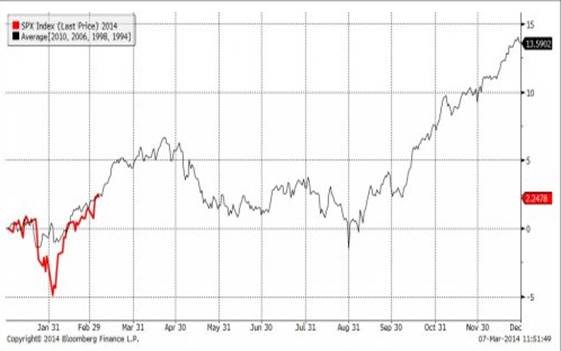
Can’t post on cycles without touching on The Election Cycle. Chris Puplava, at FinancialSense, shared a couple of interesting charts. The first one he posted, courtesy of Ned Davis Research, is based on the geometric mean from 1929 through 2009. We’re roughly at the blue arrow in the mid-term year.

clip_image006

If the Election Cycle holds to pattern then we could potentially top out in the early spring, bottom out in the late summer, and begin the vaunted run-up of the pre-election year in the Election Cycle. That potential run is demarcated by the black box. Puplava put together a chart over the last 5 mid-term election years that correlates nicely with the previous chart, stating that, “The chart below is an average of the last 5 mid-term election years, excluding 2002 (I’m not anticipating a bear market this year), overlaid by the S&P 500 so far this year. The pattern suggests a rally of 6.5% into an April peak before giving back all of its gains, followed by a bottom in late August, to finish up with a strong year-end rally.”

clip_image008

Why would I share two charts that seem to conflict with each other? Because I want to continue to communicate that one must be very careful how they interpret the squiggles. It’s doubtful we’re at a major top, but those first two charts make you stop and think for just a moment. On the other hand, the Election Cycle is real, well known, and has been expounded on by countless hordes of technicians. If a gun were put to my head to decide how to invest going forward just based on these sets of charts, I would definitely follow the Election Cycle.

The ongoing point across a great deal of my posts is that these are not normal times to be speculating. Thus, an extra measure of care has to be taken before running off and allocating capital based off of some macro-themed charts. For readers who don’t think that these are unique times to be an investor, then have a read of some excerpts from Seth Klarman’s latest letter to Baupost Group investors. It comes courtesy of ZeroHedge, and in it, Klarman shares his own thoughts that probably mirror many of your own regarding this Twilight Zone environment.

I’ve shared Seth’s credentials a million times already but if this is your first time here and you are unfamiliar with Mr. Klarman, then he’s the founder of the Baupost Group hedge fund. He manages approximately $22 billion. He’s a notorious value investor whose skills are in a class with the best. Last year alone, he returned $4 billion to investors because he didn’t find enough compelling investment opportunities and the fund’s size may have been getting a touch unwieldy. He’s a legend, so the commentary shared in his letters is worth heeding.

The volatility that has returned to the markets this year has been a thing of beauty. I know the traders of the world have enjoyed it. Well keep calm and carry on the fight to enhance your own personal wealth effect.