Short-term Equity Risks Arising

Despite Wednesday’s(3/25/2015) market weakness on virtually nothing but fear, there is plenty of technical action showing that markets appear fine. The question is how reliable is the action. Breadth indicators across multiple indices are positive. Small caps are leading large caps. Consumer discretionary to staples are favorable. Rate sensitive ETFs(TLT & XLU) have been conducting basic retracements which is perfectly natural coming off their hard sell-offs, but I think their selling will resume which will continue to indicate higher risk appetites once stocks take a little breather of their own. If the equity markets do what I think they’re going to do, which is correct a little harder here in the near-term, then I suspect TLT and XLU will chop for a bit while stocks let off of a little steam.

clip_image002

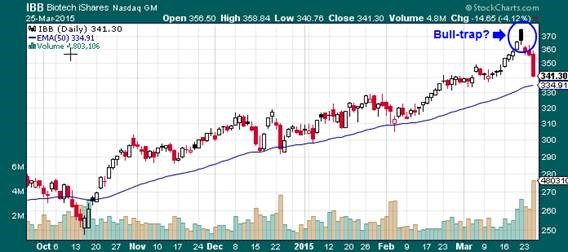
Everybody has their own methodologies for reviewing the markets to get a feel for the probability of directional plays. I really like to use inter-market analysis to help me potentially sense where the greater market may be headed. I have been watching biotech very closely as it has been the hottest sector and a market leader for some time. Real weakness in biotech may be a precursor to overall market weakness. That action last week in IBB had me suspicious. To me it appeared to be a blow-off. Call it what you want, a throw-over or a bull-trap. Either way the price action raised my hackles and officially put IBB on my radar as a temporary short. Current price action in IBB and the S&P 500 may be proving that out.
clip_image004

Now clearly, biotech is in a raging bull market and has been for several years now. You don’t want to fight that trend. It’s better just to ride it upwards for continued profit, because it’s going to take a lot more M&A in that sector before we see a top in biotech. However, there was a bit of froth in biotech M&A during the first quarter of 2015. Observe the following chart courtesy of Reuters and just look at Q1’s performance amongst pharmaceutical companies compared to the last 5 years.

clip_image006

We haven’t seen that kind of aggression since coming off the lows of 2009. There’s been approximately $60B of M&A activity in pharmaceuticals to start 2015, which accounted for 10% of overall M&A activity in the quarter. Twenty-one billion alone of that $60B was done in the Pharmacyclics purchase by AbbVie. That also signaled to me a potential short-term top for biotech as J&J and AbbVie slugged it out for rights to the cancer-fighting company.

So the real question then is how is this information actionable? Well that depends on your appetite for risk and how you’re looking to allocate capital in the short-term or long-term. If you’ve been visiting this blog for a while then you’re well aware I’m always ready to roll the dice based on my ability to interpret market action. I think shorting biotech via IBB or XBI is a good opportunity. I could have positioned earlier, but I was waiting for the price action to confirm so as to hopefully avoid being whipsawed.

If any readers are inclined to risk come capital, I think that IBB’s price action has stated to market players that it looks good for a short-term short. A small bounce at this price point is likely; especially in light of that 4% down day. I suspect the bounce could move the share price back up into the $355 to $365 range giving weak hands sufficient room to liquidate. That liquidation could then kick off the next leg down in biotech. There is a very strong floor at $290 as that is where the current 50-month EMA rests, so any option players will want to factor accordingly. I’m not stating that I think IBB will definitely hit $290, just that it’s a strong price point of support.

If IBB’s share price creates un-compelling options price points for smaller traders, then the XLV is a solid alternative. It has higher relative strength due to the size and various types of non-biotech holdings, but XLV possesses sufficient exposure to biotech that it will correct as well and it’s options may allow for a wider range of speculators to employ strategies.

As for the larger market i.e. the S&P 500, I wouldn’t expect anything deeper than a 10% correction if even that deep. There’s strong support at its 50-month EMA, as well, which is currently at $1,987. A 10% correction would take us down to approximately $1,900, which is also a round-number “power line” that I see providing strong support. I also suspect that any sell-off would result in yet another V-shaped recovery so be prepared to remove any short bias as a new leg higher ensues for the S&P 500 and biotech. Remember, these are interpretations based on my inter-market analysis. There are plenty of breadth indicators putting a more positive spin on things.

The markets are tricky, rigged, and no place for the ignorant. Manage your risks accordingly and utilize any potential correction to get long. There is continued quantitative easing on a massive scale across the world and the Fed is still reluctant to raise rates just yet. Current liquidity levels and yield curves continue to put a wind in the sails of higher risk assets. As Q1 draws to a close, take a moment to review your portfolio and see where you stand in 2015.

Dollar Strength and Euro Weakness – Trends Within Trends

You keep hearing the same message from source after source and then your trading spidey-senses start tingling with contrarian ambitions. That’s what has been going on for me with the Euro and the Dollar the last several weeks. Plenty of financial print has been dedicated to the strength of the dollar’s ascent and the weakness of the euro’s countertrend towards parity. Right now dollar strength is being bandied about due to it being a “safe haven” play for some reason(I don’t know against what current dangers) in conjunction with the cliché of America’s economy being the “cleanest dirty shirt.”

The current dollar and euro trends are glaringly obvious to all market players. Literally, every single trader and market player on the planet is watching these currencies. Which means we have a highly liquid trade opportunity availing itself and I have been waiting for some indicators to line up with my thesis to provide a lower-risk entry. There’s no sense positioning too early simply to have the mainframe warehouses wipe out the potential of the trade by running all the stops and igniting a sell-off. This could in turn create a short covering rally but utilizing multiple signals for entry points helps mitigate the whipsaws.

Make no mistake, in the long-term anything can happen with these two currencies but senseless extrapolation across multiple time frames can often create profit-delivering opportunities. Let’s observe a series of charts before the suggestion of some simple plays.

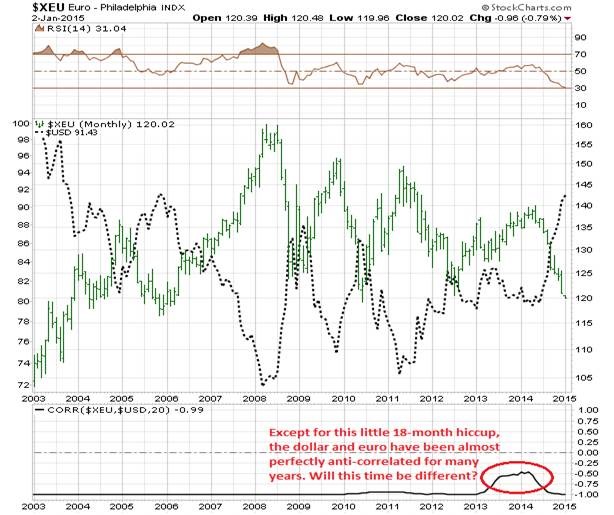
The first chart is a monthly chart of the euro going back the last 18 years. There are some simple markups on the chart. The first feature that should jump out at you is what we’ll call “The Power Line” at $1.20. This price acted as stiff resistance in the late 90’s and early 00’s (“Oh-Oh’s”), but for the last 10 years has acted as reliable support. The second feature is the potentially bearish descending triangle with “The Power Line” as the base of that triangle. Now for trading purposes, I’m betting the euro bounces here again towards that upper line of the triangle. However, one can see that as this triangle plays out and should it be broken to the downside in the future, the potential target would blow well past parity with the dollar to about $0.89. But that is another story for another day.

clip_image001

While the euro appears to be possibly setting up for a bounce off strong support, the dollar is running up against potentially strong resistance around 91 which also happens to have held for the last 10 years. This sets up a virtually perfect pair-trade between the euro and the dollar. Observe the dollar and euro’s nearly perfect negative correlation.

clip_image003

Aside from price action, sentiment indicators also look favorable. Observe the following Optix Indexes courtesy of SentimenTrader.com. The always savvy Jason Goepfert creates sentiment indexes based on an amalgamation of surveys and various sentiment indicators and applies them to a multitude of asset classes. Below are the Optix Indexes for the euro and the USD.

clip_image005

Over the last 5 years, when the euro Optix spent 4 to 6 months in the “Excessive pessimism” zone, then a countertrend usually presented itself in the short-term or intermediate term. The opposite pattern can be observed in the US dollar.

clip_image007

Can the dollar continue its vertical joyride? Possibly, but that would run counter to what have been some fairly reliable patterns that have held for several years now. Throw in the fact that the mainstream media continues to extol the virtues of the wondrously strong dollar and a small measure of mean reversion seems in order.

If one were inclined to attempt to profit on a pair trade, there are a few simple ways to go about it. There are of course the futures contracts which are generally the realm of the professionals. If you’re an armchair speculator, you can buy some of FXE and short some UUP. You can leverage that same play with some Calls on FXE and Puts on UUP. Perhaps you want to keep things simple with some ETFs going long the euro with ULE and short the dollar with UDN. If you’re inclined, play it anyway you feel comfortable. Be especially careful with ULE as average volumes are exceptionally light. I have not positioned in a trade yet as I haven’t observed a very usable signal just yet, but we are very close.

For you Fibonacci believers, here’s some potential retracements for the euro.

clip_image008

The 38.2% retracement, assuming $1.20ish is the low, is around $1.28 which was very strong support during 2013 so this makes for a good initial profit point. The trade has all the appearances of a money-laying-in-the-corner trade as sentiment has become extended, however, if it appears too obvious then it can’t be true. Right? Not necessarily. The pattern may be delayed as a final sell-off occurs to run all the stops between $1.20 and $1.17 over the next several weeks or possibly months, so the trade set-up may require some patience. That’s the discipline in swing or position trading.

If any readers choose to enter a position then good luck to you. There is a lot of doom and gloom about the euro due to the “Grexit” talk, Russian sanctions, and the ECB’s impotence amongst other things. I’m not saying to ignore any of these notions, but the charts above should hopefully spell out what the price action and sentiment are trying to communicate in light of all this bad news. I suspect the worst for the euro may already be priced into the currency, for the short-term at least.

As for 2014, I hope you ended the year in style without too many tax losses and may 2015 bring some additional prosperity to your life.

Fun With Employment Charts

Before we get to the employment chartporn, I want to share a quick note regarding my two previous posts and handicapping football games. I SUCK AT HANDICAPPING NCAA FOOTBALL THIS YEAR! College is usually my bread and butter but for some reason my radar for college handicapping has been turned off and my normally mediocre NFL radar has been fine-tuned into a well-oiled machine. Go figure. Either way, if any readers out there placed college football bets based on my picks, I hope you learned your lesson. As for the show of hubris behind my so-called college football handicapping ability, well you can be sure I learned my own lesson.

The BLS provided it’s September NFP update last Friday and the markets loved all of it. Not loving it so much now, but the overreaction was stunning last week. Unemployment fell below 6% which means America is fully employed! Hooray! Breakout the champagne because everyone that needs a job has a job in America. Hitting the 5% mark makes it true. Remember, when unemployment in the 5% range meant full employment? I think Lady Yellen’s memory is little bit fuzzy. According to a recent report at Bloomberg, “The labor market has yet to fully recover,” Fed Chair Janet Yellen said at a press conference after the FOMC meeting. “There are still too many people who want jobs but can’t find them.”

So everything is awesome, but not? Damn, and here I thought we were in full recovery mode. CPI inflation is tamed FOREVER! Monetary inflation is make-believe. And unemployment reached its magical number, so let the jacking up of rates begin already. Let’s taper the asset purchases by the Fed down to zero and feel some tightening; our economy’s ready!

Alright enough with the snark, if you haven’t already been charted out by the financial blogosphere and other various news sources then I’ll give you your fill. We’ll try to look at the perception and the reality. Bear in mind as you read these charts snipped from various other sites, that they’re all generated off of BLS data. You can go right to the BLS site yourself for verification. There you’ll find all the data tables needed to plug into Excel and create your own graphs. I readily admit that I’m way too lazy for that so enjoy your reblogged content.

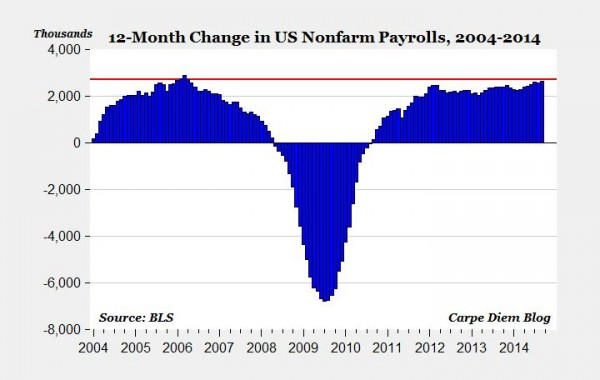
The first chart, courtesy of Carpe Diem, shows the 12-month change in NFP over the last decade. Basically, it shows that annual job growth is at a new high since the last peak in 2006.

clip_image001

Of course, this bit of great news coincides with an all-time high in temp hirings. Because nothing says full employment like setting a new record for temporary hires who will soon be unemployed again. Chart is also courtesy of Carpe Diem via FRED.

clip_image002

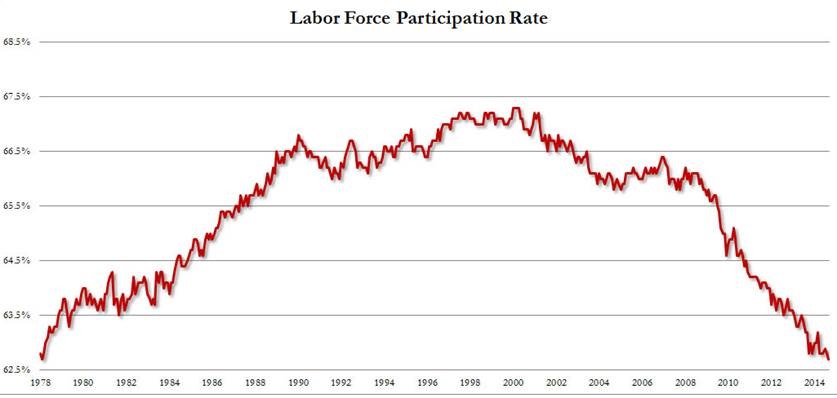
So this chart obviously speaks to the quality of the jobs being created out there, but you can’t review a new post-recession low in unemployment without reviewing the labor participation rate and its new lows. The next several charts regarding labor participation are all courtesy of the financial conspiracy theorists’ home site, Zero Hedge.

clip_image004

Allow me a quick indulgence here to rant on Josh Brown, The Reformed Broker, as he so unaptly stated in his own post last Friday regarding the NFP, “Losers will crawl out of their coffins and crypts to whine about the labor force participation rate, but no one cares. Think tank economists want things to get worse so they have some firepower for Fox News and MSNBC tonight. The reality is, the economy is growing as expected – slowly but surely – and there’s nothing “wrong” with today’s release. ” What a load of sellout, dickbag nonsense.

I remember when this guy used to offer fairly witty insights into the markets despite his own less than savory pathway into the field of finance. Now he’s so impressed with himself that he has to avoid reality, Krugman-style. I get that he’s now an established best-selling author, Yahoo Finance contributing personality, sometimes TV commentator, and CEO of a wealth management firm, so he’s had to sacrifice some of his original personality for some wealth and fame. No begrudgements here. Many famous and wealthy can be labeled a “sellout” but usually the only people who use that title, do so out of envy and/or disgust at their own lack of success. I assure you that’s not the case here. I’m just appalled at the sack this guy has in calling fellow reporters, bloggers, and media commentators, a “loser” for referring to the facts regarding America’s employment situation. This clown fish has been officially un-favorited at the MarginRich blogroll, because all 8 of my followers are really going to care. Okay, enough about Josh Brown. Wait, one more burn, what’s with the Something About Mary hairstyle?

clip_image006     clip_image008

Anyways, the percentage of working age Americans in the workforce has reached a 36 year low…but America’s fully employed at 5.9%. Right. A fair percentage of the decline in US unemployment numbers are directly attributed to the decline in the labor participation rate. There are a record 93 million working-age Americans that are not in the labor force. These facts have been reported on ad nauseam, but let’s drill down on the participation rate to the year the Great Recession started.

clip_image009

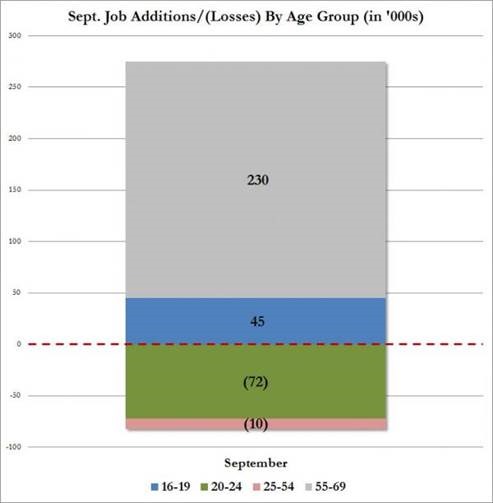
Many of Josh Brown’s ilk as disregarders of the labor participation rate will simply attribute the declining rate entirely to retiring employees. As I shared almost a year ago, the Philly Fed already tried to officially go down that route but the information just doesn’t conveniently jive. Lo and behold, look what demographic group was the largest gainer of job additions in September.

clip_image011

What do you know? It was the boomers and people in retirement age. Are we to believe that the demographic group of 55 and older is the backbone of America’s economic and employment recovery? Lest one think that this is an aberration or a one-off event for the month of September, there’s a chart for that, too. This trend has really picked up speed since the Great Recession.

clip_image012

Sorry millennials. You’re $80-Gs in debt for an education that got you a temp job where you report to a manager, aged 55 – 69, who has just been newly hired. Life’s tough. The youngest boomers and gen x don’t exactly have it a whole lot easier, but at least they’re entrenched in their jobs held from the Great Recession, where they’re just forced to complete double the work for the promise of a raise that hasn’t materialized in 6 years.

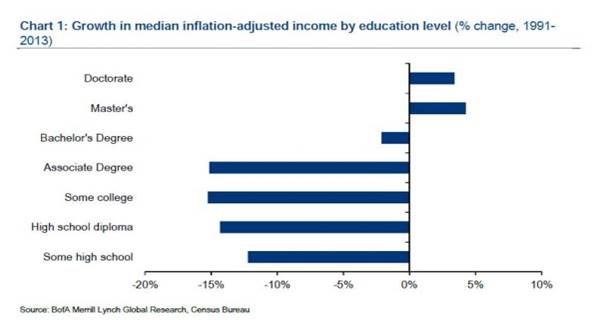
Since America is fully employed now, there should be much more income available for consumption to really begin to juice the economy. Especially since the tapering is near completion and we’re on the doorstep of the ever-so-important holiday shopping season. Unfortunately, we’ve hit a little roadblock in that department too as wages have been stagnating for some time now. Have a look at whose wages are actually growing, courtesy of BofA.

clip_image014

Unfortunately, only the most educated are consistently seeing growth in income generation. However, this statistic rides shotgun with the fact that a college degree is continuing to lose its edge as a value-adding tool for a new entrant into the workforce. Additionally, most of the middle-class, the back bone of the consuming public, fall into the educational categories below Master’s degree. Thus, negative comps at Wal-Mart, McDonalds, etc.

Demand is declining as exhibited by declining top-line revenues. We’re seeing more and more negative YoY comparable sales numbers across multiple industries. Earnings growth going forward probably won’t be driven by consumption so much as by share repurchases. I don’t want to be the constant doom and gloomer in the corner of the room brooding by myself, but if everything is so damn rosy why doesn’t it feel that way to the average American? You can’t just read the beige books, NFP reports, ISM reports, PCE and CPI price indexes, and all the other governmental reports while continuing to turn a blind eye to the genuine outlook here in the US.

Couple all this information with current stock market behavior and there’s reason to maintain a cautious stance. Last month I reported on the divergences occurring within the equity markets, offering that it was a time to take caution and build cash levels. I hope readers listened. Oil is tanking and it will generate a lot of financial buzz as it allows investors a much better entry point for previously missed opportunities. It will also provide a pseudo-subsidy to the American consumer. However, as some very important countries in the world rely on a higher price of oil, I can see where geopolitical conflict intensifies with Middle-Eastern concerns as well as Russia.

The currency markets are creating set-ups to coincide with the previously described events and that may lead to additional downside action in equity markets but possibly upside action in the commodity markets(except oil), specifically the precious metals. Please observe the following chart, courtesy of Kimble.

clip_image016

The currencies are important to keep watch on as they can be leading indicators for other asset classes. I hope you’ve built some cash levels to take advantage of the opportunities being created in several asset categories, because if you think this current sell-off is THE BIG ONE, you’re mistaken. We may get a very scary drawdown, however markets of all shape and size will see new highs going into next year and investors will want to be positioned to take advantage of the major momentum in asset prices that builds up to a legitimate bear-change in trend.

Oil and gas have sold off indiscriminately. If you felt like you were left behind in those areas, then be keeping a close eye. I wouldn’t be in a rush to start grabbing shares though, as the oil price may ride lower and for a longer time period than you’d think likely. Additionally, rig counts will take time to level off so drillers could remain depressed as well. We’ll see a bounce in driller names, but we’ll probably also see a resumption of their downtrend. Cash, a watchlist, and patience are the best friends of the prudent investor shopping for value. In the meantime, if you’re looking for a job then stop reading this damn article and go hit the Manpower agency to get a temp job you can call your own.

JJG Still Ain’t Ready

In my last post, I stated that I’d be sharing some thoughts on college football and I will later today with another post or no later than tomorrow. That’s a promise for any sports gambling addict readers who’ve been waiting with bated breath to read my words. I just wanted to share a couple of quick thoughts. One on JJG, which I wrote about a couple of months ago. Additionally, I wanted to share a note from the Price Action Lab blog as well. I regularly follow Mr. Harris’s work, but his note on Friday the 19th was the best work I’ve seen out of him.

For any readers who deign to label themselves technical analysts it’s a must-read. Really it’s a must read for any trader. In the very short but sweet article he covers these BTFD, V-shaped recoveries that started in 2012, agreeing with the timeline I also posited when squiggly-reading began losing its efficacy. Harris hypothesizes that this is due to central bank intervention. Have a look at the chart for yourself and consider back to the hard balance sheet expansion of the world’s central banks.

clip_image002

Harris goes on to opine that indexing’s time in the sun may have an abrupt shift into darkness. As for the last 5 years, he also basically states that what has been won’t always be. Take it for whatever it’s worth, but I recommend taking a few minutes to ingest the article.

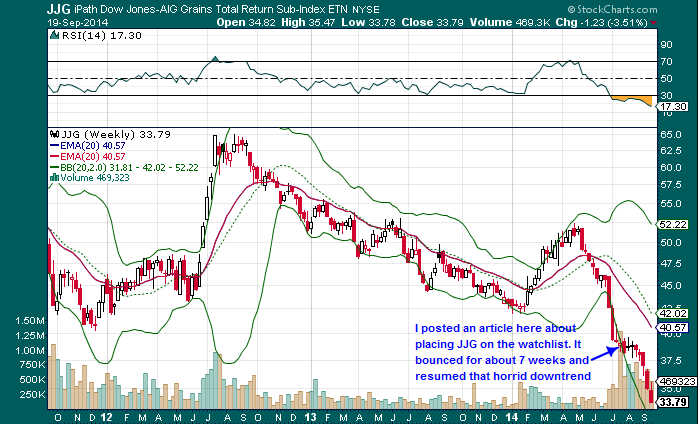
Regarding JJG, don’t feel bad if you tried to bottom-tick that one too early. Them’s the breaks. I had stated that the trade looked ripe but that my indicators weren’t giving me a go. I also stated that I would send out an update if the indicators give the green light. Now this ain’t the update for the green light, it’s just to let any readers know that we’re still keeping an eye on the ETF. Soybeans, corn, and wheat are getting destroyed. It’s serious destruction and the greater commodity index (CRB) just took a dip past support, so it’s not looking good for a trade anytime in the immediate future.

However, one of my indicators has flattened out and the other appears to be following. Even if they do shift, that may simply lead to some bottom bouncing consolidation for several months as opposed to a V-shaped rocket ride upward. I wouldn’t expect a coffee style abrupt turnaround, but anything’s possible. Have a look at the weekly JJG chart in case you haven’t in a while.

clip_image003

Once the indicators have turned in favor of an uptrend, then the HFT shops may just juice this thing for nice little return. I hope to have you along for the ride on the timing of that one. We’ll have to wait and see. For reference sake, let’s take a look back at coffee’s beautiful halt to its downtrend and abrupt rocket ride upwards for the lucky schleps(or skilled) who rode that trend to the bank.

clip_image004

Alright, so read that article from the Price Action Lab blog. Keep a wary eye on soybeans, corn, and wheat. And enjoy Saturday. College football is back, so go pay your bookie a visit and dare to be great.

PS: Marginrich.com does not condone nor endorse any illegal activity regarding unsanctioned and unlicensed sports wagering. If you are compelled beyond your will to place wagers on the outcome of any sporting event maybe it’s time to seek counseling and admit the problem is real. Read those two sentences really fast like the MicroMachines commercial guy with the moustache from the 80’s and it’ll sound real official. And for anyone who thinks I’m insensitive to the genuine sickness that is a gambling addiction and reads articles here, get real, I write about speculation regularly.

Two Trades for the Price of None

Okay, so the Toyota trade did not work out. It was a low risk, little scalp for a few easy bucks. If you put the trade on and were stopped out, well then I’m sorry but them’s the breaks. You’ll notice a little lower in that article, however, that the coffee trade was a 100% nailed and there’s still room to run. Might have been luck. Only the trading gods know.

Today though, I’m going to share what are by now two very obvious trades to the world of speculators. One is a short, and it’s move has already begun. The other is a long and the play is still setting up.

First the short, it’s Delta Airlines (DAL) or rather airlines in general. Keep in mind this stock has become a hedge fund hotel along with American Airlines (AAL), which can be either a positive or a negative. On the one hand, the large institutional support can provide a ton of liquidity for any potential pyramiding of the professional positions. Additionally, shorts can be easily squeezed with the amounts of money that could potentially be thrown at the position. However, the short float is exceptionally low at under 2% so nobody seems to be expecting any sort of real selloffs despite the 12% down-move over the last 4 weeks. In other words, there’s not a lot of kindling for a hard short squeeze.

Observe this partial list of the 50 most popular stocks amongst hedge funds as of the end of May 2014, courtesy of the WSJ’s Moneybeat via Goldman:

clip_image001

The airline stocks have enjoyed a tremendous run. From the fall of 2012 to the spring of 2014, Delta was a 4-bagger. American has treated investors well for those that held the equity and the debt too as it worked its way through bankruptcy. The new ticker AAL, post-merger with US Airways, is already up around 100% since the beginning of the year. Allegiant, who I was very wrong about in a friendly argument with a colleague a couple years ago, has been a 3-bagger since the spring of 2012. Mr. S.P. off in Deutschland, you were very right and I was very wrong. I hope you rode the stock for maximum profits.

The airlines have garnered a lot of momentum in what I think will ultimately be temporarily profitable situations. Unions have been re-bargained with. Fuel has been somewhat reasonable. And the fees for this, that, and the other have been a huge boon to the airlines’ income statements. Maybe the industry has entered the new normal along with developed world economies, and the airlines will all be immensely popular investment darlings. We can crown them as the core holdings in a new era Nifty Fifty alongside Tesla (TSLA), King Digital (KING), and Cynk Technology (CYNK), because if there’s one thing airlines are known for it is profitability.

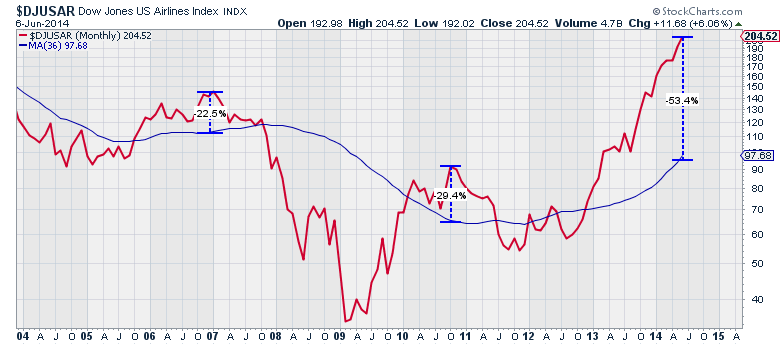
For my money though, I’m betting a little snap-back(or mean reversion as you pros like to call it) may be in the works. Valuations seem a bit stretched. Have a look at this chart from last month of the index of all the US airlines, courtesy of STA Wealth Management:

clip_image002

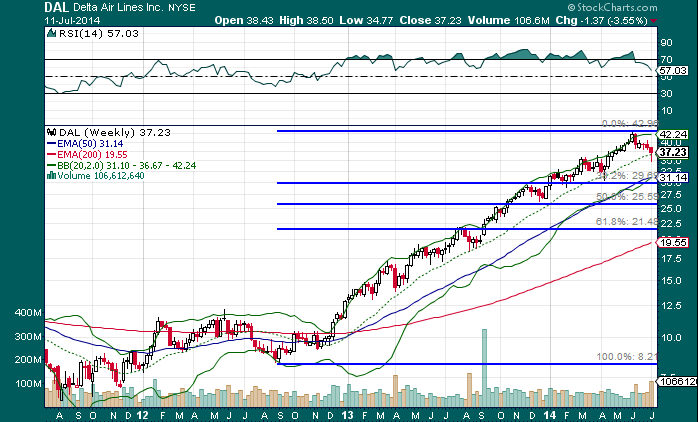
The blue line is the 36-month moving average. Does the chart say mean reversion or plow in for new highs? With no airline ETFs in existence anymore and the transport ETFs too diversified amongst all industries, you have to take your shot directly with an airline. With Delta forming its own little Eiffel Tower(on a linear scale chart), we have our short play. Observe the chart(logarithmic) below of Delta with Fibonacci retracements:

clip_image003

The 38.2% retracement target is essentially $30, so that makes for a reasonable 1st profit point on a short position. Winners have to be given room to run so you’ll have to consider the action in conjunction with the broader market along with your own stops before considering liquidating part or all of the position. My contention is that “Wood drastically underestimates the impact of…”; sorry about that. Had a Good Will Hunting flashback. No, my contention is that as market darlings the airlines could possibly lead a whole market sell-off, similar to biotech and social media a few months ago. Delta and American are already showing weakness, but especially Delta.

My two proprietary indicators gave a buy signal the week of June 30th. I almost never trade without their confirmation, unless I’m going for a quick scalp off the action of the tape. This is a real money move for me and I have already positioned into the short.

For you option players, be careful about the core strike of your strategy. For instance, $30 strikes for the September Puts and $35 for the Decembers have a ton of open interest. Things can get a little wonky around those areas so intelligently apply your tactics. Review your Greeks and determine the best course of action for this directional play.

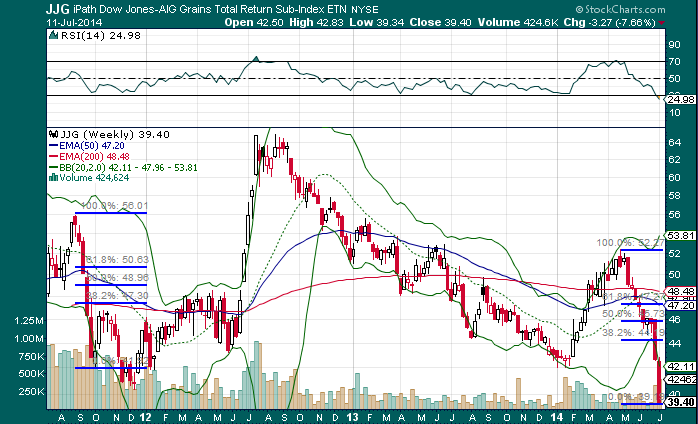
The long play is the grains. Specifically, when the time is right I’ll be using JJG as the ETF proxy. JJG is weighted to corn, soybeans, and wheat. If you’re comfortable with futures and want to focus your efforts into a single grain, then knock yourself out. For the purpose of this analysis though, I’ll be referring to the JJG as the grains equivalent. All three components have been beaten down badly the past several months in a very intense selloff. Observe the following chart. In it I have listed the current potential Fibonacci retracements if the sell-off subsides this week. I’ve also displayed the retracements for the selloff of similar magnitude back in 2011:

clip_image004

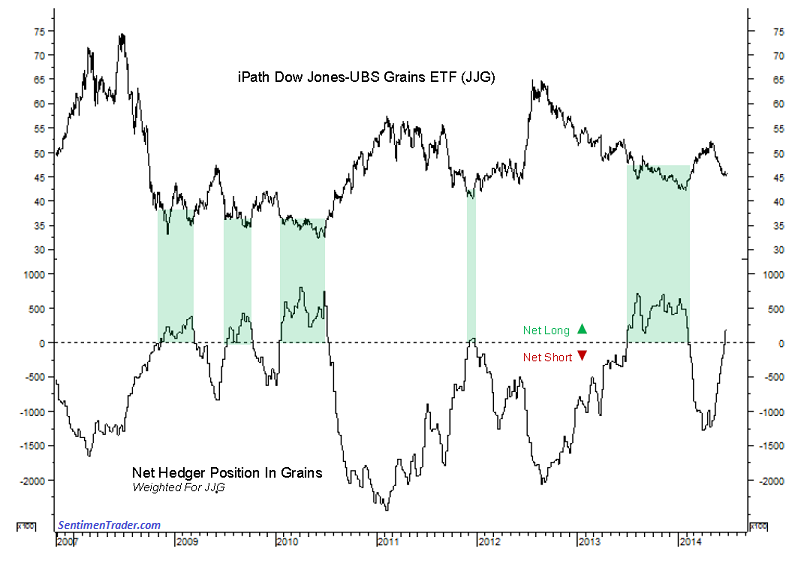
For the 2011 correction, it’s easy to observe how important the 38.2% area was for approximately 10 months. Will that be the case again? Past is not always prologue to the future, nowhere more so than in the markets. However, there is additional evidence courtesy of SentimenTrader. Jason Goepfert was able to compute a hedgers index for futures of the ETF’s components, which was based on each grains’ weighting within JJG. Here are the results:

clip_image005

Now you can review the CoT’s to assess your prospects for the futures, but for traders of the proxy, this is a handy representation. You can see that when hedgers reach a net long position this tends to be consistent with a bottoming process. As the ETF was only birthed in 2007, the 7 years of data should be statistically insignificant in theory. Relevance is relevance and performance is performance. The reason the net long is important is because some of the biggest traders in these markets are the commercial grains producers themselves. Their product sales inherently have them positioned long, so they constantly hedge their sales with short positions. When we see a net long position set-up like what we currently have, then a rally may not be far off.

There could be further downside action, but sentiment is so stretched that there may not be much selling energy left. The selloff was so extreme over the last couple of months that I think the snapback will occur soon providing a potentially profitable trade with $44 as the first Fibonacci target. I have not entered a position here. I really like the sentiment and the chance for a contrarian play, but my indicators have not confirmed the move. When they do, I’ll post an update stating that the move is on. For now keep your eyes closely on the grains for a chance to garner profits this summer.