Since it’s been awhile, this piece is sort of a long one. Read it in chunks over a few days if you have attention issues or if you get bored; but grab your mom’s reading glasses from Rite Aid and follow along because I’ve compiled more derivatives data that I think you’ll find useful even if you already feel knowledgeable enough about the subject matter. Now let me just state for the record that I’m not some cutting edge journalist or a former banker and I rely heavily on info garnered from public sources, but of course I make every attempt to validate facts. There is quite a bit of content form ZeroHedge in this post as they provide content with great depth when it comes to derivatives. I don’t claim to have perfect knowledge of the mechanics of the entire exotic derivatives universe, but I do feel I have a perfunctory level understanding which allows me to comment with relative intelligence on the subject. Now back to the message…
Volatility, volatility, volatility in all markets. Taper or no Taper? That’s the question that Mr. Market continues to ask itself across bonds, equities, currencies, and commodities; basically all the markets. Consequently, traders are being provided sweet treats in these markets because the volatility is virtually a trader’s best friend. If you’re trying to time the markets, I hope you’re effectively managing risk. If not, continue to stick with a long-term strategy that helps you feel comfortable because it really is one giant rigged casino and long holding periods are the big body guards of the unskilled timers.
I came across an intriguing article the other day from a trading site I like to visit, MercenaryTrader.com. Please bear in mind that I greatly respect and enjoy the work generated by the team at MercenaryTrader, but I simply have a difference of opinion in regards to the following article. They have an interesting take on the US Dollar as they feel it is the premier currency now and going forward. I want to share quite a bit of their content here as they take such a stark, contrasting view to what the doom & gloom crowd believe is the fate of the USD. They present why the USD is in a secular i.e. long-term bull market and determine that the USD’s rise will highly correlate with the stock market’s own rise. Here’s a few choice thoughts from the piece by Jack Sparrow(they use nom de plume’s for their article writing because obviously the author’s not a fictional pirate):
“Our thesis has long been that weakness in the USD was temporary — in large part driven by temporary unwinding of the yen carry trade. Basic fundamentals, plus confirming price action, put the USD in a long-term secular bull market after ten years of decline. This is the flipside of emerging markets imploding, which you also saw yesterday…Why did the dollar respond so powerfully to the Federal Reserve testimony? In part, we believe, because a clearer picture is finally emerging. The US economy is a juggernaut relative to dire Europe and weakening emerging markets. Asia is in a lot of trouble. Japan has already expressed the necessity of forcing a much weaker yen in order for Abenomics to work. In addition to this, you have serious credit crunch problems developing in China — and for the first time in a long time, the real prospect of a China crash. Investors are seeing inflation problems sweep through emerging markets — note the huge protests in Brazil. All these factors are combining to fuel a massive repatriation of funds out of EM assets and back into home-based dollars, again strengthening the greenback… As the great speculator George Soros once said, “I am good at riding the tide, but not the ripples of a swimming pool.” Translation: Traders need big trends to make the truly big money. The return of the US dollar — and the secular outperformance of the USD vs the rest of the world — is a HUGE, huge trend. HUGE.
Why has this possibility been so universally missed (or flat-out dismissed)? Perhaps, in part, because a large contingent of the trading community is bottom-up focused — not overly concerned with sea-change macro factors. And another large contingent of the trading community — call it the “Zero Hedge contingent” — has been myopically, religiously obsessed with the debt side of America’s balance sheet, without properly considering 1) the ASSET side of America’s balance sheet or 2) the positioning of the US vis a vis the rest of the world…
I mean, just stop and ponder for a second. The United States is:
· 1. an agrarian superpower (number one food exporter not counting multiple-country EU)
· 2. a military superpower (who else controls two oceans?)
· 3. a demographic superpower (look at our aging trends vs Europe, Japan, China)
· 4. a technology superpower (Google, Apple, Amazon, Intel, IBM, need I go on?)
· 5. a soon to be energy superpower (we are about to start exporting oil again)
· 6. the domicile of +$70 trillion in household wealth
· 7. the home of the most desired real estate in the world
And the United States government has access to all of the above, in terms of assets to draw down on, by dint of our representative democracy.”
MarginRich here; he goes on to explain the correlation values between the USD and the S&P 500:
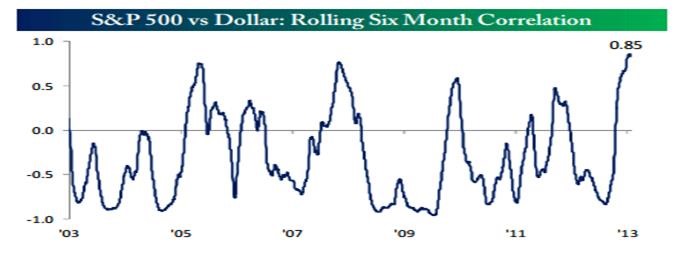
” Some other good news: A lasting resurgence in the US dollar need not be bearish for US equities. For many years, as I’m sure you’ll remember, the dollar was a key “risk off” indicator. When the dollar was up, equities tended to be down and vice versa. This was a function of heavy asset flows into emerging markets and multinational blue chips benefiting from emerging market revenues. But now the situation has reversed. With US domestic equities the new sweet spot for bullish positioning (see Bernstein argument), US equities can rise even as dollar flows repatriate back home to the United States. Think of this not just as a “great rotation” but a “great unwinding.” For a long time EM debt and EM equities seemed the place to be. With the dollar strengthening and the rest of the world faltering relative to the United States, that is no longer the case. With every uptick in the greenback, EM assets look a little bit less attractive in relative currency terms (not to mention the problems they are facing — riots in the streets anyone?). The massive over-allocation to emerging markets in recent years is being unwound, as the whole “emerging markets century” idea is getting its license revoked.
(And by the way, a side note to Jim Rogers: I love you Jimmy, your book “Investment Biker” was my literal inspiration for getting into markets. But your uber-bullish China call was about as long-term wrong as it is humanly possible to be. You are even wronger on that call than the Dow 36,000 guys circa Y2K bubble. And as for permanent gold bugs? Oh man. If you thought your world of hurt was bad already…)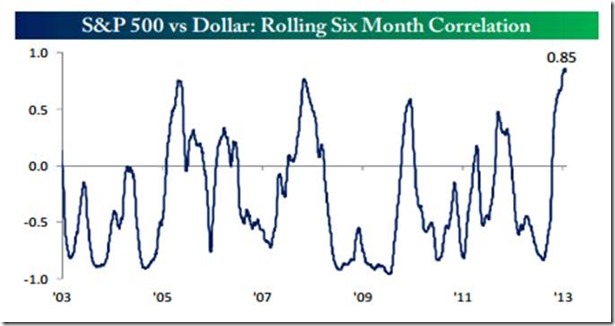 The correlation chart above, from Bespoke Investment Group, shows how the US dollar / US equities relationship has changed. The dollar and US equities now have a positive correlation, rather than the negative one that persisted for years.”
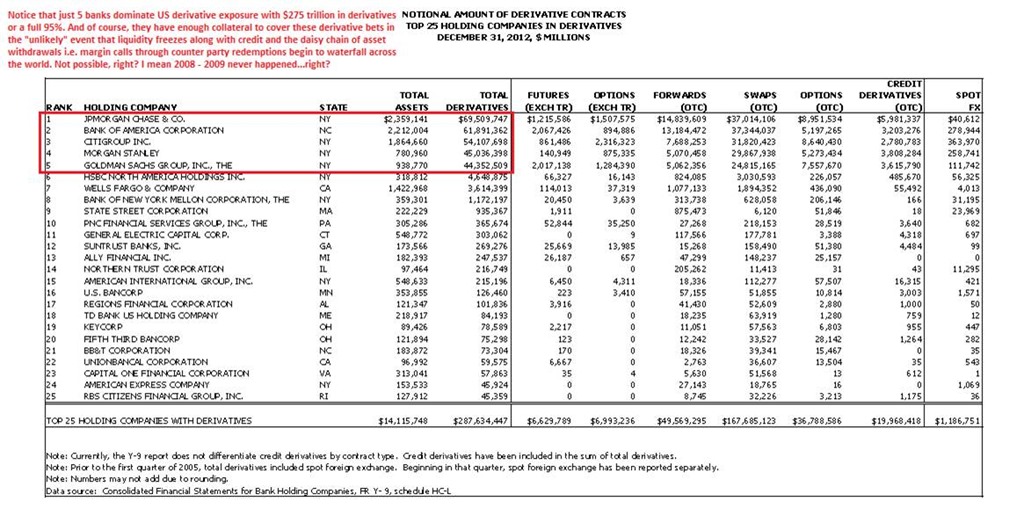
MarginRich here again; what dollar bulls continue to completely fail to note in any of their commentaries or share in any of their trading strategies are any thoughts on the derivatives exposure of the biggest banks and thus the sovereign nations where the banks are domiciled. It’s as if the derivatives market and thus the shadow banking industry don’t exist to these people. I fully understand their views and theses but these could be perceived as somewhat short sighted as they fail to completely assess and include the notional derivatives exposure by the biggest power players on the planet. Let’s revisit what the derivatives situation looks like for the biggest banks on the planet(ex-China, ex-the rest of Westernized Nations, and ex-BlackRock). Keep in mind that after the 2008 crash, the Bank of International Settlements (“BIS” which is the central bank to the world’s central banks) changed the valuation method of derivatives for banks and thus halved derivative exposures across the world from approximately $1.4 quadrillion to between $600 & $700 trillion; of which all are just unfathomable numbers. So here is what dollar bulls continually ignore, as reported by the US Office of the Comptroller of the Currency:
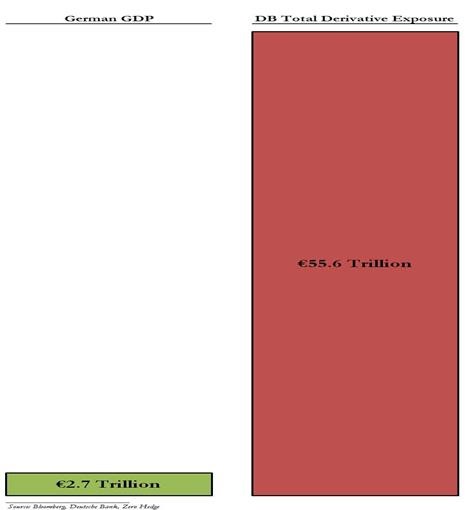
I can’t begin to understand how the heck Deutsche was excluded off of this list. Through the alchemy of balance sheet netting and German domiciling, they’re not even in the top 25 of US holding companies, but observe a snapshot of DB’s derivative position and how that compares to the entire German economy(both courtesy of ZeroHedge):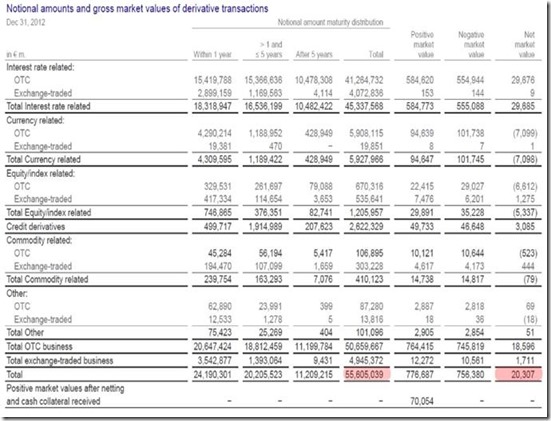
 Once again, no big deal. DB only has Euro-denominated derivative exposure that is 20 times the size of the entire German 2012 GDP; and hell, Germany is only just the 4th biggest economy in the world. There is definitely no risk in that, because Germans can just print as many Marks as they need to deal with any potential liquidity or credit issues…oh wait…yeah the ECB. Well that’s how the Federal Reserve helps support Europe through the magic of currency swaps and the “unbiased” IMF.
In fact at the end of 2012, here is what the IMF had to say about derivatives via their staff discussion paper, “Shadow Banking: Economics and Policy“(again, courtesy of ZeroHedge):
“Over-the-counter (OTC) derivatives markets straddle regulated systemically important financial institutions and the shadow banking world. Recent regulatory efforts focus on moving OTC derivatives contracts to central counterparties (CCPs). A CCP will be collecting collateral and netting bilateral positions. While CCPs do not have explicit taxpayer backing, they may be supported in times of stress. For example, the U.S. Dodd-Frank Act allows the Federal Reserve to lend to key financial market infrastructures during times of crises. Incentives to move OTC contracts could come from increasing bank capital charges on OTC positions that are not moved to CCP (BCBS, 2012).
The notional value of OTC contracts is about $600 trillion, but while much cited, that number overstates the still very sizable risks. A better estimate may be based on adding “in-the-money” (or gross positive value) and “out-of-the money” (or gross negative value) derivative positions (to obtain total exposures), further reduced by the “netting” of related positions. Once these are taken into account, the resulting exposures are currently about $3 trillion, down from $5 trillion (see table below; see also BIS, 2012, and Singh, 2010).
Another important metric is the under-collateralization of the OTC market. The Bank for International Settlements estimates that the volume of collateral supporting the OTC market is about $1.8 trillion, thus roughly only half of exposures. Assuming a collateral reuse rate between 2.5-3.0, the dedicated collateral is some $600 – $700 billion. Some counterparties (e.g., sovereigns, quasi-sovereigns, large pension funds and insurers, and AAA corporations) are often not required to post collateral. The remaining exposures will have to be collateralized when moved to CCP to avoid creating puts to the safety net. As such, there is likely to an increased demand for collateral worldwide.”
MarginRich again, so here’s the best part of that; the BIS states that once again due to the wizardry of netting that the world is only exposed to $3 trillion in derivatives. The precise number is $3.7 trillion as of the first half of 2012 which is basically the same number since 2009 after the crash in 2008, so there has effectively been absolutely no effort to wind down these derivative books which are of course only traded OTC which is why the shadow banking industry presents so much damn risk to the system. The kicker is that the BIS openly states above that there is only $600 to $700 billion backing these derivative transaction. My basic arithmetic skills show that as a very safe 5 times leverage. Thank god for conservatism by the banks, but if you take the collateral against the very real and un-netted number of $600 trillion then we calculate collateral coverage of approximately a tenth of 1% or for the layman, 1000 times leverage (as reported by ZH as well). But you may ask, well why does it say there is $1.8 trillion of collateral and what the hell is the reuse rate? That is how hypothecation comes into the picture. Financial institutions will re-post collateral that belongs to their clients in their own for-profit transactions, under the assumption that the game is such that they are guaranteed to get their money back or they’ll easily come up with the money if something goes south. This will occur with one piece of collateral between multiple entities and that is when re-hypothecation comes into play. How it’s legal is just absolutely beyond me. Feel free to revisit MF Global and the theft of innocent traders’ money who deposited their cash there for futures trading. JP Morgan re-hypothecated hundreds of millions, and by re-hypothecate I mean pilfer or let’s just call it outright stealing, from MF Global’s clients for bad bets that MF Global illegally made with depositors’ money. Many innocent people who trusted MF Global to just hold their cash as a trustee and simply help them facilitate futures trades as a brokerage are still waiting to be made whole. JPM doesn’t feel they have to give that money to the people it belongs to as they are first-in-line creditors, and the courts agree with them for now, so how this is all legal is seriously beyond me. Why would JPM be made whole before MF Global depositors when MF Global had to legally segregate depositor funds and thus could not post those segregated funds as collateral for MF Global’s own transactions, at least as I understand the laws and regulations? Anyways, that’s a discussion for another time and place but if you’re curiosity needs to be immediately satiated then you can visit here and here for a deeper dive along with the actual court case; both about Sentinel Management Group which is apparently establishing the case law however this definitely has the potential to get appealed and taken up to the Supreme Court.
Now all this talk of derivative exposure and bank collateral definitely sounds like the foundation for a long-term dollar bull market especially when you combine in the effects of quantitative easing and the inflationary effects on asset pricing. And if you don’t think asset price inflation exists, then please explain to me the rise of the stock market, the real estate market, the high yield bond markets, the fine art market, and of course the diamond markets, just to name a few several. The icing on the cake is how the US federal government intends to deal with any issues that could potentially arise in a liquidity or credit event in the banking industry. Observe the following chart displaying total FDIC assets, total US cash deposits, and the US derivative exposure all in one pretty little package(once again, courtesy of the OCC via ZH): That’s right. Your eyes don’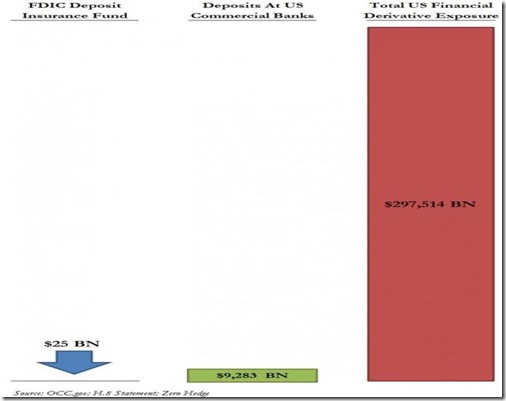 t deceive.
The government has allocated $25 billion from the premiums paid by FDIC member banks to protect depositors in the event that a Lehman-style event occurs again. Do you feel good about the long-term condition of the USD? No doubt, the USD is the top of the currency game right now; but judgment day cometh at some point. I can’t tell you when. I’ve guessed somewhere in 2015 – 2016, but nobody can know. I will continue to say that you can only subvert basic economic and monetary laws for so long. At some point the unintended consequences of this entire 4 decade monetary experiment of exiting the gold standard in combination with the shadow banking system, will draw forth some sort of epic but indeterminate action. It’s guaranteed. Seeing the lack of liquidity in the system to deal with actual risks adds insight into the risks to your cash & assets and the plausibility of a bail-in using your money. The next event will be a triple-whammy as tax payers are hit thrice; once with the bail-outs and then again with the bail-ins and then again as I’m sure the capital gains tax will rise to some egregious percentage or windfall taxes are introduced. It brings clarity to the presentation I sent so many months back when I asked who the hell was JPM referring to in the slides about who will provide needed liquidity, what they leave unsaid is that “shareholders and creditors” really means you i.e. the depositor. Coming back to the buck and why we visited the whole derivatives situation, trend trading the USD right now is one thing but I think it is a stretch to label it as being in a “secular bull market” without fully considering the risks associated with the just-discussed derivative exposure.
Which brings us back to what I(along with countless others) continue to say will be the ultimate investment haven and of course absolute hedge to the the potential busted systems of the banks and governments…precious metals. By now I would understand if you’re finding it difficult to maintain positions in precious metals shares in your portfolio and have verbally cursed the day you may have taken a position in anything related to a precious metal. It’s easy to say right now I was wrong because I was so early and that the case for precious metals is totally bunk and busted. I won’t delve back into all the reasons why your portfolio is going to need precious metals to get through and possibly even prosper through the times I’ve already described.
You can call me a “gold bug” but I haven’t encountered too many gold bugs who’ve shorted gold(via the GLD) and the miners to wash the paper losses of the long-term precious metals holdings. I also am not going to present any new trading ideas for precious metals shares as I’ve already shared a majority of my favorite plays. I will fully admit to being early in some of the plays and I wish as much as any other speculator that I had waited until now to pick-up some of the best speculative names. I also wish I had a unicorn with a magical golden horn that granted wishes, but I’m content to live with reality.
I was sharing with a colleague in an earlier message regarding a junior silver producer to try and compare your situation to Dr. Michael Burry’s, the hedge fund manager formerly of Scion Capital from The Big Short. I know you’re all familiar but let me remind you that he was paying out millions in insurance premiums on the credit default swap derivatives on mbs, which he helped to invent, as a result of getting into the trade years early. His investors, who were humongous players such as Joel Greenblatt of Gotham Capital and White Mountain Insurance, were incensed at the very real losses the premiums paid represented in light of none of the derivative contracts paying off yet and housing just continuing to rise. They gave him hundreds of millions to manage and yet berated him incessantly and threatened him with litigation, but he was resolute and steadfast in his conviction that time would ultimately be the arbiter of value. When the bets paid off, his investors made hundreds of millions of dollars in one fell swoop and Dr. Burry was totally vindicated in his ability to foresee and sit tightly until the obvious end to the trade arrived.
And that is how you should consider your UNREALIZED, PAPER losses; as “insurance premiums” that are the cost of being years early in what has the potential to be the ultimate trade this decade. Think there’s a reason Dr. Burry bought a boat load of gold and farmland, closed up shop, and essentially dropped off the grid? He just may be years early again.
Which brings us back to the shiny little metal which has caused so much pain and angst for speculators of all ilk. Gold has the potential to bring about a monetary revolution that will offset the full power of the USD over the coming years. Is the USD going to totally crash in value and be totally replaced by the Renminbi or SDR’s from the IMF? Obviously not. You can’t just displace an economic and military super-power who possesses the reserve currency in under a decade. The way the USD will drop in value will be the reduction in its use as the reserve currency around the world. Not totally of course, but as of right now, the USD has a 67% share of the currency market; a full 2/3rd. And virtually 100% for oil with the Petro Dollar, except where countries have worked out specific agreements with one another, which is already beginning to happen at a higher rate between China and other players. Take a gander at this article where China has worked out an agreement with the largest oil company on the planet in a $270B deal to double its Russian oil imports over the next 25 years. Even though the article did not specifically state which currency was used, I can state with fair assurance that it wasn’t the Petro dollar but instead probably a Renminbi/Ruble swap.
Now that USD reserve currency use percentage of 67% will inevitably drop to a much lower percentage of possibly between 40% and 50%, as the role of gold and other currencies increases and the other powers in the world decide they’ve had enough of the USD and wish to facilitate large-scale international transactions in different denominations. The drop to 50% USD use is a percentage that Ray Dalio, founder and CIO of Bridgewater, agreed would be probable. You may think to yourself, so what? Who cares about a 17% reduction in the worldwide use of the USD as the reserve currency? Let me assure you that a drop like that can have earth shattering, negative impact to the markets.
And why do we even care what Bridgewater thinks? Well it’s because it’s the largest hedge fund in America with over $140B in assets under management. Dalio along with his Co-CIO, Robert Prince, consistently provide some great macro-economic commentary from an investment standpoint that simply has to be considered. Here’s another great quote from Ray Dalio regarding how the massive debt overhang of the Westernized nations will most probably be dealt with, “…one of 3 things will have to happen: a global debt restructuring/repudiation; global hyperinflation to inflate away this debt, or a one-time financial tax on all individuals amounting to roughly 30% of all wealth. That’s pretty much it, at least according to mathematics.” Two of those outcomes spell nothing but upside for gold and Dalio said this back in September of 2011. Additionally, you’ve got Prince’s early 2012 commentary about bank debts and sovereign debts, “You’ve got insolvent banks supporting insolvent sovereigns and insolvent sovereigns supporting insolvent banks.” And lastly from Dalio regarding Buffet’s take on gold, “I think he is making a big mistake.”
Now that gold is suffering the most intense drops of the 2 year correction, especially with last Thursday’s action, let’s take a look at some potential catalysts for the metal. Incidentally, I think the bottom of this total corrective move from the September 2011 high, will be be down around $1,200; so we’re almost there. Try not to throw up in your mouth as you read that and the following. We’re seeing all-time low stock levels at the metals warehouses at the bullion banks for delivery via futures contracts through the COMEX and LBMA. Additionally, the Commercials(classified as the major producers who hedge and the bullion banks who facilitate large-scale transactions) at the COMEX are the least net short since the selloff’s of 2001, which marked an absolute low before the major run-up to September 2011. In fact, the Commitment of Traders (“CoT”) report is currently showing the absolute lowest net short position since 2001, which was essentially the all-time bottom in the gold price after it was untethered from the dollar in 1971.
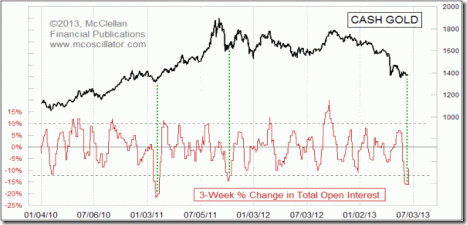
This can be observed in the first chart below. According to the creator of this chart, Tom McClellan, “Commercial traders of gold futures are showing one of the most bullish conditions in years. They are usually presumed to be the “smart money”, and so when commercial traders move to a lopsided net position as a group, it usually means that prices are going to be moving in their chosen direction…In the first chart below, the current reading is the Commercials’ lowest net short position (as a percentage of total open interest) since 2001, which was when gold prices were just starting a multi-year uptrend from below $300/oz. The message here is that commercial traders as a group are convinced that gold prices are heading higher. They usually get proven right, eventually, although sometimes we have to wait around longer than we might wish for “eventually” to get here.”
For the second chart McClellan stated, “One other way I like to use the data in the CoT Report for an interesting insight is to watch total open interest numbers…when the 3-week rate of change of total open interest drops below around -12%, it is usually a pretty good indication of an important bottom for gold prices. Whether or not this recent sudden drop in open interest is going to lead to a real and lasting uptrend for gold prices, or instead just bring a temporary pop, is something that this indicator does not tell us. But history says that it should be associated with a meaningful price bottom, which tells me that we should get some meaningful amount of a price rally from here.” I strongly recommend a visit to mcoscillator.com, as they provide outstanding commentary.

Additionally, demand for physical gold whether it’s bars, ingots, or coins has been through the roof and has stayed there since the down-move began in earnest back in mid-April. This kind of demand on quick moves down in a commodity always produces higher premiums over spot because the spike in demand paints the exact opposite picture of the tape that is trying to be painted with the paper market. McClellan produced some very interesting additional charts that also lend themselves to a potential rise in the gold price. Here is how he described them, “I have just learned recently that the behavior of gold coin dealers can offer us an interesting insight about where gold prices are headed, but perhaps not in a way one might have imagined. The Wall Street Journal publishes prices for gold coins on its web site every day. They even offer historical data going back as far as June 2007…What I discovered when looking at this data on American Eagle pricing is that the average premium over spot is around 4.88%. But whenever it gets up above 6%, the days which follow nearly always see a rise in gold prices. That does not necessarily mean that a >6% reading is a bottom for gold prices. Absolute bottoms or tops are much less important than the direction forward from any given point, and when there is a bullish bias after a certain event, that’s really useful information…I just look at what the data say, and what I see in this week’s chart seems to show a periodically useful edge in terms of figuring out what gold prices will do, if one is willing to look patiently at gold coin prices every day and wait for those pearls to appear. Interestingly, this phenomenon is not confined to just American Eagle gold coins. Here is the premium over spot prices for Canadian Maple Leaf coins. The average premium over spot for Maple Leaf coins is 4.6%, and readings above around 5.5% tend to be followed by gold price rallies over the next several days in the same way that this principle works for American Eagle coin pricing. It also works for Krugerrands. When I say it “works”, I am referring to this phenomenon of the quoted coin price’s premium spiking up well above average, which for Krugerrands seems to be about 3.8%. Readings above 5.0% over spot tend to be followed by rising gold prices over the next several days. I don’t know if this is a case of the smart gold coin dealers sensing that a rally is coming, and thus bumping up their prices to take advantage, or if some other market dynamic is at work. I just know what I see in the data. One potential problem with this data is that it only comes from one source, and we don’t know how wide of a survey net they cast when gathering this price data. But on the positive side, the data are easily available. Interestingly, this momentary pricing anomaly for gold coins arrives at the same time that the Commitment of Traders (CoT) Report data are showing that gold and silver traders are at historic extremes of sentiment. In other words, things looks like a bottom for gold prices which should matter not just for a few days to follow, but for weeks or months.”
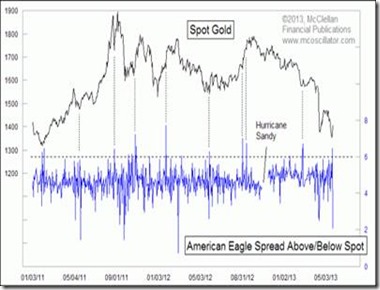
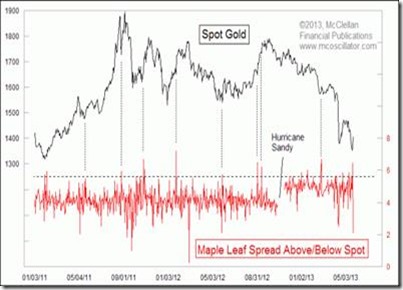
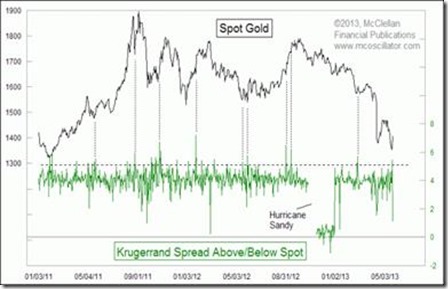
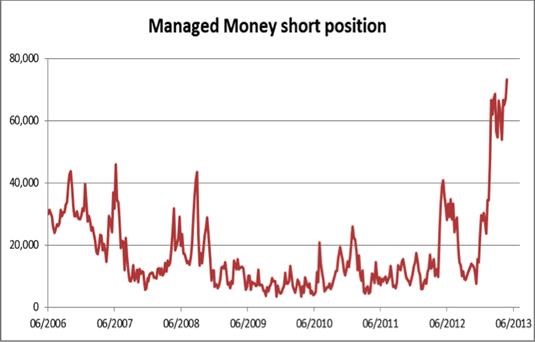
The CoT data of the bullion banks(the bullion banks are the big banks) and commercial hedgers is important because they have essentially positioned long ahead of the hedge fund/managed money group. Now keep in mind we are not talking about giant hedge funds that you know. We are talking about the smaller ones with extremely less talented management who have a stronger tendency to believe in their trend trading systems and follow the herd. This is important because the bullion banks seem to control the gold game with what could be perceived as the help of the central banks and the BIS. They can crush the hedge fund/managed money shorts and they will choose the time of when they feel like beginning to harvest those profits and drive the gold price upward. The data shows that may start occurring in the later Summer or beginning in the Fall. Either way, do not forget that at this point the bullion banks are totally and completely controlling the paper gold game. Observe the following two charts, first by Nick Laird at Sharelynx.com and second by ZH, supporting the reduction in the big banks net short exposure and the significant increase in the hedge fund/managed money gold shorts, which supports the charts up above by McClellan.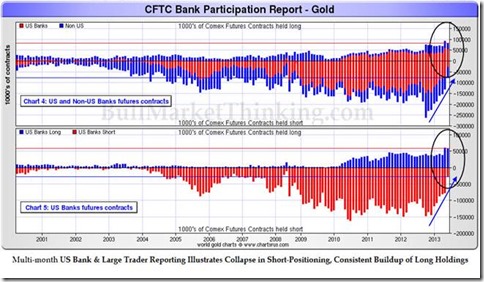
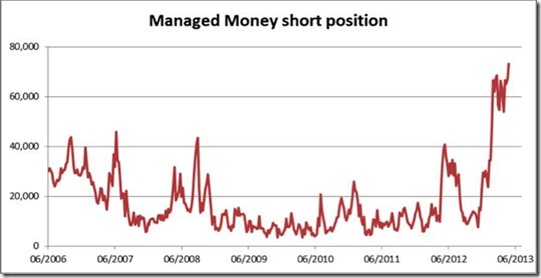
That takedown last Thursday was enough to put the fear in any weak-handed gold speculator/investor. It appears to have been the work of the gold manipulators, which by now is well documented as being the work of the bullion banks in conjunction with the BIS and with the full approval of the central banks. And if you’re STILL in the camp that doesn’t think the precious metals are not manipulated or reserve judgment then please get a clue. LIBOR was reported manipulated and entire debt markets all over the world were affected. FOREX rates manipulated by banks through the front running of the rate-sets through Reuters system affecting THE biggest market in the entire world. Sovereign bond markets of the Western world are outright manipulated and accepted as the proper course of action via the quantitative easing which is the market operations by the Western central banks to simply monetize their own debt. Precious metals are manipulated because they send a most important warning message to the world about what is impending, so yes, I tend to agree with the contention that the metals are manipulated because the psychological effects are absolutely required to maintain control of the entire fiat façade. Control of the metals will also be required to slowly introduce a fix to the system and thus we see the bullion banks positioning their banks to the long side and will allow the release of the paper gold price at their own behest.
William Kaye, a hedge fund manager out of Hong Kong who worked with Goldman Sachs in M&A before forming his fund The Pacific Group in the 90’s, reported on King World News regarding the continued trading in gold that is exceptionally questionable: “It’s the end game of a fantastic manipulation of the markets. I’m looking at my screen now as we talk, Eric. I’m in L.A. (Los Angeles), but we are still in Asian (trading) time with London just coming in at the moment, and we’ve traded over 94,000 contracts. So passing the baton to London we will have already traded 100,000 contracts. A normal night (during Asian trading) would be 20,000, to put that in perspective. So the question is, who is selling all of these contracts at levels that are multi-year lows? Who’s so keen to sell?… And if you need to sell, why are you selling at the worst time of day? Why are you selling in Asian time, which is always the thinnest section of trading? Why don’t you wait for London and Chicago to take over? And the answer is very obvious, these markets are clearly and blatantly being manipulated. The people doing it have clear price objectives. My guess is they want to see a print below $1,300 (on gold) before they are done. That will allow people (trading for the bullion banks) to make profits on their shorts. The bullion banks, from the Commitment of Traders Reports that we’ve seen plus other information that we’ve gathered, strongly indicates that the banks, which are the centerpiece of this conspiracy, have shifted rapidly from being on the edge of default, as ABN AMRO has already done, to being net long, and in some cases being very net long. So they (bullion banks) have taken the opportunity that’s been provided by the cover from what would appear to be official intervention, in what I suspect is the Fed and possibly the ECB, to take the other side of that trade. Now they are extremely net long and that sets the stage, in addition to a very promising technical picture, for a very powerful rally as we look at next week, into July and beyond. The second half (of the year) could be extremely explosive on the upside for gold and silver as well.”
Observe the following chart supporting Kaye’s thoughts and providing additional backing to McClellan’s charts up above. The very latest CoT as of 6/21/2013 was not available before I penned this, but several analysts contend that there is a small possibility that Commercials will actually print at net long next week for the first time since the beginning of the bull market, which would be very, very compelling for a potential trend change in gold if the $1,200 area is truly the bottom.

You’re all grown-up’s so you can ascertain for yourself the credence you put behind the entirety of what you have just read. The derivatives in combination with sovereign debts are the biggest economic issues in the world. I strongly advise you do not take your eyes off of them. Regarding gold, it’s my hope that if you were beginning to doubt the decisions you have made to position yourself in any precious metals or precious metals shares, that this article has reaffirmed your original reasoning. I, nor anyone, knows the when, how or what of the final outcome of the endgame here but as always; you know where I stand. SAND continues to be my absolute favorite way to play the precious metals and I continue to have no doubts about the final outcome of where SAND will trade.
A key to successful trading is risk management and hedging your trades accordingly. For you all, your hedges are generally your 401K’s and IRA’s that allow you to safely compound your investments in relatively safe, reasonably priced names. You get paid to wait with the dividends which fortunately helps you lower your bases and reduce the risk of your positions in riskier other plays, such as the precious metals shares or option moves. Concentrate on risk management and stick to playing the game within your tolerance levels. One should only speculate with capital they can afford to lose but more importantly, position sizing is critical. Going all-in in a game like this is a suckers bet, but I think failing to have any exposure to the precious metals sector would be foolish.
Read, Read, and Read some more. Good luck out there.
 (photo courtesy of Reuters)









 Margin Rich