When Last We Was Trading…

…I’d shared some thoughts on trading volatility and the action of the S&P 500. I was right about the down-move in the S&P 500. I thought a small move was possible of no more than 5% and a 3% percent move down is what we got, then a continuance of the sideways consolidation. However, I was very wrong about volatility. I suspect the reason is because the trade was simply too crowded. Volatility became a trade du jour as the intense bounce that had started in February had obviously grown long in the tooth.

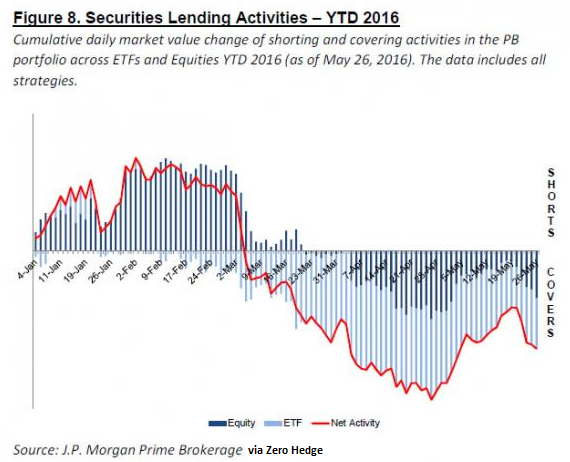
But crowded trades are a trading fool’s errand and my thesis was wrong. And so ended one of the greatest 6-month runs I’ve ever had in reading the tape, but now I’ll just have to start fresh on a new run of prognostications. The crowded trade of long volatility and short the S&P 500 was skewered by the “market making” bot shops. Even Mr. Bonds himself, Gundlach, came out and stated during a Reuters interview that from the 20th of May and on the action in the stock markets felt like a short squeeze. JPM backed that assessment as one of the largest broker dealers out there. Observe a chart they released verifying the quick spike at the end of May in short covering.

clip_image001

As this short-covering burst has squeezed a chunk of the volatility hedging, too, we still very well may get a correction of 5%ish down to just below 2,000 on the S&P 500. Volatility is still worth watching for a quick scalp if enough weak hands have been washed out and the robots let some negative momentum push the S&P 500 down and volatility up.

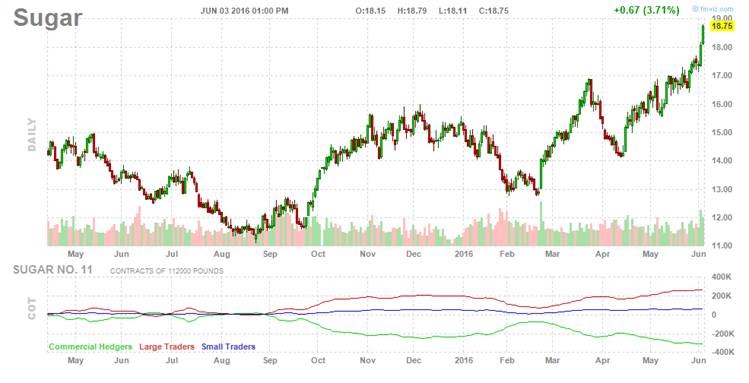
Let’s return to the soft commodities market as sugar has just been on a silly tear. Observe:

clip_image003

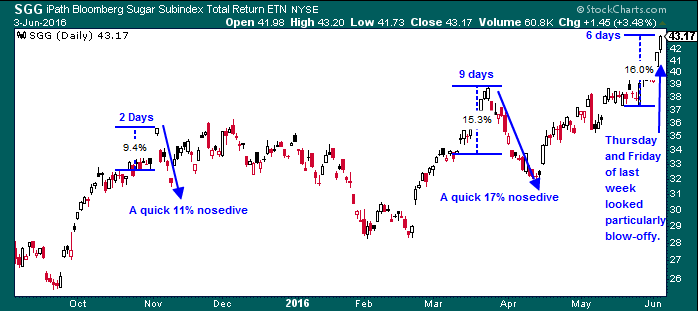
Just look at the last week, specifically. Talk about momentum ignition. The Commercial Hedgers have gone supremely short but this softy keeps ripping higher, moving 16% in the last week. Crazy. But the last two trading days look suspiciously like blow-offs. Have a look at what’s happened during the last two blow-offs in sugar over the past 9 months.

clip_image004

You can see that prior to each of the blow-offs there were frenzied gains in very short time periods, but then astute traders could have made a nice rip quickly shorting sugar for 2 to 4 weeks. Has another opportunity presented itself for one of those rips? It sure looks like it. Go elsewhere for your farm reports, international weather patterns, crop output, regional flood potential, yada, yada, yada. This is straight up tape reading.

Using the futures proxy ETF of SGG, it is clear to see that $36 is an important number for sugar. Magnetic almost.

clip_image005

Using Fibonacci from the August 2015 low to the current June high, $36 also happens to be the 38.2% retracement point on the weekly chart. Tread lightly, if you’re inclined, as the action in sugar has been fast and furious. Just look at that whipsawing action since the start of 2015. Hedge. Trade with discipline. Manage the position.

One final note from a macroeconomic standpoint, have a look at this chart of negative yield curves in Germany and Japan.

clip_image007

If this doesn’t scream insanity to you then nothing can phase you. Maybe all the developed world’s central bankers have been secretly, partially lobotomized. A little frontal lobe here, a little hippocampus there, and you have a compliant banker with the inability to remember what negative rates actually mean and the lack of cognition to act effectively. Germany and Japan combined equal approximately two-thirds of the US economy. Which means their economies matter. A lot. Germany has negative yields out to a decade and Japan out to 14 years, just screaming recession is near if not already present in those two countries. You think the US is in better shape economically because we don’t have negative yields? These are different and unique times, folks. The kind of times that are remembered with head shaking and derisive snorts by future students of the economic past. Trade smart. Build cash. Stay disciplined. New highs are coming, but new lows are closer than you think.

Continue to Suspect a Face Ripper

The evidence at hand looks very compelling that the credit cycle has turned in the world, kicked off by the downfall of the oil and natural gas industry. Energy was the spark, but loan impairment is rising around the world and before the cycle is over I’m confident we’ll see at least one major financial institution go belly up. Which in turn would then test the system’s ability to contain SIFI counterparty risks.

Fear of 2008 is back and back with a vengeance, especially fear of the banking industry’s quality of assets on balance sheets across the world. Look at all the articles that have sprung up over the last week. Look at the rise of credit default swaps on financial institutions, specifically European entities.

clip_image001

Investors are acting as if the ECB doesn’t exist and that European leaders somehow won’t acquiesce to the notion of an increase in monetizing commercial bank assets to calm things down. Deustche Bank’s balance sheet has the whole world in a tizzy but the jawboning has already begun by Schäuble and I have no doubts that Draghi will increase Euro-area QE to settle things should fears continue rocketing higher. I know that the public as well as the powers in charge do not have the stomach for another bail-out like we saw in 2008. Bail-ins will occur when a true crash occurs but before then we’ll continue to see back-door bail-outs that are easily sold to the investing public.

The fears are not just consigned to European banks.

clip_image003

As further proof of an excessive level of 2008-style fear, Forbes featured an article by Peter Tchir sharing the above index of credit default swaps pricing for senior financial institutions.

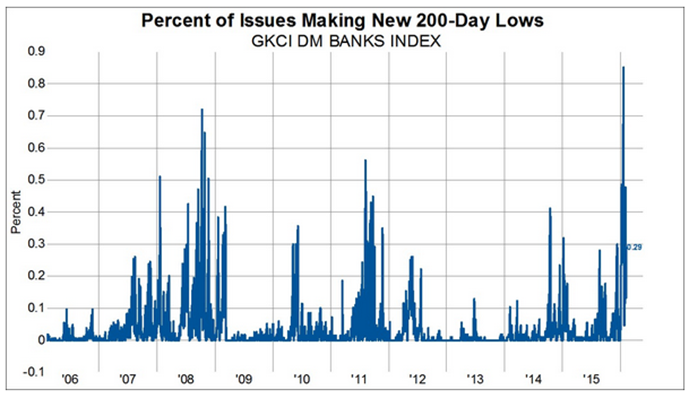
And just look at the performance of bank stocks as depicted by GaveKal.

clip_image005

Relative to the lows of the 2008 and 2011, bank equities are performing at their worse over the last 10 years. This is incredible to me. In 2008, it was as if people thought the whole system was going to implode. Literally. As for 2011, the fears centered on the Mediterranean as people thought Greece and Italy were going to sink into the seas dragging down the world economies with them.

Even the all-seeing eye of Goldman Sachs is being assailed upon. Just look at the gap-ups in the pricing of the squid’s 5-YR CDS, courtesy of ZH via a Bloomberg.

clip_image007

The fears surrounding the world’s financial institutions are not unfounded. There are countless current articles on the deterioration in credit quality in addition to the impairments of balance sheets at financial institutions around the world. It’s just the intensity with which markets have become scared of virtually all banks is truly remarkable.

The ability and the will to continue and increase quantitative easing in Europe and Japan is not being properly discounted. The US does not have to go so far as initiating QE again. Yellen and crew can simply jawbone fears downward by stating they will desist from further rate rises, which we’ve already seen Yellen hint at today. If needed the Fed can simply reverse the rate increase it implemented months ago and that should put a wind in the markets as speculators collectively wipe the sweat from their brows, despite the actual message that would be conveyed.

If we were currently in the midst of a market crash where indices drop by 50% or 60% then it would be the first one I’ve ever read about where people saw it coming months in advance and common market fears totally anticipated it. As I’ve said before, that’s not how these things work. Markets don’t crash while everybody is staring straight at them. That may be attributing too high of a weighting to mass market psychology, but I stand by the contention.

I suspect that animal spirits will be assuaged through various methods by the central banks of the world. Then stock markets can reassert a positive trend on to new highs. Despite the fact that debt markets are far larger and far more important, the stock markets are the thermometer of risk that people seem to spend the most attention on. If 2016 is to be the final hurrah for the stock markets before a rehash of 2008, then I think price action in the S&P 500 could resemble what we saw coming out of the lows of Q3 2011 but on a shorter timeline.

clip_image008

There are many sentiment indicators that are showing an excess of fear. People seem to be expecting a 40 VIX or some sort of blow-off to mark when to get back into stocks to take advantage of the final run in risk-on, but I contend that the markets have shown enough of their hand already. I’ve already allocated capital into trades to take advantage of a bounce in markets. If correct, I think we could see a real face-ripper of a move.

Should the Investing Public Be Worried if Some of the Biggest Banks are Genuinely Scared?

Questions of investing and speculating always require context within time-frame. Players in all asset classes, professional or not, approach the game from their own perspective.

Traders surfing the waves of volatility may be looking only days or weeks out. Investment managers overseeing a growth-oriented portfolio may be looking ahead months or quarters while a value-oriented portfolio manager may be looking years out. The 401k-watching worker bee may be wringing their hands at every market move and every ignorant headline despite the fact that they have 30 more income-earning years left before retirement.

The game is tougher than ever even for the professionals and it’s difficult to decide a course of action with the information overload coming at market players. Determining what’s noise and what is actually valuable information is critical in making the right moves within your portfolio.

I have long been pounding the table on building cash reserves while staying invested in the markets. I’ve also stated that I thought the downturn of late 2015 was the start of the next major bear market. I think that dip and recovery in 2015 was the bear waking up and the poor start in 2016 is investor realization of that bear. However, because everybody now sees it, the markets aren’t going to execute a full-frontal stage-dive. That’s not how these things work, right?

I think we get a recovery into new highs followed by another much smaller correction and consolidation potentially followed by another new high. After that, I suspect all the bull energy will be fully used up and the bear will begin in earnest. Remember, these are simply my suspicions based on behavioral observation of the markets; nothing more than forecasts of potential outcomes.

It’s been a long time since I’ve hit readers with some good old chartporn, but I’m in the mood to throw a bunch of squiggly pics out there to possibly help the reader better assess the market situation in 2016. Observe a 20-year, monthly chart of the S&P 500 along with some relevant indicators.

clip_image001[6]

Observe the long-term breakdowns in the indicators matching the actions of 2008 and 2000. Does that mean crisis is imminent? Nope, but I do think it reinforces my call that a new bear has started. Notice also in 2001 and 2008, we saw strong support and a bounce off of the 50-month moving average. Too many technicians are looking for that and thus too many algorithmic shops will be front running ahead of that signal, blowing out orders to drive the market higher.

I suspect this bounce we are currently in the midst of may be a bit stronger than people realize. Market players have been so used to the V-recoveries and yet they’ve already forgotten what they can be like. It appears that players are numb to the potential of a multi-week to multi-month V-bounce from the January 2016 lows. Despite what I surmise about a stronger than expected bounce, nobody can blame investors for either running for the hills or shoving their heads into the sand.

We’ve already seen the peak in net profit margins for this business cycle in the largest US corporates at the same time that markets continue to be overvalued, despite the corrective moves in December and January. Observe the following chart courtesy of ZH via Thomsen Reuters via Barclays. It depicts how the recession fuse has likely been lit.

clip_image002[6]

And with recession generally comes a bear market correction. Or is it the other way around?

Regarding overvaluation, have a look at this comparison chart from AQR depicting market returns based on various starting points of the Shiller P/E. AQR is the shop that Cliff Assnes, billionaire hedge fund manager, founded and runs.

clip_image003[6]

This coincides with GMO valuation models for future returns based on current valuations. There are plenty of Shiller P/E naysayers who believe that the indicator is bunk. The fact of the matter is that evaluating a normalized 10-year look at P/E ratios is a simple and intelligent way of quickly gauging valuation levels compared to prior periods. Of course every period in history possesses its own specific circumstances as the backstory of the valuation levels, but the raw Shiller P/E paints a clear picture for equity performance going forward.

Besides I don’t see or hear anybody calling Bob Shiller a dumb man. Despite what you may think of his ratio, Shiller is a respected academic even within the professional financial community.

Let’s take a look at a chart from one of every perma-bull’s favorite bear-shaped piñata, Dr. John Hussman. Unfortunately, Hussman catches a lot of flak. Less so after admitting to his analytical mistakes coming out of 2011 but I think he catches a bad rap for simply calling it how he sees it. Hussman’s analysis is based on a quantitative and thorough study of the markets. Can the same be said of a vast majority of the financial blogosphere? No it cannot, including myself. Observe the Hussman Hindenburgs. They nailed the current action coming into Q4 of 2015.

clip_image004[6]

The criterion of the Hussman Hindenburg is detailed in the upper left corner of the chart. Dr. Hussman’s Hindenburg indicators proved to be quite prophetic in 1999 while essentially nailing the top in 2007. For your own long-term holdings, ignore these signals at your own risk. Dr. Hussman, like Dr. Shiller, is respected amongst fellow financial professionals. Have a look at Research Affiliates’ (“RA”) own analysis on current valuation levels.

clip_image005[6]

In a research piece they published in July of 2015, RA evaluates the differences in relative valuation metrics (CAPE, Hussman, Tobin) and absolute valuation metrics. They came to the following conclusion.

Our answer to the question “Are stocks overvalued?” in the U.S. market is a resounding “Yes!” Our forecast for core U.S. equities is a 0.8% annualized real return over the next decade. The 10-year expected real return for emerging markets equity, however, is much higher at 5.9% a year. The return potential of the nondeveloped markets is so high, in fact, that the valuation models, warts and all, paint a very clear picture.

May want to rethink that lack of EM exposure going forward, depending on your time-frame.

Shall we move on to a couple of less orthodox indicators of potential trouble in the markets? Observe the two following charts which pertain to income as opposed to valuation or price action. In the first one, created by McClellan, we get an interesting correlation to total tax receipts for the US government as compared to US GDP.

clip_image006[6]

Notice that in 2000, the US crossed the 18% threshold and stayed there awhile before rising even higher at the beginning of the market selloff. For the GFC of 2007, America almost got to 18% but not quite and we still literally almost vaporized the entire financial system. Currently, we’ve reached 18% but that may or may not mean anything. In each previous occurrence, tax receipts stayed at the level for months or even years so this is an indicator worth watching but only in conjunction with many others.

Interestingly, federal tax receipts as a percentage of GDP currently reached 18% right before the markets began selling off last year. Repeat after me. Correlation is not causation, but the timing is still interesting.

The other chart that doesn’t get a lot of coverage but is very well known is net worth of US households and non-profit organizations as a percentage of disposable personal income. You can find it courtesy of our friendly Federal Reserve Bank of St. Louis and their FRED tool. The grey vertical bars in the FRED charts denote recessions.

clip_image007[6]

It’s been a clear indicator in 5 of the last 6 recessions and we also had that annoying fakeout in 1987. Much like the prior graph, this particular chart should be coincident with additional economic indicators if one is attempting to forecast potential economic as well as investment outcomes.

I want to move on to a particular area that everyone should be concerned about and that is nonperforming loans (“NPL”) at major banks. Not just at US banks but around the world. China’s commercial banks have raised fear levels in even the most seasoned professional investors due to their NPL levels increasing so drastically in 2015. I’ve long stated how debt levels in Italy have the potential to dismantle a good portion of the financial system because the Mediterranean Boot is such a key economic cog in the European Union. Some of the biggest commercial banks in Italy are on the verge of toppling during a period where now the ECB is less amenable to the previously used “bad bank” options. The pressure is beginning to mount for Italy’s leadership to formulate a strategy around potential bank failures.

You might be inclined to observe the following chart and think all is at least well for the US.

clip_image008[6]

But take a look at the following chart in commercial-only loan performance and begin to understand why the total situation looks toppy from the economy to the markets.

clip_image009[6]

For the record, commercial loans comprise approximately $2 trillion of the outstanding debt within the banking system. It is clear to see that a bottoming and an upturn occurred before the last 3 recessions and market dislocations. Now we are currently in the early innings of an upturn in NPL. If commercial loan performance behaviorally adheres to what we saw in the prior two recessions, we will see at least an additional 2% of total commercial loans become impaired assets. That’s potentially between an additional $40 billion to $50 billion at minimum that banks will have to provision for. No easy task in light of current leverage levels and collateral utilization across the repo and derivative space.

This is especially concerning because of the systemic importance of each bank to the entire financial system. Just look at the consolidation that has occurred since 1990.

clip_image011[6]

Couple this concentration with a lack of regulation allowed by Gramm-Leach-Bliley and you can see that debt impairment at the banks is not going to have a happy ending. And if you think Dodd-Frank was the answer to all of our problems, I might stop laughing sometime in March.

What would work to alleviate a lot of the financial pressures around the world in the short term is a weaker dollar. I don’t say that as a proponent of a weaker dollar. Rather, I am stating that currency exchange due to a weaker USD could help sugarcoat revenue reporting across international corporates. It would relieve pressure in the management of reserves for countries with an excess of US treasuries. The oil price could stabilize temporarily but it is well-documented that abundant supply and less-than-expected demand is still the story. Commodities could lift and thus commodity producing countries who are already fighting with their reserves issue could see a double-positive impact. All these effects would be temporary as world debt levels are at unsustainable levels and a bear market for all assets has potentially already arrived. It just has yet to completely sink its claws and fangs entirely into the world’s financial system.

Coming back to the initial question behind this post. Should the investing public be scared? Maybe not scared. Let’s call it aware. They should be aware of all the happenings that are occurring right now. Cash levels should be raised. Certain assets should be paired down depending on losses, gains, and risk exposure. More importantly it’s time to take stock in your own investing psyche. If you are building cash levels, will you have the courage to act at the appropriate time? That’s what raising cash boils down to. Do you have an understanding of the intrinsic valuation levels of specific asset classes that will motivate you to put cash to work?

Aside from brushing up on your ability to properly assess valuations, take a look inside yourself and evaluate your ability to deploy cash when fear is running rampant and the nadir of multiple markets appears to be nowhere in sight.

clip_image013[6]

Value of Increasing Portfolio Cash Levels

There are essentially two major views on cash in one’s portfolio. One view, which is predominantly held, is that cash yields nothing and thus must be allocated into an asset that does yield. The other view is that cash provides the ability to strike when value opportunities arise, and that ability is virtually priceless when the blood is running. What would you have given to have a warchest full of cash to deploy in March of 2003 or March of 2009?

The Spring 2015 edition of Columbia Business School’s (“CBS”) student-led value investing newsletter, Graham & Doddsville, profiled Matthew McLennan of First Eagle Investment Management, the house that Jean-Marie Eveillard built. By the way, Graham & Doddsville is published 3 times a year in the winter, spring, and fall. The newsletter contains interviews with investment pros, highlights of the CBS program, and investment theses by students. It can be a tad redundant of a read, much like Marginrich.com, but every now and then you can glean some quality insight from the interviewees.

McLennan shared some valuable insight on the value of cash, eloquently stating:

We can’t predict what the future will bear. At First Eagle, we view cash as a residual of a disciplined underwriting approach and as deferred purchasing power…We don’t feel the need to force cash to work just because it is a zero-cent yield today, because the return to cash has two components: it has the current yield, and it has the option of redeployment in distress. We feel, given the state of the financial architecture, there will be more windows of opportunity over the coming years to buy businesses that offer potential return hurdles in windows where the markets are less complacent.

It’s this option of redeployment why cash warrants a higher allocation right now. The spectrum of investors is vast with varying risk tolerances, varying asset levels, varying time tables, etc. Whether you’re a professional or an amateur, there is enough compelling evidence to espouse this view. Let’s start with valuations.

Sure, the major US stock market indices are hitting new all-time highs but the price action looks weak, and that’s on the back of some of the highest levels in history of current valuations. Traditional valuation methodologies such as the CAPE and Tobin Q are at levels only seen in 1929, 2000, and 2007. Does that not concern you?

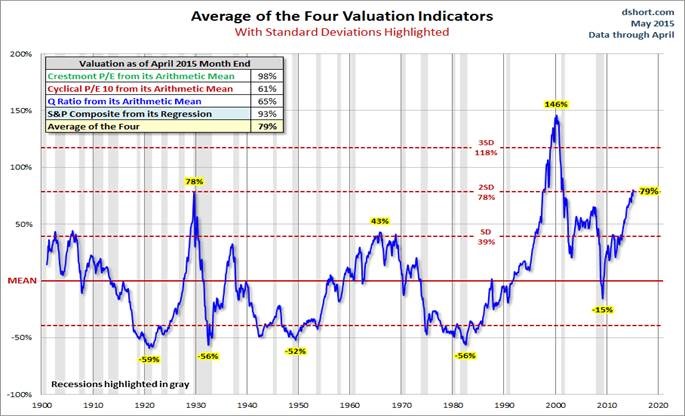
Doug Short provides charts that depicts the CAPE, which he calls P/E 10, and Q plus the Crestmont P/E and S&P 500 regression from its price. One chart that particularly captures the moment in valuations, allowing for some perspective, is the Average of the Four Valuation Indicators with the standard deviations highlighted. Observe:

clip_image002

What immediately jumps out about the chart is that we are currently two standard deviations above the mean for the average of these four indicators, and we are also at a level higher than where we were at right before the Great Depression.

So what! This time is different, right? We’ve got interest rates at basically zero and quantitative easing in Europe and Japan after having just finished in the US. With rates at the zero bound and QE occurring in the most major of markets, equities appear “fairly” valued. Which begs the question, then what is extremis? Is it 10% higher from current price levels on the S&P 500? 20% higher? 30%? Who’s to say? Certainly not the overwhelming majority of professionals. There will be some that nail the top; statistically it’s inevitable. However, the preponderance of evidence unequivocally shows that the professionals are as ignorant about the future of stock market price levels as the people who unfortunately rely on their opinions. They have no idea when the music will stop which is why they keep dancing and dancing and guiding the public to do the same.

Let me provide you with a perfect example. Here’s a December 2007 article from Bloomberg Business(pre-BusinessWeek acquisition, hence the references) titled Where to Put Your Cash in 2008. In it, seven stock market analysts were polled including some from the largest banks on Wall St. The list includes Chief Investment Officers or Chief Equity Strategists at banks such as Citigroup, BofA, and BNY Mellon. Here is where each member of the poll stated they thought the S&P 500 might be trading at by the end of 2008, 1. 1,520   2. 1,675   3. 1,680   4. 1,700   5. 1,675   6. 1,625   7. 1,700; for an average of 1,653.

Anybody recall right off the top of their head where the S&P 500 closed on December 30th, 2008? It was 890. 890!!! Even the most pessimistic of the 7 missed the mark by a whopping 42%. That is egregiously inaccurate for some of the most allegedly well-informed and experienced market forecasters. And what’s worse, these calls were made in December of 2007 well after the market had begun to turn down and create a lower-high. Now of course, hindsight is 20/20 and maybe BusinessWeek excluded any bearish pollings which may have been more accurate, but the fact is these chiefs help in the decision making of multi-billion dollar organizations with multi-billion dollar portfolios.

Many pros utilize statistical models that provide a false sense of security; not just the pros but the academics masquerading as professionals at the world’s central banks and asset management houses, too. They think everything in the world is simply a matter of accurately determining the mathematical expression of potential and probable outcomes. Because as long as you can assess portfolio risk via language like this,

clip_image003

then the world is your oyster. Recall 1998 and the wrench that LTCM threw into the equity markets thanks to its genius partners who could quantify anything and everything in the world so profits were guaranteed. More recently in 2007, every financial house and shop knew risk was mitigated because the statistical models quantitatively guaranteed it. Human behavior simply cannot be accurately quantified with any long-term consistency and the markets consistently forget that. If that were not the case then IBM would be the most successful hedge fund in the world with Watson precisely quantifying all human risk variables and factors to own the world of speculation.

The so-called smart men don’t have any better knowledge of the future than some guy off the street. The future cannot be statistically quantified within an if/then statement. The rationale of the central planners and economists is consistently, “If this then that”, but the world is not tied up and wrapped up so neatly with a bow on it. The same can be said for our economy and financial markets.

People think that the people at the top have all the answers and will provide fair warning for everyone, but that’s not the way it works and people’s incessant memory loss of all things financial prove that out. You don’t know when a component of your car’s engine is going to malfunction. It just happens. Same goes for the economy and the markets. Along will come an unforeseen event i.e. black swan i.e. fat-tail that will critically damage the component of the engine causing the machine to breakdown. Let me remind you, that the same people that stewarded the financial crisis of 2008 are still in power at all the major private, public, and government entities.

I don’t mean the same people in the literal sense, but the same kinds of individuals. All without extra sensory powers of foresight and omniscience. They continue to utilize the same models that have been so greatly leaned on since the 90’s. The kind of statistical models that say “Oh, this event could only occur once in every 10,000 years so we have nothing to worry about regarding the management of our risks.” When the next downturn comes along, and it will because cyclicality is but one of nature’s simple inevitabilities, all these smartest-people-in-the-room types will be poring over their models and wondering how such a deviation from the standard could have caught them unawares.

Don’t be caught in the same trap that ruined the financial portfolios for so many investors on the brink of retirement. Now is the time to prepare yourself, because your RIA or whoever else you entrust your financial future to will not be able to safely shepherd you through the next financial crisis. They can’t. It’s virtually impossible due to career risk, fund charters, and the greed of maximizing assets under management.

There will of course be the small cadre of asset managers that go to cash early by tactically liquidating the portfolio and placing intelligent counter bets to strategically capitalize on the next great dislocation; in the process becoming hailed as new gurus. However, the financialization of our economy has driven so much talent into the markets that it’s statistically impossible for most money managers to not lose big. Inherently, the players in the field know and understand this but the people placing their hard-earned money with these players generally do not share the same level of comprehension.

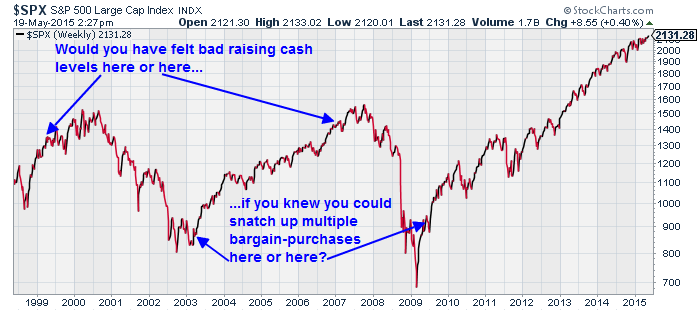
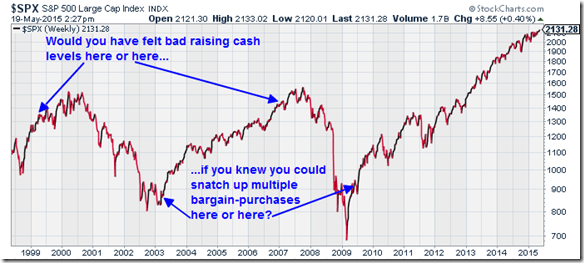
I’ve been sharing my thoughts for some time now on the potential benefits of raising cash levels. I don’t think it’s alarmist. I continue to think it’s prudence. I’m not saying exit the markets. Just start to build cash levels. Examine the chart below with the obvious benefit of hindsight.
clip_image004

Let us assume the next great dislocation takes the S&P 500 down by 50%. This assumption is based on the approximate haircuts of 47% and 56% in 2000 and 2007, respectively. For the sake of the illustration, let me also generously give the S&P 500 another 30% of upside from current levels. That would put the S&P 500 at about 2,770. Halve it and you have 1,385 which is still 35% lower from current levels, a bear market by any standard but the 50% markdown would be avoided for a portion of holdings. Then with valuations in the trough, one can begin to selectively capitalize. All the variables are unknowable. It’s a simple exercise for the sake of illustrating the value of having cash available at the appropriate moment in time.

As previously stated, if you think leaving your hard-earned money in the hands of a professional will protect you, you are mistaken. Chuck Jaffe, MarketWatch columnist, penned a recent article which imparts this very notion. The piece’s opening headline states, “Only four funds have beaten the S&P 500 for the last eight years.” That’s four as in you can count the number of actively managed funds on one hand that can beat a simple index of the S&P 500 over the last eight years. Those four funds are all in healthcare, which means it has taken the tailwinds of what is arguably the strongest demographic opportunity for the next 10 to 15 years to beat a simple index.

The markets are cyclical and what was old is new and what is new is old. The sun may wane on indexing for a time and active stock picking may get revitalized. If you intend to be one of those stock pickers then it is imperative to have the cash available for opportune investment. I’ll share what I feel is a poignant quote from Charlie Bilello, of Pension Partners, that summarizes the value on boosting cash levels in one’s current portfolio. In the article, Bilello is referring to the ATAC rotation strategies that Pension Partners advise on and utilize, however the sentiment is equally applicable to what has been articulated in this post. To wit(emphasis mine),

Similar to the mid to late 1990’s the last few years have featured runaway gains in U.S. equities. Any strategy that was built to minimize downside over this time has dramatically underperformed as there has simply been no downside to capture. While some would view this as flaw in these strategies it is the only way they can work over time. In order to minimize downside you have to be willing to give up upside in return, and by extension this means underperforming during runaway phases in bull markets. There is no other way if your primary goal is to protect capital. The tide always turns and while out of favor today, preserving capital and managing risk will be back in vogue once more, but only after the declines occur.

Brush up on your valuation skills. The sacrifice of modest current returns versus potential outsized losses while waiting for the inevitable fire sale makes cash a superior asset. Set aside the ingrained notion of maintaining a current unproductive asset bearing debasement losses for the simple notion of sometime in the near future you could be buying the most productive businesses or assets on the planet for 40 to 60 cents on the dollar. Will we get another crack at the beginning of a true secular bull market beginning with a CAPE in the single digits? Possibly, but I’ll take a CAPE in the teens just as well and I’ll want to have the ammo available when such fortuitous circumstances(for some) arise.

Update:  5/22/2015
I readily and regularly admit to not exactly being an intellectual heavyweight, so here’s an interview with Nassim Taleb from the Swiss website Finanz und Wirtschaft. They consistently feature quality international pieces from international guests. In the article, Taleb(a legitimate intellectual heavyweight) shares many of the same sentiments expressed in this post; just to add a touch of support to the claims.
American Assets Discounting European Politics

Last summer, I shared some thoughts on the stock markets’ abilities as a discounting mechanism for future events. The gist was that stocks may provide a murky read some times when it comes to prophesying.

Reading the current macro signals is a tough endeavor for any speculator, and with today’s volatility, all the more dangerous when making bets based on those signals.

That being said, I get the feeling that last week’s action in some of the rate-sensitive sectors in combination with general stock market consolidation is portending a positive outcome in the Greece/Europe situation. Bear in mind these thoughts are pure suppositions based on nothing more than a hunch. I’ve been wrong before. I’ll be wrong again. As the old Soros saw goes, “It’s not whether you’re right or wrong that’s important, but how much money you make when you’re right and how much you lose when you’re wrong.”

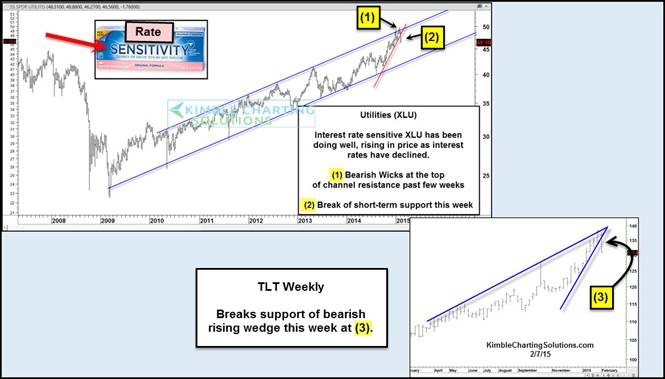
Kimble recently provided a long-term view of two key sectors.

clip_image002

We’ll revisit the impact of the breakdowns in those sectors, but the whole world of finance is focused on the potential resolution of Greece’s debt-financing problems. We have Goliath, the Troika(ECB, IMF, and European Commission “EC”), attempting to dictate the how, what, and when to David aka Greece. Right now a political game of poker is being played with the potential for worldwide ramifications. Greece’s new management is playing the hand it’s been dealt in what appears to be a very transparent fashion. Basically, they’re happy to stay in the euro as long as fair terms are met in a reworking of current debts to the Troika.

The Troika, god I hate saying that word but it does beat out typing the three entities, is really trying to play hardball with Greece but they have no leverage. None. Ok, maybe the smallest amount; just to play chicken. In my estimation, 98% of the leveraging power belongs to Greece. Dijsselbloem, EC head finmin, and Schauble, German Minister of Finance, have both been bellowing the fiery rhetoric from the tops of their lungs, “Greece better pay or else!” Or else what? They’re going to let Greece depart the euro? Ok. Yeah, sure.

Greece isn’t going back to the drachma in an exit from the euro, at least not this year, because the markets would be roiled. There are simply too many things that could go wrong to upend the European status quo for a Grexit to happen. Let’s just logically play out a generic sequence of events. Europe can’t let Greece totally default. For the owners of Greek debt and of course credit default swaps on the debt, credit events would be triggered across a multitude of financial institutions which could in turn then trigger counterparty liquidity risks which would instantly panic the financial universe. This instant panic would hit all the developed stock markets but with a focus on the European stock markets, which would negate the positive effects of the trillion-euro QE plan before it even had a chance. Too me, that’s enough to know that even if the deadline for a Greek debt resolution is pushed out, it’s still going to end with Europe caving but in a manner which saves as much face as possible.

Germany’s account surplus is so ridiculously large that I don’t really think they are going to tell Greece to go souvlaki itself. German total employment is high and exports continue to be robust. Pushing Greece to exit the euro would create an environment of fear where recession could rear its ugly head at a time when German companies are rolling. While Greece has all the appearances of being the linchpin holding the euro together, they’re really just a very, very important lugnut. Italy is the real linchpin. Their debt has the potential to topple the world. Which is why Europe doesn’t want to easily concede to Greece and open the door for Italy to dictate revised terms of its sovereign debts. Aside from Italy, there is obviously still Spain, Portugal, and Ireland; but Italy is the megaton nuke that can change everything.

Aside from the financial obstacles for Europe, there are the more important political complexities that must be addressed in pushing Greece too far, too hard. Russia has already extended an olive branch for Greek funding and Greece officials are reporting that China has now offered a helping hand. The world knows that China possesses the funds to help provide a financial backstop for Greece. I suspect the world may doubt how much funding Russia can lend in light of its own domestic problems concerning the ruble’s decline alongside oil’s rout. I contend that doubt would be misplaced. Does anyone really believe that Europe would simply push Greece into Russia’s waiting and open arms, where after, Greece will be free to negotiate any number of fear-inducing considerations like the usage of Greek ports for the Russian navy. Or how about land or sea allowances for petroleum energy pipelines. Maybe missile battery emplacements “for protection” on the northern Greek borders.

These are extreme examples as Greece is still a NATO participant, but it is unknowable with which the speed of certain actions could be taken should political alliances be shifted over this money. Consider how fast Russia appropriated the Crimean peninsula. All the angles have to be considered and with Merkel’s established relationship with Putin, I don’t see the Troika being allowed to precipitate negative financial and geopolitical outcomes.

What is difficult to reason, for me at least, is how the US will come to bear its influence in this whole game of thrones. America will have its say on bailing out Greece, but how and where and with what level of impact is a challenging thought experiment.

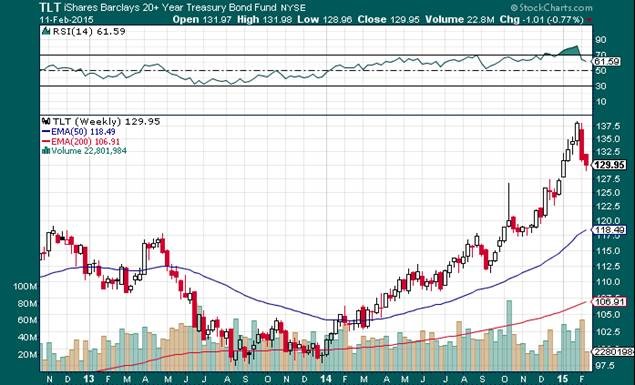
Coming back to American assets and their ability to discount the European outcomes, I think the speed with which the rate-sensitive sectors dropped last week are the tell-tell signs. Examine the two following weekly charts of TLT and XLU.

clip_image004

After a stellar run in 2014, that was a precipitous drop last week. The overall trend remains up, but the situation is very fluid as we have to consider the interrelationships between markets, especially the dollar and implied volatility across Treasury yields.

clip_image006

A familiar market adage is that Utilities tends to be a precursor for the greater stock markets. Any correlation is possible at any given time in the markets, however, we live in an age with remarkable volatility across asset classes. Thus, old interrelationships that once used to prove semi-reliable, may just not be so consistent. I think the Utilities, Treasuries, and yields are telling us that the general market environment is about to go risk-on with another leg-up in the greater stock markets.

There has been no shortage of writing on the significant perils in the market. I have read many a sound analysis that a major dislocation is “near.” But that’s the problem with using a word like “near” or any of its synonyms. Near is a relative term. It’s a word that gets used in a sentence and can mean anything from 1 day to 3 months to 2 years or whatever. Most analysts, bloggers, and general market commentators aren’t willing to stick their necks out and provide a more precise timeframe based on their opinions. They just point to a lot of evidence that says it’s “near.”

I agree that the next major leg down in the markets that began with the Great Recession in 2008 is near. I’ve long-stated that I thought 2015 – 2016 were going to be the years that major catalysts presented themselves for an epic sell-off, but I don’t think that time is upon us. I’m convinced that the markets will draw in a lot more participants first. I want to get that 1999 and 2007 feeling first. You know the feeling I’m talking about; that feeling that the markets will never go down and speculating in the stock market is a can’t lose venture.

The danger of deflationary forces is reasonably priced into the markets. Japan is still easing while the Fed is continuing to roll assets and now we have the ECB embarking on a trillion dollar extravaganza. I have read analysis that the efficacy of the ECB’s easing is highly questionable due to negative rates around the continent. I say nonsense. Animal spirits only care about a liquidity buffer to fill voids. Besides in a risk-on environment, yields will rise as higher levels of capital will flow into equities in a sector-rotational chase for alpha.

Risk-on is not mutually exclusive of risk management, no matter what. Countless interviews with billionaires around the world back up the fact that risk management is the number one key to successful speculation and investing. That being said, look for the general stock markets to pick up a little speed in advance of a potential workout between Europe and Greece. In just the last few days we’ve had two US hedge fund billionaires share their opinions on a Grexit. Dan Loeb, of Third Point, thinks there’s a lot of risk associated with these markets and has lowered net exposures across his funds so far this year. David Tepper, of Appaloosa, thinks there is nothing to worry about if Greece exits the euro. He basically stated that there’s a handful of percentage points of loss to worry about, but that the markets are strong enough to overcome a negative outcome. Loeb is prudent. Tepper believes in his analysis. I think the GermansEuropeans will reach an accord with Greece sometime soon(another relative term) and the stock markets will eat it up.

There is still that little matter of the dollar, euro, and their extreme levels in sentiment. Carry trades continue to be wonky in light of the dollar strength. Maintain a close eye on these currencies as they will enhance a risk-on move. Whether you believe the markets are discounting future events or not, there is a persistence of extreme movements. A European resolution with Greece and a shift in dollar sentiment may just provide a profitable environment for stock market participants.