Short-term Equity Risks Arising

Despite Wednesday’s(3/25/2015) market weakness on virtually nothing but fear, there is plenty of technical action showing that markets appear fine. The question is how reliable is the action. Breadth indicators across multiple indices are positive. Small caps are leading large caps. Consumer discretionary to staples are favorable. Rate sensitive ETFs(TLT & XLU) have been conducting basic retracements which is perfectly natural coming off their hard sell-offs, but I think their selling will resume which will continue to indicate higher risk appetites once stocks take a little breather of their own. If the equity markets do what I think they’re going to do, which is correct a little harder here in the near-term, then I suspect TLT and XLU will chop for a bit while stocks let off of a little steam.

clip_image002

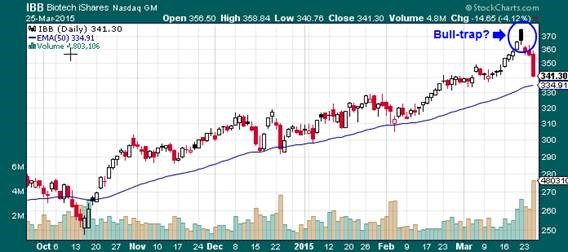
Everybody has their own methodologies for reviewing the markets to get a feel for the probability of directional plays. I really like to use inter-market analysis to help me potentially sense where the greater market may be headed. I have been watching biotech very closely as it has been the hottest sector and a market leader for some time. Real weakness in biotech may be a precursor to overall market weakness. That action last week in IBB had me suspicious. To me it appeared to be a blow-off. Call it what you want, a throw-over or a bull-trap. Either way the price action raised my hackles and officially put IBB on my radar as a temporary short. Current price action in IBB and the S&P 500 may be proving that out.

clip_image004

Now clearly, biotech is in a raging bull market and has been for several years now. You don’t want to fight that trend. It’s better just to ride it upwards for continued profit, because it’s going to take a lot more M&A in that sector before we see a top in biotech. However, there was a bit of froth in biotech M&A during the first quarter of 2015. Observe the following chart courtesy of Reuters and just look at Q1’s performance amongst pharmaceutical companies compared to the last 5 years.

clip_image006

We haven’t seen that kind of aggression since coming off the lows of 2009. There’s been approximately $60B of M&A activity in pharmaceuticals to start 2015, which accounted for 10% of overall M&A activity in the quarter. Twenty-one billion alone of that $60B was done in the Pharmacyclics purchase by AbbVie. That also signaled to me a potential short-term top for biotech as J&J and AbbVie slugged it out for rights to the cancer-fighting company.

So the real question then is how is this information actionable? Well that depends on your appetite for risk and how you’re looking to allocate capital in the short-term or long-term. If you’ve been visiting this blog for a while then you’re well aware I’m always ready to roll the dice based on my ability to interpret market action. I think shorting biotech via IBB or XBI is a good opportunity. I could have positioned earlier, but I was waiting for the price action to confirm so as to hopefully avoid being whipsawed.

If any readers are inclined to risk come capital, I think that IBB’s price action has stated to market players that it looks good for a short-term short. A small bounce at this price point is likely; especially in light of that 4% down day. I suspect the bounce could move the share price back up into the $355 to $365 range giving weak hands sufficient room to liquidate. That liquidation could then kick off the next leg down in biotech. There is a very strong floor at $290 as that is where the current 50-month EMA rests, so any option players will want to factor accordingly. I’m not stating that I think IBB will definitely hit $290, just that it’s a strong price point of support.

If IBB’s share price creates un-compelling options price points for smaller traders, then the XLV is a solid alternative. It has higher relative strength due to the size and various types of non-biotech holdings, but XLV possesses sufficient exposure to biotech that it will correct as well and it’s options may allow for a wider range of speculators to employ strategies.

As for the larger market i.e. the S&P 500, I wouldn’t expect anything deeper than a 10% correction if even that deep. There’s strong support at its 50-month EMA, as well, which is currently at $1,987. A 10% correction would take us down to approximately $1,900, which is also a round-number “power line” that I see providing strong support. I also suspect that any sell-off would result in yet another V-shaped recovery so be prepared to remove any short bias as a new leg higher ensues for the S&P 500 and biotech. Remember, these are interpretations based on my inter-market analysis. There are plenty of breadth indicators putting a more positive spin on things.

The markets are tricky, rigged, and no place for the ignorant. Manage your risks accordingly and utilize any potential correction to get long. There is continued quantitative easing on a massive scale across the world and the Fed is still reluctant to raise rates just yet. Current liquidity levels and yield curves continue to put a wind in the sails of higher risk assets. As Q1 draws to a close, take a moment to review your portfolio and see where you stand in 2015.

American Assets Discounting European Politics

Last summer, I shared some thoughts on the stock markets’ abilities as a discounting mechanism for future events. The gist was that stocks may provide a murky read some times when it comes to prophesying.

Reading the current macro signals is a tough endeavor for any speculator, and with today’s volatility, all the more dangerous when making bets based on those signals.

That being said, I get the feeling that last week’s action in some of the rate-sensitive sectors in combination with general stock market consolidation is portending a positive outcome in the Greece/Europe situation. Bear in mind these thoughts are pure suppositions based on nothing more than a hunch. I’ve been wrong before. I’ll be wrong again. As the old Soros saw goes, “It’s not whether you’re right or wrong that’s important, but how much money you make when you’re right and how much you lose when you’re wrong.”

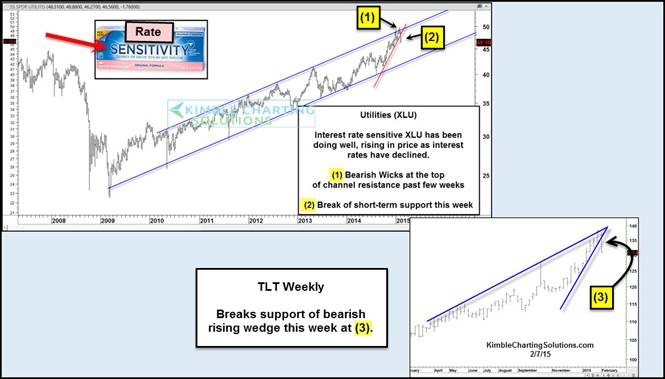
Kimble recently provided a long-term view of two key sectors.

clip_image002

We’ll revisit the impact of the breakdowns in those sectors, but the whole world of finance is focused on the potential resolution of Greece’s debt-financing problems. We have Goliath, the Troika(ECB, IMF, and European Commission “EC”), attempting to dictate the how, what, and when to David aka Greece. Right now a political game of poker is being played with the potential for worldwide ramifications. Greece’s new management is playing the hand it’s been dealt in what appears to be a very transparent fashion. Basically, they’re happy to stay in the euro as long as fair terms are met in a reworking of current debts to the Troika.

The Troika, god I hate saying that word but it does beat out typing the three entities, is really trying to play hardball with Greece but they have no leverage. None. Ok, maybe the smallest amount; just to play chicken. In my estimation, 98% of the leveraging power belongs to Greece. Dijsselbloem, EC head finmin, and Schauble, German Minister of Finance, have both been bellowing the fiery rhetoric from the tops of their lungs, “Greece better pay or else!” Or else what? They’re going to let Greece depart the euro? Ok. Yeah, sure.

Greece isn’t going back to the drachma in an exit from the euro, at least not this year, because the markets would be roiled. There are simply too many things that could go wrong to upend the European status quo for a Grexit to happen. Let’s just logically play out a generic sequence of events. Europe can’t let Greece totally default. For the owners of Greek debt and of course credit default swaps on the debt, credit events would be triggered across a multitude of financial institutions which could in turn then trigger counterparty liquidity risks which would instantly panic the financial universe. This instant panic would hit all the developed stock markets but with a focus on the European stock markets, which would negate the positive effects of the trillion-euro QE plan before it even had a chance. Too me, that’s enough to know that even if the deadline for a Greek debt resolution is pushed out, it’s still going to end with Europe caving but in a manner which saves as much face as possible.

Germany’s account surplus is so ridiculously large that I don’t really think they are going to tell Greece to go souvlaki itself. German total employment is high and exports continue to be robust. Pushing Greece to exit the euro would create an environment of fear where recession could rear its ugly head at a time when German companies are rolling. While Greece has all the appearances of being the linchpin holding the euro together, they’re really just a very, very important lugnut. Italy is the real linchpin. Their debt has the potential to topple the world. Which is why Europe doesn’t want to easily concede to Greece and open the door for Italy to dictate revised terms of its sovereign debts. Aside from Italy, there is obviously still Spain, Portugal, and Ireland; but Italy is the megaton nuke that can change everything.

Aside from the financial obstacles for Europe, there are the more important political complexities that must be addressed in pushing Greece too far, too hard. Russia has already extended an olive branch for Greek funding and Greece officials are reporting that China has now offered a helping hand. The world knows that China possesses the funds to help provide a financial backstop for Greece. I suspect the world may doubt how much funding Russia can lend in light of its own domestic problems concerning the ruble’s decline alongside oil’s rout. I contend that doubt would be misplaced. Does anyone really believe that Europe would simply push Greece into Russia’s waiting and open arms, where after, Greece will be free to negotiate any number of fear-inducing considerations like the usage of Greek ports for the Russian navy. Or how about land or sea allowances for petroleum energy pipelines. Maybe missile battery emplacements “for protection” on the northern Greek borders.

These are extreme examples as Greece is still a NATO participant, but it is unknowable with which the speed of certain actions could be taken should political alliances be shifted over this money. Consider how fast Russia appropriated the Crimean peninsula. All the angles have to be considered and with Merkel’s established relationship with Putin, I don’t see the Troika being allowed to precipitate negative financial and geopolitical outcomes.

What is difficult to reason, for me at least, is how the US will come to bear its influence in this whole game of thrones. America will have its say on bailing out Greece, but how and where and with what level of impact is a challenging thought experiment.

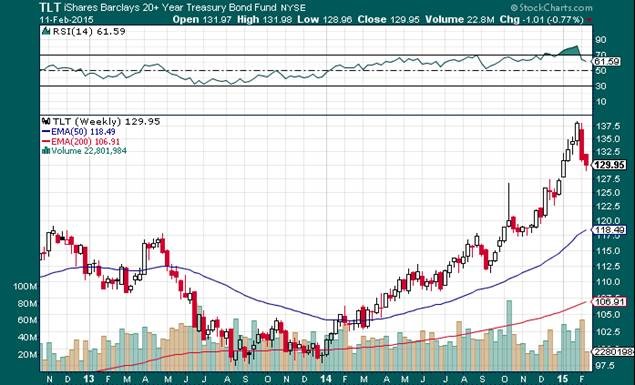
Coming back to American assets and their ability to discount the European outcomes, I think the speed with which the rate-sensitive sectors dropped last week are the tell-tell signs. Examine the two following weekly charts of TLT and XLU.

clip_image004

After a stellar run in 2014, that was a precipitous drop last week. The overall trend remains up, but the situation is very fluid as we have to consider the interrelationships between markets, especially the dollar and implied volatility across Treasury yields.

clip_image006

A familiar market adage is that Utilities tends to be a precursor for the greater stock markets. Any correlation is possible at any given time in the markets, however, we live in an age with remarkable volatility across asset classes. Thus, old interrelationships that once used to prove semi-reliable, may just not be so consistent. I think the Utilities, Treasuries, and yields are telling us that the general market environment is about to go risk-on with another leg-up in the greater stock markets.

There has been no shortage of writing on the significant perils in the market. I have read many a sound analysis that a major dislocation is “near.” But that’s the problem with using a word like “near” or any of its synonyms. Near is a relative term. It’s a word that gets used in a sentence and can mean anything from 1 day to 3 months to 2 years or whatever. Most analysts, bloggers, and general market commentators aren’t willing to stick their necks out and provide a more precise timeframe based on their opinions. They just point to a lot of evidence that says it’s “near.”

I agree that the next major leg down in the markets that began with the Great Recession in 2008 is near. I’ve long-stated that I thought 2015 – 2016 were going to be the years that major catalysts presented themselves for an epic sell-off, but I don’t think that time is upon us. I’m convinced that the markets will draw in a lot more participants first. I want to get that 1999 and 2007 feeling first. You know the feeling I’m talking about; that feeling that the markets will never go down and speculating in the stock market is a can’t lose venture.

The danger of deflationary forces is reasonably priced into the markets. Japan is still easing while the Fed is continuing to roll assets and now we have the ECB embarking on a trillion dollar extravaganza. I have read analysis that the efficacy of the ECB’s easing is highly questionable due to negative rates around the continent. I say nonsense. Animal spirits only care about a liquidity buffer to fill voids. Besides in a risk-on environment, yields will rise as higher levels of capital will flow into equities in a sector-rotational chase for alpha.

Risk-on is not mutually exclusive of risk management, no matter what. Countless interviews with billionaires around the world back up the fact that risk management is the number one key to successful speculation and investing. That being said, look for the general stock markets to pick up a little speed in advance of a potential workout between Europe and Greece. In just the last few days we’ve had two US hedge fund billionaires share their opinions on a Grexit. Dan Loeb, of Third Point, thinks there’s a lot of risk associated with these markets and has lowered net exposures across his funds so far this year. David Tepper, of Appaloosa, thinks there is nothing to worry about if Greece exits the euro. He basically stated that there’s a handful of percentage points of loss to worry about, but that the markets are strong enough to overcome a negative outcome. Loeb is prudent. Tepper believes in his analysis. I think the GermansEuropeans will reach an accord with Greece sometime soon(another relative term) and the stock markets will eat it up.

There is still that little matter of the dollar, euro, and their extreme levels in sentiment. Carry trades continue to be wonky in light of the dollar strength. Maintain a close eye on these currencies as they will enhance a risk-on move. Whether you believe the markets are discounting future events or not, there is a persistence of extreme movements. A European resolution with Greece and a shift in dollar sentiment may just provide a profitable environment for stock market participants.

Economic Distortions

Here at MarginRich.com, I mention Jeremy Grantham and his firm GMO quite a bit. That is for two very big reasons. Number 1, he and his firm manage in excess of $100 billion for the biggest institutional investors across the land. And number 2, he’s publicly nailed multiple bubble calls. Does he nail them to the day? Well no, but he’s been close enough and has effectively ensured his clients were positioned accordingly to mitigate the damage of the last two major stock market bubbles.

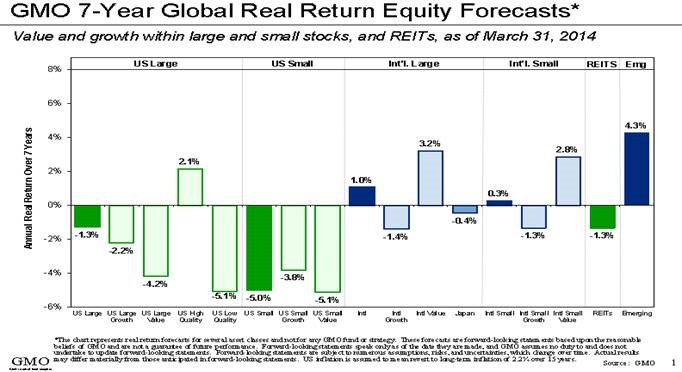
GMO came out with its most recent 7-year forecast for various asset classes and equities. It ain’t a pretty picture. These guys have consistently nailed their forecasts, especially for equities. They’re predicting negative returns essentially across the board of various sectors with pockets of relative strength in Int’l value, US high quality, and emerging markets. Observe the drilldown:

clip_image002

Why do you think this forecast is so negative? It may be valuations, but I think it’s because they see a major dislocation occurring within the next 7 years. This dislocation will cause most sectors to lose money over the specified time period. And of course depending how one is positioned, losses can and will be a lot worse than what is depicted in the chart. GMO will never reveal the secret sauce, so to speak, behind their methodology in determining their 7-year forecast. It’s probably safe to assume they use an amalgamation of various data inputs involving valuation, macroeconomic outlooks, interest rates, monetary trends, geopolitical trends, and so forth.

You don’t need to be able to reproduce the forecast in order to trust it. Knowing that this is how GMO perceives equity market returns going forward, one really needs to be conscious with their long-money portfolios. This is a message I have been consistently sharing over the past few articles, so let’s visit a few severe distortions that may have a major effect on equity markets within the next 7 years.

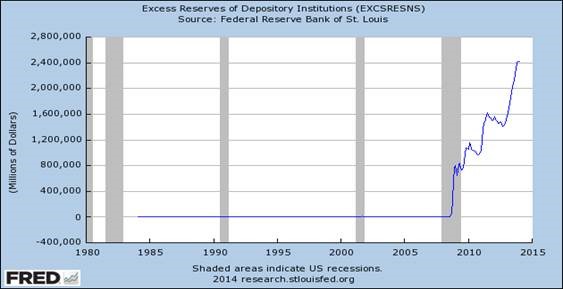
The first distortion is excess reserves maintained at the Federal Reserve. This first chart is to show how ridiculously large this number has grown to, which is now in excess of $2.4 trillion. That’s the cumulative and collected excess reserves of the banks who collude conduct business with the Federal Reserve.

clip_image004

Notice how before 2007, the amount was virtually zero. I realize this chart only goes back to the early 1980’s, so here’s a “Discontinued Series” chart that the Fed previously utilized to report the excess reserves. It goes back to the 1950’s and shows the same virtual zero in excess reserves as the normal course of business. That’s right, up until the Great Recession the amount of excess reserves held at the Fed was in the single digit billions. That’s basically zero. Since 2007, it has been a different story entirely.

clip_image006

For the uninitiated regarding excess reserves, I want to provide a relatively brief explanation. For the reader with an already good grasp, I apologize for any redundancy. The excess reserves were at virtually zero for all those decades because the Fed never paid any interest on them. Then in response to the entire financial world sitting on the precipice of obliteration, a multi-part plan was instituted in order to maintain the status quo and keep the entire system intact. The federal funds rate was dropped to zero where it has stayed, interest began to be paid by the Fed on excess reserves, and the process of quantitative easing(“QE”) was illustriously birthed.

The federal funds rate was dropped to zero so as to stimulate the economy in the face of certain deflationary doom. The book is still out on whether the US has seen true economic improvement due to ZIRP. What we do know is that savers are being heavily penalized by this policy and investors of all ilk are being forced up the risk ladder in increasingly desperate attempts for yield. The paying of interest by the Fed for excess reserves is one of the Fed’s tools for maintaining interest rates where they want them. It also just so happens to be able to provide a colossal liquidity buffer for the so called balance sheets of the participating banks i.e. Wall St.

Between the erroneously valued derivative books across the entire industry and jumbled collateral chains, the participating banks and the Fed think they’ve built an adequate buffer to potentially withstand additional impairment to balance sheets. And why shouldn’t they? They’ve got everything under control because now they can taper QE. Quantitative Easing was established to fight both fronts of the policy as a tool to reduce long-term interest rates while also stimulating the economy. Do you feel like the economy is stimulated? I know one thing for sure that has been stimulated and that’s asset prices. Take a moment to yourself and remember how this story has played out for the Weimar republic of Germany, recently in Zimbabwe, and even more recently in Venezuela.

Wondering why it matters so much that the banks keep their excess reserves at the Fed instead of productively using them within the economy? It’s because the money is essentially free. When the Fed monetizes its debt and buys assets such as MBS, it creates an asset on its own balance sheet and a corresponding liability. That liability is the excess reserves that belong to the TBTF banks who are the Fed’s main partners in facilitating QE. The banks keep those excess reserves with the Fed because why would you give away your gravy train and expose it to more unnecessary risk? The Fed pays 0.25% on excess reserves. May not seem like much, but 0.25% on $2.4 trillion equals $6 billion for the biggest banks to collect risk free in interest income.

If you were a bank CEO and knew you had derivative exposure that could single-handedly dismantle the system, would you kill the golden goose provided by the Fed? The proof is already in the pudding as the velocity of money is cratering but has had no material effect on our economy thus far. There’s no velocity of the money supply because banks aren’t lending out to businesses and households. Sure large corporations have been able to finance buy-backs and special dividends but capital expenditures have yet to reach a point of acceleration where we know some good economic tidings are bound to follow.

In the chart below, I’ve overlaid the rise of the excess reserves vs. the velocity of the M2 money supply.

clip_image008

If that’s not a chart yelling out for some mean-reversion, then I don’t know what is. So what are some triggers to increase velocity and why does it matter? An increase in velocity matters because that price inflation that everyone was so scared of during the beginning phases of TARP and QE, could finally begin to materialize. And this could hamstring any efforts to get the economy breathing on its own without the use of a respirator. As far as a trigger to generate velocity, it would take the Fed no longer paying interest(like they’ve almost always done) or even charging to hold excess reserves. The participating banks would immediately withdraw that $2.4 trillion in cash and put it to work. Where? Businesses and households. If those dollars hit the economy in a flood over the course of a year or two, we could see some scary jumps in asset prices that matter and not just fine art and collectible cars. Not to mention, there’s still all that cash that the mega-corporations keep parked internationally. If the US were to shift tax policy for this money and it were to be repatriated and spread around the economy, we could be talking about a doubly increase in money velocity.

The Fed knows this and you would think they wouldn’t be dumb enough to cut off their nose to spite their face but the Fed is backed into a corner. Additionally, the Fed has to answer to its political masters all while managing the world’s perception of America’s currency and economy. This is a dangerous game being played right now, as after 2008, Fed policy entered the realm of pure experimentation.

Would the Fed have maintained these policies this long, which are causing massive economic distortions, if the economy had really reached escape velocity or at least was well on its way? Let’s revisit interest rates, the second massive distortion. Gary Tanashian, with his Notes From the Rabbit Hole newsletter, provided an elegantly simple chart putting on full display the lack of efficacy of the Fed’s ZIRP policy to have any material effect on the economy. Below you’ll see the 3-month T-bill yield($IRX) overlaid against the S&P 500 index($SPX). You can see in the past 20 years that as the economy and markets picked up, the Fed would subsequently raise interest rates. That is completely normal policy and has been consistently used for decades.

clip_image010

But as you can see in the chart, where’s the rise in rates? The correlation of the two are generally fairly strong. Oh, so our economy is not genuinely approaching a growth level that warrants a raise in interest rates? These are the results of the great financial experiment, of which we are all a part of the double-blinded no placebo study that’s about to have a phase 3 letdown in the next year or two.

The Fed has been able to subvert a normal business cycle by reflating on demand through interest rate policy and monetary policy. That last doozie back in 2008 should have seen the destruction of several industry giants and the Fed wasn’t ready to allow that to happen in America. I get it. The pain and suffering would probably have been unspeakable and potentially worse than the Great Depression. When you combine the fact that the developed countries are so interconnected, the US didn’t want to single-handedly bring down the entire world’s economies. All that being said, the tricks to perpetrate the subversion of normal business cycle forces have been used up. You can’t drive interest rates any lower. You can’t print even more dollars and expect sufficient potency. Hence, the notion that the Fed is backed into a corner.

As far as impact to the market, I read a simple statement over at Economicnoise.com, that sums up the good fortune the Fed has had in driving up market prices in an attempt to drive the wealth effect while building animal spirits. Economicnoise.com stated, “Within the last fourteen years, there have been two major market corrections, both of which saw drops of 55% from their highs. That, or more, is the potential for what lies ahead…but next time the government is unlikely to be able to re-inflate the stock market bubble. To put into perspective how lucky (investors have been), it took 25 years for the Dow Jones to recover to its pre-crash highs after the Great Depression. Likewise, the Dow hit an intraday high of 1,000 in 1962 but never closed above 1,000 until about twenty years later.”

These distortions are what the doomsday types, Austrian economics practitioners, goldbugs, and similar minded types have been seeing and simply can’t seem to shake off. The team at GMO has never been labeled as any of those types; only true professionals’ professionals in the game of capital allocation. Below is the other chart in their 7-year forecast and it covers multiple asset classes as opposed to just equities.

clip_image012

The granddaddy winner for the next 7 years is timber, according to them. So forget about investing. Go cut some trees down. Chop’em up and store them in your house. Over the next 7 years that wood will have outperformed your 401k. Lame jokes aside, there are a few ways to easily make a play on timber. There are of course the biggest North American players such as Plum Creek (PCL), Weyerhaeuser (WY), Rayonier (RYN), and Potlatch (PCH). If you prefer ETF’s, there is iShares Global Timber & Forestry (WOOD) which focuses on North America and thus has significant positions in the largest players here. For more of an international flare to your timber exposure, Guggenheim offers its own Timber ETF (CUT). A cursory glance of CUT’s holdings will show that it focuses its holdings around the planet as opposed to N. America.

Since the average joe can’t simply invest in huge plots of timber like a hedge fund, endowment, or pension fund, then these are decent options to play the sector. PCL is the biggest of the N. American group and thus has a well established reputation on the street. However, friends and old colleagues will already be familiar with what is probably my favorite way to garner some timber exposure, and that is through Brookfield Asset Management. BAM! Remember though, at the end of the day these are still equities and have the potential to be pulled down with every other sector in the event of a sell-off or major dislocation.

Comparing Plum Creek to Brookfield Asset Management is not exactly an apples to apples comparison, as Brookfield is a massive asset manager focusing on real or hard assets with a portfolio approaching $200 billion. Plum Creek possesses the largest portfolio of timber acreage in N. America, so their market capitalization is justified. PCL carries a timber portfolio worth approximately $5 billion. Brookfield’s portfolio of timber acreage is significant in real terms but small compared to their entire portfolio. BAM carries approximately $4 billion worth of timber assets, and that is after selling approximately $2.5 billion worth of timber assets last year to Weyerhaeuser. BAM will monetize assets when appropriate. They don’t hold just to hold, however they’re considered some of the finest value investors in the world when it comes to real assets.

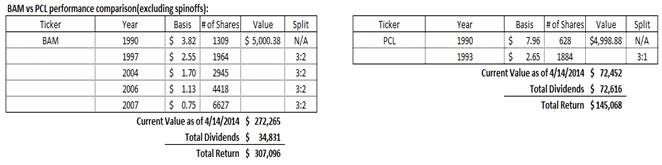
Let’s take a side by side look at long-term performance of each company since 1990. We’re using 1990 as PCL was founded in 1989, so I wanted to give it a year of operations under its belt for comparison purposes. The following chart compares the split adjusted values of each stock starting with an initial $5,000 and includes dividends but excludes the two spin-offs(BIP & BPY) from BAM.

clip_image014*Dividend data garnered from Dividata.com

You can see that BAM’s long-term performance speaks for itself. If you account for BIP & BPY, then to me it appears to be a no-brainer between the two for long-term exposure to timber. PCL’s dividend is vastly bigger, so if an investor needed that higher yield for whatever reason then it would make the decision of choosing between the two a little tougher. Overall though, if you want some timber exposure in combination with other world-class real assets then BAM is a heckuva way to play it.

Valuations matter. Momentum can be ridden, but in the end a stock’s price will revert to an appropriate valuation after momentum has made investors lose their collective minds. GMO’s forecast is not to be taken lightly. It’s just another recent indicator that should really make investors pause and think before allocating capital. I tend to concur with old Uncle Warren in that it’s not usually a safe bet to bet against America, so I promise that I’m not a total gloom & doomer here at MarginRich.com. These economic distortions, just a few of so many, are communicating a signal that America and really the world’s developed markets could find themselves in some pretty rough seas in the not too distant future. Invest accordingly.

Analogous Equities Markets – 1970’s & 20Teens

Secular bull? Or bear about to do its thing on “unsuspecting” market players? These are questions making serious rounds on the world wide interlinking-web. That’s because fear sells and nothing gets eyeballs and clicks for the user-ravenous financial sites like some market-topping bear talk.

If you were alive and investing in the 70’s, or like myself, have read up on the stock market action of the 70’s then one can see how similar the two time periods seem to be acting(at least in the S&P 500). Don’t worry, I’m not about to hit you with yet another comparison chart of some calamitous US financial event laid over current action. Instead, I’d like to share some work by Lance Roberts. For the record, I like those comparison charts but I also take them for what they are…entertainment. At best they’re another useful input and at worse they’re just noise.

If you’re unfamiliar with Mr. Roberts, he consistently writes compelling market pieces. I happen to think he’s one of the more under-appreciated financial commentators on the web right now. He’s the co-founder and general partner of STA Wealth Management. Earlier in the year, Mr. Roberts shared some graphs comparing current times to the secular bull formed in the 80’s and the fakeout in the 70’s. At STA they definitely have Austrian economic tendencies in their communications regarding the markets, and so obviously can lean toward a more bearish stance at times. Or as other Austrians call it, just being realistic in light of all the economic data readily ascertainable.

They have significant assets under management of approximately $500 million to $600 million, so these guys are the real deal. Specifically, they focus on the client who possesses low six-figures to approximately $5 million in capital, so they’re not exactly whale hunters. STA feels that market is an underserved niche of wealth management. I’m not trying to plug their services nor do I have any relationship with their firm. Like other commentators or service providers I include in my posts here at MarginRich.com, I’m fairly certain STA doesn’t even know this blog exists. I just want to share with my readers another financial blogger whose work I really enjoy. You can also find work by Lance Roberts at Advisor Perspectives, home of dshort.

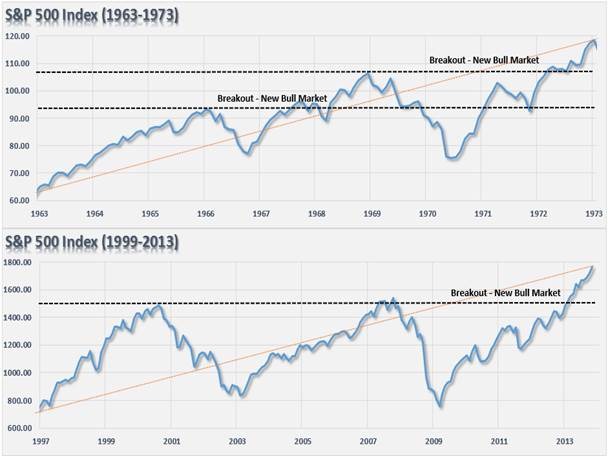
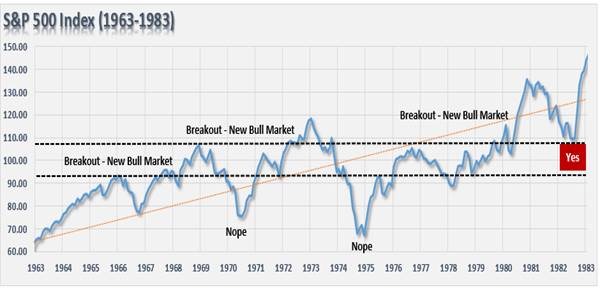
Now back to the charts Roberts shared in January. The first one shows a direct comparison of the current period to the false breakout of the late 60’s into what looked like a new bull going into 1973.

clip_image002

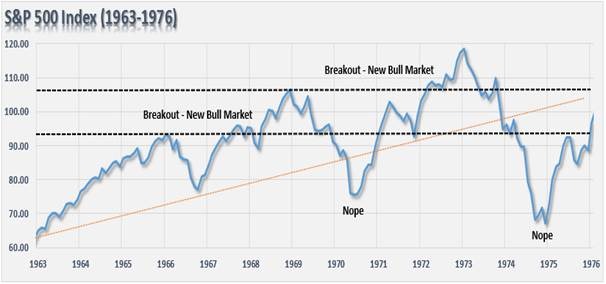
As we all know, The recession starting in 1973 was one of the worse times to be in the stock market in its history. The next chart shows the S&P’s performance and the realization of the false hopes for investors during those time periods.

clip_image004

Sorta looks like the decade of the Oh-Oh’s, except the action up to 1973 produced higher highs. As opposed to what we experienced in 2000 and 2007 in the S&P 500 with virtually equal tops. The reason for that was obviously all the capital was pouring into the NASDAQ in 2000.

Moving on to the last chart. Roberts shows the total picture with the final washout in 1981 and the true beginning of the 18 year mega-secular bull market that helped to explode the growth of the mutual fund and retirement investing industries. Of course there were up’s and down’s during the real secular bull, but boomers blessed with the easiest time to make buy and hold gains during peak earning years helped to build the academic case of always investing in stocks for the long run. Not that I want to get into any philosophical debates on investment strategies or the level of difficulty of investing through the 80’s and 90’s. I use the term “easy” through the lenses of hindsight.

clip_image006

The point of sharing these charts is to increase awareness that this 5 year run that America has been on off of the 2009 lows, may not be the start of a real secular run like we saw from 1982 to 2000. In 1982, the conditions were more like a final “cleansing”, so to speak. The new CEO of America was instilling a lot of genuine hope and assuaging genuine fears with genuine actions, not lies or baseless rhetoric. Valuations were exceptionally low with single digit P/E’s and very enticing dividend yields across the market. Price inflation had been beaten back by the last semi-responsible Fed head.

Simply put, these are not conditions that exist today. In fact, the exact opposite of each of those conditions exist today. I understand that the music is playing but do you want to keep dancing? Conditions are decidedly different due to deep distortions across the financial landscape. But hey, I’m only one voice of many and if you’re one of plenty of people(including professionals) who think we’re in the midst of a secular bull market, then by all means keep putting new money to work. However, even if you’re dollar cost averaging and you don’t believe in “timing” the market, now may be a time to build your cash levels.

Don’t just take my word for it. In a previous post I cited some thoughts shared by Seth Klarman and Jeremy Grantham. They each communicated their fears of the frothiness of these markets but that the markets will continue to move higher before an inevitable bust. Now the inimitable Howard Marks has essentially shared the same sentiment in his latest Memo From Our Chairman. Collectively, these 3 gentlemen help oversee more than $200 billion in assets under management. In addition to their combined multiple decades of experience, their respective savvy has made each of them billionaires. Now if scions of the investment world such as these fellas are telling you to be cautious, do you really want to be the rebel without a cause out there allocating your capital based on the premise that trees DO grow to the sky?

Look I know the path of least resistance for the markets is up and I’ve reinforced that in previous posts. It’s just that based on the distortions, it really feels like a reckoning is coming. And just some basic cycle research yields a time table of approximately 12 to 24 months from now for some potentially tough times as an investor. I’m not talking about exiting the markets entirely. I’m talking about raising cash levels to be prepared when the real values potentially present themselves and minding your stops. Next time I’ll share some hopefully enlightening charts and thoughts on those aforementioned distortions.

To invest the emergency fund, or not, that is the question

I wanted to veer away from the normal subject matter and touch a little bit on personal finance. We’re going to visit the concept of the emergency fund(“e-fund”). It’s a subject that’s made some heavy rounds in the financial news sites and blogosphere to start 2014, but the subject of e-funds gets expounded on annually in countless articles.

Marketwatch ran an article on how to retire early. The piece was focused on Mr. Money Moustache and his methods of living well with less. One of the personal policies he espouses was that there’s not really a need to maintain an e-fund. It’s not that he doesn’t believe in them, just that an e-fund is probably best for a specific demographic. Here’s what he stated in the article:

Yeah, I’ve always questioned the idea of an emergency fund. It’s a great tool for the financial beginner who lives from paycheck to paycheck, and for whom a broken water heater would make the difference between making ends meet and borrowing via a credit card. But once you get off the ground, your credit card is a monthly buffer and your investment accounts are the emergency fund.

So I have no savings account at all, and keep just a few thousand dollars in the checking account. If a huge unexpected expense ever came up that was greater than my income, I would put it on the credit card along with all other monthly spending. Then just sell some shares of an index fund and transfer that back to the bank before the credit-card automatic payment happened at the end of the month. And I’ve still never had to run a credit-card balance in my life.

The great part is that if your spending is much lower than your income, these emergencies become very rare, because there is always a surplus, which you have to sweep away into investments each month. So if the water heater dies, you buy a new one and just invest a little bit less that month.

Maintaining access to adequate amounts of liquidity when a true need arises is simply a matter of prudence. The rich may not call it their “emergency fund” per se, but they tend to keep enough cash on hand or maintain easy access when they need it. The middle class are generally fastidious about maintaining an e-fund despite the level of job security or adequate assets already accumulated. The less fortunate, and those just starting out in the game of asset accumulation, are simply looking to scrape together what they can so they have something squirreled away for a genuine unexpected need.

Everyone has to assess their own total financial situation and determine what is the best mix for their e-fund. Is it all cash? Is it all investments and play the statistical odds game against Murphy’ Law that the markets won’t be in the middle of a serious dislocation at the exact time you need to liquidate? Is an e-fund even needed?

Suze Orman and Dave Ramsey, the personal finance gurus for the Great Unwashed, have two decidedly different takes on the e-fund but both believe in the concept. Orman believes that 8 months of expenses should be covered with the emergency fund, and that one should forsake making more than minimum payments on any credit card debt in order to build up that surplus. Ramsey believes in building up $1,000 ASAP for emergency purposes and then paying off all non-mortgage debt i.e. revolving credit, auto loans, and student loans by utilizing the debt-snowball method. Then once those debts are paid, begin building an e-fund to cover 3 to 6 months’ worth of expenses.

The one glaring consistency across Orman, Ramsey, and the countless other commentators is the total lack of imagination in how to allocate the e-fund. Here’s the same list of financial instruments shared ad nauseum across the web: online savings account, CD’s, laddered CD’s, money market, T-bonds, or I-bonds. If one truly wants a “risk free” tool for safe interest accrual then these are of course adequate options, but you still have penalty risk with the CD’s and bonds. The problem is that these instruments yield virtually nothing. Thank you ZIRP.

I’m a proponent of part cash/part investing. If you’re going to maintain a sizeable e-fund, which is of course a relative term, then there are several tools available that offer vastly superior yield without the pure risk of stocks. I didn’t say zero risk; just not pure stock market risk. I’m talking about closed-end funds(“CEF’s”) in the income sectors. Specifically, I’m talking about investing in CEF’s that hold preferred securities, muni-bonds, and energy-related MLP’s.

CEF’s can be a good addition to an e-fund because they easily provide yields over 5% and can often sell at a discount to net asset value(“NAV”). Meaning, the total market capitalization of the closed end fund will trade for less than the total market capitalization of the investments the fund holds. It is not unusual to be able to enter a position into a CEF for $0.90 on the dollar. Stated another way, if Make-Believe fund’s NAV is $10 a share, then the market may place a value on the share at $9. This discount may occur for any number of reasons. Circumstances are different for each fund. The most obvious reason is sentiment in the primary asset class of a CEF’s holdings.

My current 3 favorite CEF’s for partial e-funding are tickers: JPS, NEA, and KYE. I’ll get to some details on each in a moment. I want to share a site first.

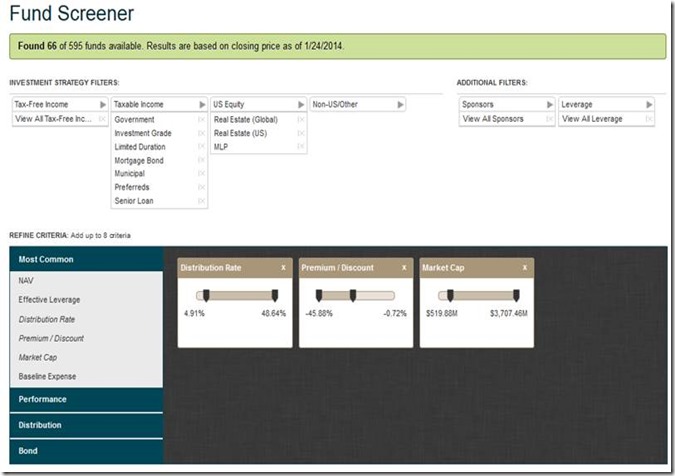
If you’re one of my readers who is un-initiated in the world of closed end funds, then stop by CEFConnect.com. There you can find most everything you need to explore the world of CEF’s and link to the sites of each asset manager to obtain even more detail about a fund you may be interested in. It’s a comprehensive site that provides news, education, interviews, a screener and more. In fact, here’s a snapshot of the screening page I used to pare down my own list of CEF’s.
clip_image002

The screener is easily customizable to winnow down the list of hundreds of CEF’s. From the pic above, you can see that my screen utilized a 5% minimum distribution rate, which is the CEF equivalent to yield for you stock dividend and bond coupon junkies. I also screened by discount to NAV and Market Cap to ensure that only funds that traded at a discount and with adequate liquidity would be filtered. The list was narrowed down to 66 closed end funds. I knew what sectors I wanted to choose from, so then it was a matter of assessing discounts to NAV, yields, and market caps to make final selections.

The Nuveen name is well known in the CEF space and has a long, rich history operating as a financial institution since 1898. Nuveen possesses total assets under management of $215 billion. Visit Nuveen for additional details about the company and its selection of CEF’s.

I like preferred stocks because they’re highly liquid, trade like common stocks, and in a lot of situations can yield income as steady as a bond. Preferred stocks provide no voting rights to shareholders but they are farther up the food chain in the event of a bankruptcy. Preferred stocks generally trade at a par price of $25 and tend not to get too far above or below that except in times of serious economic strain. Municipal bonds are tax free and appear to have a great deal of the fear in the sector already baked into the price. Lastly, the energy-related MLP’s allow for the upside potential of energy production increases across the world by investing in the companies that provide energy transport via pipelines and ship containers. These companies are the “toll booth” operators of energy transport and their consistently assured business allows outstanding cash flows from these master limited partnerships. Additionally, these three are not the most strongly correlated assets across the income space which provides a small margin of safety.

JPS is a Nuveen offering that specializes in preferred securities. Why bother with the hassle of researching which credit worthy securities to allocate your funds in when you can have the experts at Nuveen take care of you. JPS offers a juicy 8% yield paid in monthly distributions of 5.5 cents each, and the current discount to the NAV is 11%. So you’d be paying $0.89 for $1.00 worth of assets.

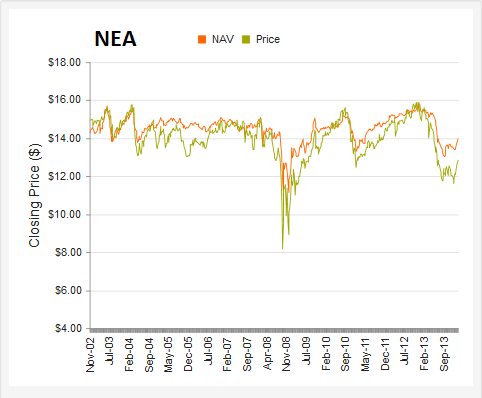
NEA is another Nuveen offering, but it specializes in municipal bonds. Municipal bonds are tax free instruments so they’re probably best utilized in a taxable account, but I’m no CPA or tax attorney so please consult an expert for advice on your specific situation. And remember, the securities described in this post are not a specific recommendation to the reader. They are simply an offering of my preference in how to semi-allocate an emergency fund. Muni-bonds were oversold in 2013 and some fear of muni-bonds may be well founded. Cities in California were going bankrupt. Detroit is Detroit. Puerto Rico is freaking out fixed income investors, but all these fears have now been discounted into the sector. Hopefully, fully discounted. If you recall in my last post, in the last 20 years muni’s have always bounced back to gain at least 10% after a down year.

Plus, NEA trades at a 8% discount to its NAV. The best part of this instrument is that while it yields a lovely 6.4% at last close as of this writing, the yield is tax free. So if you’re in the highest tax bracket of 39.6%, that’s a taxable equivalent yield of 10.6%. A double digit yield is not easy to come by these days and here you have a tool that allows you to earn that yield at a discount. Your taxable equivalent yield is calculated by taking the fund’s current distribution yield and dividing it by 1 minus your tax rate.

Example: 6.38/(1 – .25) = 8.5%

The last fund is KYE, which technically invests across a broad range of energy related assets and not just MLP’s, but I just generalize it as an energy-MLP specialist. KYE offers a yield of over 7% and trades at a discount of 9% to the NAV. So again, you’re only paying $0.91 for a $1.00 worth of assets. The fund has positions in companies such as Kinder Morgan, Williams, ONEOK, Plains All American, and Teekay; which are all heavyweights in their respective fields. If you believe in the growth of America’s energy production and potential for energy export while also believing in the potential growth of worldwide demand for energy, then KYE appears to be a conservative bet on that growth while also being paid to watch if the thesis is correct. Kayne Anderson is not a typical mass market asset manager. I guess you could consider them a little more boutique in their operations, but $25 billion in total AUM is certainly nothing to sneeze at. They’ve been around for 30 years now and have a focus on energy, muni’s, private equity, and mezzanine level credit opportunities. Learn more at KayneCapital.com.

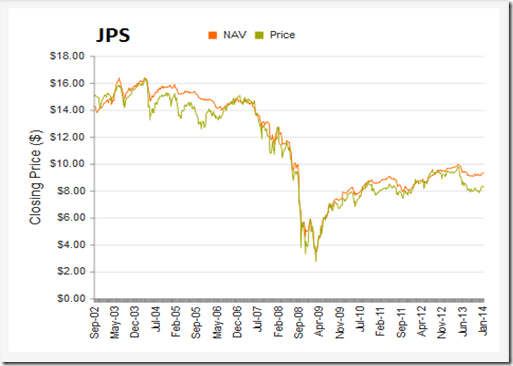
So here’s the point in the article where you think to yourself, “Yeah thanks for the recommendations but how did these investments stack up during the financial crises?” Like I said, no risk can be eliminated; only mitigated. That’s why it’s called investing aka speculating. In 2008 – 2009, every asset on the planet lost value. These 3 offerings recovered surprisingly well, especially NEA and KYE. They fell hard but bounced back fairly quickly into their pre-crisis trading ranges. JPS fared worse as it has yet to even touch its inception per share price of $15. However it has risen 150% off of the lows, all while yielding over 7% like clockwork. Observe the following trio of charts courtesy of CEFConnect.

Preferreds
clip_image003

Although again, it has not recovered its pre-crash pricing, JPS bounced up to over $8 a share in fairly short order and has maintained a fairly tight range between $8 and $10 a share. With the NAV discount, this looks like a good window for allocation.

Muni’s
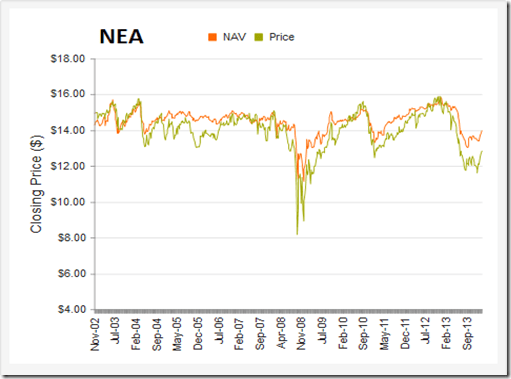
clip_image004

NEA recovered to new all-time highs in 2012, but then a couple of California cities, a Motor City, and a certain salsa dancing island later has brought the fund back down to 2009 levels. The baked in fear and NAV discount present a compelling opportunity for appreciation and yield.

Energy Transport
clip_image005

KYE has performed the most consistently before and after the last financial crisis, trading in a tight range between $25 and $30 a share. Pre-crisis, the fund primarily traded at a discount. Post-crisis, it has traded primarily at a premium. Now, despite all the energy being discovered, drilled, and pumped in America in addition to the ZIRP environment, KYE again trades at a discount towards the lower end of the price range.

These charts show that there are obvious risks in making an investment. One can’t just allocate some cash to these securities and then forget them like they’re a savings account. These are uncertain times to be investing and you have to be vigilant in constantly assessing the risks of an allocation. The largest risk associated with these funds is interest rate risk. In a Zero-Interest-Rate-Policy environment, these funds can be affected if rates begin to rise. KYE would be less affected than JPS which would be less affected than NEA, which is partly why I have chosen the three holdings, but a rising rate environment would have a negative effect.

Fortunately, the widely-known fact that the Federal Reserve wants to maintain ZIRP through 2015 provides at least a 2 year window to take advantage with these 3 closed-end funds. But facts and circumstances can change, and so accordingly, decisions about how funds are allocated must adapt. A couple of ways to help mitigate some of the risks is to use trailing stops as well as look at how far a potential premium builds. If the premium builds too far, say 5% to 10% over NAV, then taking profits may be a good idea. Even accounting for frictional costs, it may be worth earning the capital gain. The resultant cash can then be placed in a different fund, maybe in the same family, that is a reasonable facsimile from a holdings and performance standpoint. Or, you can park the cash in savings again and simply wait for the premium to abate, which by reviewing the charts up above, happens quite often.

Lastly, we’ll visit the fee structure. Professional expertise along with the provided infrastructure has to be paid for and these CEF’s are no different than any other mutual fund or ETF. At first glance, the fees and expenses appear outrageous but only to an ETF-addict who doesn’t understand what they’re getting for their money. The table below summarizes the management fees and expenses for the 3 funds:

Fund Family Ticker Management Fee Other Expenses Interest Expense Total
Nuveen JPS 1.17% 0.07% 0.47% 1.71%
Nuveen NEA 0.90% 0.09% 0.83% 1.82%
Kayne Anderson KYE 1.83% 0.91% 1.64% 4.38%

Now don’t get scared away by those numbers just yet and go running for cover under the low-fee Vanguard umbrella. Keep in mind these fees and expenses are taken from operational profits of the funds. After the fund accounts for these 3 operational expenses, then available cash flows are distributed to shareholders. So despite those fees and expenses, shareholders earn a yield of over 7% in JPS and KYE while NEA provides a taxable equivalent yield of between 8% to 10%. Last time I checked the Vanguard ETF’s, even with their incredible fee structure, there are zero ETF’s that yield over 5%. The universe for financial products is wide and vast; presenting workable solutions for everybody.

Assess your own situation. Determine the best course of action for you or your family and make a decision regarding an emergency fund. But now instead of simply reading about the same old non-yielding(but relatively safe) bank tools everyone has at their disposal, you have some high-yielding options that provide a small margin of safety. Remember, if you’re unsure, seek the advice of a professional and always be sure to conduct your own due diligence.